The smell hits you before the understanding does. Walk into any real leather workshop in America—not a retail showroom pumping synthetic “leather scent” through the HVAC, but an actual bench where a craftsman is hand-stitching a seam with waxed linen thread—and the air tells you everything about provenance. It smells like tannin and beeswax and decades of accumulated intention. It smells, frankly, like what your grandfather’s office used to smell like before the world went plastic. In 2026, as leather prices surge under the pressure of sweeping tariffs, a shrinking U.S. cattle herd at its lowest point since the 1950s, and global supply chain disruptions that have pushed retail leather goods prices up by near double-digit percentages (CNBC, 2025), a quiet but fierce cohort of American makers continues to do what the algorithm cannot: they build things by hand that outlast the people who make them. The global leather goods market has swelled to an estimated $436 billion in 2025 and is projected to reach $590 billion by 2029 (Research and Markets, 2025). Yet even within that ocean of commerce, the independent American leather craftsman occupies a singular position—part artisan, part philosopher, part stubborn contrarian who looked at the trajectory of disposable culture and simply refused.
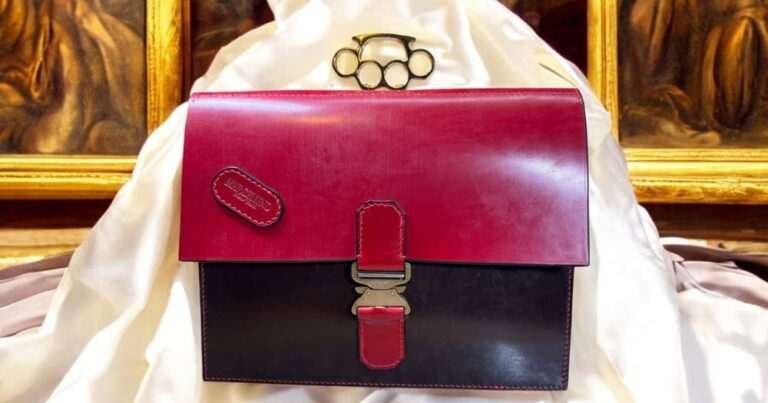
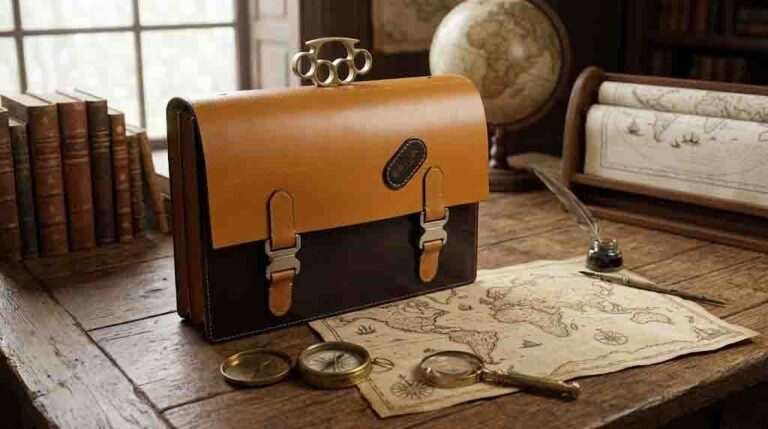
I understand this stubbornness intimately. For over two decades, I have run The Heritage Diner in Mount Sinai on Long Island’s North Shore, a quarter-century landmark built on the same premise that governs every maker on this list: the unseen details are what define a masterpiece. Simultaneously, at my Marcellino NY workshop in Huntington, I hand-build bespoke English bridle leather briefcases for lawyers, surgeons, and executives who have grown weary of Italian brand names stitched onto Chinese-made leather. That dual existence—restaurateur by dawn, leather artisan by trade—has given me an uncommon vantage point from which to observe the American maker economy. And what I see in 2026 is not a nostalgia movement. It is an insurgency.
What follows is a carefully curated guide to fifteen American leather goods makers—from heritage operations with multi-generational legacies to one-person workshops operating out of converted garages—who are collectively redefining what “Made in America” means in the age of automation. Each entry includes location, specialty, approximate price range, and the distinguishing quality that earns them a place on this list.
The Tannery Foundation: Where American Leather Begins
Before we examine the makers, we must acknowledge the source. Every great leather good begins not at the workbench but at the tannery, and America’s leather infrastructure is thinner than most consumers realize. In the 1950s, roughly 1,000 tanneries employing over 300,000 workers operated across the United States (Leather and Hide Council of America, 2025). Today, that number has dwindled to a few hundred, with the workforce reduced to approximately 50,000. Two tanneries in particular supply the hides that appear across nearly every workshop on this list.
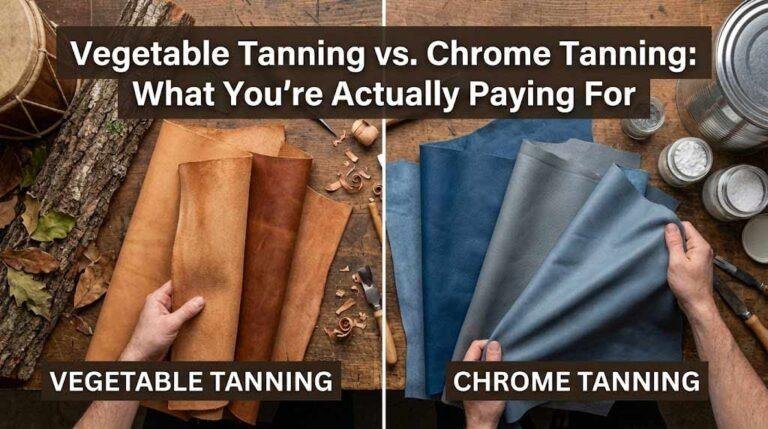
Horween Leather Company, founded in 1905 on Chicago’s North Branch of the Chicago River, remains the continent’s most storied tannery. Now in its fifth generation under the stewardship of Nick Horween, the company produces its legendary Chromexcel through a combination tannage process that has remained essentially unchanged for over a century. Their Shell Cordovan—harvested from the dense connective tissue beneath the hindquarters of a horse and requiring six to nine months of processing—is universally regarded as the most luxurious leather in the world. As Skip Horween III, the company’s president, has stated: the temptation to speed up the process has always been easy to resist (Stridewise, 2023).
Wickett & Craig, founded in 1867 and now operating from a sixteen-acre facility in Curwensville, Pennsylvania, is one of only two remaining vegetable tanneries in the United States. Their six-week tanning process uses a proprietary blend of Mimosa and Quebracho tree bark tannins across seventy-two vats. Their English Bridle leather—drum-dyed and hot-stuffed with waxes, oils, and tallows—is the material I select for every Marcellino NY briefcase that leaves my Huntington workshop, because no other domestic bridle leather achieves the same depth of saturation while maintaining the structural integrity necessary for a bag built to outlast its owner.
Understanding these tanneries is essential context. When you see “Horween Chromexcel” or “Wickett & Craig Bridle” on a product listing, you are reading a provenance statement as meaningful as “Waygu from Miyazaki Prefecture” or “Parmigiano-Reggiano from Parma.” The leather is the terroir.
YouTube — Inside the Horween Tannery: https://www.youtube.com/watch?v=mEYvPGYljUc
The Heritage Guard: Makers with Decades of Pedigree
1. Frank Clegg Leatherworks — Fall River, Massachusetts
Specialty: Handcrafted briefcases, duffels, totes, and accessories. Price Range: $195–$1,800+. Founded: 1970.
Frank Clegg has been building leather goods by hand in Massachusetts for over fifty years, making the operation one of the longest-running artisan leather workshops in America. Every piece is constructed in their Fall River workshop using leather sourced exclusively from Leather Working Group-certified tanneries, ensuring traceability from hide to finished product. The Clegg aesthetic is distinctly New England: clean lines, muted tones, understated hardware. Their zip-top briefcase is a staple among Boston financial professionals who consider a logo on a bag to be a sign of insecurity rather than status.
What sets them apart: Five decades of unbroken, American-made production. In a market flooded with brands that outsource to Asia and slap “Designed in America” on the tag, Frank Clegg’s commitment to domestic manufacturing is not a marketing strategy—it is a bloodline.
Web: frankcleggleatherworks.com
2. Saddleback Leather Co. — Azle, Texas
Specialty: Over-engineered full-grain leather bags, briefcases, and travel goods. Price Range: $49–$900+. Founded: 2003.
Dave Munson started Saddleback in El Paso, selling briefcases from the back of his truck in Mexico before building the company into a cult favorite among the Buy It For Life community. The brand’s motto—”They’ll Fight Over It When You’re Dead”—is not merely copywriting; it is underwritten by a 100-year warranty. Saddleback’s bags are designed with zero breakable parts: no zippers that can fail, no snaps that can shear, just brass buckles and full-grain leather engineered to survive generations of use. Their design philosophy intentionally privileges durability over fashion, a Thoreau-inspired approach that Munson has described as affecting the quality of the day (Saddleback Leather, 2023).
What sets them apart: The 100-year warranty is not symbolic. It is a contractual obligation backed by a company that has scaled while maintaining the structural philosophy of a one-man workshop.
Web: saddlebackleather.com
3. Colonel Littleton — Lynnville, Tennessee
Specialty: Heirloom-quality leather portfolios, briefcases, desk accessories, and personal goods. Price Range: $29–$2,500+. Founded: Lynnville, Tennessee.
Operating from a small town in Tennessee, Colonel Littleton produces leather goods with a distinctly Southern sense of ceremony. Their No. 1943 Navigator Briefcase—named for the year, not a model number—reflects a design philosophy rooted in military heritage and American history. The company has expanded into American Buffalo leather, producing pieces with the kind of rugged texture that recalls the frontier mythology of the early West. Colonel Littleton’s packaging is legendary among customers: handwritten notes, MoonPies tucked into shipment boxes, and a level of personal attention that transforms a transaction into a relationship.
What sets them apart: The intersection of Southern storytelling and heirloom craftsmanship. Every product feels as though it was designed for the kind of man who writes letters by hand and keeps a leather-bound ledger.
Web: colonellittleton.com
The Modern Vanguard: Post-2000 Makers Redefining the Craft
4. Marcellino NY — Huntington, New York
Specialty: Bespoke English bridle leather briefcases and professional bags. Price Range: By consultation (bespoke pricing). Founded: Long Island, New York.
Full disclosure: this is my workshop, and I include it here not out of vanity but because the Marcellino standard represents a specific philosophy within the American leather goods landscape that deserves articulation. Every Marcellino briefcase is built to order using J. & E. Sedgwick English bridle leather or Wickett & Craig domestic bridle, hand-selected for grain integrity, then hand-stitched using traditional saddlery techniques with waxed linen thread. No machine stitching. No assembly line. No inventory sitting in a warehouse depreciating. Each bag is built for a specific person—their measurements, their daily carry requirements, their professional context. This is the distinction between “bespoke” and “custom”: bespoke begins with the client’s body and life, not with a catalogue of options.
The same philosophy that has kept The Heritage Diner open on Route 25A in Mount Sinai for over twenty-five years—obsessive attention to the details that most people never consciously notice—governs every decision at the Marcellino bench. It is the philosophy that Paola and I are carrying into our 2026 boutique real estate venture on the North Shore: provenance, authenticity, and the conviction that the unseen seam matters as much as the visible one.
What sets it apart: True bespoke construction on Long Island, using domestic and English bridle leathers, for clients who understand that the briefcase they carry into a courtroom or operating theater communicates something about the standard they hold for everything else.
Web: marcellinony.com
5. Ashland Leather Co. — Chicago, Illinois
Specialty: Shell Cordovan wallets, belts, and watch bands. Price Range: $50–$500+. Founded: Chicago, Illinois.
Co-founded by Phil Kalas and Dan Cordova—Phil having worked at the Horween tannery and Dan bearing a surname that literally traces to the Spanish city from which Shell Cordovan originated a millennium ago—Ashland Leather occupies the intersection of leather production and leather goods fabrication. Every product is crafted exclusively from Horween leather, primarily the revered Shell Cordovan, and every piece is made in Chicago. The company offers a lifetime guarantee, backing the inherent durability of Shell Cordovan with an institutional promise.
What sets them apart: Proximity to the source. Ashland Leather is quite possibly the closest maker to its tannery in the American market, a relationship that gives them access to rare colorways, first-pick hides, and an intimate understanding of the material at the molecular level.
Web: ashlandleather.com
6. Tanner Goods — Portland, Oregon
Specialty: Vegetable-tanned leather belts, wallets, bags, and lifestyle accessories. Price Range: $30–$500+. Founded: 2006.
Sam Huff and Jevan Lautz started Tanner Goods in a 150-square-foot space behind an art gallery in Portland, inspired by their childhoods among saddle-makers in the small town of Sisters, Oregon. The company has since grown to employ a team of craftsmen, processing an estimated fifty to sixty full hides per week at their Portland workshop using a combination of vintage tools and traditional techniques. Tanner Goods uses domestically sourced vegetable-tanned leather and heavyweight waxed canvas—sourced from the last remaining American textile mill that produces the specific fabric—and has built a lifestyle brand that extends into ceramics, denim, and outdoor gear through their Mazama sub-brand.
What sets them apart: The Pacific Northwest ethos made tangible. Every Tanner Goods product carries the regional DNA of Portland’s maker culture—a place where craftsmanship is not a marketing angle but a civic identity.
Web: tannergoods.com
7. Lotuff Leather — Providence, Rhode Island
Specialty: Luxury leather bags, briefcases, and accessories handmade from vegetable-tanned leather. Price Range: $200–$12,000+ (American alligator pieces). Founded: 2013.
Operating from a studio in Providence—a city with deep roots in American industrial manufacturing—Lotuff Leather has attracted the attention of publications like GQ, which named their No. 12 Weekender the best leather duffel bag for travelers. Nearly 80% of the Lotuff team is composed of women, and approximately 75% of their studio artists hold degrees from institutions like the Rhode Island School of Design. This is not incidental: Lotuff approaches leather goods as fine art objects that happen to be functional, a philosophy reflected in their American alligator collection, where individual bags command prices commensurate with their rarity and the six-month tanning process required to prepare the exotic hides.
What sets them apart: The RISD connection. Lotuff has built a pipeline from one of the world’s most prestigious design schools directly into their workshop, creating a bridge between classical fine art training and utilitarian craft that produces objects of uncommon beauty.
Web: lotuffleather.com
YouTube — Lotuff Leather: The Making of a Leather Bag: https://www.youtube.com/watch?v=fLbXRFEiQcI
The Independents: Small Shops, Outsized Impact
8. Coronado Leather — San Diego, California
Specialty: Horween leather and American bison briefcases, duffels, jackets, and vests. Price Range: $75–$1,200+. Founded: 1981.
With over forty years of continuous operation from San Diego, Coronado is one of the elder statesmen of the American independent leather goods scene. They work extensively with Horween leathers—Chromexcel, Dublin, Horsehide, and Shell Cordovan—as well as American bison hides that are tanned domestically. Every product is serialized with a unique nine-digit number and backed by a lifetime guarantee. Their No. 200 CEO Briefcase, in production since 2005, has become something of an icon in the heritage leather community, and their stone-washed leather collection—finished in California—represents a distinctive aesthetic that no other American maker replicates.
What sets them apart: Four decades of direct-to-consumer independence. Coronado has never relied on wholesale accounts or department store placement, building their reputation entirely through the quality of the product and word-of-mouth loyalty.
Web: coronadoleather.com
9. Odin Leather Goods — Lewisville, Texas
Specialty: Hand-stitched leather goods and accessories using U.S.-tanned leathers. Price Range: $25–$400+. Founded: Lewisville, Texas.
Odin Clack’s story begins with a spontaneous trip to a leather store that transformed into a profitable brand with two retail locations and a dedicated team. Operating from the heart of Texas, Odin Leather Goods is a small studio that punches far above its weight, crafting wallets, belts, bags, and accessories entirely by hand using domestically tanned leathers. Odin has become an influential voice in the maker community, hosting workshops, running a podcast for creative entrepreneurs, and teaching the craft to a new generation of leatherworkers through recorded webinars and in-person classes.
What sets them apart: Odin Clack is not just a maker but a teacher and community builder. In an industry where knowledge has historically been passed down through apprenticeship, Odin has democratized access to professional-grade leather working techniques through digital education and open-studio events.
Web: odinleathergoods.com
10. Brynn Capella — Chicago, Illinois
Specialty: Women’s leather handbags, crossbody bags, and accessories. Price Range: $48–$698+. Founded: Chicago, Illinois.
Handcrafted in small batches from a production studio on the south side of Chicago, with design operations in the Logan Square neighborhood, Brynn Capella fills a crucial gap in the American leather goods landscape: premium women’s bags made domestically from full-grain cowhide. The brand prioritizes ethical practices and fair wages, and their commitment to minimizing waste—turning leftover leather pieces into small goods like bracelets and key fobs—reflects a zero-waste philosophy that is rare in the industry. Every bag ships with a quality guarantee and direct access to the makers, not a call center.
What sets them apart: A women-focused, Chicago-made brand in a market where American-made women’s leather goods are dramatically underrepresented. The combination of full-grain leather quality and deliberate, fashion-forward design makes Brynn Capella a bridge between the heritage leather community and the contemporary women’s accessories market.
Web: brynncapella.com
11. Holtz Leather Co. — Huntsville, Alabama
Specialty: Personalized leather journals, wallets, desk accessories, and gifts. Price Range: $35–$250+. Founded: Huntsville, Alabama.
Holtz Leather operates at the intersection of craft and personalization, producing handcrafted-to-order leather goods from their Huntsville workshop. Every product is made by their team of skilled artisans with no shortcuts and no mass production—a mantra they apply with the same discipline that Huntsville applies to rocket engineering. Their personalized leather journals and desk accessories have made them a favorite for corporate gifting, offering businesses a tangible alternative to the disposable branded merchandise that ends up in desk drawers. The operation has grown into what they call a “crazy big family,” scaling without sacrificing the bench-made ethos.
What sets them apart: Personalization as a core competency, not an afterthought. Holtz has built their business model around the premise that a leather good inscribed with a name or date becomes an heirloom, transforming a consumer product into a personal artifact.
Web: holtzleather.com
The Rising Makers: Newer Voices in the American Leather Renaissance
12. Loyal Stricklin — Nashville, Tennessee
Specialty: Leather bags, wallets, jackets, denim, and waxed canvas goods. Price Range: $40–$800+. Founded: 2014.
Michael Stricklin launched Loyal Stricklin during graduate school at Auburn University, and what began as a creative side project rapidly evolved into a full-time operation based in Nashville. The brand occupies a distinctive lane in the market: heritage-quality leather goods combined with denim and waxed canvas apparel, all designed around the concept of patina as narrative. Stricklin sources from globally respected tanneries and names them intentionally on each product listing, a transparency that signals deep respect for the material supply chain. The Nashville workshop produces the majority of goods by hand to order, and Stricklin himself remains on the production floor daily.
What sets them apart: The graduate-school-to-workshop pipeline. Stricklin brings formal design training to a craft traditionally learned through apprenticeship, and his Nashville location positions the brand at the cultural nexus of music, craftsmanship, and Southern creative entrepreneurship.
Web: loyalstricklin.com
13. ColsenKeane Leather — Charlotte, North Carolina
Specialty: Full-grain leather travel bags, messenger bags, journal covers, and everyday carry. Price Range: $40–$700+. Founded: Charlotte, North Carolina.
ColsenKeane has built a devoted following among leather enthusiasts who frequent forums like r/BuyItForLife and Styleforum, earning recognition through the kind of organic, word-of-mouth reputation that cannot be purchased through advertising. Their Crazy Horse leather—a pull-up leather that shows dramatic patina with use—has become a signature material, and their products are frequently described by customers as improving with each year of daily carry. The Charlotte retail location doubles as a working studio, allowing visitors to see the goods being made and speak directly with the craftspeople.
What sets them apart: Community-driven growth. ColsenKeane’s reputation was built not through influencer partnerships or paid media but through the sustained enthusiasm of customers who photograph their bags years after purchase and share the patina evolution online.
Web: colsenkeane.com
14. Marlondo Leather Co. — Oklahoma
Specialty: Full-grain vegetable-tanned leather briefcases, backpacks, wallets, and crossbody bags. Price Range: $16–$545+. Founded: Oklahoma.
Marlondo represents the accessible end of the American artisan leather spectrum—products made from full-grain vegetable-tanned cowhide with solid brass hardware at price points that challenge the assumption that handmade American leather goods are exclusively luxury items. Their briefcases range from the $315 Simple Briefcase to the $550 Double Space, and their wallets start under $30. Every product is handmade, and most are built to order with approximately eight-to-ten-week lead times. This patience is the price of admission for genuine craft at honest pricing.
What sets them apart: Value proposition without compromise. Marlondo demonstrates that full-grain vegetable-tanned leather goods can be made in America at prices that don’t require a second mortgage, expanding the market for quality beyond the ultra-premium tier.
Web: marlondoleather.com
15. Go Forth Goods — USA
Specialty: Leather bags, totes, and accessories built using old-world construction methods. Price Range: $50–$600+. Founded: United States.
For over a decade, Go Forth Goods has produced leather bags and accessories using construction techniques that pre-date the industrial revolution—a deliberate choice that their customer base of busy professionals, outdoor enthusiasts, and discerning buyers values precisely because it guarantees durability that modern manufacturing shortcuts cannot replicate. Their American bison leather totes and bags have developed a following among customers who prioritize texture and character in their materials, and their commitment to heirloom quality means every piece is designed to be passed down through generations.
What sets them apart: Old-world construction as a competitive advantage. While most brands chase efficiency, Go Forth Goods invests in the slower, more labor-intensive techniques that produce goods with structural integrity measured in decades, not seasons.
Web: goforthgoods.com
YouTube — The Art of Leather Craftsmanship: https://www.youtube.com/watch?v=TpxS6ILkJtE
The Economics of the Handmade: Why American Leather Goods Matter in 2026
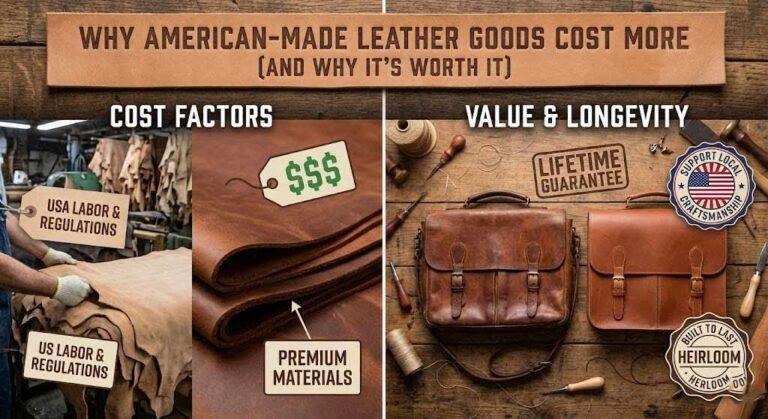
The tariff environment of 2025–2026 has created an unexpected tailwind for domestic leather goods makers. As CNBC reported in December 2025, companies relying on finished goods imported from Asia have absorbed the steepest tariff impacts, while brands sourcing and producing domestically have been comparatively insulated. Analysts project that leather goods prices could climb another 22% over the next two years as tariffs, global bottlenecks, and the shrinking U.S. cattle herd—now at its smallest since the 1950s following prolonged drought, rising feed costs, and herd liquidation—ripple through supply chains (CNBC, 2025). In this environment, the American leather artisan is not merely a cultural figure; they are an economic hedge.
Consider the arithmetic of ownership. A mass-produced imported leather briefcase purchased for $150 will likely need replacement within two to three years, yielding a per-year cost of approximately $50–$75. A $500 briefcase from any of the makers on this list, built from full-grain leather with a lifetime warranty, amortizes over twenty or thirty years of daily use at $17–$25 per year. The patina it develops over that time—the darkening at the handles where your grip has worn the leather smooth, the softening of the body where it has molded to your daily contents—transforms it from an accessory into an autobiography written in leather.
This is the logic that drives everything I do, whether I am sourcing beef for the Heritage Diner from local Long Island farms, selecting a hide for a Marcellino briefcase, or evaluating a property on the North Shore with Paola for our upcoming boutique venture. Provenance is not a luxury. It is a form of resistance against the disposable, the algorithmic, and the anonymous.
How to Choose: A Buyer’s Framework
For the reader considering their first serious leather purchase—or their next one—here is the framework I use when evaluating any maker, including myself:
First, ask about the leather. A maker who cannot name their tannery is a maker who does not control their supply chain. The best American makers specify not only the type of leather but the origin: Horween Chromexcel, Wickett & Craig Bridle, C.F. Stead Suede. This specificity is not pretension; it is accountability.
Second, examine the stitching. Machine lock-stitch looks uniform but fails catastrophically: when one thread breaks, the entire seam can unravel. Hand saddle-stitching uses two needles and a single thread that interlocks at every hole, meaning a break in the thread at any point leaves the rest of the seam intact. Not every product on this list is hand-stitched—some makers use industrial machines to great effect—but understanding the distinction helps you calibrate what you are paying for.
Third, consider the warranty. A 100-year warranty is not a marketing gimmick when it comes from a company that has engineered the product to actually last that long. It is a statement of structural confidence, and it transfers value to the secondhand market as well, making a well-built American leather good one of the few consumer products that appreciates rather than depreciates.
Fourth, and finally, meet the maker if you can. Visit the workshop. Smell the leather. Watch the hands. In an economy increasingly mediated by screens and algorithms, the physical act of seeing a craftsman at their bench—the same way you might watch a line cook at The Heritage Diner work a flattop or a real estate agent walk you through a home’s original millwork—reconnects you to the chain of human intention that separates a product from a possession.
The fifteen makers profiled here are not the only American leather artisans worthy of your attention, but they represent the breadth and depth of a movement that is older than the nation itself and more vital than it has been in decades. In 2026, with tariffs reshaping global trade, with a cattle herd at historic lows, and with consumers increasingly skeptical of disposable goods marketed as “luxury,” the American leather maker stands at a remarkable inflection point. What they build with their hands is not simply a product. It is an argument—stitched in waxed thread and cured in the tannins of ancient bark—that the things worth having are the things made to last.
Peter is the owner of The Heritage Diner (est. 2000) in Mount Sinai, NY, the founder of Marcellino NY bespoke leather goods in Huntington, and is launching a boutique real estate venture with his wife, Broker Paola, on Long Island’s North Shore in 2026. He writes about craftsmanship, provenance, and the art of building things that endure at heritagediner.com/blog.
Sources cited:
- CNBC. “Tariffs Hit Boots, Bags and More as Leather Prices Jump.” December 2025.
- Research and Markets. “Leather Goods Global Market Report 2025.” October 2025.
- Leather and Hide Council of America. U.S. Tannery Workforce Data, 2025.
- Stridewise. “Why Horween Leather Company is America’s Best Tannery.” 2023.
- Saddleback Leather Co. Brand Philosophy Statement, 2023.
- Individual maker websites, accessed February 2026.