By Peter
Written in 1932 — stop and sit with that for a moment. The year Franklin Roosevelt was elected president. The year the neutron was discovered. The year commercial air travel was still largely a fantasy for ordinary people. And yet Aldous Huxley sat down and imagined, in precise and almost clinical detail, a world where human beings are genetically engineered before birth, psychologically conditioned from infancy, sorted by caste based on their biology, kept docile by a pleasure drug called Soma, and so thoroughly insulated from suffering, struggle, and meaning that they no longer notice what they’ve lost. He called it the World State. He thought he was writing satire. What he was actually doing was drafting a blueprint.
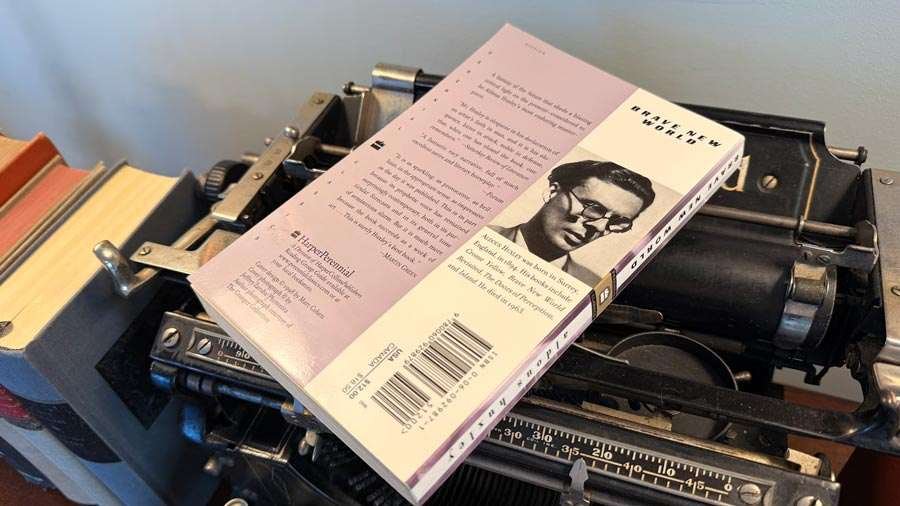
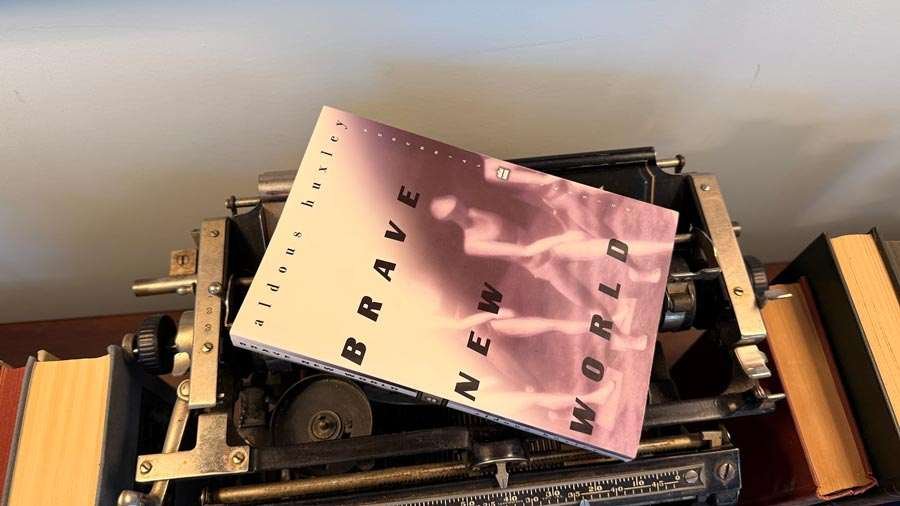
Brave New World is one of those rare novels that grows more relevant with every decade that passes rather than less. Ninety-four years after its publication, we are not living in Huxley’s world — but we are moving toward it in ways he would have recognized immediately, and in ways that no one in 1932 could have anticipated. The fact that this book exists at all, that one man’s imagination reached this far this early, is the thing that never stops being astonishing.
What Huxley Built
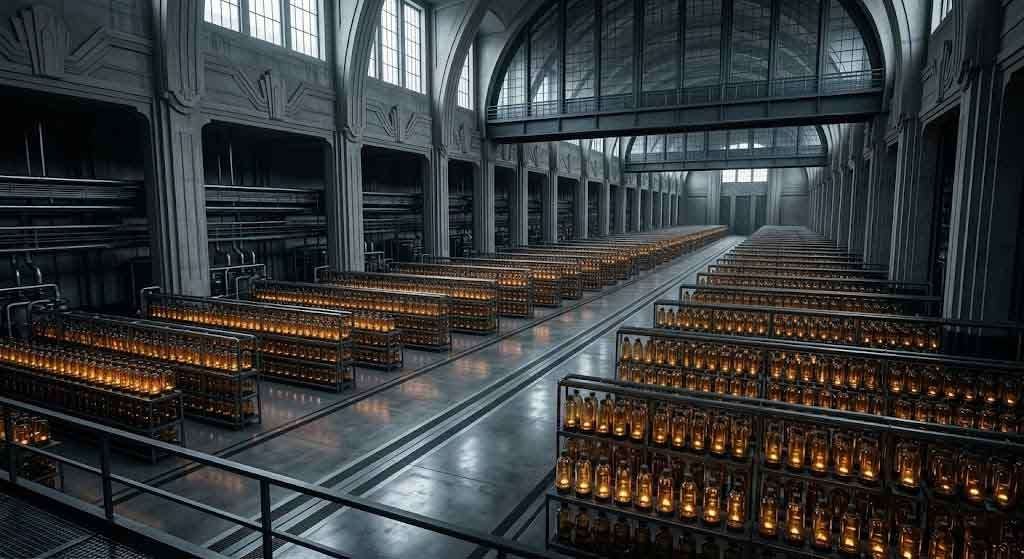
The World State of Brave New World is not a tyranny in the conventional sense — no jackboots, no secret police in the night, no show trials. That was Orwell’s vision, and it is a different kind of dread. Huxley’s dystopia is more seductive and, in some ways, more frightening precisely because it is comfortable. Citizens of the World State are not oppressed. They are happy. They have been engineered, from conception in a laboratory bottle through years of sleep-taught conditioning, to want exactly what society needs them to want. Stability is the supreme value. And stability has been achieved — at the cost of art, science, religion, family, love, and any form of experience that carries genuine risk.
The population is divided into castes — Alphas and Betas at the top, Gammas, Deltas, and Epsilons at the bottom — each group produced in industrial quantities via the Bokanovsky Process, which clones a single fertilized egg into up to ninety-six identical individuals. The lower castes are deliberately oxygen-deprived and chemically stunted during development so they have neither the capacity nor the desire for anything beyond their assigned function. This is eugenics not as a fever dream of the radical fringe but as government policy, optimized and industrialized, wearing the face of efficiency and social good.
Huxley was writing in the immediate aftermath of the eugenics movement’s peak respectability — a period when forced sterilization programs were operating in the United States and much of Europe with full legal sanction and widespread public approval. He took that logic and followed it to its terminus.
The Shock of the Familiar
What strikes you reading Brave New World in 2026 is not how alien it feels. It is how much of it has already arrived, in pieces, through different doors.
Genetic engineering of human embryos is no longer science fiction. CRISPR technology has made targeted gene editing not only possible but increasingly routine in research contexts, and the ethical debates around germline editing — changes that would be inherited by future generations — are live and unresolved right now. In 2018, a Chinese scientist named He Jiankui announced he had created the world’s first gene-edited babies, twins whose CCR5 gene had been modified to confer resistance to HIV. The scientific community’s response was horror and condemnation. But the capability existed. The door had been opened.
The pharmaceutical management of mood and behavior — Huxley’s Soma translated into our own pharmacopeia of antidepressants, anxiolytics, and attention modulators — is not a dystopian warning anymore. It is Tuesday. This is not an argument against psychiatric medication; that would be a crude misreading of Huxley’s point. His concern was not with the drugs themselves but with a society that reaches for chemical contentment as a substitute for addressing the conditions that produce misery. The question he was asking is the same one we avoid today: what are we medicating away, and what might we lose if the answer is pain itself?
The social media attention economy — engineered for maximum engagement, minimum friction, and the continuous delivery of small dopamine rewards — maps onto the World State’s entertainment apparatus with an accuracy that suggests either prophecy or coincidence, and the difference is hard to find. Neil Postman made a version of this argument in Amusing Ourselves to Death (1985), drawing the explicit contrast between Orwell’s fear that books would be banned and Huxley’s fear that no one would want to read them. Postman wrote that Huxley believed we would be ruined not by what we hate but by what we love — and that, of the two visions, Huxley’s had proven the more accurate.
Bernard, Helmholtz, and the Savage
The novel’s three central characters exist on a spectrum of alienation from the World State, and each one illuminates a different failure mode of the system.
Bernard Marx is an Alpha who is physically undersized — the rumor being that alcohol was accidentally introduced into his blood-surrogate during development — and his slight difference from the norm has made him just aware enough of his own unhappiness to be dangerous. He is not a hero. He is a malcontent, vain and self-pitying, who uses his access to the Savage as social currency the moment it becomes available. Huxley refuses to let his dissidents be admirable, which is one of the novel’s sharpest observations: alienation does not automatically produce wisdom or integrity. It just produces alienation.
Helmholtz Watson, Bernard’s friend, is an Alpha-Plus of genuine intellectual and emotional capacity who has begun to feel, dimly, that his talent is being used for nothing worth using it for. He writes hypnopaedic slogans for a living. He senses there is something else language could do, something language once did, but he cannot name it because the civilization he inhabits has systematically destroyed every example.
John the Savage — raised on a Reservation outside the World State, formed by Shakespeare rather than conditioning — arrives in London as the novel’s moral center and its most tragic figure. He has the vocabulary for human depth, drawn from The Tempest and Othello and King Lear, and he finds a world that has rendered that vocabulary meaningless. His insistence on the right to be unhappy, to suffer, to experience the full register of human existence, is the novel’s thesis stated plainly: a life without the capacity for genuine pain is also a life without the capacity for genuine meaning.
The Controller Mustapha Mond, in the book’s most intellectually alive scene, agrees with him entirely. He simply argues that stability is worth the price. It is a debate Huxley does not resolve — and that refusal to resolve it is what keeps the book alive.
What Huxley Feared Most
Huxley revisited his own novel in Brave New World Revisited in 1958, twenty-six years after writing it, and concluded that the world was moving toward his dystopia faster than he had predicted. He had thought it would take centuries. By 1958, he thought it might take decades. What he feared most, he wrote, was not the crude application of force but the willing surrender of freedom — the possibility that people would learn to love their servitude so thoroughly that the question of whether it was servitude would stop occurring to them.
That is the sentence that echoes loudest today. Not in any dramatic or apocalyptic sense, but in the quieter, more ordinary sense of scrolling through a feed designed by engineers to keep you scrolling, or reaching for a substance to flatten an emotion that might have been worth feeling, or accepting a version of life optimized for comfort and ease at the cost of whatever it is that makes life feel fully inhabited.
My piece on Horizontal Gene Transfer explores how radically modern biology has complicated our understanding of heredity and genetic identity — territory Huxley intuited with remarkable precision. And if the World State’s managed, consequence-free existence reminds you of anything in contemporary technology and social design, my review of The God Delusion touches on the same underlying question: what, exactly, are we willing to trade away in exchange for feeling better?
The Verdict
Brave New World is not a perfect novel. Its women are thinly drawn, its plot mechanics occasionally creak, and Huxley’s satirical instincts sometimes override his dramatic ones. But none of that matters very much, because the ideas driving it are so precise and so durable that the story serves mainly as a delivery mechanism for a set of questions that have become more urgent with every passing year, not less.
A man in 1932 imagined genetic engineering, behavioral pharmacology, mass psychological conditioning, and the voluntary surrender of freedom in exchange for comfort and distraction. He published it as a novel. Ninety-four years later, we are still trying to catch up with what he saw.
Read it. Then read it again in ten years and notice what has changed.
You Might Also Like:
- The God Delusion by Richard Dawkins — A Review
- Horizontal Gene Transfer: Why Darwin’s Tree of Life Is Actually a Tangled Web
Sources:
- Huxley, Aldous. Brave New World. Chatto & Windus, 1932. Amazon
- Huxley, Aldous. Brave New World Revisited. Harper & Brothers, 1958. Amazon
- Postman, Neil. Amusing Ourselves to Death. Viking Penguin, 1985. Amazon
- Lemann, Nicholas. “Huxley in Hollywood.” The New Yorker, 2002. newyorker.com
- Regalado, Antonio. “CRISPR Baby Scientist Fails to Satisfy Critics.” MIT Technology Review, 2018. technologyreview.com
- Claeys, Gregory. Dystopia: A Natural History. Oxford University Press, 2017. Amazon