By Peter
Few writers in the canon of Western literature demand a biographer equal to their own ferocity. Dostoevsky is one of them. His life was not a backdrop to his work — it was the raw material from which every novel was hammered out, still hot, still bleeding. Mock executions. Siberian labor camps. Epileptic fits in the middle of the night. Gambling debts that swallowed advances whole. To write a biography of Fyodor Mikhailovich Dostoevsky is to accept an almost violent obligation to both the man and the literature. Joseph Frank accepted that obligation — and over the course of five volumes spanning more than three decades, he produced something that has no real precedent in literary biography: a work that is, in itself, a kind of masterpiece.
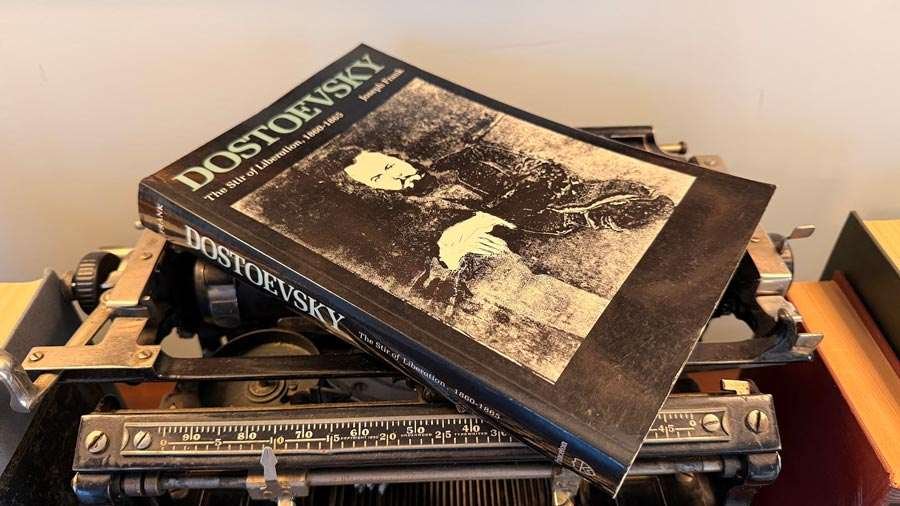
Dostoevsky: The Stir of Liberation, 1860–1865 is the third volume in Frank’s monumental series, and it covers what may be the single most consequential five-year stretch in Dostoevsky’s creative life. These are the years that follow his release from Siberian prison and exile — years of furious reintegration, philosophical realignment, and the explosive artistic emergence that would produce Notes from Underground, published in 1864, and set the trajectory for every major work that followed.
Who Joseph Frank Was, and Why That Matters
Joseph Frank was a literary scholar and professor at Princeton and Stanford whose work on Dostoevsky consumed the better part of his professional life. The first volume appeared in 1976; the fifth and final in 2002. The full series was later condensed into a single-volume abridgment, but the five-volume set remains the definitive version — the one scholars reach for, the one that gives you Dostoevsky in full resolution rather than compressed.
What makes Frank’s approach unusual, and ultimately indispensable, is his insistence on the inseparability of the historical and the literary. He does not simply recount Dostoevsky’s life and then gesture toward the novels. He reads the novels as documents of their precise historical moment — shaped by the debates, political pressures, and intellectual currents circulating through mid-nineteenth-century Russia with the force of a cultural earthquake. You cannot understand Notes from Underground, Frank argues, without understanding the radical intelligentsia of the 1860s, the influence of Chernyshevsky’s utilitarian novel What Is to Be Done?, and the specific ideological landscape that Dostoevsky was arguing against — sometimes line by line, paragraph by paragraph.
This is biographical criticism of a rare order. Frank gives you the context not as decoration but as oxygen.

The Years That Made Everything Possible
The period covered by The Stir of Liberation begins with Dostoevsky’s return from Siberia in 1860 — a man who had spent four years in a labor camp surrounded by common criminals and peasants, an experience that shattered his earlier idealism and replaced it with something far more complicated. The naïve progressive he had been in the 1840s, arrested and convicted for participation in a socialist reading circle, was gone. What emerged from the camp was a thinker for whom human freedom was not a political abstraction but a moral and spiritual emergency.
Frank traces how Dostoevsky, in these years, refounded himself. He and his brother Mikhail launched two literary journals — Vremya (Time) and then Epokha (Epoch) — through which Dostoevsky developed the philosophical position known as pochvennichestvo, or “soil ideology,” a distinctly Russian form of cultural nationalism that sought to reconcile the educated classes with the common people from whom Peter the Great’s westernization had severed them. These were not side projects. They were the intellectual crucible in which his mature worldview was formed.
And running through all of it, in Frank’s telling, is Dostoevsky’s deepening conviction that the Western rationalist tradition — the utilitarian calculus, the belief that human behavior could be reduced to self-interest and managed accordingly — missed something essential and irreducible about what it means to be a person. That conviction becomes Notes from Underground. That conviction, taken to its furthest extremes, eventually becomes Crime and Punishment, The Idiot, The Brothers Karamazov.
Notes from Underground as the Pivot Point
Frank’s treatment of Notes from Underground is the intellectual heart of this volume, and it is worth reading even if you approach the biography with no intention of reading the rest of the series. He situates the novella not merely as a literary experiment in narrative voice but as a direct philosophical rebuttal — a polemical act disguised as fiction.
The Underground Man, Frank argues, is Dostoevsky’s controlled demolition of the rational egoist — the model of human behavior championed by the utilitarian thinkers of the day who believed that enlightened self-interest, properly understood, would lead men naturally toward rational social organization. The Underground Man demonstrates, with manic and humiliating precision, that human beings do not behave this way. That they will choose suffering, contradiction, and spite over rational benefit — simply because the capacity to choose irrationally is the last proof of their freedom. The “crystal palace” of perfect rational order is, to the Underground Man, a prison.
This is existentialism before the word existed. Kierkegaard was writing in Denmark at the same time, unknown to Dostoevsky. Nietzsche was a teenager. The Underground Man arrives in world literature as a kind of spontaneous generation — a fully formed critique of modernity that would take the rest of European philosophy another half-century to catch up with.
Reading Frank on this is, in a word, thrilling. He shows you exactly what Dostoevsky was arguing against, which means you feel the force of what he was arguing for in a way that the novel alone — taken without context — simply cannot deliver.
What Frank Does That No Other Dostoevsky Biographer Has Done
There are other fine books on Dostoevsky. Geir Kjetsaa’s biography is readable and thorough. A.B. Yarmolinsky’s has genuine warmth. But Frank’s achievement is categorically different because he refuses to choose between the life and the work. He holds both simultaneously, with the patience of a man who has been thinking about nothing else for thirty years.
There is also a quality to Frank’s prose that deserves naming. He is not a showy writer. He does not reach for the lyrical when the analytical will do. But he is relentlessly clear, and in a subject this dense — Russian intellectual history, Orthodox theology, the sociology of the 1860s intelligentsia — clarity is not a modest virtue. It is an extraordinary one. He makes you feel, by the final pages of each volume, that you have genuinely understood something that resisted understanding before.
For anyone who has spent time with the existentialists — with Heidegger’s insistence on the primacy of being, with Nietzsche’s furious rejection of herd morality, with Kierkegaard’s leap into the irrational — reading Frank on Dostoevsky is the experience of watching a missing piece of intellectual history fall into place. Dostoevsky was not downstream from existentialism. He was, in many respects, its source.
A Personal Note
Dostoevsky has occupied my reading life for longer than I can precisely date. There is something in his insistence on the fullness of the human person — the capacity for both the most degraded and the most transcendent behavior, often within the same character, sometimes within the same paragraph — that feels more honest about the actual texture of experience than anything produced in the century that followed him. The novels are not comfortable. They are not meant to be. They are moral emergencies disguised as entertainment, and they have never stopped feeling urgent.
The Frank biography deepens all of that. It does not simplify Dostoevsky or make him more palatable. It makes him more necessary. And for a biographer, there is no higher praise.

If the Frank series has whetted your appetite for the existentialist tradition, our review of The God Delusion by Richard Dawkins explores the collision between reason, faith, and the nature of freedom from a very different but equally provocative angle. And if you prefer your philosophy through narrative, the Book Reviews archive has much more to explore.
You Might Also Like:
- The God Delusion by Richard Dawkins — A Review
- Brawler by Lauren Groff — Nine Stories That Refuse to Look Away
Sources:
- Frank, Joseph. Dostoevsky: The Stir of Liberation, 1860–1865. Princeton University Press, 1986. Amazon
- Dostoevsky, Fyodor. Notes from Underground. Trans. Richard Pevear and Larissa Volokhonsky. Vintage, 1994. Amazon
- Kjetsaa, Geir. Dostoevsky: A Biography. Fawcett Columbine, 1989. Amazon
- The New York Review of Books. Joseph Frank obituary and retrospective. nybooks.com
- Stanford University. Joseph Frank faculty profile and bibliography. stanford.edu