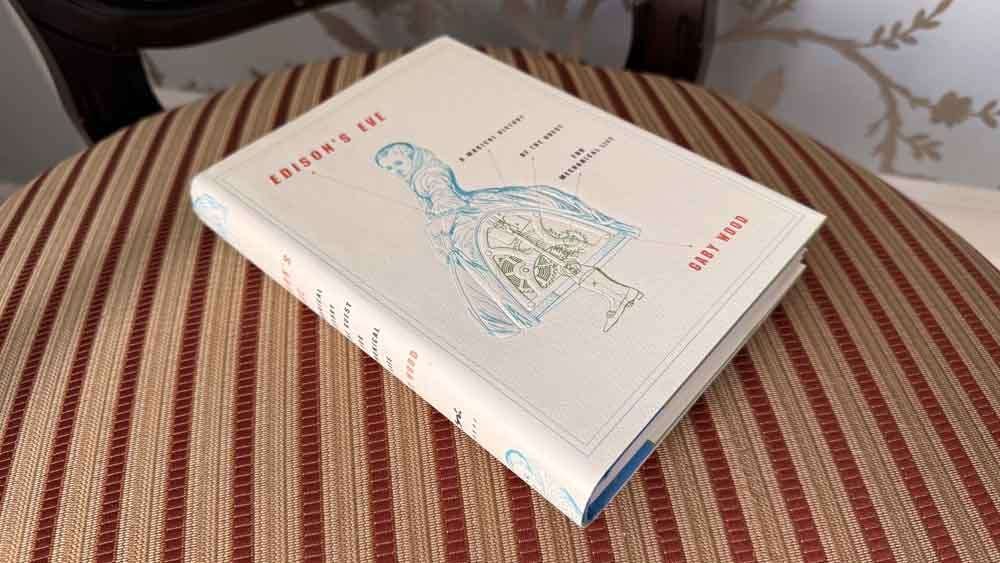
What does it mean to build a life? Not to live one — but to construct it, from gears and wax and wire, with hands that ache and a mind that refuses to accept the boundary between the animate and the made? Gaby Wood’s Edison’s Eve: A Magical History of the Quest for Mechanical Life is a book that circles this question across three centuries, through duck intestines and chess frauds and a talking doll that terrified children, arriving finally at a truth more unsettling than any automaton: that the obsession with manufacturing life is not science run amok, but something older and more human than reason itself.
Wood is a British journalist and critic, a Cambridge-educated writer whose prose sits comfortably at the intersection of cultural history and philosophical inquiry. Published in 2002 in the UK as Living Dolls and released in the United States in 2003 under its more evocative title, the book unfolds in five chapters, each treating a different chapter in humanity’s long romance with mechanical imitation. She moves from the Enlightenment automatons of Jacques de Vaucanson, to the chess-playing fraud known as “the Turk,” to Edison’s doomed talking doll project, to the early cinema of Georges Méliès, and finally to a group of performing dwarfs known as the Doll Family whose audiences occasionally refused to believe they were real. The arc is strange, and deliberately so. Wood wants the discomfort. She is tracing not a history of technology but a history of longing.
Vaucanson’s Duck and the Body as Machine
The book opens in the eighteenth century with Jacques de Vaucanson, a French inventor who built mechanical marvels that left Paris alternately dazzled and disturbed. His flute-playing android reportedly breathed air through its mechanism, producing twelve complete melodies. His mechanical duck — the one that became the stuff of legend — appeared to eat grain, digest it, and excrete it. Physicians of the era were openly describing the human body as a complex piece of machinery, and Vaucanson was their sculptor, their proof of concept made literal in copper and wire. Wood digs into the philosophical context with precision: Descartes haunts these pages, his notion that bodies operate like hydraulic systems providing the intellectual soil in which these contraptions grew. The man-machine thesis, taken seriously by Enlightenment thinkers, was both liberating and terrifying — it explained function, but it raised the question of what was left over, what the machine could never replicate.
Vaucanson’s duck, it turns out, was at least partially a hoax. The excretion was pre-loaded. But Wood’s point is not to debunk the trick so much as to ask why people so desperately wanted to believe it. Audiences weren’t deceived because they were stupid. They were deceived because they wanted proof of something — that life could be mapped, replicated, controlled. The craftsman’s obsession and the scientist’s obsession share the same root: the refusal to accept mystery without a fight.
The Turk and the Ethics of Illusion
Von Kempelen’s chess-playing Turk — a mechanical figure dressed in Ottoman robes, seated before a board, capable of defeating nearly every opponent it faced — was one of the great con jobs of the eighteenth century. A human chess master was concealed inside the cabinet, moving the pieces through a clever internal mechanism. Wood is less interested in the exposure of the fraud than in the way audiences responded to the machine before they knew the truth. They fainted. They crossed themselves. The greatest chess players of the era reported that no game had left them more drained, because the opponent was unknowable. Something about the Turk’s blankness, its inhuman patience, made the boundary between machine and mind terrifyingly unclear.
Wood draws from this chapter a thread that runs through the entire book: uncertainty itself is what produces the uncanny. Sigmund Freud’s concept of das Unheimliche — the uncanny, the familiar made strange — gets an extended workout here, and Wood applies it with intelligence rather than mechanical repetition. The Turk unsettled people not because it was provably alive but because it was impossibly ambiguous. And ambiguity, in matters of consciousness, turns out to be more disturbing than confirmation of either answer.
Edison’s Obsession and the Perfect Woman
The book’s title chapter is its most revealing, and the most relevant to the angle of obsessive craftmanship. Thomas Edison — a man who slept four hours a night, regarded rest as a waste of good material, and patented over a thousand inventions — became fixated in the late 1880s on producing a talking doll. He dedicated an entire building to the project. He employed 250 factory workers. He aimed to produce 500 dolls per day. The doll’s metal torso housed a miniature phonograph; young girls in Edison’s employ recorded nursery rhymes onto wax cylinders, and the doll would play them back when a crank in its back was turned.
The project failed spectacularly. The mechanism was too fragile, the sound too distorted, and the dolls, when they spoke, reportedly terrified the children they were meant to delight. Wood quotes contemporary accounts of children recoiling, parents returning the dolls in alarm. The voice was wrong in a way that Edison’s genius could not quite fix — close enough to human to be disturbing, too mechanical to be trusted.
What makes Wood’s treatment of Edison so sharp is her attention to his stated intentions. He didn’t just want a toy. He envisioned the phonograph as a tool of permanence, a means of preserving human voices after death. From the moment he invented it, the machine was reported as a resurrection device — a way of giving the dead a continued life in sound. To embody that phonograph in a human form, to give it a woman’s body and a child’s voice, was for Edison an attempt to build something he could not quite name. Wood describes his attitude toward women — documented in a Good Housekeeping essay he wrote about electricity — as that of a man who saw women as improvable systems, perfectible through technology. His doll was not merely a toy. It was a vision of control, of life that answered to design.
This is where the book cuts deepest. The obsessive craftsman — whether building an automaton in Paris, designing a chess cabinet in Vienna, or running a factory in New Jersey — is not simply trying to replicate life. He is trying to surpass the terms life imposes on him. The fragility, the unpredictability, the refusal of flesh to hold its shape indefinitely. The doll that speaks forever, the machine that never tires, the opponent that never loses patience: these are not scientific achievements so much as dreams of mastery over the conditions of existence. As Wood frames it, it is the Pygmalion myth played out again and again — not as art, but as engineering.
Méliès, Cinema, and the Magic of Mechanical Dreams
Wood’s fourth chapter turns to Georges Méliès, the French illusionist turned filmmaker who became one of cinema’s first great fantasists. Méliès saw in the moving image the ultimate automaton — pictures that breathed and moved and looked back at you. His connection to the automaton tradition was direct: he had worked as a stage magician, had purchased and studied Vaucanson’s mechanisms, and brought their spirit of beautiful deception into early film. Wood traces the lineage carefully, arguing that cinema is the logical extension of the automaton — life imitated not in metal but in light. The medium itself is a kind of mechanical life.
This chapter is the book’s most elegant pivot. By the time cinema arrives, the question of what counts as artificial life has expanded from gear-work to image. And yet the anxiety persists: is what we’re watching real? Does it feel? Can it know us back? The questions that paralyzed audiences watching von Kempelen’s Turk in 1769 are structurally identical to the questions being posed today in laboratories building machines with apparent emotions. Wood sees this continuity clearly, and she makes it resonate.
The Doll Family and the Limits of the Book
The final chapter is the book’s most idiosyncratic and, for some readers, its most jarring departure. Wood traces the history of the Doll Family — four German-born siblings, all of short stature, who performed with Ringling Brothers Circus and appeared in films including The Wizard of Oz — whose stage act blurred the line between human and mechanical in the opposite direction. Some audiences genuinely believed the Dolls were sophisticated toys, not people. Wood eventually tracks down the last surviving member, Tiny Doll, elderly and living in Florida, and the encounter is quietly devastating. Here is a person who spent a lifetime being mistaken for an object, a mechanism, something less than fully alive — and who managed, against considerable odds, to remain entirely human.
The connection to the automaton theme requires a somewhat generous interpretive leap, and it is fair to say that the book’s critics have pointed out that Wood’s analytical commentary doesn’t always match the depth of her research. Publishers Weekly noted that the anecdotes are delightful but the analysis sometimes thin, and that observation holds. Wood’s strength is in the telling, in the accumulation of strange and wonderful particulars, more than in the systematic construction of a philosophical argument. The book reads, at its best, like a series of brilliant cabinet displays — each one worth stopping in front of, each one illuminating something real — even if the museum as a whole doesn’t have a single, unified thesis you can carry out with you.
What the Book Gets Right and What It Costs
The tension at the heart of Edison’s Eve is the same tension at the heart of every obsessive creation: the gap between what you want to make and what you can actually build. Edison’s doll shrieked instead of sang. Vaucanson’s duck digested nothing. The Turk was a fraud. None of them delivered what their makers promised. And yet each one advanced the conversation, pushed the question further, demanded that the culture reckon with what it meant to be alive and what it meant to imitate life.
There is something in this book that invites a reckoning with the current moment. The AI systems being built today — and the questions they are generating about consciousness, emotion, creativity, and intent — are not discontinuous with Edison’s doll factory. They are its direct descendant. The anxiety about where the machine ends and the mind begins is not a new feature of the twenty-first century; it is a very old question wearing new hardware. I wrote recently about the rise of AI agents and what autonomous systems actually do and found myself tracing the same questions Wood raises here — not about capability, but about meaning. What do we want these machines to be? And what does that want tell us about ourselves?
Wood doesn’t answer those questions. Neither did Edison. But Edison’s Eve is valuable precisely because it insists on asking them across the full sweep of history, rather than treating them as a novelty of the present. The obsessive craftsman who builds a speaking doll and the engineer who builds a language model are, in Wood’s telling, part of the same long conversation — one that began not with silicon but with copper and wax and the profound human need to make something that could, for just a moment, seem to speak back.
Edison’s Eve is not a perfect book. Its final third wanders, and it asks more questions than it resolves. But it is the kind of book that stays with you — that makes the everyday objects of the world seem newly strange, that makes you wonder, when a machine does something unexpectedly graceful, what exactly is happening behind the mechanism. That is a rare and valuable quality in nonfiction, and Wood earns it honestly.
Edison’s Eve: A Magical History of the Quest for Mechanical Life By Gaby Wood Anchor Books / Knopf, 2003 304 pages Available on Amazon | Barnes & Noble
You Might Also Like:
- Understanding Emergent Properties in AI: When Machines Surprise Us
- Thus Spoke Zarathustra by Friedrich Nietzsche — The Book That Rewired My Understanding of Everything
Sources: