Punk rock gave me a lot of things before philosophy got hold of me. A tolerance for noise. A suspicion of authority. An instinct that the official version of almost anything was probably incomplete. And a slogan I saw spray-painted on jackets, scrawled across show flyers, and screamed from stages in Brooklyn basements long before I understood its full intellectual weight: No Gods No Masters. It was raw and confrontational and I loved it. What I did not know, standing in those rooms at sixteen, was that the phrase had a precise genealogy — that it traced back to Auguste Blanqui, a nineteenth-century French revolutionary who spent nearly half his life in prison for his politics — and that it would eventually become the title of one of the most important anthologies in the history of political thought.
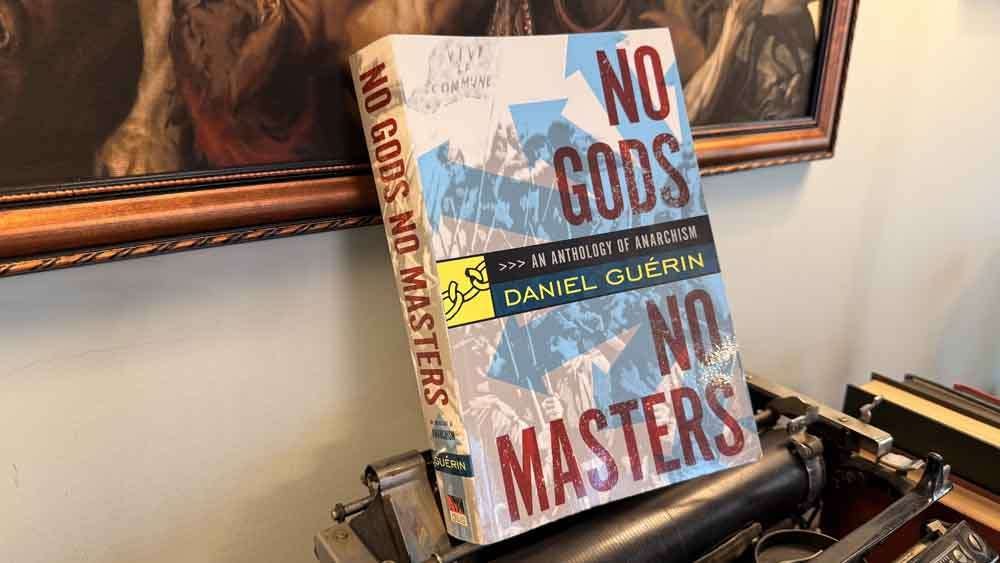
Daniel Guérin’s No Gods No Masters: An Anthology of Anarchism, first published in France in 1980 and translated into English by Paul Sharkey for AK Press, is not a polemic. It is a primary source document — a carefully assembled archive of the foundational thinkers, organizers, and agitators who built the anarchist tradition from the mid-nineteenth century through the early twentieth. Guérin lets the record speak. What the record says is considerably more rigorous, more humane, and more philosophically serious than anything the word “anarchism” tends to conjure in contemporary popular culture.
The Word and What Happened to It
Anarchism, in the popular imagination of 2025, means chaos. It means a teenager in a Guy Fawkes mask. It means broken windows at a protest, or, in a completely different misappropriation, a tech libertarian’s fantasy of zero regulation and infinite personal sovereignty. None of these bear more than a surface resemblance to the tradition Guérin documents.
The word comes from the Greek anarchos — without ruler, without authority. What the anarchist tradition actually argued, across a remarkable diversity of thinkers and tactical approaches, was something more specific and more demanding: that hierarchical authority — the state, the church, concentrated capital — is not just oppressive in its particular forms but illegitimate in principle, and that human beings are capable of organizing their social and economic lives through voluntary cooperation, mutual aid, and free association without coercive institutions standing over them.
This is not a call for chaos. It is a call for a different kind of order — one built from the bottom up rather than imposed from above. The distinction matters enormously, and Guérin’s anthology makes it impossible to miss.

Guérin’s Architecture: Who Is in This Book and Why
The anthology opens with what Guérin calls the “Founding Fathers” of anarchism — Pierre-Joseph Proudhon, Mikhail Bakunin, and Peter Kropotkin — and moves through the major currents that followed: collectivist anarchism, anarcho-communism, anarcho-syndicalism, and individualist anarchism. It includes not just theoretical writing but manifestos, letters, speeches, and accounts of direct action, giving the tradition texture and motion rather than presenting it as a static set of ideas.
Pierre-Joseph Proudhon (1809–1865) is the first. He coined the phrase “property is theft” — one of the most deliberately provocative sentences in political philosophy — and was the first major thinker to claim the label “anarchist” for himself, in 1840. His argument was not that all possession was illegitimate but that the specific form of property that generates passive income — that allows one person to extract value from another’s labor simply by virtue of ownership — was a kind of institutionalized robbery. Proudhon was a mutualist: he believed in workers owning the tools of their labor and exchanging goods and services at cost, without exploitation. He was also a contradictory figure — famously anti-feminist in his personal views, a tension Guérin does not obscure.
Mikhail Bakunin (1814–1876) is where the tradition catches fire. The Russian nobleman turned revolutionary agitator was Marx’s great opponent within the First International, and their conflict — philosophical as much as personal — shaped the split between authoritarian socialism and libertarian socialism that still structures much of the left’s internal argument today. Bakunin’s critique of Marx was essentially prophetic: he argued that a revolutionary state, even one controlled by a workers’ party, would reproduce domination rather than abolish it. The party would become the new ruling class. History, across the twentieth century, gave Bakunin rather more credit on this point than he received in his lifetime.
Peter Kropotkin (1842–1921) is perhaps the most systematically compelling of the three. A trained geographer and naturalist, Kropotkin brought an empirical sensibility to anarchist theory. His landmark work Mutual Aid: A Factor of Evolution (1902) — a direct argument with Social Darwinism — documented cooperative behavior across species and human societies, arguing that solidarity and mutual support were as fundamental to evolution as competition. Where the Social Darwinists looked at nature and saw a justification for ruthless competition, Kropotkin looked at the same nature and saw a long history of organisms surviving precisely by helping one another. It is a reading that modern evolutionary biology, particularly in the study of eusocial insects and cooperative hunting species, has found considerably more nuanced than the crude “nature red in tooth and claw” version — a thread explored in a different register on this blog in the piece on On the Origin of Species.
The Syndicalist Thread: Where Anarchism Touched the Real World
One of Guérin’s signal contributions in this anthology is his sustained attention to anarcho-syndicalism — the labor movement variant of anarchist thought that came closest, in historical practice, to implementing its ideas at scale. The syndicalists argued that the trade union, rather than the political party, was the proper vehicle for revolutionary change. Workers organized in their industries, refusing to delegate their power to representatives or vanguards, would build the infrastructure of a new society within the shell of the old — and then, through the general strike, bring the existing order to a halt.
The French Confédération Générale du Travail (CGT) in its early years, the Industrial Workers of the World (the Wobblies) in the United States, and most dramatically the anarchist collectives of Catalonia during the Spanish Civil War (1936–1939) represent the closest historical approximations of anarchist theory in practice. The Spanish case is the most instructive. In the months following the military uprising against the Republic, workers in Barcelona and throughout Aragon collectivized factories, farms, and utilities — organizing production and distribution without managers or owners, coordinating through federated councils. George Orwell, who went to Spain to fight fascism, described what he found in Barcelona in Homage to Catalonia as something genuinely unlike anything he had seen: a city where the working class appeared to actually be in charge. It lasted until the anarchists were suppressed — partly by Franco’s forces, partly by the Soviet-aligned communists within the Republic itself.
Guérin includes substantial material on this history, and it is among the most compelling in the anthology precisely because it refuses to remain abstract.
Anarchism and the Left: The Argument That Never Ended
The tension between anarchism and Marxism — between libertarian and authoritarian strands of socialist thought — runs through No Gods No Masters like a fault line. Guérin himself was a complicated figure on this question: a lifelong socialist who was drawn to both traditions and spent much of his intellectual life trying to reconcile them, arguing in other works for what he called a “libertarian Marxism.”
The core disagreement is not about the diagnosis. Both traditions agreed that capitalism was exploitative, that the state served ruling-class interests, and that a fundamental reorganization of economic life was necessary. The disagreement was about the cure. Marx argued that the working class needed to seize state power as a transitional step toward a classless, stateless society. Bakunin argued — with a bitterness sharpened by personal contempt — that there was no such thing as a transitional state that would willingly abolish itself. Power, once concentrated, reproduces itself. The instrument of liberation becomes the new form of domination.
This is not an academic dispute. It played out in blood across the twentieth century — in Russia, in China, in Cuba, in every country where a Marxist-Leninist party took power and the withering away of the state never arrived. Whether one reads this history as the inevitable consequence of Marxist theory or as a series of tragic deformations of it, Bakunin’s warning stands as one of the more uncomfortable pieces of political prescience in the modern record.
What Anarchism Is Not: Clearing the Debris
The popular conflation of anarchism with mere destruction — with vandalism, nihilism, or adolescent rejection of all structure — is worth addressing directly, because Guérin’s anthology makes the confusion almost inexcusable for anyone who actually reads it.
Anarchists were not against organization. They were against hierarchical organization — the kind in which authority flows downward from a concentrated center that cannot be held accountable by those subject to it. The alternatives they proposed — federated councils, workers’ assemblies, voluntary communes — were highly organized. The Spanish collectives ran hospitals, schools, and tram systems. The IWW built one of the most sophisticated labor organizing structures in American history. This is not chaos. It is a different theory of how order can be produced and maintained.
The other persistent misreading — particularly common in American libertarian circles — is the equation of anarchism with free-market individualism. The “anarcho-capitalism” that some on the right claim as a lineage has essentially nothing to do with the tradition Guérin documents, which was anti-capitalist to its foundations. Proudhon, Bakunin, and Kropotkin were not arguing for the removal of the state so that capital could operate without restraint. They were arguing against both the state and capital as mutually reinforcing systems of domination. The removal of one while leaving the other intact was not liberation — it was just a different arrangement of the same cage.
Why This Book Belongs on Your Shelf
I came to No Gods No Masters from a particular angle — through years of reading Nietzsche, Heidegger, the existentialists, and eventually the evolutionary thinkers, building a picture of what it means to construct meaning and organize life without inherited authority. Anarchism, read seriously, is the political expression of something those thinkers circled in the philosophical register: the insistence that legitimacy cannot be simply inherited or assumed, that it must be continuously earned and consented to, that the human capacity for self-organization is deeper and more durable than any institution wants us to believe.
The slogan on those basement show flyers in Brooklyn was not wrong. It was just compressed. No Gods No Masters is the uncompressed version — the intellectual history behind a cry that, it turns out, had more rigor in it than most of the people shouting it knew. Including me, at sixteen, in a room full of noise. I am glad I eventually found out what it meant.
No Gods No Masters is available through AK Press, the publisher that has kept the anarchist canon in print for decades, and through most major booksellers.
You Might Also Like
- Thus Spoke Zarathustra by Friedrich Nietzsche: The Book That Rewired My Understanding of Everything
- The God Delusion by Richard Dawkins — A Review
- Brave New World by Aldous Huxley — A Review
Sources
- Guérin, Daniel. No Gods No Masters: An Anthology of Anarchism. Translated by Paul Sharkey. AK Press, 1998. AK Press
- Proudhon, Pierre-Joseph. What Is Property? 1840. Project Gutenberg
- Kropotkin, Peter. Mutual Aid: A Factor of Evolution. 1902. Project Gutenberg
- Orwell, George. Homage to Catalonia. Secker & Warburg, 1938.
- Graham, Robert. Anarchism: A Documentary History of Libertarian Ideas. Black Rose Books, 2005.
- Marshall, Peter. Demanding the Impossible: A History of Anarchism. HarperCollins, 1992.
- Woodcock, George. Anarchism: A History of Libertarian Ideas and Movements. Broadview Press, 2004.