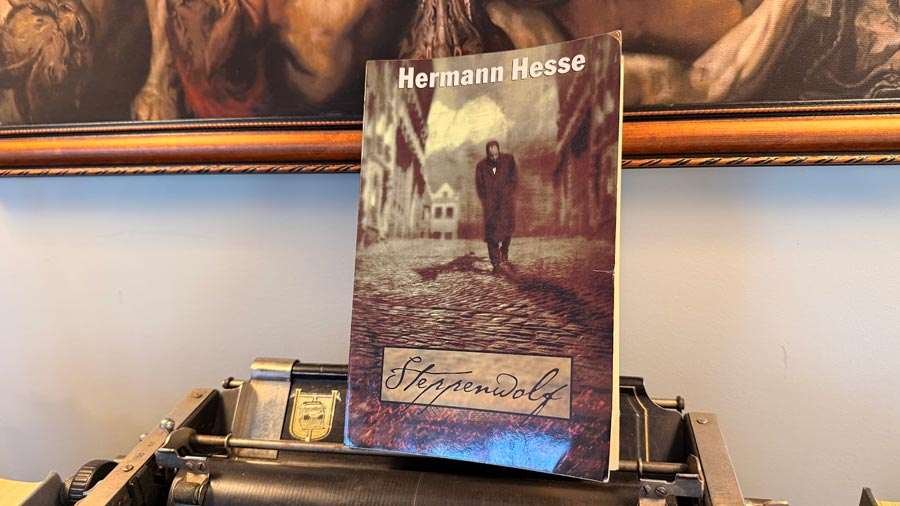
Rare books locate you. You don’t choose them so much as collide with them — at the wrong age or the right one, depending on what the collision leaves behind. Hermann Hesse’s Steppenwolf, published in 1927 and available via Penguin Classics, is that kind of book. It doesn’t ask for your interpretation. It demands your reckoning.
The novel follows Harry Haller, a middle-aged intellectual in crisis — a man who believes himself to be split between two irreconcilable natures: the disciplined, bookish bourgeois and the wild, restless wolf of the steppes. He is repulsed by society and yet unable to leave it entirely. He longs for transcendence and yet is too lucid, too honest, to settle for easy answers. Hesse calls this the “Steppenwolf problem.” It is, at its core, the problem of self-division — the distance between who we are and who we believe ourselves to be.
The Wolf and the Man
What makes Haller so uncomfortable to read — and so enduring — is his refusal to be resolved. Most literary characters arc toward something: redemption, defeat, understanding. Haller resists all of it. He lives in what Hesse describes as the space “between two worlds,” belonging fully to neither the life of the spirit nor the life of ordinary men. That in-between space is not portrayed as romantic suffering. It is portrayed as a kind of slow suffocation.
Hesse was drawing on his own breakdown when he wrote this. He had emerged from psychoanalysis with Carl Jung’s student Josef Lang, and the novel carries that interior excavation on every page. The “Treatise on the Steppenwolf” — an unusual document that appears mid-novel as if handed to Haller by the universe itself — reads like a clinical and philosophical dissection of his own psychology. Hesse argues, through this treatise, that the binary self (wolf vs. man) is itself the delusion. The soul is not two things. It is thousands.
The Magic Theater and the Death of Ego
The novel’s final act takes place in the Magic Theater — a surreal, hallucinatory space that reads like Hesse’s attempt to dramatize the unconscious in real time. The invitation at the door reads: “For Madmen Only.” What follows is less a narrative than an experience — a series of psychological rooms that force Haller to confront every fixed identity he has constructed around himself.
Scholar and cultural critic Colin Wilson, in his 1956 work The Outsider, identified Haller as a definitive example of the modern outsider — the man of heightened perception who cannot integrate himself into the comfort of collective life. Wilson wrote that such figures are condemned to see too clearly to rest, and too honestly to pretend. Hesse would not have disagreed. His Haller is not a hero. He is a diagnosis.
The Magic Theater sequence also anticipates what psychedelic culture would later attempt to formalize: the dissolution of the fixed self as a path toward something freer. Whether Hesse intended this or not, the 1960s counterculture adopted Steppenwolf — and the rock band that took its name from the novel — as a kind of spiritual manifesto. That adoption was both fitting and reductive, as most cultural adoptions are.
Hermine, Pablo, and the Education of the Senses
Two figures interrupt Haller’s solipsism with startling effect. Hermine — a young woman who seems to know Haller better than he knows himself — becomes his guide into pleasure, lightness, and the body. She teaches him to dance. She teaches him, more importantly, to stop treating enjoyment as a betrayal of his intellectual seriousness.
Pablo, the saxophonist, operates as the novel’s quiet antithesis to everything Haller represents. Where Haller overthinks, Pablo simply is. He does not philosophize. He plays music and offers presence. Hesse uses him as a rebuke to the tyranny of self-consciousness — the idea that a life examined endlessly is not, in fact, being lived at all.
The tension between Hermine and Pablo on one side and Haller’s relentless interiority on the other is the novel’s most human drama. It is also its most honest question: can a person of deep intellectual formation ever truly relax into the moment? Or has thought itself become the trap?
Hesse, Nietzsche, and the Weight of Becoming
Steppenwolf is saturated with Nietzsche — not cited, but metabolized. Haller’s crisis is fundamentally a post-Nietzschean one: the old certainties are gone (God, tradition, the stability of the bourgeois world), and what remains is the terrifying freedom of self-construction. Haller does not take that freedom as liberation. He takes it as a burden he cannot set down.
Hesse was also working through the disillusionment of post-World War I Europe, and Haller’s contempt for the nationalist fervor building around him feels eerily contemporary. He attends a lecture by a professor who argues that Germany must prepare for the next war, and Haller’s interior monologue — the seething, precise disgust of a man who has seen what that argument leads to — is some of the most quietly devastating prose in the novel.
This political dimension is often overlooked by readers who come to Steppenwolf for personal reasons. But Hesse understood that the divided self is not merely a private condition. It is the condition of a civilization that has lost its center and filled the vacuum with noise.
Why This Book Matters Now
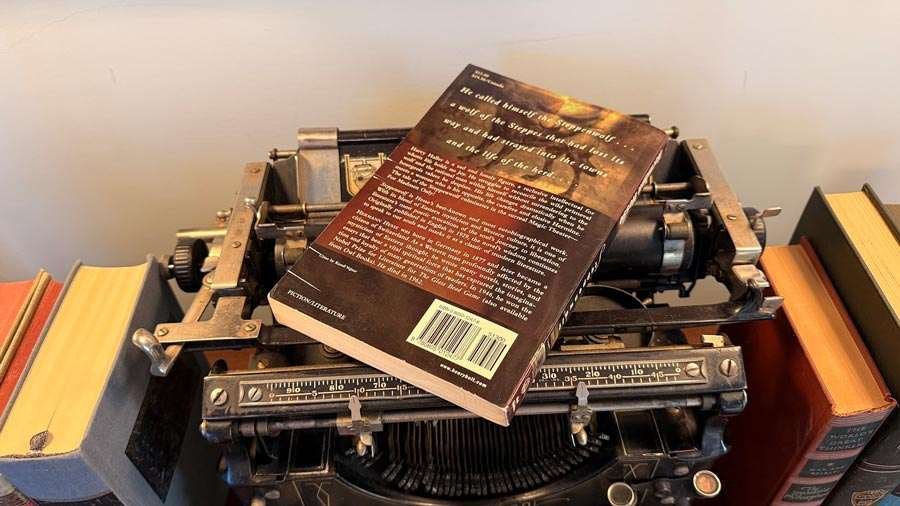
Reading Steppenwolf in the current moment, when identity has become simultaneously more fluid and more fiercely defended than at any time in recent memory, the book feels not dated but prescient. The question of who we are — how many selves live inside one body, one career, one life — has never been more openly contested.
Hesse named that line — between the wolf and the man, between the life of the mind and the life of the body — with a precision that nearly a century of readers have returned to for good reason. That precision is the book’s real gift.

What Steppenwolf offers is not comfort. It offers clarity — the specific relief of a book that refuses to reduce its subject to something manageable. Haller does not heal by the novel’s end. He continues. And that continuation, Hesse suggests, is not failure. It is the actual work of being alive.
Pick up the Penguin Classics edition and expect to read slowly. This is not a book you finish. It is a book that finishes with you for a while, then waits.
Sources
- Hesse, Hermann. Steppenwolf. Penguin Classics, translated by David Horrocks, 2012. (Original: 1927)
- Wilson, Colin. The Outsider. Victor Gollancz / Tarcher Perigee, 1956.
- Freedman, Ralph. Hermann Hesse: Pilgrim of Crisis. Pantheon Books, 1978.
- Hesse, Hermann. My Belief: Essays on Life and Art. Farrar, Straus and Giroux, 1974.