Watching Christopher Hitchens debate a room full of theologians was one of the more exhilarating intellectual experiences you could have in the early internet era. Long before the algorithm decided what you’d think next, you could find yourself down a rabbit hole at midnight — Hitchens at Biola University in 2009, squaring off against philosopher William Lane Craig on whether God exists, the crowd packed with nearly three thousand people and thousands more watching online. Craig was precise, methodical, armed with cosmological arguments and syllogisms built like steel scaffolding. Hitchens was something else entirely: a moralist, a rhetorician, a man who wielded the English language the way a master swordsman handles a blade. He didn’t always win on points. But he made you feel the weight of the question in a way formal philosophy rarely does.
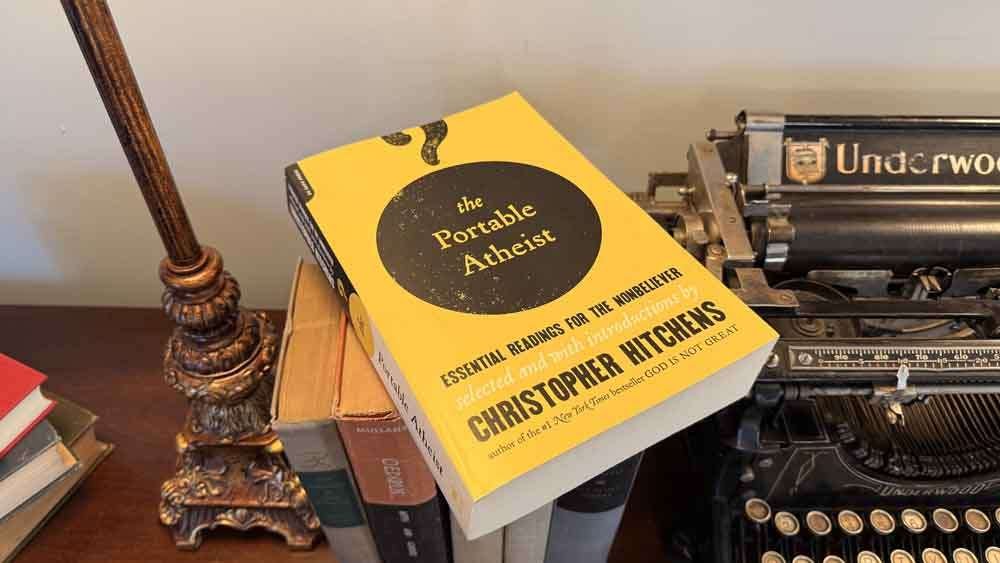
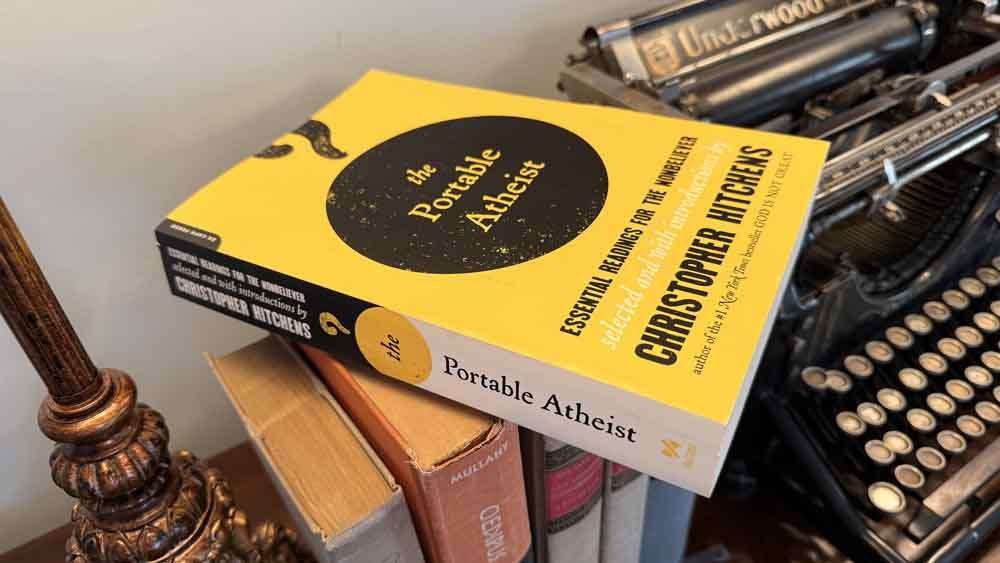
The Portable Atheist: Essential Readings for the Nonbeliever is the literary companion to everything Hitchens argued in those arenas. Published in 2007, it is not his own book in the conventional sense — it is an anthology, five hundred pages of selected readings he assembled and introduced, tracing the arc of atheist and freethought writing from ancient Rome to the present day. Think of it as Hitchens building a case before you even open the courtroom doors.
The Curator as Advocate
What makes this book more than just a collection is Hitchens’s framing. He contributes short introductions to each selection, and those introductions are where the man himself lives. His position is clear from the start: religion does not merely get things wrong, it actively manufactures problems where none exist. As he writes in his introduction, religion “invents a problem where none exists by describing the wicked as also made in the image of god.” That is a precise, almost clinical charge — and it sets the tone for everything that follows.
The breadth of the selections is striking. Hitchens opens with Lucretius, the Roman poet whose De Rerum Natura argued nearly two thousand years ago that the universe operates on natural causes and that fear of death is the root of religious superstition. From there, he moves through Omar Khayyám, Spinoza, Hume, Darwin, Marx, Mark Twain, H.L. Mencken, Bertrand Russell, Emma Goldman, George Orwell, and Albert Einstein — and then into contemporaries like Richard Dawkins, Daniel Dennett, Sam Harris, Ayaan Hirsi Ali, and original contributions from Salman Rushdie and Ian McEwan. The lineup reads like a syllabus for the most provocative course you never took in college.
Darwin as the Linchpin
If there is a philosophical spine running through the anthology, it is Darwin. Hitchens understood, as Dawkins had argued in The Selfish Gene, that evolution by natural selection is not just a biological theory — it is a complete demolition of the argument from design that has anchored theistic reasoning for centuries. Once you accept that complexity can arise from simplicity without a designer, the cosmological scaffolding starts to wobble.
The Darwin selections here — drawn from his Autobiography — are quietly devastating precisely because they are not polemical. Darwin describes his gradual loss of faith not as a dramatic rupture but as the slow erosion of an assumption he had never rigorously examined. That personal voice gives the anthology something it might otherwise lack: the texture of a human being actually working through the question, rather than dispatching it.
The Moral Argument, Turned Around
The section of the book I find most enduring is Hitchens’s challenge to the claim that morality requires divine sanction. He asks the question directly: which ethical statement made or action performed by a believer could not have been made or performed by a nonbeliever? It is a simple question, and he never really gets a satisfying answer from the other side — because there isn’t one.
Emma Goldman’s contribution, The Philosophy of Atheism, anticipates this argument by decades. She argues that the genuinely moral actors in history — those who fought for truth, justice, and human dignity — were far more often the godless ones than the pious. Whether you agree with that entirely or not, the argument deserves a serious answer, not a dismissal.
This is where Hitchens outpaced many of his contemporaries. He was not just arguing that God doesn’t exist. He was arguing that the institutions built in God’s name have caused measurable, documented harm — and that religion demands a kind of moral deference it has not earned. As someone who grew up in a Greek Orthodox household in Brooklyn, I understand the comfort those traditions carry, and I don’t share every line of Hitchens’s contempt. But the historical record he marshals is not easy to argue with.
Rushdie, McEwan, and the Literary Case
The original contributions from Salman Rushdie and Ian McEwan are among the anthology’s most satisfying inclusions, because they approach the question from a literary rather than a scientific angle.
Rushdie’s piece, written as an open letter to the six billionth person born on earth, argues for a world without heaven — not as a nihilistic exercise, but as an embrace of the only life we can be certain we have. McEwan’s contribution, End of the World Blues, is a meditation on religious apocalypticism and its tendency to celebrate destruction as divine fulfillment. Both pieces remind you that this is not purely a philosophical debate — it is a debate with real stakes in how human beings organize their societies and treat each other.
What the Book Cannot Quite Do
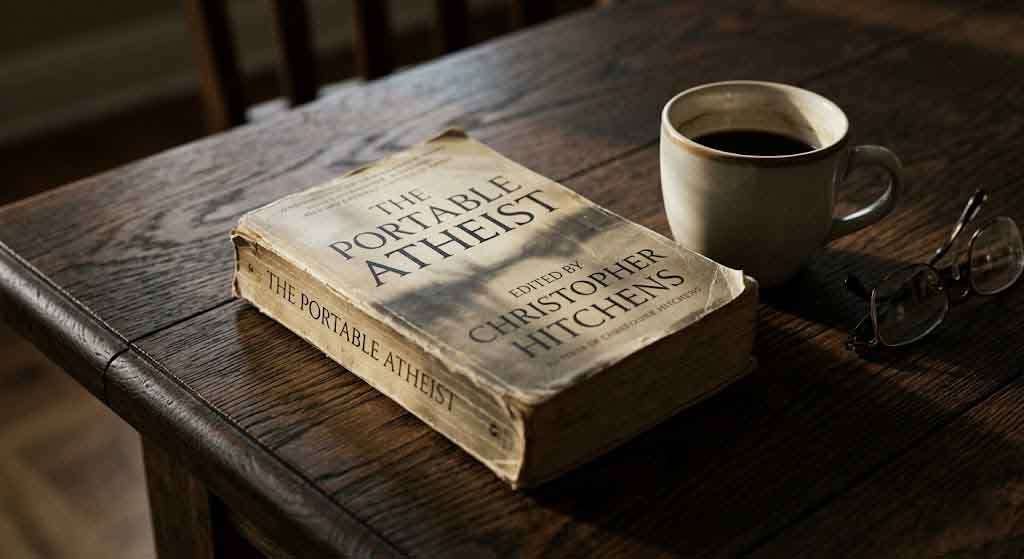
It would be dishonest to call The Portable Atheist a perfectly balanced intellectual exercise. It isn’t trying to be. Hitchens’s selection criteria are explicitly adversarial, and the anthology makes no real room for the theological responses that serious philosophers of religion — from Alvin Plantinga to David Bentley Hart — have developed. The formal philosophical rebuttals to the cosmological argument, the teleological argument, and the moral argument are largely left off the stage.
That is, in a way, both the book’s strength and its limitation. As advocacy and as intellectual history, it is magnificent. As a comprehensive picture of the debate, it is one side of the courtroom.
But Hitchens was never pretending otherwise. He knew what he was building. He was not writing a textbook — he was writing a brief.
The Voice That Is Gone
What the book ultimately preserves is a mind of rare quality. Hitchens died of esophageal cancer in December 2011, and the public intellectual space has not quite filled the gap he left. His particular combination — literary culture, political seriousness, historical range, and personal courage in the face of enormous social pressure — was unusual. He took on questions that polite society still treats as taboo, and he did it with wit rather than venom, which made him impossible to simply dismiss.
Reading The Portable Atheist now, in 2026, the questions it raises feel no less urgent. Theocratic politics have not retreated. The conflict between scientific understanding and institutional religion has not resolved. The argument about whether morality depends on the divine remains alive in courtrooms, legislatures, and schoolrooms.
Hitchens assembled this book as a toolkit. Whether you pick it up as a skeptic looking for ammunition, a believer looking for the strongest version of the opposing case, or simply a reader who likes to think — it will give you more than you expected. The only position it does not accommodate is comfortable incuriosity.
Pick it up at Amazon or Barnes & Noble.
If you enjoyed this review, you might also want to read my take on The God Delusion by Richard Dawkins — a book that covers adjacent territory with more scientific rigor, though perhaps less literary flair.
Sources
- Hitchens, Christopher. The Portable Atheist: Essential Readings for the Nonbeliever. Da Capo Press, 2007. Amazon
- Wikipedia: The Portable Atheist
- Goodreads: Reader Reviews and Quotes
- Biola University: Does God Exist Debate — Craig vs. Hitchens, 2009
- Open Culture: Does God Exist? Christopher Hitchens Debates William Lane Craig
- Dawkins, Richard. The Selfish Gene. Oxford University Press, 1976. Amazon