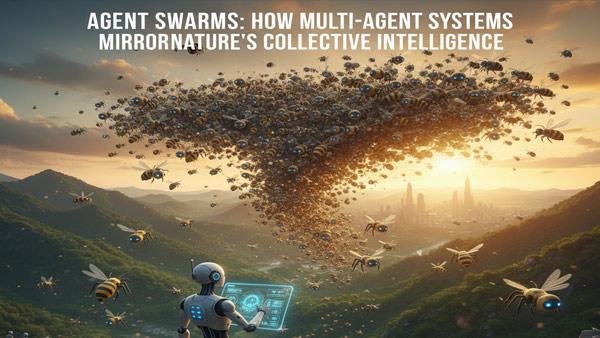
Army ants can build living bridges, coordinate raids, and optimize foraging routes without central command. This biological phenomenon inspired AI agent swarms—systems that coordinate specialized agents to solve challenges beyond any single model’s capability.
From Solo Intelligence to Swarm Thinking
Traditional AI followed one paradigm: build increasingly large, powerful monolithic models. But single centralized models face scalability issues, brittleness, limited specialization, and resource constraints.
Multi-agent systems flip this paradigm by deploying networks of specialized agents that communicate and collaborate. The global MAS market, valued at $5.40 billion in 2024, is forecast to reach $184.8 billion by 2034.
The Biological Blueprint
Ant Colony Optimization
Ant colonies solve routing problems through pheromone trails. Ants deposit chemical markers that attract others, with shorter paths accumulating pheromones faster. This inspired Ant Colony Optimization algorithms for logistics and network routing.
Particle Swarm Optimization
Bird flocks move in coordinated patterns without central control. Each individual follows simple local rules. Particle Swarm Optimization algorithms apply these principles to search optimization problems.
Real-World Applications
Robotics and Physical Systems
TU Delft researchers created drone swarms for search-and-rescue. Each drone independently searches, avoids obstacles, and communicates with adjacent drones. These drones operate without GPS or central command, collectively mapping environments.
Healthcare Coordination
Multi-agent systems coordinate activities across diagnostics, treatment planning, and patient monitoring. Specialized agents analyze medical images, process lab results, review patient history, and check drug interactions.