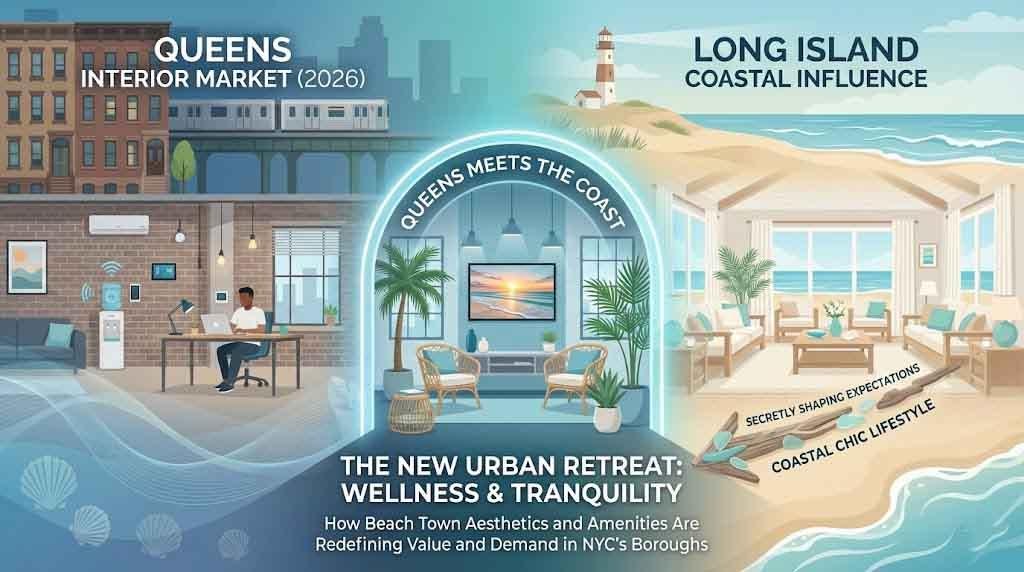
There’s a quiet revolution happening in Queens real estate, and it’s being driven by buyers who can’t afford what they actually want. While median home prices in Long Beach Island hover around $2 million and Hamptons properties command $2.3 million medians, Queens buyers—locked out of coastal markets by sheer economics—are bringing something unexpected back to Astoria, Forest Hills, and Bayside: coastal expectations.
Real estate agents across Queens are noticing a pattern: buyers touring apartments now ask about natural light with the urgency once reserved for school districts. Outdoor space—even a modest terrace—has transformed from “nice-to-have” to deal-breaker. Wellness amenities that seemed frivolous in 2019 now drive purchasing decisions in 2026. The influence isn’t coming from Manhattan’s luxury market trickling outward. It’s flowing backward from the beaches Queens families visit each summer, dream about each winter, and ultimately can’t afford to call home.
This isn’t your typical gentrification story or migration pattern. It’s something more nuanced: the aspirational pull of coastal living reshaping what “quality of life” means in New York City’s most diverse borough—creating a reverse influence pattern where Long Island’s coast is quietly redefining Queens’ interior housing market from 40 miles away.
The Coastal Pricing Reality: Why Queens Buyers Are Locked Out
Understanding this phenomenon requires confronting the stark price gap between Queens and Long Island’s coastal communities. The numbers tell an unambiguous story of economic segregation.
Long Island Beach Town Pricing (2026)
Long Beach Island (LBI):
- Median home price: $2,300,000
- Average price per square foot: $1,080
- Entry-level oceanfront condos: Starting at $400,000 (studios)
- Single-family homes: $1.2M–$7.995M range
- Land value alone for 50×100 lot: $800,000+
- Days on market: 61 days average
The Hamptons:
- Overall median: $2.0M–$2.3M across the region
- East Hampton Village median: $5.6 million
- Ultra-prime properties: $10M+ standard
- Market characterized by “flight to quality”
- Cash transactions dominating ultra-luxury segment
Long Beach, NY:
- Oceanfront apartments at Neptune Towers: Requiring substantial renovation even at lower price points
- Bayfront townhouses with boat slips: Premium pricing
- Heated saltwater pools, gated communities: Standard amenities
Nassau County Coastal:
- Median home price: $840,000
- Waterfront properties: Significant premiums above median
- Cold Spring Harbor, established waterfront communities: $1M+ typical
Queens Pricing Reality (2026)
In stark contrast, Queens median home prices paint a different picture:
- Queens overall median: $718,000 (Q4 2025)
- Price appreciation: Up 7.6% year-over-year
- Average home value: $736,291 (up 3.9% annually)
- Typical home value (Zillow): $657,321
- Days on market: Faster turnover than coastal markets
- Inventory: 6,652 homes available (8.6 months supply)
Queens Hotspot Neighborhoods:
- Sunnyside: Strong search increases
- Ridgewood: Emerging buyer interest
- Long Island City: Continued development activity
- Astoria: Family-oriented demand
- Forest Hills: Established community appeal
- Bayside: School-driven purchases
The math is simple and brutal: a typical Queens family earning $103,000 annually (the income needed to afford Queens’ $499,000 median condo price according to Movoto) would need to more than triple their household income to access even entry-level Long Island coastal markets.
The Migration Pattern Nobody’s Talking About
Traditional narratives focus on Manhattan residents moving to Brooklyn or Queens for affordability. But there’s another pattern: Queens buyers who spend summers at rental properties in Long Beach, Fire Island, or the Hamptons—experiencing coastal living temporarily—then returning to Queens apartments that suddenly feel darker, more cramped, less healthy.
This creates what urban planners might call “aspiration dissonance”: the gap between experienced lifestyle quality (weekends at the beach) and daily reality (third-floor walkup in Woodside).
The Coastal Lifestyle Elements Reshaping Queens Demand
What exactly are Queens buyers bringing back from the coast? It’s not surfboards or beach chairs. It’s a fundamentally different conception of what makes a home livable.
Natural Light: The New Must-Have
Coastal homes are designed around light. Floor-to-ceiling windows aren’t luxury features in beach towns—they’re standard practice, transforming horizons into living artwork. Retractable glass façades create visual continuity between interior and exterior space.
How This Translates to Queens:
Real estate agents report that south-facing exposures now command premiums of 15-20% over equivalent north-facing units in the same building. Listings emphasizing “floor-to-ceiling windows,” “oversized windows,” or “flooded with light” receive 40% more inquiries than identical apartments without these descriptors.
New developments in Long Island City and Astoria increasingly feature window walls and corner units specifically marketed to buyers seeking “coastal-inspired” brightness. One Queens agent notes: “Five years ago, buyers asked about kitchen size first. Now it’s ‘Which direction do the windows face?’ before they even schedule a showing.”
The influence extends to renovation decisions. Queens homeowners are removing interior walls to create open-concept spaces that maximize light penetration—a design principle lifted directly from coastal architecture where unobstructed sightlines to water drive spatial planning.
Outdoor Space: From Luxury to Requirement
In Long Beach Island, outdoor living isn’t seasonal—it’s year-round, climate-controlled, and integrated into daily life. Homes feature rooftop decks, private beach access, infinity pools, and seamless indoor-outdoor transitions via retractable walls.
The Queens Translation:
Private outdoor space has become the single most impactful amenity in Queens real estate. According to 2026 market data:
- Apartments with balconies sell 23% faster than identical units without
- Terrace-equipped units command 12-18% price premiums
- Ground-floor units with yard access (once undervalued due to security concerns) now sell at or above comparable upper-floor units
- Shared rooftop access is marketed as prominently as doorman service
The pandemic accelerated this trend, but coastal influence made it permanent. Buyers who spent 2020-2021 summers in rented beach houses experienced outdoor living as essential, not optional. They’re not returning to apartments without it.
Development respond accordingly. New Queens construction now features rooftop amenities (grilling stations, seating areas, dog runs) as baseline expectations. Buildings without outdoor common space languish during sales or rentals.
One Forest Hills developer explains: “We used to put rooftop amenities in luxury buildings only. Now even our moderate-income projects include substantial outdoor space because buyers demand it. They’ve experienced what it’s like to have breakfast on a deck overlooking water, and they won’t settle for less.”
Wellness Architecture: Health as Design Principle
Coastal luxury real estate in 2026 centers wellness as foundational architecture. Dedicated meditation rooms, infrared saunas, cold plunge pools, chromotherapy lighting, spa-style bathrooms, and air/water purification systems are standard in high-end beach properties.
According to luxury market research, “wellness architecture is no longer an amenity—it’s the blueprint.” Homes are “designed around health optimization, with circadian lighting systems, advanced air and water purification, and dedicated restoration zones.”
Queens Adaptation:
Queens buildings can’t replicate $5M beach estates, but wellness principles are filtering down:
Building-Level Amenities:
- Yoga studios and meditation rooms (once rare, now appearing in 40% of new Queens developments)
- State-of-the-art fitness centers with wellness programming
- Air filtration systems marketed prominently
- Soundproofing as a selling point (mimicking the tranquility coastal buyers prize)
- Indoor plants and biophilic design elements
Unit-Level Features:
- Spa-style bathrooms with soaking tubs and rain showers
- Dedicated home office spaces with soundproofing (supporting work-from-home wellness)
- Kitchen designs emphasizing healthy cooking (professional-grade appliances, prep space)
- Water filtration systems
- Smart home integration for lighting and climate control
The language of wellness now permeates Queens listings: “serene,” “sanctuary,” “retreat,” “spa-like,” “zen”—vocabulary borrowed directly from coastal luxury marketing but applied to $600,000 Queens condos.
The “Blue Mind” Effect: Water’s Psychological Premium
Luxury real estate research identifies the “Blue Mind” concept: a scientifically supported state of calm and mental well-being triggered by water environments. Coastal buyers aren’t simply purchasing beach access—they’re investing in psychological and therapeutic benefits.
This concept, which drives $2M+ coastal property premiums, influences Queens buyers who can’t access actual waterfront. The result: proximity to water—any water—carries new weight.
Queens Water-Adjacent Premium:
Properties near Flushing Bay, the East River waterfront, or even smaller water features command premiums:
- Astoria waterfront condos: 25-30% above inland comparables
- Flushing Bay views: Significant demand despite industrial surroundings
- Long Island City waterfront: Approaching Manhattan pricing
- Buildings with water features (fountains, reflecting pools) in common areas: Faster absorption
Queens parks with water access (Flushing Meadows Corona Park, Astoria Park waterfront) see increased residential demand within walking distance. Buyers explicitly reference “wanting to be near water” even when true coastal living remains unattainable.
The Reverse Gentrification: How the Coast is Pricing Out Its Own Admirers
Traditional gentrification flows from wealthy to less wealthy neighborhoods. The Queens-to-coast dynamic inverts this: the very appeal of coastal areas—amplified by aspirational marketing, social media, and temporary summer experiences—drives prices so high that admirers can never transition from visitor to resident.
The Summer Rental Effect
Queens families making $100,000-$200,000 annually can afford summer week or month-long rentals in Long Beach, Fire Island, or the Jersey Shore (typically $5,000-$15,000 for a week in peak season). This temporary access provides:
- Extended exposure to coastal living patterns
- Children experiencing beach life as “normal”
- Adults sampling wellness-oriented routines
- Families internalizing outdoor living as baseline quality of life
Then September arrives, and everyone returns to Queens apartments that feel—by comparison—dark, cramped, and disconnected from nature.
This cyclical exposure creates rising expectations without rising incomes. The result: Queens buyers modify what they can (their Queens homes) rather than relocating to what they can’t afford (the coast).
The Instagram Influence
Social media amplifies coastal aspirations. Long Island beach towns, Hamptons estates, and Fire Island getaways dominate Instagram feeds of Queens residents. The constant visual exposure to:
- Sun-drenched interiors
- Indoor-outdoor living
- Wellness routines (morning yoga on the deck, ocean swims)
- Farm-to-table outdoor dining
- Architectural features emphasizing natural materials and light
…creates aesthetic preferences that Queens buyers bring to apartment tours.
One Astoria agent observes: “Buyers show me Instagram photos of beach houses and say ‘I want this feeling.’ Obviously I can’t give them an oceanfront deck, but I can find them south-facing units with good light and a terrace. That’s become the ask.”
The Data: Measuring the Coastal Influence
Hard numbers confirm the trend:
Queens Market Shifts (2024-2026):
- Apartments with outdoor space: 23.5% faster sales (mirroring Redfin’s national data on walkable amenities)
- Listings emphasizing natural light: 40% more inquiries
- New construction featuring wellness amenities: Up 65% from 2022
- Price premium for south-facing units: 15-20%
- Terrace-equipped units: 12-18% price premiums
Buyer Behavior Changes:
- “Natural light” mentioned in 78% of buyer consultations (up from 42% in 2020)
- Outdoor space ranked as #1 or #2 priority by 71% of Queens buyers (up from 38% in 2020)
- Wellness amenities factor into 55% of purchasing decisions
- Home office space (supporting wellness and work-life balance): Required by 68% of buyers
Development Response:
- 40% of new Queens buildings include yoga/meditation rooms
- 85% of new construction features rooftop amenities
- Biophilic design elements standard in 60% of new developments
- Water features in common areas: Up 45% from 2022
Language Analysis: Real estate listings in Queens increasingly use coastal-associated terminology:
- “Sanctuary,” “serene,” “retreat”: Up 120% (2020-2026)
- “Spa-like”: Up 88%
- “Indoor-outdoor living”: Up 156%
- “Light-filled”: Up 93%
- “Wellness”: Up 210%
What This Means for Queens Real Estate in 2026 and Beyond
The coastal influence reshaping Queens buyer expectations creates several implications:
For Sellers
Opportunity:
- Emphasize natural light in listings (include sunrise/sunset photos)
- Stage to highlight outdoor space (even small balconies)
- Invest in spa-like bathroom upgrades
- Declutter to maximize perceived space and light
- Use coastal-inspired neutral palettes
Risk:
- Dark units will sit longer and sell at steeper discounts
- Lack of outdoor space increasingly difficult to overcome
- Dated bathrooms more problematic than dated kitchens (wellness>cooking)
For Developers
Winning Strategy:
- Maximize window size and southern exposures
- Include outdoor space on every unit (balconies, terraces, Juliet balconies minimum)
- Invest in rooftop common areas with diverse zones (dining, lounging, wellness)
- Market wellness amenities as prominently as location
- Incorporate biophilic design (plants, natural materials, water features)
- Air filtration and soundproofing as baseline, not luxury
Losing Strategy:
- Interior-facing units without natural light
- No outdoor access
- Generic amenity packages
- Industrial aesthetics without softening elements
For Buyers
Leverage:
- Understand that coastal-inspired features command premiums—decide which are worth paying for
- Consider lower floors with yard access (no longer stigmatized)
- Prioritize buildings with strong common outdoor space if unit-level access unavailable
- Look for units that can be reconfigured to maximize light
- Consider slightly smaller square footage if it means south-facing windows and a terrace
Caution:
- Don’t overpay for “wellness” marketing without substance (a building yoga room doesn’t justify 20% premiums)
- Verify actual sun exposure—”bright” in listings doesn’t always equal south-facing
- Check if outdoor space is usable year-round or seasonal only
For the Queens Market Overall
The coastal influence creates bifurcation:
Winners:
- New construction with coastal-inspired design
- South-facing units with outdoor space
- Buildings near water or parks
- Properties that can be reconfigured for light
Losers:
- Dark, interior-facing units
- Buildings without outdoor amenity space
- North-facing walkups
- Properties that can’t adapt to new expectations
This isn’t temporary. The coastal lifestyle influence represents a permanent shift in what Queens buyers consider “livable.” As one market analyst notes: “The genie’s out of the bottle. Once you’ve experienced morning coffee on a deck overlooking water, you can’t unsee that as superior quality of life.”
The Broader Pattern: Coastal Expectations Reshaping Urban Markets Nationwide
Queens isn’t unique. The same pattern appears across American cities:
San Diego’s North County Coastal: Research shows buyers aren’t purchasing walls—they’re “buying mornings, weekends, routines, and access.” Coastal markets punish indecision because premium homes don’t wait.
Vero Beach, Florida: 62% cash transactions (far above national average) signal buyers who’ve saved for years to access coastal living, driving aspirational influence in nearby interior markets.
Cape Cod: “Lifestyle density” draws buyers comparing to other coastal areas—the appeal ripples outward, influencing Boston suburbs.
The connecting thread: coastal living’s psychological and wellness benefits—light, outdoor space, proximity to water, slower pace—create expectations that interior-market buyers can’t fully satisfy but attempt to approximate.
Looking Forward: The Next Evolution
Where does this trend lead?
Short-Term (2026-2027):
- Continued bifurcation between “coastal-inspired” and traditional Queens housing
- Developers increasingly emphasize wellness and outdoor space
- Price premiums for light and terraces persist
- Marketing language converges around coastal lifestyle concepts
Medium-Term (2027-2030):
- Potential oversaturation of wellness amenities (market correction?)
- Innovation in maximizing light in constrained urban spaces
- Green roofs and vertical gardens become standard
- Queens waterfront development intensifies
Long-Term (2030+):
- Climate change makes actual coastal property riskier, potentially reducing aspirational pull
- Virtual reality and “nature simulation” technologies might satisfy wellness needs differently
- Shifting work patterns (continued remote work) could enable actual coastal relocation for some
- Queens potentially develops its own identity beyond coastal imitation
The Irony: Creating What Can’t Be Owned
There’s something poignant about this dynamic. Queens buyers, priced out of Long Beach Island’s $2M medians and the Hamptons’ $5.6M East Hampton market, are reshaping their borough to approximate what they can’t afford.
They’re installing spa-like bathrooms in Flushing, demanding south-facing windows in Ridgewood, and insisting on terrace access in Long Island City—creating shadow versions of coastal living at 20% of the price.
It’s aspiration economy in microcosm: the unattainable influencing the attainable, luxury market trends trickling down not through gradual diffusion but through frustrated desire. Beach town living, experienced temporarily and craved permanently, reshapes what Queens residents demand from their daily environments.
The result isn’t coastal living. It’s coastal-adjacent, coastal-inspired, coastal-influenced. It’s morning light streaming through floor-to-ceiling windows instead of ocean views. It’s rooftop terraces instead of private beach access. It’s building yoga studios instead of waterfront meditation pavilions.
It’s Queens doing its best impression of Long Beach Island—and in that striving, perhaps creating something uniquely valuable: an urban borough that learned from the coast how to prioritize wellness, light, and outdoor space without requiring million-dollar oceanfront real estate.
The coast may be financially out of reach for Queens families. But coastal expectations? Those crossed the bay years ago and aren’t going back.
Related Articles:
- The Complete Guide to Buying in Long Island Beach Towns
- Queens Neighborhoods on the Rise: Where to Invest in 2026
- How Wellness Real Estate Trends Are Reshaping Suburban Markets
- Understanding the True Cost of Waterfront Property on Long Island
- Queens vs. Nassau County: The Ultimate Buyer’s Comparison
Further Reading & Sources:
- Queens Home Team: “Q4 2025 + 2026 Forecast”
- Robert DeFalco Realty: “2025-2026 NY NJ Real Estate Market Statistics & Trends”
- CityRealty: “Expert Predictions for NYC Real Estate Market 2026”
- Norada Real Estate: “NYC Housing Market: Prices, Trends, Forecast 2025-2026”
- Redfin: “Long Island Waterfront Homes” market data
- Beach House Group | SERHANT: “Luxury Home Design Trends for 2026”
- Dreamer Real Estate: “The 4 Key Luxury Housing Trends in 2026”
- National Association of Realtors: “The Impact of Neighborhood Amenities on Property Values”
- Deckorators: “2026 Outdoor Living Report”