If you look at Zillow anywhere on Long Island right now, forty acres of land costs a fortune. In Port Jefferson Station, however, forty acres is currently on the table for the price of a ham sandwich.
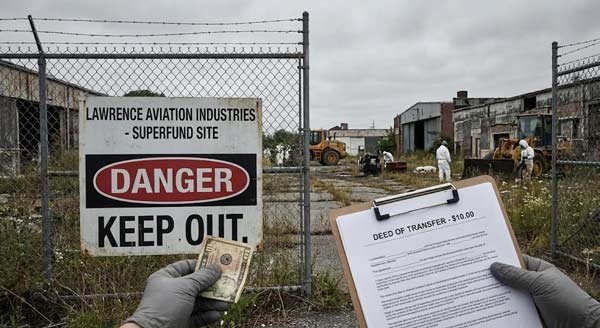
The Metropolitan Transportation Authority (MTA) has a standing offer to purchase a massive slice of the former Lawrence Aviation Industries property for exactly $10. It sounds like a typo, or perhaps a scam. But the price tag is real, and it comes with a history so toxic—literally and legally—that for decades, no one would touch it with a ten-foot pole.
Now, with a critical deadline looming at the end of June, this $10 deal has become the center of a high-stakes standoff between environmentalists, the LIRR, and state bureaucracy. At stake is not just a bargain-bin land grab, but the potential electrification of the Port Jefferson Branch—a “Holy Grail” project for commuters that has been stalled for half a century.
Here is the bizarre, infuriating, and compelling story of how a titanium manufacturer became a Superfund nightmare, and why the fight to redeem it is coming down to the wire.
1. The Titanium Kingdom: Rise of a Toxic Empire
To understand why this land is being sold for pocket change, you have to look at what lies beneath the soil.
From 1959 to roughly 2003, Lawrence Aviation Industries (LAI) was a titan in the aeronautics world. They manufactured high-grade titanium sheeting used in military aircraft and golf clubs. But while the company was churning out aerospace components, it was also churning out a horrifying amount of industrial waste.
For decades, the standard operating procedure at LAI wasn’t disposal; it was dumping. The facility, led by its notoriously combative owner Gerald Cohen, discharged thousands of gallons of acid sludge, oils, and trichloroethylene (TCE) directly into the ground.
The site became a literal poison factory. There were unlined cesspools and an “acid lagoon” where liquid waste was simply poured into the earth. When regulators started sniffing around in 1980, workers were ordered to crush over 1,600 drums of toxic waste with heavy machinery, allowing the liquid contents to spill out and soak into the soil, rather than paying to have them properly removed.
2. The Fall: The $50 Million Ghost
The empire collapsed in the early 2000s under the weight of federal investigations. In a scene straight out of a crime drama, federal agents raided the facility, eventually charging Cohen and the company with massive environmental crimes.
Cohen was sentenced to prison in 2009 for illegally storing hazardous waste, but the damage was already done. The EPA declared the 126-acre property a federal Superfund site in 2000.
The cleanup statistics are staggering:
- 17,000 tons of contaminated soil excavated.
- 13.5 tons of PCB-filled electrical equipment removed.
- $50 million+ spent by the EPA to remediate the site.
- Two groundwater treatment systems installed to manage a toxic plume that had migrated off-site, threatening nearby residential wells.
For years, the land sat as a “ghost” property—tax-delinquent, abandoned, and terrifying to investors. The cleanup costs and liability fears rendered the land effectively worthless, despite its prime location.
3. The $10 Deal Explained
Enter the Suffolk County Landbank.
The Landbank is a special entity designed to handle “zombie properties”—tax-delinquent brownfields that private developers won’t touch. They seized the property to try and get it back on the tax rolls.
The vision they crafted was a “triple win” that sliced the 126-acre site into three distinct parcels:
- The Solar Farm: ~40 acres designated for a 5-megawatt solar array.
- The Open Space: ~40 acres preserved for the community and the Setauket Greenway.
- The Rail Yard: ~40 acres sold to the MTA for a LIRR yard.
The price for the MTA’s slice? $10.
Why so low? Because the MTA isn’t just buying land; they are absorbing a site with a dark stigma and complex logistical challenges. The $10 is a token transfer fee to facilitate a public good. It’s a “clean slate” transaction designed to bypass the usual appraisal wars and get the project moving immediately.
4. The “Holy Grail” of Commuting: Electrification
Why does the MTA want a toxic waste site?
For decades, commuters on the Port Jefferson Branch have suffered through the “scoot”—the need to transfer from electric trains to diesel trains at Huntington or wait for the rare “dual-mode” locomotives. The dream has always been to electrify the tracks all the way to Port Jefferson.
The obstacle hasn’t just been the cost of the third rail; it’s been the lack of a train yard. You can’t run more electric trains if you have nowhere to park, clean, and store them at the end of the line. The current Port Jeff station is too cramped to expand.
The Lawrence Aviation site sits directly adjacent to the LIRR tracks. It is geographically perfect.
- The Vision: Build a new yard on the Superfund site.
- The Result: This unlocks the capacity to electrify the branch, potentially cutting commute times and increasing frequency for thousands of riders.
5. The DOT Standoff: Why It’s Stalled
Despite the EPA declaring the soil cleanup complete in 2025, the deal has been stuck in bureaucratic purgatory.
The current villain in this story isn’t a polluter, but a disagreement over a bike path. The New York State Department of Transportation (DOT) holds an easement on a small strip of the land—specifically, a 2,200-foot section of the beloved Setauket Greenway trail.
The DOT has hesitated to release this easement to the MTA. Why? Speculation abounds that the DOT wants to keep the land available for future expansions of Route 112 or Route 347, although no such projects are publicly funded or planned.
This inter-agency staring contest—State DOT vs. State MTA—has forced the Suffolk County Landbank to issue multiple extensions on the contract.
6. The Final Countdown: June 2026
This brings us to today, February 14, 2026.
The deadline to close the $10 deal has been pushed to the end of June. Local officials, including Brookhaven Supervisor Dan Panico and various civic associations, are practically begging the Governor’s office to force the DOT’s hand.
If the deal falls through in June:
- The MTA loses the only viable site for a Port Jeff yard.
- The Landbank is left holding a massive, non-revenue-generating asset.
- The electrification of the Port Jeff branch likely dies for another generation.
The irony is palpable. We spent $50 million cleaning up the sins of the past, only to have the future held hostage by a paperwork dispute over a bike path easement.