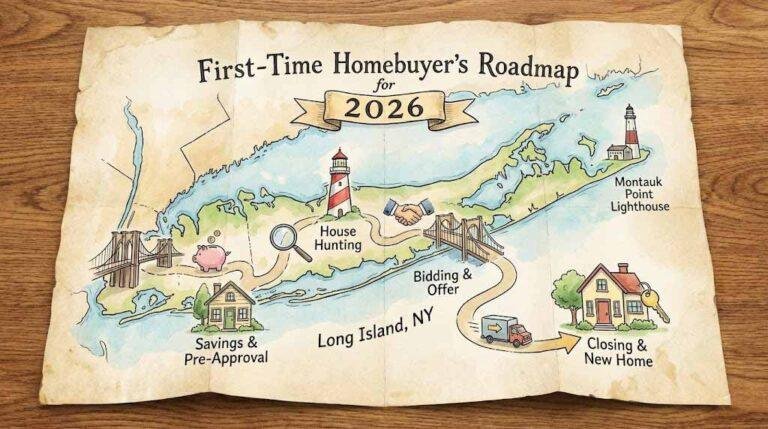

ou found it. After months of searching through Long Island’s picked-over inventory, touring homes that looked nothing like their listing photos, and losing out to all-cash offers on anything remotely decent, you finally found THE house.
It checks every box: Right school district. Reasonable commute. Updated kitchen. Finished basement. Backyard big enough for the kids. Even the property taxes are only slightly soul-crushing instead of completely devastating.
You’re ready to make an offer. Then your agent calls: “There are already four other offers scheduled for tomorrow. This is going to be a bidding war.”
Welcome to the Long Island real estate market in 2026, where 2.08 months of inventory means every halfway decent property becomes a battlefield. This isn’t 2021-level insanity (when people waived inspections and offered $100K over asking), but make no mistake: With inventory this tight, bidding wars haven’t disappeared—they’ve just become more strategic.
Here’s your complete battle plan for winning in a multiple-offer situation without overpaying, waiving protections you’ll regret, or losing your mind in the process.
Understanding the New Bidding War Landscape (2026 vs. 2021)
Let’s set the record straight: 2026 bidding wars are not 2021 bidding wars.
What Changed:
2021: The Frenzy Era
- Interest rates: 3.0-3.5%
- Inventory: 1.2-1.5 months
- Buyer behavior: Emotional panic
- Common tactics: Waive everything, offer 20-30% over asking, write love letters, cash with no contingencies
- Result: Overpaying was standard, regret was common
2026: The Strategic Era
- Interest rates: 6.15%
- Inventory: 2.08 months
- Buyer behavior: Calculated urgency
- Common tactics: Verified financing, reasonable over-ask offers, strategic contingency management, gap coverage
- Result: Winners are prepared, not just highest bidders
The key difference: In 2021, throwing money solved everything. In 2026, throwing money helps but strategy wins.
Why Bidding Wars Still Happen in 2026
Even though the market has cooled from its peak, multiple-offer situations persist because:
1. Quality Inventory Scarcity: 2.08 months overall inventory, but turnkey homes in good school districts? Maybe 0.8 months.
2. Mortgage Lock-In Effect: Homeowners with 3% mortgages aren’t selling unless they absolutely must. This keeps supply artificially low.
3. Buyer Selectivity: With rates at 6.15%, buyers are pickier. They wait for homes that check every box. When one appears, everyone pounces simultaneously.
4. First-Time Buyers with Assistance: Down payment assistance programs (up to $60,000) created new buyers who can compete on price. More qualified buyers = more competition.
5. Investor Activity: Investors represent 15-20% of Long Island buyers. They’re paying cash and buying everything.
Before You Enter the Arena: Pre-Battle Preparation
Most bidding wars are won before the first offer is even written. Here’s how to position yourself for victory:
Step 1: Get Verified Pre-Approval (Not Just Pre-Qualification)
Pre-qualification: “Based on what you told me, you might qualify for $750K.”
Pre-approval: “Based on your documents, you’re approved for $750K.”
Verified pre-approval: “Your file has been through full underwriting. You’re approved for $750K. We’re ready to close in 30 days.”
Why this matters: Sellers prioritize certainty. A verified pre-approval from a well-known lender beats a higher offer from a buyer with a sketchy pre-qualification.
How to get it:
- Choose a reputable Long Island lender (avoid online-only lenders for competitive offers)
- Submit all documentation upfront (tax returns, pay stubs, bank statements, etc.)
- Ask your lender to complete underwriting before you make offers
- Get a letter stating “verified approval” or “underwritten approval”
Cost: Usually free, takes 3-5 business days
Advantage: Listing agents call your lender. Your lender says “This buyer is locked and loaded.” Competing offer’s lender says “We haven’t actually reviewed their file yet.” Guess who wins?
Step 2: Build Relationships with Your Team
Your agent matters more in bidding wars than in normal transactions.
What makes an agent valuable in multiple-offer situations:
1. Local reputation:
If listing agents know and trust your agent, your offer gets taken seriously.
2. Communication skills:
Your agent calls the listing agent, builds rapport, discovers what the seller really wants (beyond just price).
3. Bidding war experience:
An agent who’s won 10 bidding wars knows the psychological game. An agent who’s lost 10 doesn’t.
Questions to ask potential agents:
- “What’s your success rate in multiple-offer situations in the past 12 months?”
- “Do you have relationships with top listing agents in [target area]?”
- “Can you get me a same-day showing on a hot listing?”
- “Will you call the listing agent to find out what the seller prioritizes?”
Red flags:
- Agent says “Just offer $50K over asking, you’ll probably get it”
- Agent can’t get you showings within 24 hours of listing
- Agent has no local market knowledge
- Agent is brand new (bidding wars are not training ground)
Step 3: Know Your Absolute Maximum
Before you tour the house, calculate:
- Maximum purchase price you can afford
- Maximum purchase price you’re WILLING to pay (these are different)
- Appraisal gap coverage capacity (cash you can add if appraisal is low)
- Renovation budget if property needs work
Example:
- Maximum you can afford: $800,000 (based on lender approval)
- Maximum you’re willing to pay: $750,000 (based on your budget comfort)
- Appraisal gap coverage: $15,000 (savings beyond down payment)
- Renovation budget: $20,000 (deferred maintenance fund)
In a bidding war for a $700,000 list price home:
- You won’t offer more than $750,000
- You’ll cover up to $15,000 gap if appraisal comes in low
- You’ll accept up to $20,000 of deferred maintenance
Critical: Write these numbers down BEFORE emotions take over. Stick to them.
Step 4: Understand Your Competition
Not all bidding wars have the same players. Your strategy changes based on who you’re up against:
Competing against first-time buyers:
- They’re often pre-approved to the max (no buffer)
- They usually need financing contingency
- They might be using down payment assistance (longer closing)
- Your advantage: Flexibility, larger down payment, faster closing
Competing against investors:
- Often cash offers
- Waive everything
- Very fast closing (sometimes 2 weeks)
- Your advantage: You’ll actually live there (emotional appeal to some sellers)
Competing against move-up buyers:
- Strong financing
- Experienced (won bidding wars before)
- Often have sale contingency (must sell current home first)
- Your advantage: No contingency, faster closing
Competing against all-cash buyers:
- Hardest to beat on speed/certainty
- No financing contingency
- No appraisal requirement
- Your advantage: Price (you can offer more with financing), emotional appeal
The Battle Plan: Winning Strategies for 2026
Strategy 1: The Strong Financial Foundation
Elements:
1. Larger earnest money deposit:
- Standard: $1,000-$3,000
- Competitive: $5,000-$10,000
- Aggressive: 3-5% of purchase price
Why it works: Demonstrates commitment. If you back out for non-contingency reasons, you lose this money. Sellers know you’re serious.
2. Bigger down payment:
- FHA minimum: 3.5%
- Conventional minimum: 5%
- Competitive: 15-20%
- Most competitive: 25%+
Why it works: Lower loan-to-value = less lender risk = faster, more certain closing.
3. Appraisal gap coverage:
The problem: Home lists for $700,000. You offer $730,000 in a bidding war. Appraisal comes in at $710,000. Your lender will only lend on $710,000. You need $20,000 cash to cover the gap or renegotiate (which sellers hate).
The solution: Include in your offer: “Buyer will cover appraisal gap up to $20,000.”
Translation: If the appraisal comes in low, you’ll bring extra cash rather than renegotiate. Sellers LOVE this because it eliminates a common deal-killing issue.
How much to offer:
- Conservative: $5,000-$10,000
- Competitive: $15,000-$25,000
- Aggressive: $30,000+
Only commit what you actually have in savings. Don’t bluff—you’ll have to produce the cash.
Strategy 2: The Waive-vs-Keep Contingency Decision Matrix
The three major contingencies:
1. Financing Contingency
- What it protects: If your financing falls through, you get your earnest money back
- Should you waive? ALMOST NEVER (unless you’re actually paying cash)
- Exception: If you have verified approval + 20%+ down payment + stable employment, MAYBE consider shortening period from 30 days to 21 days
2. Inspection Contingency
- What it protects: If inspection reveals major issues, you can renegotiate or walk away
- Should you waive? NO (especially on Long Island with old housing stock)
- Alternative: Offer “information-only inspection”
Information-only inspection strategy:
- You still get the home inspected
- You waive the right to renegotiate based on findings
- You can only walk away if something catastrophic is found
- Shows seller you’re serious but protects you from buying a disaster
3. Appraisal Contingency
- What it protects: If appraisal comes in below purchase price, you can renegotiate or walk
- Should you waive? NO, but offer gap coverage instead
- Alternative: “Buyer will waive appraisal contingency if appraisal is within $20,000 of purchase price. If the gap exceeds $20,000, buyer may renegotiate.”
The smart approach: Don’t waive protections. Modify them to reduce seller risk while keeping your downside limited.
Strategy 3: The Closing Date Flexibility Play
What sellers want:
- Selling to buy: 60-90 day closing (need time to find new home)
- Already bought: 30-45 day closing (paying two mortgages, want out fast)
- Inherited property: Any time (just want it sold)
- Relocation: Specific date (employer deadline)
- Investor: Fast (cash flow matters)
Your move: Ask the listing agent what the seller’s ideal timeline is. Then offer exactly that.
Sweetener: Offer rent-back option
Example: “Buyer offers 45-day closing with free 30-day rent-back option at seller’s discretion.”
Translation: Seller can close quickly, get their money, but stay in the house rent-free for an extra month if needed to coordinate their move.
Why this wins bidding wars: It solves a logistics problem that money doesn’t solve. A seller choosing between:
- Offer A: $720,000, standard closing
- Offer B: $715,000, perfect timing + rent-back option
Offer B wins more often than you’d expect.
Strategy 4: The Escalation Clause (Use With Caution)
What it is: “Buyer offers $710,000, and will escalate in $5,000 increments up to a maximum of $740,000 to beat any competing offer by $5,000, provided seller furnishes proof of competing offer.”
Pros:
- Ensures you don’t overpay if there’s no real competition
- Automatically beats other offers
- Shows you’re serious
Cons:
- Signals your maximum price
- Some sellers/agents don’t like them
- Can create weird dynamics
When to use:
- When you strongly suspect multiple offers but don’t know how high others will go
- When you want to beat competition without showing your full hand
- When listing specifically asks for “highest and best”
When to avoid:
- When you can just offer your best price directly
- When the market is clearly hot (you’ll hit your max anyway)
- When the seller/agent is old-school and finds escalation clauses annoying
Critical component: ALWAYS include “provided seller furnishes proof of competing offer.”
Otherwise a seller could claim there’s a $750,000 offer (fake) to push your escalation clause to max.
Strategy 5: The Personal Connection (The Love Letter That Actually Works)
Old approach (doesn’t work anymore): Sob story about your family’s dreams, your kids, your dog, your grandmother who would have loved this house.
2026 approach: Strategic, specific, authentic.
What works:
- Mentioning something specific about the house that shows you noticed
- Demonstrating you understand the neighborhood/community
- Explaining why THIS house vs. just “a house”
- Being concise (1 page max, ideally half page)
Example of effective letter:
“Dear [Seller’s Name],
We’ve been searching for the right home in Mount Sinai for eight months because we know it’s where we want to raise our family. The A-rated school district, the walkability of Heritage Park, and the genuine sense of community here are exactly what we’ve been looking for.
The moment we walked into your home, we could envision our mornings on the front porch, family dinners in the kitchen you’ve clearly loved, and our kids running around the backyard the way yours probably did. The care you’ve put into maintaining this home is obvious, and we would be honored to continue that tradition.
We know you probably have multiple offers, and we wanted you to know ours comes with verified financing, a strong down payment, and the flexibility to close on your timeline—whatever works best for you.
We hope we have the opportunity to make this house our home.
Sincerely,
[Your Names]“
Why this works:
- Specific (mentions the actual town, actual features)
- Respectful (acknowledges seller’s care)
- Strategic (reminds them of strong financing/flexibility)
- Brief (doesn’t demand emotional labor from seller)
When this doesn’t work:
- Investor sellers (don’t care)
- Estate sales (no emotional attachment)
- Bank-owned properties (nobody reads it)
Ask your agent: “Will a personal letter help here?” If they say no, don’t bother.
Strategy 6: The Cash-Equivalent Offer
The problem: You need financing, but all-cash offers beat you.
The solution: Make your offer look like cash.
How:
1. Get a “cash-equivalent” pre-approval letter:
Some lenders offer letters that say: “This buyer is approved for a $700,000 cash-equivalent purchase, meaning we can close in 15 days with no appraisal contingency if needed.”
Translation: The lender has reviewed everything and is ready to move fast.
2. Offer to waive appraisal:
Only do this if you have enough cash to cover a low appraisal. But for sellers, waived appraisal = almost as good as cash.
3. Shorten all timelines:
- Standard financing: 30-45 day close
- Cash-equivalent: 21 day close
4. Offer proof of funds for down payment:
Include bank statements showing your down payment + closing costs already in the account.
Result: Seller looks at your offer and thinks “This is basically cash” even though you’re using a mortgage.
Warning: Only use this strategy if you’re actually ready to move that fast. Don’t bluff.
Strategy 7: The Kitchen Sink Approach (When You REALLY Want It)
Sometimes you find THE house. The one. The unicorn. The property you’d regret not buying for the rest of your life.
When that happens, throw the kitchen sink:
The kitchen sink offer includes:
- Price: Highest you can possibly afford
- Earnest money: 5% of purchase price
- Down payment: 20%+
- Appraisal gap coverage: $25,000+
- Inspection: Information-only
- Closing timeline: Seller’s choice
- Rent-back: Free for 30 days if needed
- Proof of funds: Bank statements attached
- Verified pre-approval: From top local lender
- Personal letter: Specific, authentic, brief
- As-is clause: “Buyer will accept property in current condition”
When to use:
- This is your dream home
- You’ve been outbid multiple times
- Market shows no signs of improving
- You can actually afford everything you’re offering
When NOT to use:
- This is your 3rd choice property
- You’re stretching your budget
- The market is softening
- You haven’t been actively searching long
Reality check: The kitchen sink approach costs you real money and real protections. Only deploy when you’re certain.
Common Bidding War Mistakes (And How to Avoid Them)
Mistake 1: Offering Too Much Too Fast
The error: Listing price: $700,000. You offer $750,000 immediately.
Why it’s wrong: You might have won at $720,000.
The fix: Let your agent probe the listing agent. Ask how many offers they have. Start closer to asking (maybe $710,000-$715,000) with strong terms. Escalate only if needed.
Mistake 2: Getting Emotional
The error: “We NEED this house. Offer whatever it takes!”
Why it’s wrong: Emotion clouds judgment. You overpay, waive protections you need, regret later.
The fix: Decide your maximum BEFORE touring. Write it down. If emotions are overwhelming, have your agent handle negotiations. They’re not emotionally invested.
Mistake 3: Ignoring Red Flags Because of Competition
The error: House has foundation cracks, outdated electrical, needs new roof. You waive inspection because of competing offers.
Why it’s wrong: You just bought $80,000 of problems you didn’t budget for.
The fix: Never waive inspection on Long Island. Old housing stock + coastal environment = too much risk. Use information-only inspection instead.
Mistake 4: Not Understanding Seller Priorities
The error: Assuming highest price always wins.
The reality: Sometimes sellers prioritize:
- Certainty of closing
- Quick closing
- Delayed closing
- Avoiding estate sale drama
- Buyer who will love the home
The fix: Have your agent ask the listing agent: “What is most important to your seller besides price?”
Mistake 5: Using a Weak Lender
The error: Getting pre-approval from online-only lender nobody’s heard of.
Why it’s wrong: Listing agents don’t trust unknown lenders. Your offer gets discounted.
The fix: Use a local, well-known Long Island lender. Yes, their rates might be 0.125% higher. That’s worth it to win the house.
Mistake 6: Not Having Reserves
The error: Using every dollar for down payment and closing costs.
The result: Appraisal comes in $20,000 low. You don’t have the cash to cover the gap. Deal falls apart.
The fix: Keep 5-10% of purchase price in reserves beyond down payment/closing costs.
Mistake 7: Forgetting Closing Costs
The error: Budgeting $100,000 for down payment, forgetting $30,000 in closing costs.
The reality: Long Island closing costs are 3-5% of purchase price.
The fix: Budget for both. Don’t offer appraisal gap coverage if it empties your emergency fund.
After You Win: Protecting Yourself
Congratulations, your offer was accepted! Now don’t screw it up.
Phase 1: Lock Your Rate Immediately
Interest rates change daily. The rate you were quoted last week might not be the rate today.
Strategy:
- Lock rate within 24-48 hours of accepted offer
- Consider float-down option (if rates drop, you get the lower rate)
- Typical lock: 30-45 days
Phase 2: Order Inspection ASAP
Even with information-only inspection, you need to know what you’re buying.
What to inspect:
- General home inspection (structure, systems, etc.)
- Termite inspection (required for most mortgages)
- Radon testing (common on Long Island)
- Mold testing (if basement has moisture)
- Septic inspection (if not on public sewer)
- Well inspection (if not on public water)
Cost: $800-$1,500 total
Timeline: Schedule within 3-5 days of contract, complete within 10-14 days
Phase 3: Stay in Communication
With your lender:
- Respond to all requests immediately
- Don’t change jobs, buy a car, or open credit cards
- Monitor your email/phone constantly
With your agent:
- Ask questions when confused
- Trust their advice (you hired them for this)
- Don’t negotiate directly with seller
With the seller’s agent:
- Be polite, professional
- Respond promptly to requests
- Don’t get into conflicts
Phase 4: Prepare for Curveballs
Common issues after winning:
1. Low appraisal:
- If you offered gap coverage, you’ll need to pay it
- If appraisal is WAY below (15%+), renegotiate or consider walking
2. Inspection reveals major issues:
- If you offered information-only inspection, you can’t renegotiate
- If something is catastrophic, you might be able to walk (consult attorney)
3. Financing delays:
- Lender asks for more documentation
- Underwriting takes longer than expected
- Stay on top of all requests
4. Title issues:
- Liens, judgments, or unclear ownership
- Attorney handles this, but it can delay closing
5. Seller gets cold feet:
- Rare but happens
- They might try to back out or delay
- Your attorney enforces the contract
The Nuclear Option: When to Walk Away
Even after you’ve won the bidding war, sometimes you need to walk:
Walk if:
- Appraisal comes in 20%+ below purchase price (unless you have the cash and don’t care)
- Inspection reveals foundation failure, mold throughout, or major structural issues
- You lose your job between contract and closing
- Title has major liens that can’t be cleared
- Seller can’t provide clear title
- Major undisclosed issues discovered
- Your financial situation changes dramatically
Don’t walk if:
- You’re having second thoughts (normal)
- Interest rates increased slightly (you locked your rate)
- Inspection found minor issues (every house has them)
- Appraisal came in $5,000-$10,000 low (you likely offered gap coverage)
Walking away costs you:
- Earnest money (if walking for non-contingency reason)
- Inspection costs
- Appraisal costs
- Attorney fees
- Time and stress
But it saves you from:
- Buying the wrong house
- Financial disaster
- 30 years of regret
Sometimes the best way to win a bidding war is knowing when to lose.
The Bottom Line: Winning Without Regret
Here’s the truth about bidding wars in 2026: They’re won by preparation, not desperation.
The buyers who win:
- Got verified pre-approval weeks before house hunting
- Built relationships with experienced local agents
- Knew their absolute maximum before touring
- Offered strategic terms (not just highest price)
- Moved decisively when the right house appeared
The buyers who lose:
- Showed up with weak pre-qualification
- Hired inexperienced agents
- Made emotional decisions
- Focused only on price
- Hesitated when they should have acted
The buyers who win but regret it:
- Waived all protections
- Overpaid significantly
- Stretched budget beyond comfort
- Ignored red flags
- Made decisions based on competition, not value
Your goal isn’t just to win the bidding war.
It’s to win the house you actually want, at a price you can actually afford, with protections you actually need.
With 2.08 months of inventory, bidding wars aren’t going away in 2026. But with the right strategy, you can compete without compromising your financial future.
Now get out there and win the right house, not just any house.
Related Articles:
- First-Time Homebuyer’s Roadmap for Long Island in 2026
- How to Spot Red Flags During Home Tours
- The Complete Long Island Home Inspection Guide
- Understanding Appraisal Gap Coverage
- When to Walk Away: Signs You’re Buying the Wrong House
Resources:
- Long Island Housing Partnership: www.lihp.org
- NY State Mortgage Assistance: hcr.ny.gov/sonyma
- Consumer Financial Protection Bureau (CFPB): www.consumerfinance.gov