When 37-year-old tech worker Michael Chen couldn’t get a diagnosis for his mysterious symptoms after months of doctor visits, he turned to ChatGPT in desperation. The AI analyzed his symptoms and suggested a rare autoimmune condition—Behçet’s disease—that his doctors had never considered. After mentioning it at his next appointment, his physician ordered the appropriate tests. The results came back positive.
“ChatGPT saved my life,” Chen told NPR in January 2026.
But here’s the part of the story that matters more: two weeks before Chen’s breakthrough, another person had used ChatGPT for medical advice and was told to try ivermectin for testicular cancer—advice that could have delayed proper treatment for a highly treatable disease. In a separate documented case, a 60-year-old man ended up hallucinating after consuming sodium bromide based on ChatGPT’s suggestion for reducing salt intake.
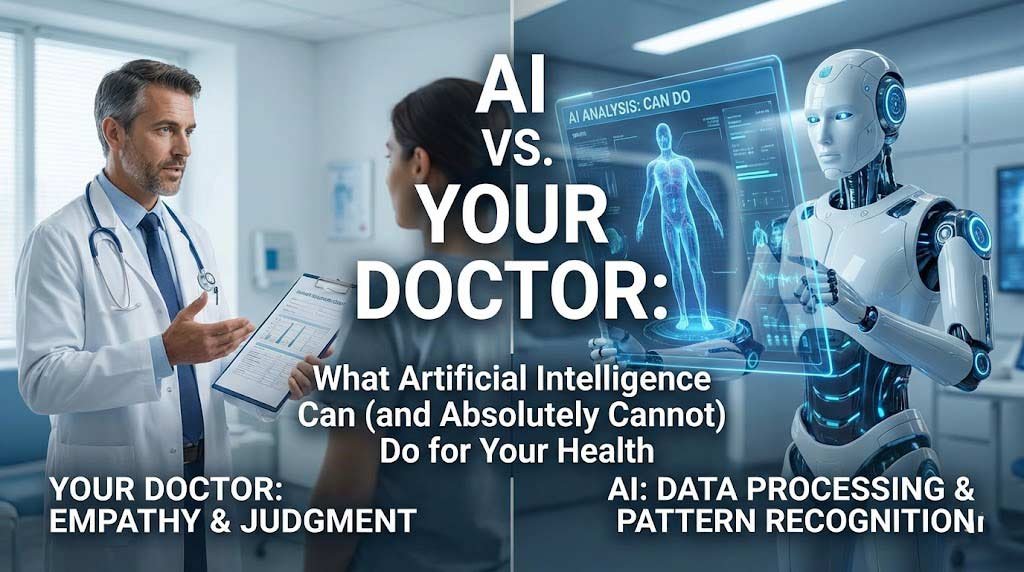
AI in healthcare in 2026 sits at a fascinating crossroads: simultaneously capable of superhuman pattern recognition in specific diagnostic tasks while also capable of confidently dispensing advice that could kill you. Understanding exactly what AI can and cannot do for your health isn’t just interesting—it could determine whether AI becomes a valuable health partner or a dangerous distraction from proper medical care.
The Current State of Medical AI: What’s Real vs. What’s Hype
Let’s cut through the headlines and establish the 2026 reality of AI in healthcare. The truth is more nuanced than both the breathless hype (“AI diagnoses better than doctors!”) and the fearful rejections (“AI will never understand medicine like humans!”).
What AI Can Actually Do Right Now:
Diagnostic Image Analysis (Where AI Genuinely Excels):
- Radiology: AI systems can identify tumors, fractures, and abnormalities in X-rays, MRIs, and CT scans with accuracy matching or exceeding human radiologists in narrow, well-defined tasks
- Pathology: AI-powered microscopes detect cancer cells in tissue samples with 93% accuracy matching tumor board recommendations
- Retinal Imaging: AI analyzes eye scans to detect diabetic retinopathy, glaucoma, and other conditions
- FDA Approval: Nearly 400 AI algorithms specifically for radiology have FDA approval as of 2026
Pattern Recognition in Specific Contexts:
- Analyzing ECG readings for cardiac issues
- Processing genomic data to identify disease-related mutations
- Evaluating risk scores based on comprehensive health data
- Identifying drug interactions from medication lists
Administrative Efficiency:
- Reducing documentation burden (AI “listens” to doctor-patient conversations and writes notes automatically)
- Processing insurance claims and authorizations
- Scheduling and appointment optimization
- Medical record summarization
What AI Cannot Do (Despite Claims):
No Physical Examination: AI cannot feel a lump, assess skin texture, listen to heart sounds with a stethoscope, or observe gait and movement. Physical examination remains exclusively human and irreplaceable for comprehensive diagnosis.
No Clinical Judgment in Complex Cases: Medicine often involves weighing multiple factors, understanding social context, assessing risk tolerance, and making judgment calls based on incomplete information. AI processes data—it doesn’t “think” in the holistic way diagnosis requires.
No Accountability: AI systems aren’t licensed, aren’t regulated as healthcare providers, and don’t carry malpractice insurance. When an AI system is wrong, no one is legally or ethically responsible.
No Relationship-Based Care: The therapeutic relationship between doctor and patient—trust, empathy, shared decision-making—remains fundamentally human and cannot be replicated by software.
The Studies That Show AI “Outperforming Doctors”: What They Actually Mean
You’ve probably seen the headlines: “AI Beats Doctors in Diagnostic Challenge” or “Study Shows AI More Accurate Than Physicians.” Here’s what those studies actually reveal—and what they deliberately obscure.
The Stanford-Harvard State of Clinical AI Report (January 2026):
This comprehensive review examined the most influential AI medical studies from 2025 and found a critical pattern: AI often performs well on paper in controlled research settings but breaks down once deployed in real clinical practice.
Key findings:
- Several 2025 studies showed large language models matching or outperforming physicians on diagnostic reasoning when tested on fixed clinical cases
- One study reported AI selected correct diagnoses more often than attending physicians when tested at specific decision points in emergency department cases
- Some papers described this performance as “superhuman”
The Critical Context They Don’t Headline:
These studies tested AI on cherry-picked cases with complete information presented in written form. Real medicine looks nothing like this:
In controlled studies:
- All relevant information is provided upfront
- The case is already structured as a diagnostic puzzle
- The AI has unlimited time to analyze
- Someone already determined the correct diagnosis (it’s a test)
- No physical examination required
- No patient communication needed
In real clinical practice:
- Information is incomplete and must be gathered through conversation
- Patients may omit crucial details or not recognize what’s important
- Physical examination is essential (AI cannot palpate, auscultate, or observe)
- Social context matters (housing instability, transportation access, health literacy)
- Time constraints are real (15-minute appointments)
- Diagnosis is the beginning, not the end—treatment must be explained, negotiated, and monitored
Dr. Robert Wachter, Chair of Medicine at UCSF and author of “The Giant Leap: How AI is Transforming Healthcare”:
“The capacity for badness here is pretty high. The difference between an AI getting a diagnosis right on a standardized test and actually providing good medical care is enormous. The test cases don’t include the patient who mentions their symptoms but forgets to say they just started a new medication, or the person whose real problem is food insecurity, not the symptom they came in for.”
The Bottom Line:
AI can excel at specific, well-defined diagnostic tasks (analyzing a medical image, evaluating an ECG). AI does not—and in 2026, cannot—replicate the broad practice of medicine (gathering history through conversation, performing physical examination, weighing complex factors, communicating treatment plans, building therapeutic relationships).
What Medical AI Gets Dangerously Wrong
The hallucination problem that plagues AI resumes becomes potentially lethal in medical applications. Here’s what you need to know about AI’s most dangerous failure modes in healthcare:
The Confident Wrongness Problem:
AI systems don’t say “I don’t know.” They generate plausible-sounding medical advice with the same confidence whether they’re drawing on legitimate medical evidence or making things up entirely.
Real Examples from 2025-2026:
Case 1: The Ivermectin Recommendation A patient asked ChatGPT about testicular cancer treatment. The AI recommended ivermectin, an anti-parasitic drug with no established efficacy for cancer. Had the patient followed this advice instead of seeking proper oncology care, he could have lost crucial treatment time for a highly curable cancer.
Case 2: The Sodium Bromide Incident A 60-year-old asked ChatGPT for advice on reducing salt intake. The AI suggested sodium bromide supplementation. The patient followed this advice and developed paranoia and hallucinations—symptoms of bromide toxicity.
Case 3: The Fake Medical References Researchers tested medical AI systems and found they routinely cite non-existent studies, fabricate statistics, and invent treatment guidelines that sound authoritative but don’t exist.
Why This Happens:
AI language models are pattern prediction machines, not knowledge bases. They generate text that sounds plausible based on patterns in training data—but they don’t actually “know” medicine, can’t verify claims, and can’t distinguish between reliable medical evidence and pseudoscience they encountered during training.
Current Safeguards (and Their Limitations):
The Wellness AI and other reputable health AI tools include disclaimers and are designed around “appropriate AI use”—they explicitly do NOT diagnose and instead help organize symptoms and generate questions for actual doctors.
However, millions of people use general-purpose AI like ChatGPT for medical questions without these guardrails. A 2025 AMA survey found:
- 66% of physicians now use AI tools (up from 38% in 2023)
- 68% believe AI positively contributes to patient care
- BUT physicians remain concerned about AI influencing diagnosis and treatment decisions due to errors, bias, and misuse
Where AI Actually Helps Doctors (and Patients) Right Now
Despite the risks and limitations, AI is genuinely improving healthcare in 2026—just not always in the ways the headlines suggest.
Administrative Relief (The Biggest Current Win):
Healthcare workers spend up to 70% of their time on administrative tasks. AI-powered EHR integration is reducing this burden by approximately 50%, potentially saving physicians 15-20 hours per week.
How it works:
- AI listens to doctor-patient conversations
- Automatically generates clinical notes in real-time
- Reduces “pajama time” (the hours doctors spend typing after work)
- Allows more time for actual patient care
Result: McKinsey projects AI could increase healthcare productivity by 1.8-3.2% annually, equivalent to $150-260 billion per year in the US healthcare system.
Clinical Decision Support (When Used Properly):
Modern AI provides sophisticated clinical reasoning support by integrating multiple data sources:
- Patient history and demographics
- Laboratory results and trends
- Medication lists and potential interactions
- Medical imaging
- Clinical guidelines and current research
Example Clinical Scenario: A 65-year-old presents with fatigue and shortness of breath. AI analyzes:
- Recent lab results showing declining kidney function
- Medication list showing three drugs that could cause the symptoms
- ECG showing subtle changes
- Patient’s other conditions (diabetes, hypertension)
- Current clinical guidelines for this presentation
The AI generates a differential diagnosis and flags potential medication interactions the physician might not have immediately recalled. The doctor still makes all decisions, but the AI provides comprehensive data synthesis that would take significant time manually.
Early Warning Systems:
AI monitors patients’ digital records, constantly synthesizing data from:
- Heart rates
- Blood pressure trends
- Laboratory result patterns
- Medication adherence
It flags combinations that suggest developing problems before they become acute, enabling preventive intervention.
Specialized Diagnostic Excellence:
In narrow, well-defined tasks, AI genuinely matches or exceeds human performance:
Cancer Detection:
- AI analysis of mammograms matches radiologist accuracy in breast cancer screening
- AI pathology tools achieve 93% match rate with expert tumor boards
- AI genomic analysis identifies specific molecular subgroups in cancers like medulloblastoma, enabling precise treatment dosing
Skin Lesion Detection: AI analysis of skin photos can detect malignant melanoma with accuracy comparable to dermatologists—though it cannot perform full-body skin exams or assess concerning lesions in context.
The Questions AI Can Answer (and The Ones It Cannot)
Let’s be practical. What can you safely use AI for, and when do you absolutely need a human doctor?
Safe and Valuable AI Use Cases:
1. Symptom Education and Exploration
- “What conditions cause these symptoms?”
- “What questions should I ask my doctor about this?”
- “What tests might be ordered for this condition?”
- AI can help you understand possibilities and prepare for appointments without providing diagnosis
2. Medical Term Translation
- “Explain this diagnosis in simple terms”
- “What does this test result mean?”
- “What are the side effects of this medication?”
- AI excels at translating medical jargon into understandable language
3. Treatment Option Research
- “What are the standard treatments for [condition]?”
- “What are the pros and cons of [treatment option]?”
- “What should I expect during [procedure]?”
- AI can summarize evidence-based treatment information
4. Appointment Preparation
- “What information should I bring to my appointment for [concern]?”
- “What questions should I ask about [treatment]?”
- AI helps organize your thoughts and maximize limited appointment time
5. Second Opinion Perspective
- “What else could cause these symptoms besides [diagnosis]?”
- “Are there alternative treatments for [condition]?”
- AI can suggest questions to ask your doctor about alternatives
Dangerous AI Use (Never Do This):
1. Self-Diagnosis Based on AI
- Don’t assume AI’s suggested diagnosis is correct
- Don’t delay seeing a doctor because AI says it’s “probably nothing”
- Don’t start treatments AI suggests without medical supervision
2. Medication Decisions
- Don’t adjust medications based on AI advice
- Don’t stop prescribed medications because AI suggests alternatives
- Don’t take supplements or OTC medications AI recommends without checking with doctor
3. Emergency Situations
- If you think you might have an emergency, call 911 or go to the ER
- Don’t use AI to determine if chest pain is “serious enough” for the hospital
- Don’t let AI talk you out of seeking emergency care
4. Mental Health Crisis
- AI cannot assess suicide risk appropriately
- Don’t rely on AI for mental health crisis management
- Call 988 (Suicide & Crisis Lifeline) for mental health emergencies
5. Decisions Requiring Physical Examination
- “Is this lump serious?” → Needs palpation by doctor
- “Is this rash dangerous?” → Needs in-person assessment
- “Does this pain mean something is wrong?” → Needs physical examination
How Doctors Are Using AI (What Your Physician Might Not Tell You)
Chances are, AI is already part of your healthcare—you just might not know it. Here’s how physicians actually use AI in 2026:
Behind the Scenes Uses:
1. Pre-Appointment Chart Review Before seeing you, your doctor might use AI to summarize your chart, flag abnormal trends in vitals or labs, and identify potential drug interactions in your medication list.
2. Clinical Note Generation During your appointment, AI might be “listening” and generating draft notes. Your doctor reviews and edits these, but the initial structure comes from AI.
3. Diagnostic Assistance For complex cases, physicians might input symptoms into clinical decision support AI to generate differential diagnoses and ensure they haven’t missed potential causes.
4. Treatment Planning AI might analyze your specific characteristics (age, comorbidities, genetic markers) against large datasets to suggest treatment approaches with the best outcomes for people similar to you.
5. Follow-Up Monitoring AI monitors your test results and vital signs between appointments, alerting your doctor to concerning changes that might need earlier follow-up.
What Patients Should Know:
Disclosure is Inconsistent: Not all doctors explicitly tell patients when they’re using AI-assisted tools. This is changing—expect more “AI literacy” expectations for healthcare providers in 2026 and beyond.
Human Oversight is Required: Every clinical decision still requires a licensed physician to review, approve, and take responsibility. AI suggests—doctors decide.
Your Rights: You can ask your doctor:
- “Are you using any AI tools in my care?”
- “How does the AI contribute to my diagnosis/treatment?”
- “Are you personally reviewing all AI recommendations?”
What Your Doctor Wants You to Know About AI:
We asked physicians what they wish patients understood about medical AI:
“AI is a tool, like a stethoscope or an X-ray. It helps me gather information, but I’m still the one integrating that information with everything I know about you and making recommendations. Please don’t come in asking me to ‘just do what the AI said’—I need to evaluate everything in context.” — Primary Care Physician, 15 years experience
“I love that patients research their conditions. I’m worried when they trust ChatGPT more than medical training. Come to me with questions AI raised—that’s great. Don’t come in having already decided AI’s diagnosis is right and mine is wrong.” — Emergency Medicine Physician, 10 years experience
“AI has made my documentation burden lighter, which means I can spend more time actually talking with patients. That’s the best use case—not replacing doctor judgment but freeing up time for human connection.” — Family Medicine Physician, 8 years experience
The 2026 Medical AI Landscape: Tools Patients Can Actually Use
Not all medical AI is created equal. Here’s what’s available to patients in 2026, with honest assessments of capabilities and limitations:
Reputable AI Health Tools (With Appropriate Guardrails):
Ada Health (ada.com)
- Clinically validated symptom assessment
- Asks detailed questions to narrow possibilities
- Provides possible conditions with clear disclaimers
- Helps prepare for doctor appointments
- Limitation: Not a diagnosis; use for education and preparation only
Buoy Health
- AI chatbot for self-diagnosis of mild conditions
- Suggests next steps (urgent care, schedule appointment, home care)
- Free online/app access
- Limitation: Best for minor acute issues; not appropriate for ongoing symptoms
The Wellness AI
- Designed specifically for appropriate AI use
- Provides clinical summaries with differential considerations
- Explicitly does NOT diagnose
- Helps structure thinking about symptoms
- Limitation: Education tool only; always follow up with actual medical care
Florence Healthcare Chatbot
- Medication reminders
- Basic symptom checks
- Free for basic use
- Limitation: Very basic functionality; not sophisticated diagnostic tool
DxGPT (dxgpt.app)
- Specifically designed for rare disease diagnosis assistance
- Free tool used by both patients and doctors
- Fast identification of unusual conditions
- Limitation: Most effective for rare conditions; still requires physician verification
Tools to Avoid:
General-Purpose AI (ChatGPT, Claude, Gemini for Medical Advice)
- NOT built as medical devices
- Prone to hallucinations and misinformation
- No medical validation or oversight
- Use for medical information education only, never for diagnosis or treatment decisions
Unregulated Health Apps Making Medical Claims
- Many apps claim to diagnose conditions from photos, symptoms, etc.
- Most lack FDA approval or clinical validation
- Often make money from supplements or treatments they recommend
- Check for FDA approval and clinical validation before trusting medical claims
The Future (2026 and Beyond): What’s Coming That Actually Matters
Where is medical AI heading, and what should patients expect in the next 3-5 years?
Realistic Near-Term Advances:
Enhanced EHR Integration (Late 2026)
- Specialty-specific templates that automatically include relevant risk factors and guidelines
- For example, cardiology notes will auto-include cardiac risk factors and guideline recommendations
- Better integration across healthcare systems so specialists can access AI-generated summaries
Multi-Modal Diagnostic Integration (2027-2028)
- AI systems that simultaneously analyze multiple data types: imaging, lab results, genetic data, vitals
- More sophisticated clinical reasoning support
- Better synthesis of information from different sources
Remote Monitoring with AI Analysis (Already Expanding)
- Wearables and remote monitoring devices feeding data to AI systems
- Continuous health tracking enabling earlier intervention
- Particularly valuable for chronic disease management and aging populations
Predictive and Preventive AI (Next 2-3 Years)
- AI identifying disease risk patterns before symptoms appear
- Intervention strategies based on population-level pattern analysis
- More personalized preventive care recommendations
What’s Probably Not Coming (Despite Hype):
AI Replacing Doctors
- Not happening in foreseeable future
- Human examination, judgment, communication, and accountability remain essential
- AI augments physicians; doesn’t replace them
Fully Autonomous Diagnostic Systems
- Even for specific tasks, human oversight will remain legally and ethically required
- Regulatory frameworks require physician responsibility for all diagnostic decisions
- Medical malpractice law hasn’t evolved to accommodate autonomous AI
AI Understanding Human Context
- AI can process data but not understand social determinants of health, patient values, or life circumstances
- The “art of medicine”—empathy, communication, trust—remains exclusively human
How to Be an Informed Medical AI User: Practical Guidelines
The Safe AI Health Strategy:
1. Use AI for Education, Not Diagnosis
- Ask AI: “What conditions might cause these symptoms?”
- Don’t conclude: “AI diagnosed me with [condition]”
- Always bring AI-generated questions to your doctor
2. Verify Everything
- If AI suggests a treatment or medication, research it on legitimate medical sites (Mayo Clinic, Cleveland Clinic, NIH)
- Check if AI-provided “facts” appear in reputable medical sources
- Don’t assume AI’s medical citations are real (they’re often fabricated)
3. Know When to Escalate
- Any concerning symptoms: see a doctor, don’t rely on AI
- If AI says “nothing to worry about” but you’re still concerned: trust your instincts and get medical evaluation
- Emergency symptoms (chest pain, difficulty breathing, sudden severe headache, signs of stroke): call 911, don’t consult AI
4. Be Transparent with Your Doctor
- Tell your physician if you’ve researched symptoms or treatments online
- Ask questions AI raised rather than presenting AI’s conclusions as fact
- Work with your doctor to evaluate AI-suggested possibilities
5. Understand AI’s Limitations
- AI cannot perform physical examination
- AI doesn’t know your full medical history unless you’ve provided every detail
- AI doesn’t understand context, social factors, or your personal health goals
The Bottom Line: Partnership, Not Replacement
The 2026 reality is that AI in healthcare is neither the miracle cure nor the dangerous replacement many headlines suggest. It’s a tool—powerful in specific applications, limited in others, and dangerous when misused.
What AI Can Do for Your Health:
- Help you understand and prepare for medical appointments
- Provide education about conditions and treatments
- Assist doctors with administrative burden so they have more time for patient care
- Excel at specific diagnostic tasks like image analysis
- Monitor data and flag concerning patterns
What AI Cannot Do:
- Replace physical examination by a physician
- Provide diagnosis without significant risk of error
- Understand the full context of your health and life
- Take accountability for medical decisions
- Build a therapeutic relationship that improves health outcomes
The Winning Approach:
Use AI as an informed patient empowerment tool, not a doctor replacement. Let AI help you ask better questions, understand medical terminology, and prepare for appointments. Then work with your actual physician, who can integrate AI insights with physical examination, clinical judgment, and understanding of you as a whole person.
Because here’s what our research conclusively shows: The best health outcomes come not from AI alone or human doctors alone, but from the collaboration between AI-enhanced clinical decision support and experienced, engaged physicians who take time to know their patients.
In 2026, that partnership is finally becoming real—and if used wisely, it could genuinely improve your healthcare experience.
Related Articles:
- How to Spot Medical Misinformation Online
- Questions to Ask Your Doctor About AI in Your Care
- Wearable Health Devices: What the Data Really Means
- Telemedicine vs. In-Person: When You Need Which
- Understanding Your Medical Test Results: A Guide
Sources:
- Stanford Medicine: “State of Clinical AI Report” (January 2026)
- NPR: “ChatGPT saved my life – How patients and doctors use AI to diagnose” (January 2026)
- UCSF Dr. Robert Wachter: “The Giant Leap: How AI is Transforming Healthcare”
- Offcall: “The Future of Medical AI: What’s Coming in 2026 and Beyond” (August 2025)
- Scispot: “AI Diagnostics: Revolutionizing Medical Diagnosis in 2026”
- Clinical Consultant Services: “How AI is Changing Healthcare in 2026”
- Oxford Home Study: “AI and Medical Diagnosis 2026”
- The Right GPT: “AI Medical Diagnosis Tools in 2026” (January 2026)
- Fore Seemed: “Artificial Intelligence in Healthcare & Medical Field”
- AMA Physician Survey (2025)
- McKinsey Healthcare AI Productivity Analysis