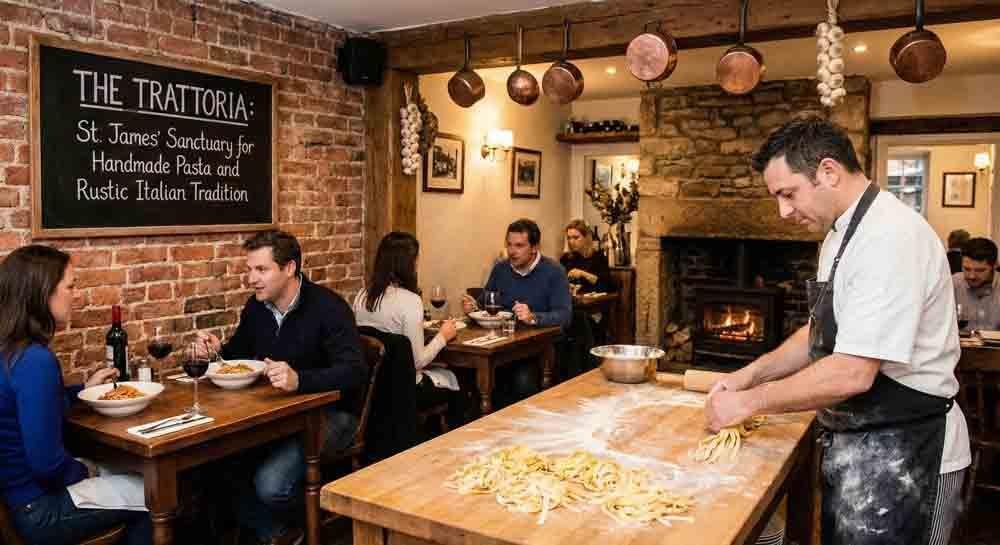
A very small room takes on its own kind of light when the kitchen is open and the chef is working three feet from your table — a warm, living glow shaped by flame, steam, and the quiet choreography of someone cooking within arm’s reach. It’s not ambience so much as presence, a luminosity that feels earned moment by moment as each dish comes into being right in front of you. It is not the clinical fluorescence of a chain restaurant or the theatrical dimness of a Manhattan prix fixe temple. It is the honest, slightly golden glow of a place where the food matters more than the décor, where the man cooking your dinner will walk out and shake your hand before you leave, and where the lasagna Bolognese has been named the best on Long Island by Newsday — a distinction that, in a region with roughly 7.6 million residents and no shortage of Italian grandmothers, carries the weight of a judicial ruling (Newsday, Restaurant Review). Tucked behind a hair salon on North Country Road in St. James, seating barely twenty-eight souls in a dining room that feels more like a Tuscan farmhouse kitchen than a Long Island restaurant, The Trattoria is the kind of establishment that reminds you why the word “trattoria” — from the Italian trattare, meaning “to treat” — once described the most sacred contract in hospitality: I will feed you well, and you will trust me to do so.
The Chef: Stephen Gallagher’s Unlikely Road to North Country Road
Chef Stephen Gallagher’s origin story reads less like a culinary school brochure and more like the biography of a craftsman who discovered his medium by accident. As a high school freshman, Gallagher took a part-time job washing dishes at a bakery — not because he loved food, but because someone quit and working inside beat collecting shopping carts in a King Kullen parking lot during a Long Island winter. That bakery led to a restaurant in Stony Brook called The Country House, where Gallagher realized he possessed what he describes as “a natural aptitude for cooking” — the kind of understatement you might expect from a man who would eventually train under some of the most demanding kitchens in the Western Hemisphere (Long Island Press, 2021).
Gallagher attended the New York Technical Institute for culinary arts, though he is famously candid about discouraging young cooks from the culinary school route, citing the prohibitive cost and his conviction that restaurant kitchens teach what classrooms cannot. His formative years read like a culinary travelogue of serious kitchens: Star Boggs in Westhampton Beach, The Jamesport Manor Inn on the North Fork, the Buccaneer Terrace Restaurant on St. Croix in the U.S. Virgin Islands — where he served as Chef de Cuisine and developed a deep connection to the Caribbean community he would later honor through charity — and The Summit Restaurant at The Broadmoor Hotel in Colorado Springs, a Forbes Five-Star, AAA Five-Diamond property where Gallagher cooked alongside Chef Bertrand Bouquin and reportedly served both a former Vice President and Tony Robbins at private events (Long Island Press, 2021; Long Island Cares, 2025).
These are not the credentials of a man playing restaurant. These are the credentials of a craftsman who spent decades refining his technique across climates, cuisines, and cultures before settling into a twenty-eight-seat room on Long Island’s North Shore to do the most difficult thing in the restaurant business: cook honest food, every single night, without a safety net.
The Lineage: From Kitchen A Bistro to a Name of Its Own
To understand The Trattoria is to understand the remarkable culinary ecosystem that flourished along North Country Road in St. James during the early 2000s — a stretch that locals began calling “Restaurant Row” with good reason. Chef Eric Lomondo opened Kitchen A Bistro in 2001, a tiny, smoke-filled storefront in a strip shopping center that quickly became one of the most critically acclaimed restaurants on Long Island. Lomondo’s philosophy was radical in its simplicity: no credit cards, bring your own wine, and trust that the food would be extraordinary. It worked. The restaurant earned devoted followings, expanded to a larger location in 2009, and spawned Kitchen A Trattoria in the original space (Patch, 2012; Long Island Pulse Magazine, 2012).
In 2009, Gallagher joined Lomondo’s family of restaurants, first as Chef de Cuisine at Kitchen A Bistro, then as Executive Chef of Kitchen A Trattoria. When Lomondo decided to focus his energy on Orto — his rustic Italian venture that opened in Miller Place in 2012 in the historic Daniel Miller House — Gallagher purchased Kitchen A Trattoria in November 2013 and christened it simply: The Trattoria (Edible Long Island, 2017).
The transition from employee to owner was, by Gallagher’s own admission, humbling. “I thought I knew everything about the restaurant business but there was a lot to learn,” he told the Long Island Press. “That initial first year, getting my bearings, figuring out which way was up, was a real challenge.” Lomondo, whom Gallagher credits as both mentor and friend, provided critical support during the transition. It is the kind of generational handoff that defines the best of Long Island’s independent restaurant culture — not a corporate acquisition or a franchise expansion, but one skilled cook entrusting his kitchen to another, the way a master leather worker might hand his bench to a journeyman who has proven his hands.
The Food: A Daily-Changing Canvas of Rustic Italian Mastery
The Trattoria does not have a static menu. This single fact distinguishes it from approximately ninety percent of the Italian restaurants operating on Long Island at any given moment. Gallagher changes his offerings daily, guided by seasonal availability, market-driven sourcing, and the kind of restless creative intelligence that prevents a chef from ever settling into autopilot. The result is a dining experience that rewards repeat visits the way a favorite novel rewards rereading — familiar in its rhythms, surprising in its details.
The restaurant’s signature dishes have achieved near-legendary status among North Shore diners. The lasagna Bolognese — the dish that earned Newsday‘s highest praise — is a study in patience and proportion, built on a slow-simmered ragù that transforms humble ground meat into something approaching the sacred. The red wine brasato with creamy polenta delivers the kind of deep, braised richness that makes you understand why Italian grandmothers spent entire Sundays at the stove. The orecchiette with house-made sausage and broccoli rabe pesto channels the handmade pasta traditions of Puglia, where women still shape “little ears” of semolina dough on the doorsteps of Bari’s old city — a tradition beautifully documented by Vicky Bennison’s Pasta Grannies YouTube channel (https://www.youtube.com/channel/UCedsqpl7jaIb8BiaUFuC9KQ), which has preserved the techniques of hundreds of Italian nonnas for a global audience.
The black pasta with calamari and spicy tomato, the pork loin with farro, the Montauk fluke with seasonal vegetables — each dish reflects Gallagher’s ability to balance technique with restraint. And the desserts, all made in-house, are no afterthought: the flourless chocolate almond cake with vanilla gelato and the Nutella pound cake have each earned their own devotees.
For those seeking the full measure of Gallagher’s range, the Chef’s Tasting Menu is the move. Diners have reported multi-course progressions that include amuse-bouche gazpacho, house-made burrata with pickled peaches, seared tuna, orecchiette with sausage and broccoli rabe pesto, and red wine brasato with creamy polenta and white truffles — a parade of courses that, as one Tripadvisor reviewer noted, rival experiences at Michelin-starred establishments, albeit without the tablecloths and the attitude (Tripadvisor, 2024; OpenTable, 2025).
The Room: Twenty-Eight Seats and the Power of Intimacy
The Trattoria seats approximately twenty-eight guests. The tables are close together. The kitchen is open. There are no tablecloths, no starched napkins folded into origami swans, no ambient electronic music curated by a consulting DJ. The walls are wooden. The atmosphere is what happens when you strip away every pretension and leave only the essential elements of hospitality: good food, attentive service, and the quiet confidence of a chef who does not need to perform because the plates do the talking.
This intimacy is The Trattoria’s greatest asset and its most polarizing feature. The closeness of the tables means you will hear your neighbor’s conversation — and they will hear yours. More than one reviewer has noted, with evident delight, that the proximity invites a communal energy rare in contemporary dining. Your neighbor might lean over and recommend the brasato. You might find yourself discussing the wine list with a couple celebrating an anniversary at the next table. The chef will almost certainly emerge from behind the open kitchen at some point during your meal to greet you personally and ask how everything is.
This is not a restaurant for those who require visual grandeur or acoustic privacy. It is a restaurant for those who understand that the most memorable meals in human history were not served in ballrooms but in small rooms where the cook cared deeply and the company was close.
The Spirit of Generosity: Charity, Community, and the St. Croix Connection
In October 2017, when Hurricanes Irma and Maria devastated the U.S. Virgin Islands, Gallagher did not simply post a fundraising link on social media. He reached back to the community that had shaped his career — the island of St. Croix, where he had spent four years cooking and living — and organized a charity wine dinner in partnership with Anthony Nappa, a Long Island winemaker with his own deep ties to the British Virgin Islands. Nappa and his wife, chef Sarah, had been married there; their wedding venue, which had employed over three hundred people, was virtually destroyed (Edible Long Island, 2017).
The five-course dinner, paired with Anthony Nappa wines including a rare Reserve Pinot Noir typically exclusive to wine club members, raised funds for the Bitter End Yacht Club Staff Irma Relief Fund and the St. Pete Air USVI Relief Effort. Tickets were one hundred fifty dollars per person, inclusive of tax and gratuity, with all proceeds donated. It was the kind of event that reveals the character beneath the chef’s coat — a man who understands that a restaurant is not merely a business but a platform, and that a kitchen’s greatest power lies not in the meals it serves for profit but in the meals it serves for purpose.
Gallagher has also participated in Long Island Cares’ “Chefs Against Hunger” initiative, contributing his talents to the Harry Chapin Food Bank’s mission of fighting hunger across Long Island — a cause that resonates deeply in a region where food insecurity persists alongside extraordinary culinary abundance (Long Island Cares, 2025).
The Practical Details: What You Need to Know Before You Go
The Trattoria operates with a set of house rules that, while occasionally surprising to first-time visitors, are integral to its character and economics.
Reservations are not merely recommended — they are essential. With twenty-eight seats and a devoted clientele that returns multiple times per week, walk-in availability is rare, particularly on weekends. Call ahead: (631) 584-3518.
Payment is cash or check only. The restaurant does not accept credit or debit cards. This policy, inherited from the Kitchen A lineage and maintained by Gallagher, is a deliberate choice that keeps overhead low and prices remarkably fair for the quality of food served. Come prepared.
Wine and Spirits: The Trattoria now serves beer, wine, and spirits. Guests are still welcome to bring their own bottles, with a corkage fee of fifteen dollars per 750ml bottle — a policy that has long been one of the restaurant’s most beloved features, allowing diners to pair their favorite wines with Gallagher’s cooking without a typical restaurant markup.
Hours: Lunch is served Monday through Friday, noon to 2:00 PM. Dinner runs Monday through Thursday from 5:00 to 9:00 PM, Friday and Saturday from 5:30 to 10:00 PM, and Sunday from 4:00 to 8:00 PM.
Location: 532 North Country Road, St. James, NY 11780. The restaurant is located half a mile from the St. James station on the Long Island Rail Road, making it accessible to city visitors willing to take the train for a meal that justifies the journey. Look for it behind the hair salon — the slight difficulty of finding it is part of the charm.
Private Events: The Trattoria accommodates private parties of up to thirty-two guests on-premise, with several packages available. Off-premise catering is also offered.
Website: thetrattoriarestaurant.com
Awards and Recognition: Named Best Lasagna on Long Island by Newsday. Named among the Best Restaurants in America by OpenTable. Ranked number one of thirty-three restaurants in St. James on Tripadvisor, with a Travelers’ Choice Award. Rated 4.8 stars across 612 OpenTable diners and 195 Yelp reviews.
The Unseen Details: Why The Trattoria Endures
There is a concept in craft that the Italians call sprezzatura — the art of making the difficult appear effortless. It is the quality that distinguishes a handmade Marcellino briefcase from a machine-stamped imitation, and it is the quality that distinguishes The Trattoria from the hundreds of Italian restaurants that open and close on Long Island every decade. When Gallagher changes his menu daily, he is not following a trend; he is practicing the discipline of a cook who refuses to let routine erode quality. When he walks out of the open kitchen to greet every table, he is not performing hospitality; he is living it. When he prices a three-course prix fixe dinner at a level that working families can afford, he is making a statement about what fine dining should be and whom it should serve.
The COVID-19 pandemic tested The Trattoria as it tested every small restaurant in America. Gallagher shortened his operating days, laid off staff, and pivoted to takeout — which, he admitted, was not sufficient to cover expenses. But the St. James community rallied, showing up consistently and demonstrating the kind of local loyalty that no Yelp rating can quantify. “St. James is a great place to operate a business,” Gallagher told the Long Island Press, “because the residents are so supportive.” It is the kind of understatement that, from a man of few words, carries the resonance of a love letter.
Asked about his plans for The Trattoria’s future, Gallagher offered perhaps the most honest mission statement in the history of Long Island dining: “I’m just working on keeping it all going.” In an era of celebrity chef empires and venture-backed restaurant groups, of ghost kitchens and algorithmic delivery platforms, there is something profoundly radical about a man with a twenty-eight-seat room, an open kitchen, and a daily-changing menu who simply wants to keep cooking well. The Trattoria endures not because it chases the next trend but because it honors the oldest one: that the best meal is the one made with care, served with warmth, and shared in close company.
For diners seeking an immersive introduction to the art of Italian handmade pasta and the traditions that inform kitchens like Gallagher’s, the Pasta Grannies YouTube channel offers an extraordinary archive of Italian nonnas demonstrating regional techniques passed down through generations: https://www.youtube.com/channel/UCedsqpl7jaIb8BiaUFuC9KQ