A Heritage Diner Profile — The Restaurants of Long Island Series
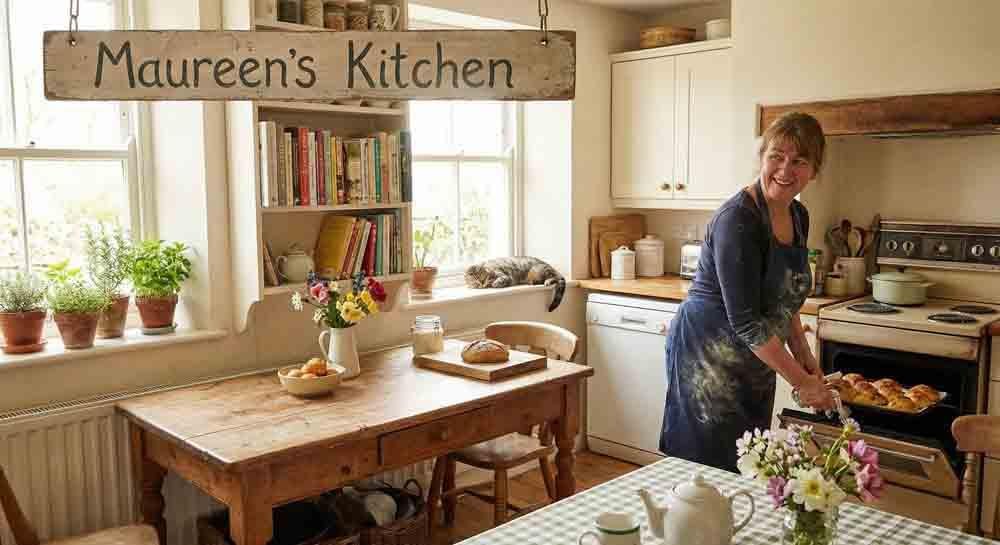
A stretch of Terry Road in Smithtown can feel almost ritualistic on a Saturday morning — the kind of place where a line forms before the sun has fully decided what kind of day it wants to be. Families in hoodies, couples clutching coffees against the chill, early risers who know exactly why they’re here — all gathering in that soft, half-lit hour when anticipation hangs in the air thicker than the steam from the griddle across the street. Families in puffy coats and couples clutching each other against the February chill stand shoulder to shoulder on a paved lot, waiting — happily, willingly, without a reservation or a credit card between them — for a table inside what appears to be a two-story country house. A giant cow head juts from the roofline. Inside, the walls are papered with bovine memorabilia donated by generations of loyal patrons. The air is thick with the scent of batter hitting a hot griddle and the unmistakable perfume of fresh-cracked eggs sizzling in real butter. This is Maureen’s Kitchen. And for forty years, it has been the undisputed breakfast temple of Long Island.
As someone who has operated The Heritage Diner on the North Shore for a quarter century, I understand something about these places in a way that Yelp reviewers and food bloggers simply cannot. The survival of an independent restaurant for four decades is not a marketing achievement. It is an act of daily defiance against an industry where the National Restaurant Association estimates that roughly sixty percent of new establishments close within the first year (National Restaurant Association, 2023). What Maureen Dernbach built on Terry Road — and what her children Kevin Dernbach and Christine Fortier continue to steward — is not a business plan. It is a covenant between a family and a community. And in the age of algorithmic dining recommendations and ghost kitchens, that covenant has become one of the rarest commodities on earth.
The Origin: A Wrong Turn That Changed Suffolk County
Every great establishment has a founding myth, and Maureen’s belongs in the canon of Long Island legend. In 1985, Maureen Dernbach was driving along the Smithtown Bypass — Route 347, that relentless artery of Suffolk County commerce — when she made a wrong turn onto Terry Road. At the bottom of what was once an old sand mine, she encountered a shack. Where others would have seen blight, Dernbach saw a restaurant (Suffolk County Legislature, 2023).
On May 5th, 1985, Maureen opened the doors to a ten-seat operation with a screen door and a dream. The initial clientele was blue-collar workers — tradesmen and laborers who needed a solid meal at a fair price before the day’s labor began. People sat on steps and on the grass when the tiny interior overflowed. There was no brand strategy. There was no Instagram account. There was a woman who could cook, who cared about the people she fed, and who understood the radical simplicity of the proposition: make something good, charge something fair, and treat every person who walks through the door like family.
This is a philosophy I understand deeply. At The Heritage Diner, we built twenty-five years of service on the same foundation. It is the difference between a restaurant and a place — between a transaction and a relationship. The great sociologist Ray Oldenburg called these establishments “third places,” spaces that are neither home nor work but something essential to civic life (Oldenburg, The Great Good Place, 1989). Maureen’s Kitchen was a third place before anyone thought to theorize about them.
The Move Across the Street: Growth Without Compromise
By 1997, the shack could no longer contain what Maureen’s Kitchen had become. The Dernbach family made the decision to relocate across Terry Road into a custom-built structure designed to look like a Victorian country house — complete with glass-enclosed porches, cowhide-covered booths, and a breakfast bar where patrons could watch every egg crack and every pancake flip in real time (Media Wise, 2014).
The move was a masterstroke of architectural philosophy. In an era when restaurant consultants were advising owners to chase trends — exposed brick, industrial lighting, reclaimed everything — the Dernbach family doubled down on warmth. The new Maureen’s Kitchen felt like walking into a farmhouse that happened to serve the best oatmeal on the eastern seaboard. Glass windows surround the sides of the building, flooding the dining room with natural light. Only a marble countertop separates the customers from the kitchen. The transparency is not accidental. It is a statement of values: we have nothing to hide.
This is a principle I carry into everything I build. Whether it is the hand-stitching on a Marcellino NY briefcase — where every stitch is visible, every material traceable to its tannery of origin — or the sourcing of ingredients at The Heritage Diner, the philosophy is the same. Provenance is not a luxury. It is a responsibility. When Kevin Dernbach stands behind that counter at five in the morning prepping for service, he is performing the same ritual of accountability that defines every serious craftsman I have ever known.
The Cow: Iconography, Heritage, and the Callicoon Connection
The cows are impossible to miss. They are on the booths. They are on the coffee mugs. They are in a glass display case as ceramic figurines donated by decades of customers. A massive cow head protrudes from the building’s roofline like a bovine gargoyle. For the uninitiated, it reads as kitsch. For those who know the story, it is something far more meaningful.
The cow motif traces directly to Kevin Dernbach’s father, who operated a cow farm in Callicoon, New York — the rural Delaware County hamlet that sits along the upper reaches of the Delaware River. Maureen brought the motif down to Long Island as a tribute to the family’s agricultural roots (Media Wise, 2014). It is, in the truest sense, a brand built on provenance rather than focus groups.
This matters because the best icons in food and hospitality always emerge organically. The cows at Maureen’s Kitchen are not a designer’s invention. They are a family heirloom translated into décor. In the same way that the patina on a well-worn English bridle leather briefcase tells the story of every boardroom and airport and rainy commute it has survived, the cow collection at Maureen’s tells the story of a community that has invested its identity in a place. Customers do not just eat here. They contribute to the mythology.
The Menu: Where Creativity Meets the Common Man
Kevin Dernbach and Christine Fortier inherited their mother’s recipes and then did what all great craftspeople do: they honored the tradition while pushing the boundaries. The result is a menu that manages to be simultaneously familiar and adventurous — a tightrope act that most restaurants fail spectacularly.
The signature dishes have become the stuff of Long Island lore. The croissant stuffed French toast — which earned a feature on the Cooking Channel’s Unique Eats — is an exercise in controlled indulgence. The baked oatmeal, served with warm milk, is less a breakfast item than a revelation: dense, fragrant with walnuts, apples, and raisins, baked to a consistency that splits the difference between cookie and cereal. The pistachio pancakes are fluffy, nutty, and unapologetically generous. The daily specials board — changed every single day — showcases a kitchen that refuses to coast on its reputation.
What strikes me most, as a restaurateur who has spent twenty-five years calibrating the balance between consistency and creativity, is the discipline behind this variety. New specials daily sounds exciting on paper. In practice, it demands a level of sourcing, prep, and execution that would break most kitchens. It requires a team that trusts each other implicitly and an ownership that is willing to absorb the risk of the unfamiliar. The Dernbachs have been doing this for four decades without a dip in quality. That is not talent. That is will.
As Kevin Dernbach himself has put it: his mother always wanted to take care of the common man — the person working hard to provide for a family. Quality food, generous portions, fair prices. That founding ethos has never wavered. At a time when the average brunch in Manhattan can easily run forty dollars a plate before the mimosa lands, Maureen’s Kitchen has been recognized by Zagat as one of the best restaurants on Long Island under twenty-five dollars (Zagat). The economics of generosity, it turns out, are sustainable when the generosity is genuine.
The Awards: Long Island’s Undisputed Breakfast Champion
The accolades tell their own story. Maureen’s Kitchen has won Best Breakfast on Long Island in the Bethpage Best of Long Island Awards a staggering twelve times in fourteen attempts since 2010. The restaurant claimed Best Brunch for five consecutive years and Best Luncheonette for three straight years in the 2023 awards cycle (Smithtown Patch, 2023). In 2024, they captured Best Breakfast yet again, with the awards committee acknowledging the restaurant’s ability to satisfy patrons of all ages with generous portions and top-quality ingredients (Smithtown Patch, 2024).
These are not industry insider awards. These are voted on by the residents of Long Island — the people who actually eat at these establishments week after week. There is no lobbying. There is no publicist orchestrating a campaign. There is only the accumulated weight of forty years of showing up, cooking honest food, and remembering that the person sitting at table six has a daughter who just started college and a husband who takes his coffee black with two sugars.
The restaurant was also featured on the Cooking Channel’s Unique Eats and earned a spot on OnlyInYourState.com’s list of the twelve places you should eat in New York in 2017. Ranked number one out of eighty-six restaurants in Smithtown on Tripadvisor with a 4.4-star rating across more than 540 reviews, and commanding over 1,500 reviews and 1,500 photos on Yelp, Maureen’s Kitchen has achieved something that no marketing budget can manufacture: unanimous, cross-generational, sustained public adoration.
The Family: Christine, Kevin, and the Second-Generation Promise
When Maureen Dernbach decided to retire, the question of succession loomed large. In the restaurant industry, generational transitions are notoriously brutal. The National Restaurant Association’s data on family-owned restaurants surviving the transition to the second generation is sobering — fewer than thirty percent make it (Cornell Hospitality Quarterly, 2019). Christine Fortier and Kevin Dernbach defied those odds not by reinventing their mother’s vision but by deepening it.
Both are chefs. Both work the kitchen. Both understand that ownership in a place like this is not a title — it is a physical act. Kevin is there at five in the morning, prepping. Christine manages the operational complexity of feeding hundreds of people a day in a restaurant that takes no reservations, accepts only cash, and has a line out the door by eight o’clock on weekends. Their partnership represents the rarest thing in American small business: a family that works together without the dysfunction that typically accompanies such arrangements.
The community orientation remains central. As Kevin has expressed: they were raised on the belief that how you treat the community reflects directly on the restaurant. Even difficult customers are met with the goal of turning their day around. This is not corporate customer service language. This is the genuine ethos of people who understand that a neighborhood restaurant is, at its best, a form of civic infrastructure.
I have seen this dynamic play out from behind my own counter at The Heritage Diner. The regulars who come every Tuesday. The families who celebrate every birthday at the same booth. The widower who comes in alone every morning because the coffee and the conversation are the best parts of his day. These relationships are the invisible load-bearing walls of a community. Maureen’s Kitchen, under Christine and Kevin’s stewardship, carries that weight with grace.
Essential Information: Your Visit to Maureen’s Kitchen
Address: 108 Terry Road, Smithtown, NY 11787
Telephone: (631) 360-9227
Hours: Monday – Friday: 7:00 AM – 2:00 PM Saturday – Sunday: 7:00 AM – 1:45 PM
Payment: Cash only (ATM available on premises)
Reservations: Not accepted — first come, first served
Accessibility: Fully accessible with ramps at two entrances, single-story layout, and accessible restrooms with baby-changing stations
Social Media: Instagram: @maureenskitchen_ Facebook: Maureen’s Kitchen
Delivery & Takeout: Available through Uber Eats, Postmates, and Grubhub
- Uber Eats: Order Here
- Grubhub: Order Here
Review Platforms:
- Tripadvisor: Ranked #1 of 86 Restaurants in Smithtown — 4.4 Stars, 540+ Reviews
- Yelp: Maureen’s Kitchen — 1,580+ Reviews, 1,530+ Photos
What to Know Before You Go: Bring cash. Come hungry. Arrive early on weekends — the post-church crowd creates the longest waits. The glass-enclosed porch offers slightly quieter seating. Sit at the counter if you want to watch the kitchen in action. And do not leave without trying the baked oatmeal. It will recalibrate your understanding of what oatmeal is capable of.
Signature Dishes to Order: Croissant Stuffed French Toast (as featured on Unique Eats), Pistachio Pancakes, Baked Oatmeal with Warm Milk, Corned Beef Hash, Challah Stuffed French Toast, Lemon Poppy Ricotta Pancakes, and the Dinosaur Egg (three egg whites with one yolk over easy).
Multimedia:
- Visit Maureen’s Kitchen for a Family-Owned and Homey Restaurant Experience — Video Journalist Waldo Cabrera’s feature on the restaurant
- Maureen’s Kitchen on Unique Eats — TV Foodies episode page
There is a moment, if you time your visit correctly, when the morning light hits the glass porch at Maureen’s Kitchen and catches the steam rising from a fresh cup of coffee in a cow-spotted mug, and you can hear the clatter of plates and the murmur of families and the sizzle of something extraordinary on the flat top — and you understand, viscerally, that this is what forty years of refusing to compromise sounds like. It sounds like a full house. It sounds like a child counting ceramic cows in the waiting room while her parents study the specials board. It sounds like Kevin Dernbach greeting a regular by name at five past seven on a Wednesday.
In my world — where the curing of a leather hide requires the same patience as the seasoning of a cast-iron griddle, where the closing of a real estate deal demands the same precision as the folding of a croissant — I have learned to recognize mastery when I encounter it. Maureen’s Kitchen is mastery. Not the showy, Michelin-starred, deconstructed-foam kind of mastery. The deeper kind. The kind that gets up at five in the morning, every morning, for forty years, and serves the common man with uncommon excellence.
Maureen Dernbach made a wrong turn on the Smithtown Bypass in 1985 and found her life’s work at the bottom of a sand mine. Her children turned that work into a dynasty. And every person who has ever waited in that line on Terry Road — cash in pocket, appetite intact, knowing with absolute certainty that whatever arrives at the table will be worth the wait — is part of that story now.
That is not a restaurant. That is a legacy.
Peter from The Heritage Diner has operated his restaurant at 275 Route 25A in Mount Sinai, NY since 2000. He is the founder of Marcellino NY, a bespoke leather atelier, and is preparing to launch Maison Pawli, a boutique real estate venture with his wife, Broker Paola, in 2026. For more profiles of Long Island’s essential restaurants, visit heritagediner.com/blog.