Al Fresco Elegance on the Streets of St. James
There is a particular kind of silence that settles over North Country Road in St. James just before dusk on a Thursday evening — the golden hour when the old farmhouse at 404 begins to exhale the perfume of slow-simmered ragù, roasting garlic, and fennel pollen through its open garden doors. It is a silence that does not last. Within the hour, the gravel lot will fill, the bar will hum with the clinking of Barolo against crystal, and Pietro Molendini himself will be standing at the threshold of his restaurant, hand extended, smile wide, welcoming you not as a customer but as a guest arriving at his home. This is Pietro Cucina Italiana — and on the North Shore of Long Island, it has become something close to sacred ground for anyone who understands that the Italian table is not merely a place to eat but a place to be.
I have spent twenty-five years behind a counter and over a flat-top at The Heritage Diner in Mount Sinai, and in that quarter-century I have learned that the restaurants which survive — truly survive, not merely persist — are the ones built on an irreducible human truth: people return to places where they feel known. Pietro Cucina Italiana is one of those places. And the story of how it came to be, on a quiet stretch of road between Smithtown and Stony Brook, is a story about what happens when New York City mastery meets Long Island soul.
From Greenwich Village to the Farmhouse: The Molendini Journey
Every great restaurant has an origin myth, but Pietro Cucina Italiana has something better — an origin that reads like an Italian emigration narrative in reverse. Pietro Molendini spent three decades in the crucible of Manhattan’s most demanding kitchens (OpenTable, 2025). His résumé is not a list of jobs; it is a map of New York’s Italian dining aristocracy. A decade at Cipriani — the dynasty that turned Harry’s Bar in Venice into a global hospitality empire beginning in 1931, and whose 42nd Street landmark became the gilded stage for every power dinner in Midtown (Cipriani S.A., 2025). Stints at Bar Pitti, the cash-only Tuscan institution on Sixth Avenue where Beyoncé and Jay-Z have been regulars, where the pappardelle in rabbit ragù has been called the finest in the city, and where the sidewalk tables constitute the most glamorous people-watching in Greenwich Village. Time at Da Silvano, the now-shuttered celebrity magnet that for years reigned as New York’s most famous Italian address.
These are not merely restaurants. They are finishing schools for the Italian hospitality arts — academies of sauce, timing, sourcing, and the ancient Roman understanding that a meal is a civic act. Pietro Molendini did not just pass through these kitchens. He absorbed their DNA.
Then, as the story goes, he and his wife Kelly — a woman whose dry wit and organizational brilliance form the operational backbone of everything the Molendinis touch — decided it was time to build something of their own. They had already proven themselves with Vite Vinosteria in Astoria, Queens, a neighborhood gem that earned a devoted following. But the pull of the North Shore, where the couple had settled in Centerport, proved irresistible.
The building they found was a classic St. James farmhouse — one of those weathered, gambrel-roofed structures that dot North Country Road like punctuation marks in a sentence about Long Island’s agrarian past. The Molendinis spent a full summer renovating, stripping the interior to its bones and rebuilding it with the clean, neutral tones and contemporary Roman artwork that now define the space. The bar expanded from four seats to eleven. The garden was reimagined as an al fresco dining room worthy of the Amalfi Coast. And in the kitchen, Pietro installed his old colleague and culinary brother-in-arms, Chef Fabian Garcia Manca, who had run the kitchen at Vite Vinosteria and shared Pietro’s obsessive commitment to ingredient sourcing.
The Menu: Where Sourcing Becomes Storytelling
At Pietro Cucina Italiana, the menu reads less like a list of dishes and more like a manifest of provenance. Kelly Molendini once joked to a reporter that her husband and Chef Manca are never home — they are perpetually in transit across the tristate area, hunting for the perfect ingredient (OpenTable, 2025). Meat sourced from specialty purveyors in the Bronx. Burrata shipped fresh from artisanal makers in New Jersey. Dried pasta imported directly from small producers in Italy and Sicily.
This is the kind of sourcing philosophy that separates a genuinely great Italian restaurant from a competent one, and it is something I understand intimately. At The Heritage Diner, we have spent years cultivating relationships with local farms and regional suppliers, because the truth about food — whether it is a Heritage Burger or a plate of Pietro’s handmade pappardelle — is that excellence begins long before the kitchen. It begins in the field, at the dock, in the selection of raw materials that will eventually become flavor.
Consider the appetizers alone. The Arancini alla Siciliana: homemade crispy saffron rice balls filled with short rib ragù and besciamella sauce — a dish that requires three separate preparations executed in concert. The Grilled Portuguese Octopus, served with salad, potatoes, tomatoes, and avocado, a plate that demands both the confidence to source a quality cephalopod and the restraint not to overcook it. The Oven Roasted Eggplant with aged goat cheese, organic honey, crushed pistachio, and roasted peppers — a Pugliese-inflected composition that balances sweet, salt, earth, and crunch in a single bite.
The pasta program is where Pietro Cucina Italiana truly announces its pedigree. Handmade pappardelle with prime Angus short rib ragù. Tortellini filled with veal in a white cream sauce with green peas and Italian ham. Half-moon ravioli stuffed with pumpkin and taleggio cheese in butter sage sauce — a dish that could have walked straight out of a Mantuan farmhouse. And homemade gnocchi with porcini mushrooms, shaved Parmigiano, and white truffle oil, each dumpling a pillow of potato and flour that dissolves against the palate like a whispered secret.
The entrées extend the narrative: Stufato D’agnello — a lamb shank stewed with carrots, onions, celery, and red wine, served over soft polenta bramata that carries the golden warmth of northern Italy. Coscie di Anatra — duck legs confited for twelve hours in extra virgin olive oil with fresh herbs and Indian white pepper, accompanied by homemade carrot mashed potatoes. A whole organic roasted chicken with Pugliese olives, sweet peppers, thyme, and capers. These are not dishes designed to impress with novelty. They are dishes designed to endure — to become the meals you remember, the flavors you crave on a cold February evening when the wind off the Sound cuts through St. James like a blade.
The Space: A Farmhouse Reimagined
The interior renovation the Molendinis undertook was a masterclass in restraint. Where other restaurateurs might have leaned into rustic kitsch — exposed brick, mason jar candles, reclaimed wood clichés — Pietro and Kelly chose a different path. The dining room is modern and clean, with neutral tones that serve as a canvas for the contemporary artwork Pietro brought from his native Rome. The effect is one of quiet sophistication, a space that feels simultaneously European and Long Island, urban and pastoral.
The expanded bar, now seating eleven, has become a destination in itself — a place where the cocktail and wine program reflects the same sourcing obsession that drives the kitchen. The wine list is curated with the specificity of someone who spent a decade pouring at Cipriani, where the wrong Nebbiolo pairing could end a career.
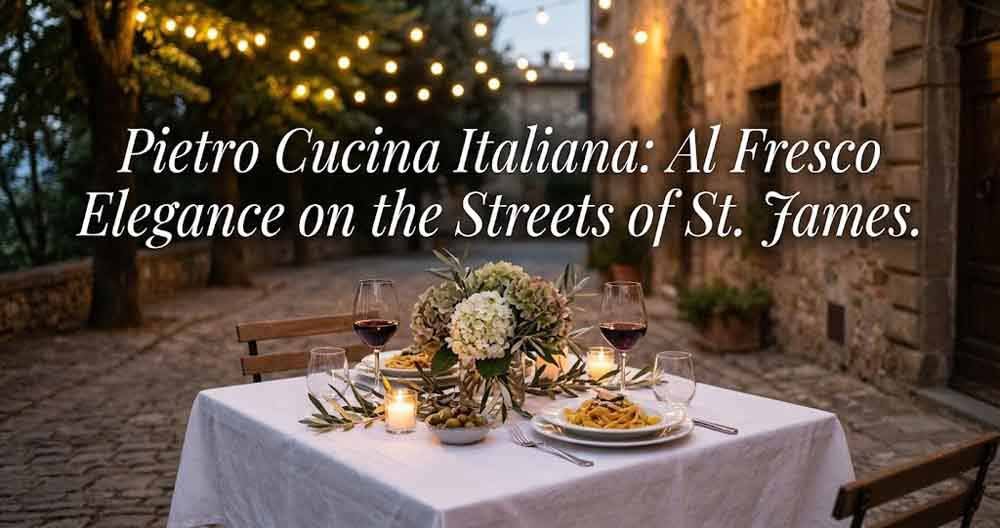
But the true magic of Pietro Cucina Italiana reveals itself outdoors. The garden and covered terrace — where soft music drifts through warm evenings and live jazz occasionally fills the summer air — is the kind of al fresco dining experience that Long Islanders typically have to drive to the Hamptons or fly to the Mediterranean to find. Here, under the canopy of an old St. James farmhouse, surrounded by the gentle hum of a North Shore evening, the garden at Pietro’s becomes a portal. You are no longer on North Country Road. You are in Trastevere, or the hills above Positano, or a courtyard in Lecce where time moves according to a different clock.
In the real estate world — and this is something my wife Paola and I think about constantly as we prepare for our 2026 boutique venture in Mount Sinai — spaces like this are what drive property value. They are what transform a zip code from a location into a destination. Pietro Cucina Italiana has not merely opened a restaurant in St. James; it has elevated the cultural gravity of the entire corridor.
The Pietro Effect: Hospitality as Personal Art
Perhaps the single most frequently cited detail in reviews of Pietro Cucina Italiana — across OpenTable, where the restaurant carries a 4.8-star rating from over 600 diners, across Yelp’s 150-plus reviews, across Tripadvisor’s growing archive of testimonials — is the presence of Pietro himself at the door (OpenTable, 2025). He greets. He engages. He remembers your name, your last order, your anniversary. He walks the room not as an owner surveying his domain but as a host tending to his family.
This is not an accident. This is the Cipriani inheritance — the understanding, encoded in four generations of Venetian hospitality since Giuseppe Cipriani opened Harry’s Bar in 1931, that the relationship between restaurateur and guest is not transactional but relational (Cipriani S.A., 2025). It is the same philosophy that has kept The Heritage Diner alive for twenty-five years in Mount Sinai: the recognition that in an era of automation, algorithmic recommendation, and friction-free digital ordering, the most disruptive technology a restaurant can deploy is a human being who cares.
Diners describe the experience in language that transcends the culinary. One reviewer called it feeling like you had returned to an Italian grandmother’s home. Another likened it to the warmth of Mamma Lombardi’s in its New York City heyday. A regular declared it simply the finest restaurant on Long Island. These are not the words of people describing a meal. These are the words of people describing a relationship.
St. James and the New North Shore Renaissance
Pietro Cucina Italiana did not arrive in a vacuum. St. James, that quiet hamlet tucked between Smithtown and Stony Brook along the historic spine of North Country Road, has been undergoing a quiet culinary awakening. Neighbors include NOCO, the farm-to-table New American restaurant at 429 North Country Road that champions local farms and sustainable sourcing. The five-course tasting menu temple EATmosaic operates just doors away at 418 North Country Road. Enology Wine Bar and Bistro has added a curated wine destination to the mix.
This clustering of quality is not coincidental. It is an expression of a broader trend reshaping Long Island’s North Shore — a movement away from chain homogeneity and toward the kind of bespoke, proprietor-driven experiences that define the most vibrant dining corridors in the world. In the same way that Greenwich Village once concentrated Italian excellence within a few blocks of Sixth Avenue and Bleecker, St. James is becoming a destination where the drive itself — east along 25A, past the farms and harbors and centuries-old churches — is part of the experience.
For those of us who live and work on the North Shore, this renaissance is personal. At Marcellino NY, we build English bridle leather briefcases by hand for a clientele that spans the globe, and we do it because we believe that bespoke craftsmanship — whether in leather, in food, or in the way a community is built — is the antidote to a world that mistakes efficiency for excellence. Pietro Molendini understands this. His twelve-hour duck confit is not efficient. His personal greeting at the door is not scalable. His sourcing trips to the Bronx for meat are not optimized. And that is precisely why they matter.
The Details: Everything You Need to Know
Pietro Cucina Italiana is located at 404 North Country Road, St. James, NY 11787. The restaurant is open Wednesday through Sunday for dinner service, with doors opening at 4:00 PM. Closed Monday and Tuesday.
Reservations are strongly recommended, particularly for weekend evenings and the summer garden season, and can be made through OpenTable or by calling (631) 862-6129.
Website: pietro631.com
Instagram: @pietrocucinaitaliana — with over 15,000 followers, their feed is a visual testament to the kitchen’s artistry.
Takeout and Delivery: Available by calling the restaurant directly. Also available through Grubhub for online ordering.
The restaurant is wheelchair accessible, family-friendly with high chairs and booster seats available, and accepts all major credit cards. On-site parking is available, and the outdoor garden and covered terrace offer al fresco dining in season with soft music and occasional live jazz performances.
For the YouTube-inclined: To understand the tradition of handmade Italian pasta that forms the backbone of Pietro’s menu, I recommend the extraordinary Pasta Grannies channel — a living archive of Italian nonnas demonstrating the art of pasta-making that has captivated nearly a million subscribers worldwide: https://www.youtube.com/channel/UCedsqpl7jaIb8BiaUFuC9KQ
There are restaurants you visit and restaurants you return to. Pietro Cucina Italiana, like the best of what the North Shore has to offer, belongs firmly in the second category. It is the kind of place that makes you protective of it — reluctant to share the secret, worried that the garden tables will fill before you arrive. But the truth is, places like this thrive on being known. They thrive on the fullness of the room, the warmth of the greeting, the shared recognition between host and guest that what is happening here — over a plate of handmade pappardelle, under the canopy of a St. James evening — is not merely dinner. It is civilization at its most elemental, its most beautiful, its most enduring.
Peter from The Heritage Diner writes about food, craftsmanship, and the culture of the North Shore from Mount Sinai, New York. The Heritage Diner has served the community at 275 Route 25A since 2000. Marcellino NY handcrafts bespoke English bridle leather briefcases from Huntington, NY — visit marcellinony.com. For apps, projects, and more, visit x9m8.com.