Some places build their reputation on spectacle — the grand opening, the celebrity drop‑in, the viral review cycle — and others earn it through something far steadier: the slow, earned weight of trust. Mirabelle Restaurant and Tavern at the Three Village Inn in Stony Brook, New York belongs firmly to the second category. Set within a colonial-era structure whose foundations predate the American Republic, Mirabelle operates at the intersection of history and hospitality, where a building that once sheltered the ambitions of a 19th-century shipping magnate now cradles the most rarefied aspirations of Long Island’s culinary culture.
For those of us who have spent decades building something on Long Island’s North Shore — whether a diner, a leather workshop, or a real estate vision — the story of Mirabelle is one we recognize intimately. It is the story of a craftsman’s relentless pursuit of an ideal, translated nightly into plates of duck duo and Faroe Island salmon, into firelit rooms where the evening air carries the memory of decades of exceptional meals. It is, at its root, the story of Guy Reuge: a Norman-born chef who arrived in America in 1973 with a classical French education and the quiet conviction that Long Island deserved a restaurant that could measure itself against the finest tables in the world.
A Colonial House, a Shipping Empire, and the Birth of an Inn
The structure at 150 Main Street was built in 1751 by Richard Hallock, and its walls have absorbed more American history than most buildings in the region. In 1835, Jonas Smith — one of the country’s most prominent ship owners and, by many accounts, Long Island’s first self-made millionaire — acquired the Hallock Homestead as a summer residence. (Edible Long Island, 2014) After his death in 1867, the property passed through several hands before a pivotal transformation in 1929, when Mrs. Frank Melville (known as Jennie) purchased and renovated it for use as a Women’s Exchange. What began as a tea room offering sandwiches and refreshments gradually grew into a full-service inn, and by 1939, the Three Village Inn was formally established as a country hospitality landmark.
The Inn’s historical significance extends further still. According to the venue’s own historical records, the property sits along what historians now call the Washington Spy Trail — a network of routes connected to the Culper Spy Ring that provided General Washington with critical intelligence during the American Revolution. (mirabelleatthreevillageinn.com, 2024) Dining at Mirabelle means sitting within walls that have, in a very literal sense, witnessed the forging of a nation. There is no manufactured provenance here. The patina is real.
Guy Reuge: France’s Gift to Long Island
Born in Saint-Lô, Normandy, and raised in the Loire Valley, Guy Reuge began his formal culinary apprenticeship at fourteen years of age in Orléans, France. By seventeen he had joined the Tour des Compagnons — the ancient French guild tradition for teaching traditional trades — and by twenty he was serving as personal chef to General Pierre Briquet, director of the École Polytechnique in Paris, occasionally cooking for French President Charles de Gaulle. (Master Chefs of France, 2020)
When Reuge arrived in New York in 1973, he embedded himself quickly into the city’s most demanding kitchens: René Pujol, Maxwell’s Plum, Le Cygne (one of only four New York restaurants to hold four New York Times stars in the 1970s), and eventually the Tavern on the Green — at one point among the highest-grossing restaurants in the United States. In 1984, alongside his wife Maria, a former editor at Gourmet magazine, Reuge opened the original Mirabelle in an old farmhouse in St. James. The restaurant collected the highest ratings from both Newsday and The New York Times and operated at the pinnacle of Long Island fine dining for twenty-five consecutive years. (Edible Long Island, 2014)
In 2009, Lessing’s Hospitality Group — the century-old Long Island institution whose roots trace to 1890 — invited Reuge to relocate the Mirabelle name and culinary philosophy to their historic Three Village Inn in Stony Brook. The reborn Mirabelle was met with immediate critical acclaim. Newsday’s Peter Gianotti awarded the restaurant its highest rating, writing that it improves upon the original in a handsome, serene setting. Joanne Starkey of The New York Times gave it a “Don’t Miss” designation — equivalent to the former four-star rating — and former Times critic Richard Scholem declared, simply, that no Long Island restaurant was better. (Long Island Press, 2023)
In 2006, the Maîtres Cuisiniers de France awarded Reuge the coveted La Toque d’Argent and the title Chef of the Year — a distinction shared with Jacques Pépin, Daniel Boulud, and André Soltner among its past honorees. The French government had previously recognized him with the Chevalier du Mérite Agricole in 2001 for his contributions to French culinary agriculture. He has appeared on the Food Network’s Barefoot Contessa with Ina Garten, authored the cookbook Le Petit Mirabelle, and has been profiled in Bon Appétit, Food Arts, New York magazine, and Gourmet.
A New Era: Chef Fernando Machado and the Living Legacy
Following Reuge’s retirement in 2022 after nearly four decades of service to the Mirabelle name, the mantle passed to Fernando Machado, who had worked alongside Reuge as Chef de Cuisine since 2009. Machado, who began his hospitality career in his native Portugal before coming to the United States in the 1990s, spent twelve years at Davenport Press in Mineola before joining Mirabelle. (Long Island Press, 2023)
“I learned to appreciate things like how you put the food on the plate, how it’s properly cooked, the taste,” Machado has said, reflecting on the Reuge years. The guiding philosophy he inherited is disarmingly simple and characteristically French: make dishes that are simple, but very tasty. Executed with precision. This is not the philosophy of a kitchen that chases trends. It is the philosophy of a kitchen that understands that excellence, like a well-tanned hide or a properly seasoned cast-iron skillet, is a function of discipline over time — not novelty for its own sake.
Lessing’s Executive Chef Billy Muzio and Executive Chef of the Three Village Inn Peter Baran round out a culinary leadership team that ensures both the fine dining Restaurant and the more casual Tavern maintain their shared commitment to quality sourcing and French-inflected technique. (mirabelleatthreevillageinn.com, 2024)
The Dining Experience: Two Rooms, One Standard
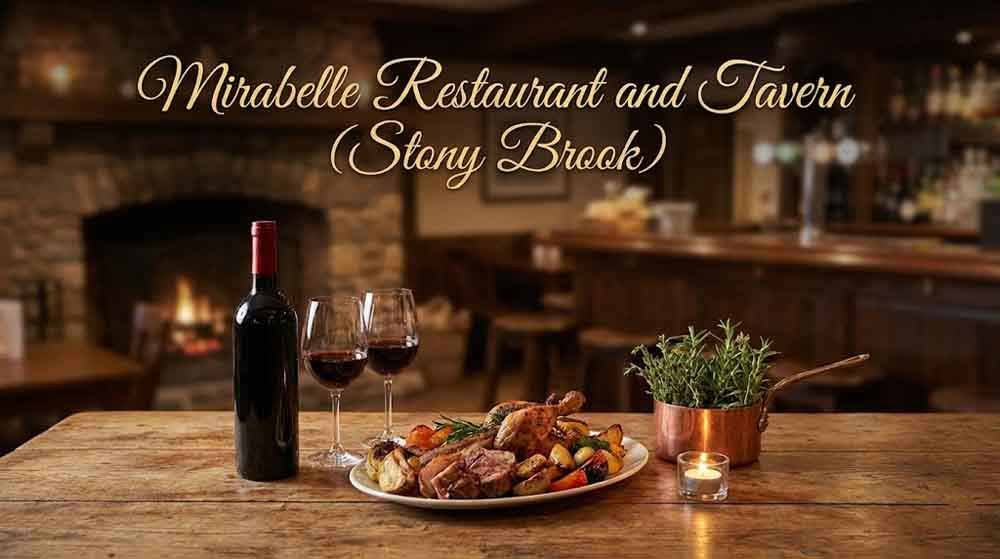
Mirabelle operates as two distinct but philosophically unified spaces within the Three Village Inn. Mirabelle Restaurant offers a refined fine dining experience anchored in what the kitchen calls its Fresh-Meets-French farm-to-table prix fixe — seasonal ingredients sourced locally and elevated through classical French technique. The Tavern presents a more approachable register of the same culinary intelligence, where the 1890 Burger (named in tribute to the founding year of Lessing’s Hospitality Group) shares a menu with Montauk Lobster Agnolotti, Crispy Deviled Eggs, and a Faroe Island Salmon accompanied by gulf shrimp-saffron risotto and Meyer lemon vinaigrette.
The signature Mirabelle Duck Duo — served with cauliflower Moroccan couscous, Medjool date purée, and port wine glacé — has become the kind of dish that regulars plan evenings around. The Prime New York Strip Steak arrives with bone marrow butter and crispy wedge fries at a price point ($69) that reflects both the provenance of the beef and the skill of its preparation. The wine program is award-winning, curated to complement both the classical French preparations and the more adventurous contemporary plates. (mirabelleatthreevillageinn.com menus, 2024)
The physical setting amplifies everything on the plate. Interior fireplaces create the amber warmth that is the antithesis of the cold, performative aesthetic of contemporary fine dining spaces. Guests on OpenTable with over 1,400 reviews award the restaurant 4.1 stars and repeatedly invoke the word “romantic” — the kind of adjective earned not through design consultants but through genuine atmospheric integrity. (OpenTable, 2026) The Tavern’s bar energy and the Restaurant’s refinement coexist in a building whose walls understand, at the structural level, what it means to endure.
Events, Weddings, and the Inn Above
The Three Village Inn’s position overlooking Stony Brook Harbor makes it one of the North Shore’s most coveted wedding and private event venues. The Inn offers Master and Signature Suites with luxury accommodations, complimentary high-speed internet, and exclusive access to the Stony Brook Village Shopping Center — positioning it as a destination stay for those attending events or simply seeking a North Shore retreat. The event spaces can accommodate everything from intimate anniversary dinners to large wedding receptions, with the backdrop of colonial architecture and harbor views providing a setting that no purpose-built events facility can authentically replicate.
Live music is offered on weekends (call ahead for the current schedule), and the kitchen offers off-premise catering for home, office, and custom locations — extending the Mirabelle standard beyond the Inn’s walls for those who require it. (OpenTable, 2026)
North Shore Dining and the Meaning of Place
From the vantage point of 25 years building a North Shore institution of my own, what Mirabelle represents is something larger than a restaurant profile can fully contain. It is proof that the North Shore of Long Island has never required anyone’s permission to be a place of genuine excellence. Stony Brook Village — with its colonial architecture, its harbor, its proximity to one of the nation’s great research universities — has always possessed the cultural and intellectual gravity to sustain world-class dining. What it required was a craftsman of Reuge’s caliber to arrive, put down roots, and insist on standards.
The lesson, for anyone building anything on this stretch of coast, is consistent with what Heidegger called dwelling — the act of truly inhabiting a place, of letting its particular character shape what you make there. Mirabelle does not import a concept to Stony Brook. Mirabelle grew out of Stony Brook, out of the farmhouse in St. James that preceded it, out of decades of locally sourced ingredients and relationships with the producers who understand this landscape. That rootedness is what luxury, properly understood, has always been. Not the imported and the branded, but the irreproducibly local.
A craftsman judges another craftsman’s work not by the surface but by the unseen decisions. The quality of the hide beneath the finish. The calibration of the oven before service. The restraint that keeps a sauce from obscuring the ingredient it is meant to honor. By that standard, Mirabelle Restaurant and Tavern at the Three Village Inn is a masterwork — one built over forty years of daily decisions made at the highest possible level of intention. It deserves its place among Long Island’s defining institutions, and it deserves your table.
Visit Mirabelle Restaurant and Tavern
Address: 150 Main Street, Stony Brook, NY 11790
Phone: (631) 751-0555
Website: mirabelleatthreevillageinn.com
Reservations: OpenTable
Hours: Lunch Wednesday–Saturday 12pm–4pm | Dinner Wednesday–Saturday 5pm–9pm | Sunday Dinner 4pm–8pm | Sunday Brunch 11am–3pm
One mile from the Stony Brook LIRR station.