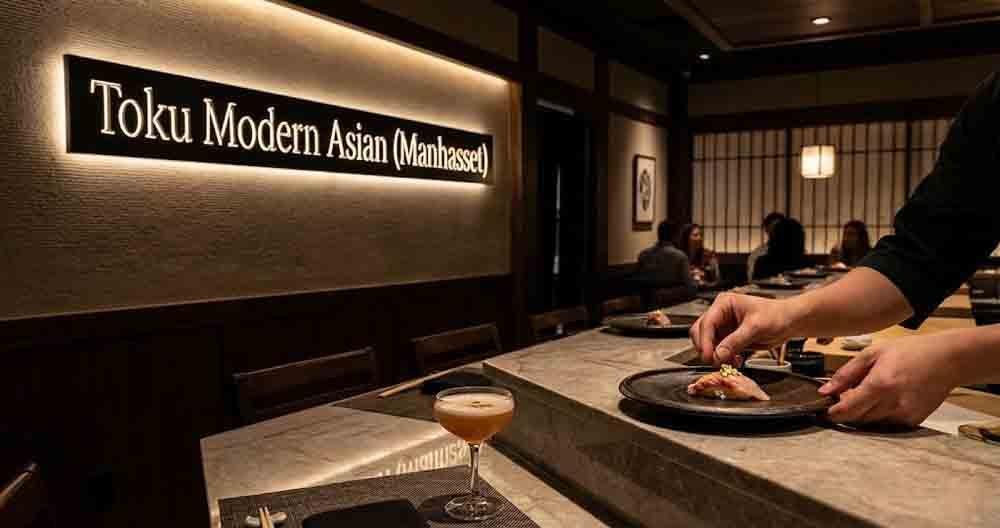
A quality of light reveals itself only in spaces shaped with intention — a glow that doesn’t come from fixtures or bulbs but from the way a room has been thought through, cared for, and quietly tuned until the illumination feels like part of its character rather than something applied to it. Walk into Toku Modern Asian on any given evening—past the Hermès and Prada storefronts, past the limestone facades of Americana Manhasset’s open-air promenade—and you encounter it immediately: a warm, amber luminescence radiating from a backlit onyx bar top, filtered through translucent glass panels that architect Peter Bentel conceived as a modern reinterpretation of a Japanese shoji screen. This is not ambient lighting. This is architecture performing the same function as the first cut of a sushi chef’s knife—setting the terms of an experience before a single word is spoken. Since 2007, Toku has occupied a singular position on Long Island’s Gold Coast dining landscape: a pan-Asian restaurant that operates with the precision of a Michelin-starred kitchen, the energy of a Manhattan lounge, and the deep familial roots of a multi-generational New York restaurant dynasty. As someone who has spent twenty-five years behind the griddle at The Heritage Diner in Mount Sinai—watching trends rise and collapse, watching operators chase flash over fundamentals—I can tell you that what Gillis and George Poll have built at Toku is something rarer than a great meal. It is an institution. And institutions, like the best leather or the best cast iron, only improve with sustained, disciplined use.
The Poll Brothers: A Century of New York Hospitality
The story of Toku is inseparable from the story of the Poll family, a saga that traces back nearly a hundred years to a food service business operating in New York City during the 1920s. Gillis and George Poll grew up in Manhasset—literally within walking distance of where Toku now stands—working as busboys and water carriers at their father James’s restaurant, Pappas, a high-volume seafood institution in Sheepshead Bay, Brooklyn (Poll Restaurants, 2024). Their brother Dean, the middle sibling, would go on to rescue Gallagher’s Steakhouse from closure in 2013, earning a resurrection that the New York Post compared to bringing a classic back from the dead (Wikipedia, 2025). But it was Gillis and George who stayed rooted on Long Island, branching off in 1980 to open Pappas Restaurant in Williston Park, which evolved into Riverbay Seafood Bar & Grill (Poll Restaurants, 2024).
The trajectory from that modest beginning to the current Poll Restaurants empire—Bryant & Cooper Steakhouse in Roslyn, Majors Steakhouse in East Meadow, Cipollini Trattoria, Bar Frites, Hendrick’s Tavern, The Bryant, and both Toku locations—represents one of the most sustained runs of independent restaurant excellence in the New York metropolitan area. When the New York Times rated the region’s steak houses, Bryant & Cooper was ranked number one (Long Island Pulse Magazine, 2012). The brothers have been honored by St. Francis Hospital, the Mental Health Association of Nassau County, the Sass Foundation for Medical Research, the North Shore Child & Family Guidance Center, the Children’s Medical Fund, and the JCC Sid Jacobson Center, and have supported over fifty charitable organizations across Long Island (Poll Restaurants, 2024). This is what the restaurant industry looks like when it is practiced as a vocation rather than a venture—when the operator’s name is on the wall not because of ego, but because of accountability.
Architecture as Philosophy: The Bentel & Bentel Design
Toku’s interior was designed by Bentel & Bentel Architects, the Locust Valley firm whose portfolio reads like a master class in the architecture of hospitality: The Modern at MoMA, Gramercy Tavern, Eleven Madison Park, Le Bernardin, and Craft, among dozens of others (Bentel & Bentel, 2007). For Toku, the firm faced a particular challenge—transforming a long, narrow retail space within the Americana Manhasset complex into something that felt neither cavernous nor claustrophobic. Their solution was elegant in its conceptual clarity. Long, rectangular planes of wenge wood, blackened steel, and black slate alternate with surfaces of backlit onyx, white leather, and white-washed wood plank, interlocking along the central axis of the restaurant in what the architects describe as a spatial expression of yin and yang (Bentel & Bentel, 2007).
There are no conventional light fixtures anywhere in the space. All illumination comes from concealed sources or candlelight. A massive fabric lantern suspended from a skylight introduces natural light into the core of the restaurant during the day, and at night, concealed fixtures allow the dome to glow from within. Wooden bells from nineteenth-century mainland China hang above the sushi bar. Suspended sake drums behind the main bar add what one journalist described as a sense of jubilant ceremony (Americana Manhasset Concours d’Elegance, 2018). The window facade along Northern Boulevard opens completely during warmer months, allowing the energy of the Miracle Mile to flow directly into the bar and lounge. I think about this kind of intentionality constantly at the Heritage Diner and at my Marcellino NY leather workshop in Huntington. Whether you are curing a side of English bridle leather at the tannery or designing a restaurant that must endure eighteen years of nightly service, the unseen structural decisions—the ones no guest will ever consciously register—are the ones that determine longevity.
The Menu: Northeast Asia Through a Global Lens
Toku holds a two-star review from the New York Times and a three-star review from Newsday, distinctions that place it among the most critically recognized Asian restaurants on Long Island (Yelp, 2024). The cuisine is predominantly Japanese, with Chinese influences and deliberate touches of Thai, Korean, and Southeast Asian technique—a reflection of the Poll brothers’ own extensive dining experiences across the Pacific Rim. The menu, as George Poll has stated, was built by assembling their personal favorites from years of international travel and adding proprietary twists (OpenTable, 2026).
The structural genius of Toku’s menu is its flexibility. Guests can approach it as a traditional three-course progression—appetizer, entrée, dessert—or they can build an evening exclusively from the sushi bar, the robata grill, and the appetizer menu. Rock Shrimp Tempura with spicy aioli, Tuna Crispy Rice, the Toku Special Roll layered with spicy tuna, avocado, and seared filet mignon, Miso Black Cod, Peking Duck Tacos, Mongolian Filet Mignon, and Pad Thai all coexist on a carte that encourages communal ordering and shared plates (LI Blogger, 2025). The sake program is serious, ranging from clean, dry expressions ideal for sashimi to complex bottles with notes of lychee and muscat, and the cocktail program—anchored by the now-iconic Lychee Martini—holds its own against any bar in Nassau County.
There is also a daily rotating Bento Box at lunch and a dedicated prix fixe option, and the Aventura, Florida location now offers a fourteen-course Omakase experience curated by the executive sushi chef in a private dining room (OpenTable, 2026). This kind of range—from casual Tuesday lunch to a tasting menu worthy of a destination dinner—demonstrates the operational depth that only a nearly four-decade restaurant family can deliver.
Americana Manhasset: The Ecosystem of Aspiration
Understanding Toku requires understanding its ecosystem. Americana Manhasset is not a mall. It is a 220,000-square-foot, open-air luxury shopping center anchoring the stretch of Northern Boulevard known locally as the Miracle Mile. Developed by Castagna Realty since 1956 and redesigned by architect Peter Marino with landscape architecture by Oehme van Sweden, the complex houses approximately sixty boutiques including Louis Vuitton, Chanel, Hermès, Gucci, Prada, Dior, Cartier, Tiffany & Co., and Van Cleef & Arpels (Americana Manhasset, 2026). Located just twenty miles from Manhattan and accessible via Exit 36 off the Long Island Expressway, the Americana functions as Long Island’s answer to Madison Avenue—a curated environment where retail, dining, and aesthetic experience converge into something greater than the sum of its parts.
Toku and Cipollini Trattoria are the Americana’s two anchor restaurants, both operated by the Poll brothers. The placement is not incidental. It positions Toku’s clientele within a consumer environment defined by craftsmanship, exclusivity, and considered taste—the same values that drive a client to commission a bespoke Marcellino NY briefcase or to seek out a property with provenance on the North Shore rather than settling for new construction without character. For Paola and me, as we prepare to launch Maison Pawli in 2026, the Americana Manhasset model is instructive: it proves that when you curate an environment with sufficient rigor, the businesses within it elevate each other.
Private Events, Catering, and the Expansion to Aventura
Toku’s private dining capacity is substantial and often underappreciated. The restaurant accommodates corporate gatherings of thirty, sit-down celebrations for fifty, and cocktail receptions for up to one hundred in its dedicated private dining area, with the full restaurant available for events hosting up to one hundred fifty seated or two hundred fifty for cocktails (OpenTable, 2026). The off-premise catering division provides complete event planning with chefs, kitchen staff, trained servers, and bartenders for events ranging from an intimate chef’s tasting for twelve to outdoor galas for five hundred under tent.
In a significant expansion move, the Poll brothers brought Toku to Aventura, Florida, opening within the Aventura Mall—one of South Florida’s premier retail destinations, now accessible via Brightline rail. The Aventura location features a fifty-three-seat bar area, plush banquettes, and an open kitchen designed to showcase the culinary team’s precision (Modern Luxury, 2025). The Florida outpost maintains the same design DNA rooted in the nineteenth-century Japanese home aesthetic, the same menu philosophy of sharable modern Asian fare, and the same commitment to handcrafted cocktails and curated sake that define the Manhasset original. The expansion confirms what those of us in the hospitality industry already knew—the Poll formula is not site-dependent. It is culture-dependent.
Community, Philanthropy, and the North Shore Legacy
Perhaps what resonates most deeply about the Poll brothers’ operation, from the perspective of someone who has run a neighborhood institution for a quarter century, is their commitment to the communities that sustained them. The family’s philanthropic record includes direct involvement with St. Francis Hospital, the Mental Health Association of Nassau County, the Sass Foundation for Medical Research, the North Shore Child & Family Guidance Center, the Children’s Medical Fund, and the JCC Sid Jacobson Center (Poll Restaurants, 2024). They have supported more than fifty charitable organizations across Long Island. Their father, well into his nineties, continued visiting the restaurants every night. Their mother, Alexandra, provided the initial capital that got the first restaurant off the ground. As Gillis once reflected on their trajectory: the overnight success was a lifetime in the making (Long Island Pulse Magazine, 2012).
This is the connective tissue between a place like Toku and a place like The Heritage Diner. The menus could not be more different. The price points occupy different galaxies. But the underlying architecture is identical: family ownership, local roots, relentless consistency, and the understanding that a restaurant is not a business that serves food—it is a community institution that happens to express itself through the kitchen. For those of us on the North Shore who believe that the fabric of a place is woven from the permanence of its institutions, Toku Modern Asian is an essential thread. It is one of the finest restaurants on Long Island, and it has earned that distinction the only way it can be earned—through eighteen years of showing up, every day, and doing the work.
Toku Modern Asian — Manhasset 2014 Northern Boulevard, Manhasset, NY 11030 Phone: (516) 627-8658 Website: tokumodernasian.com Reservations: OpenTable Instagram: @tokurestaurants Poll Restaurants: pollrestaurants.com
Hours (Manhasset): Sunday–Wednesday: 12:00 PM – 10:00 PM Thursday–Friday: 12:00 PM – 11:00 PM Saturday: 12:00 PM – 12:00 AM
Toku Modern Asian — Aventura 19575 Biscayne Boulevard, Suite 1109, Aventura, FL 33180 Phone: (305) 465-8658
Peter from The Heritage Diner — 275 Route 25A, Mount Sinai, NY — is a restaurateur, bespoke leather craftsman at Marcellino NY, and real estate developer preparing the 2026 launch of Maison Pawli with his wife, Broker Paola. He holds graduate degrees in Philosophy from Long Island University and The New School University in New York City.