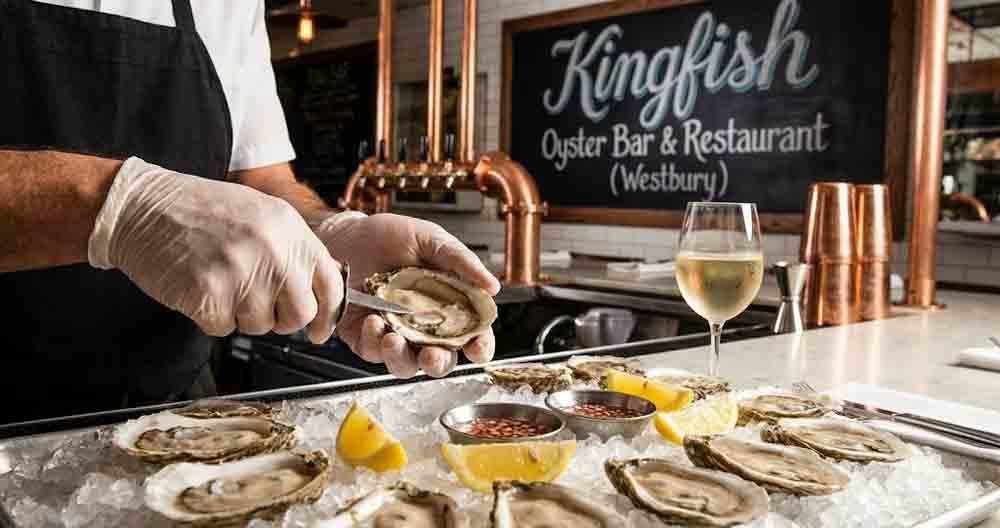
When the brass and glass doors of The Vanderbilt luxury residence swung open in the summer of 2018, Westbury gained something far more consequential than another place to eat. Housed within an $85 million architectural statement built by The Beechwood Organization on land that once trembled beneath the wheels of the original Vanderbilt Cup Race cars, Kingfish Oyster Bar & Restaurant arrived as the crowning culinary jewel of Nassau County’s most ambitious residential development in a generation. Behind the stove stood a man whose name, on Long Island, carries the gravitational weight of a regional institution — Chef Tom Schaudel, a CIA-trained virtuoso with more than fifty years in the restaurant trenches, a guitar player who fronts a band called Hurricane, and the author of two riotously funny memoirs about the beautiful insanity of feeding people for a living. For Peter from The Heritage Diner — a man who has spent a quarter century flipping eggs, searing burgers, and understanding the irreplaceable texture of honest hospitality — Kingfish represented the apex of what happens when a veteran restaurateur bets everything on provenance, precision, and the raw, briny poetry of the Atlantic Ocean.
The Architect: Tom Schaudel and Fifty Years of Long Island Fire
To understand Kingfish, one must first reckon with the extraordinary career of its creator. Thomas G. Schaudel started washing dishes at fifteen years old in Carle Place, lying about his age to get the gig, driven by the adolescent need to fund his electric guitar habit (Patch, 2010). He enrolled at the Culinary Institute of America in Hyde Park and graduated in 1973, then apprenticed under Sandy Curti, a sous chef from the legendary Le Pavillon in Manhattan (Long Island Pulse, 2010). In 1982, Schaudel pooled ten thousand dollars with two friends and opened Panama Hatties in Huntington Station — and from that scrappy launch pad, he built what industry insiders would eventually call a culinary empire.
The roster of restaurants that Schaudel has opened, reinvented, or resurrected reads like a cartography of Long Island dining itself: Angelfish in Long Beach, Lemongrass in Roslyn, Coolfish in Syosset, Thom Thom in Wantagh, 107 Forest Avenue in Locust Valley, Rockfish in Huntington, Jedediah Hawkins Inn in Jamesport, PassionFish in Westhampton Beach, Spring Close House in East Hampton, Downtown Grille & Wine Bar in Montauk, Petulant Wino in Aquebogue, Jewel in Melville, and Be Ju Sashimi Bar in Melville (aMano Restaurant, 2024). He was the inaugural inductee into the Long Island Dining Alliance’s Hall of Fame. The press dubbed him “the Kingfish of Long Island restaurateurs” and “the Sean Connery of Cuisine” (Patch, 2010). He estimated, with characteristic bluntness, that he had served more than two million people across four decades.
That nickname — Kingfish — was no accident when it came time to christen the restaurant at The Vanderbilt. It was Schaudel stamping his own mythology onto a 150-seat dining room and seasonal patio, declaring that the crown of his career would be a monument to the thing he loved most: the seafood of the Atlantic Rim.
The Setting: Inside The Vanderbilt
The Vanderbilt itself deserves attention, because the building and the restaurant were conceived as a single, indivisible experience. Designed by Stonehill Taylor and developed by Beechwood Homes — one of Long Island’s largest residential builders — the six-story structure features an Old World-styled facade, a hand-blown glass chandelier in the lobby, custom bronze and glass entry tables, and historical nods to the site’s legacy as home to the former Vanderbilt Raceway and the adjacent Roosevelt Field airstrip from which Charles Lindbergh launched his transatlantic solo flight in 1927 (NY Real Estate Journal, 2016). The complex houses luxury rental apartments and extended-stay hotel suites, a state-of-the-art fitness center, an English garden, a private courtyard with an outdoor heated pool, and — at its commercial and spiritual center — the restaurant.
Kingfish occupied the lobby level with an expansive, airy dining room appointed in contemporary neutrals, natural materials, and nautical accents that suggested the deck of a well-captained vessel rather than the expected brass-and-mahogany oyster bar clichés. The seasonal outdoor patio offered al fresco dining that capitalized on The Vanderbilt’s manicured landscaping. Guests entered through the building’s luminous lobby and descended into a space that Schaudel himself described with deliberate modesty — he wanted Kingfish to feel like a comfortable pair of sneakers, a place where you could order a big meal with a bottle of wine or simply sit at the bar and shuck oysters with a soda (Nassau Illustrated, 2018).
Atlantic Rim: A Culinary Philosophy Born on Long Island
Schaudel coined the term “Atlantic Rim” to describe Kingfish’s menu — a phrase that captured the cuisine’s orbit around the coastal waterways, bays, and inlets stretching from New England through the Mid-Atlantic and down to the Carolinas, with particular reverence for the shellfish beds and fishing grounds of eastern Long Island (TripAdvisor, 2018). The concept was more than marketing. It was a philosophical position. In an era when every upscale restaurant in the tri-state area claims farm-to-table lineage, Schaudel’s Atlantic Rim declared a tighter radius of authenticity: this food comes from the waters and farms within a day’s drive of your table, and the chef who prepares it has been walking those shores and visiting those purveyors for half a century.
The raw bar was the restaurant’s pulsing heart. Oysters — locally grown specifically for Schaudel by regional aquaculture partners — were served freshly shucked, grilled on the half shell, and fried in salads. The menu extended into lobster knuckle sandwiches and grilled lobster rolls, a pan-roasted swordfish plated with parmesan risotto and mushrooms sourced from Orient Point, and a grilled yellowfin tuna served alongside warm fingerling potato salad, green beans, cherry tomatoes, and quail egg (Long Island Press, 2018). The skillet-seared New York strip, accompanied by grilled jumbo shrimp, whipped parsnips, green beans, and a local merlot demi-glace, anchored the carnivorous offerings with the authority of a chef who understood that even a seafood house must honor the landlocked appetite.
Desserts carried the same unfussy elegance — a cinnamon apple crisp served in a cast-iron skillet with vanilla gelato, and a Rocky Road bar composed of chocolate cake, marshmallow, wet walnuts, and triple chocolate gelato (Long Island Weekly, 2018). The cocktail program featured inventive compositions like the Vanderbilt — Maker’s Mark, orange marmalade, solerno, tangerine juice, and egg whites — and the Spice and Brine, a bracing combination of Ketel One, pepperoncini juice, and a smoked blue cheese-stuffed banana pepper. The wine list leaned heavily into local Long Island vintages, reflecting Schaudel’s lifelong advocacy for the region’s winemakers, including his own proprietary wines produced at Paumanok Vineyards in Aquebogue (Northforker, 2017).
A Room That Told Stories: Events, Community, and the Oyster Tuesday Tradition
Beyond its daily service, Kingfish functioned as a community anchor within The Vanderbilt complex. The restaurant hosted corporate and private events in rooms that accommodated up to ninety guests, with cocktail parties, sit-down dinners, and buffet packages tailored for all occasions and budgets (OpenTable, 2026). Tuesday nights became a local institution — the restaurant ran an oyster special that drew devoted regulars who would arrive early for happy hour, order half-price oysters, and settle in for an evening of bivalve indulgence before transitioning to full dinner service.
The Vanderbilt’s management leveraged Kingfish as a centerpiece for broader cultural programming. In January 2020, The Purist magazine and Beechwood Homes co-hosted a “Beauty Inside and Out” wellness panel at the restaurant, where guests were greeted with mimosas, freshly shucked oysters, sushi, and a lunch buffet prepared by Schaudel himself (The Purist, 2020). These events positioned Kingfish not merely as a dining destination but as a cultural salon — a gathering place where food, wellness, lifestyle, and intellectual curiosity converged under the same roof.
The restaurant also became a craft beer destination in its own right. Untappd check-ins from 2019 and 2020 reveal a curated tap list favoring local and artisanal producers — Greenport Harbor Brewing Company’s Velvet Sea, Five Boroughs Brewing Co.’s Tiny Juicy IPA and Pilsner, and Lexington Brewing’s Kentucky Vanilla Barrel Cream Ale among the featured pours (Untappd, 2020). For a fine dining seafood restaurant, this commitment to locally brewed craft beer was yet another expression of Schaudel’s Atlantic Rim philosophy — everything within arm’s reach, everything honest.
The Chef as Author, Musician, and Philosopher
What set Kingfish apart from countless other upscale seafood operations on Long Island was the irreplaceable personality of its creator. Schaudel is not merely a cook — he is a raconteur, a rock guitarist, a wine producer, a published memoirist, and, in the quiet moments between services, something of a philosopher about the human comedy that unfolds nightly in dining rooms across the country. His first book, Playing with Fire: Whining & Dining on the Gold Coast (2008), cataloged the most absurdly memorable customer encounters from four decades of service — a ninety-year-old serial bird-flipper, an elderly gentleman smuggling a metal clipboard menu holder down his pants, a woman who got drunk, passed out, got revived, and aced an intervention all within twenty minutes (Amazon, 2008). His sequel, A Second Helping: Whining and Dining on Long Island (2022), continued the tradition with five hundred pages of industry hilarity drawn from fifty years behind the line (Barnes & Noble, 2022).
This literary and philosophical dimension infused Kingfish with an atmosphere that transcended its menu. When Schaudel told the Nassau Illustrated that he wanted guests to “feel like that comfortable pair of sneakers,” he was articulating a hospitality philosophy that Peter from The Heritage Diner understands at the molecular level — the idea that a restaurant’s true currency is not its oyster selection or its wine list, but the invisible feeling of belonging that a great operator cultivates through thousands of small, deliberate acts of care. Schaudel’s appearances on the Food Network’s Door Knock Dinners — where he cooked Cheerios-Encrusted Chicken and then jammed the blues with his band, The Def Chefs — and his CUNY TV interview cemented his reputation as Long Island’s most charismatic culinary export (Food Network; CUNY TV).
Legacy, Closure, and the Enduring Lesson of Provenance
Kingfish Oyster Bar & Restaurant has since closed its doors at The Vanderbilt, joining the long list of Schaudel-conceived establishments that blazed brightly, served magnificently, and eventually yielded the stage to whatever comes next. In the restaurant industry, this is not failure — it is the natural rhythm of a career built on reinvention. Schaudel himself has opened more than twenty restaurants across Long Island, and the closing of any single chapter only makes room for the next. His current ventures — A Lure Chowder House & Oyster-ia in Southold, aMano in Mattituck, and By Hand Catering — continue to channel the same Atlantic Rim ethos that animated Kingfish (aMano Restaurant, 2024).
For those of us who work in this industry — who understand that a restaurant is not a building but a living organism sustained by the passion and stubbornness of the people who pour themselves into it every single day — Kingfish remains an important case study in what is possible when a world-class chef, a visionary developer, and the raw materials of Long Island’s natural bounty converge in a single room. The oysters Schaudel served were not just food. They were arguments for locality, for craft, for the idea that the best things in life come from the waters and farms closest to where you sit.
As someone who has spent twenty-five years behind the griddle at The Heritage Diner in Mount Sinai, Peter knows this truth intimately. The same philosophy that drove Schaudel to grow his own oysters and make his own wine is the same instinct that compels a diner owner to source his eggs from a farm he can drive to in fifteen minutes, or a leather craftsman at Marcellino NY to hand-select English bridle hides from tanneries with two-hundred-year lineages. Provenance is not a trend. It is the foundation of everything worth building — whether it is a bespoke briefcase, a boutique real estate venture on the North Shore, or a plate of freshly shucked oysters served in the lobby of a building named for the family that invented automobile racing in America.
Restaurant: Kingfish Oyster Bar & Restaurant (Permanently Closed)
Address: 990 Corporate Drive, Westbury, NY 11590 (Located in The Vanderbilt)
Phone: (516) 640-5777
Website: kingfishoysterbar.com (no longer active)
Chef/Owner: Tom Schaudel — tomschaudelchef.com
DoorDash: doordash.com/store/kingfish-oyster-bar-westbury-706653/ (no longer active)
Google Rating: 4.1 stars (98 reviews)
OpenTable Rating: 4.3 stars (472 diners)
TripAdvisor Rating: 4.0 stars (21 reviews)
Cuisine: Atlantic Rim Seafood, American Fine Dining
Price Range: $30–$60 per person
Tom Schaudel’s Books:
- Playing with Fire: Whining & Dining on the Gold Coast (2008)
- A Second Helping: Whining and Dining on Long Island (2022)
Tom Schaudel’s Current Restaurants:
- A Lure Chowder House & Oyster-ia — Southold, NY
- aMano — Mattituck, NY
Written by Peter from The Heritage Diner — 275 Route 25A, Mount Sinai, NY. Peter holds graduate degrees in Philosophy from Long Island University and The New School in New York City. He is the founder of Marcellino NY, a bespoke English bridle leather workshop in Huntington, and co-founder with his wife Paola of Maison Pawli, a boutique real estate venture launching in 2026 on Long Island’s North Shore.