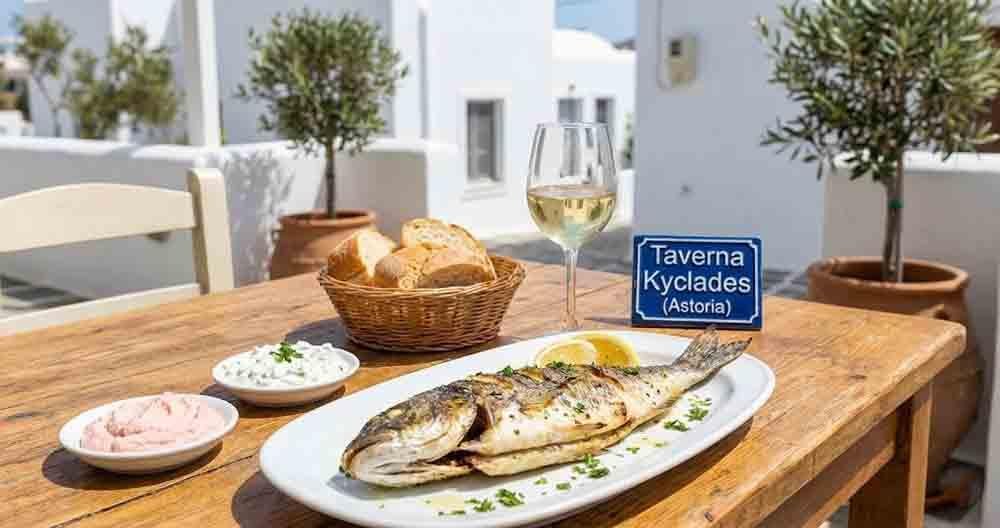
Somewhere between the thunderclap of a grilled octopus tentacle hitting a white-hot plancha and the faint mineral scent of Aegean olive oil pooling beneath a whole bronzino, a man named Ardian Skenderi reinvented what it means to run a neighborhood restaurant in New York City. Standing six-foot-six—a former professional basketball player on the Albanian national team who traded jump shots for julienned lemons—Skenderi has, since purchasing the original Taverna Kyclades in 2001, built one of the most consequential seafood restaurants in the five boroughs. Not through Michelin-chasing theatrics or Instagram-driven molecular plating, but through an almost monastic devotion to a single principle: the ingredient itself is the entire argument. That philosophy has earned him recognition in the MICHELIN Guide (Michelin Guide USA, 2024–2025), praise from Frank Bruni in The New York Times, celebrity devotees ranging from George Clooney to Kevin Bacon, and a permanent place in the culinary identity of Astoria, Queens. For Peter from the Heritage Diner—someone who has spent twenty-five years understanding the sacred geometry of a neighborhood restaurant—Kyclades represents the platonic ideal: a place where the food never lies and the line out the door never shortens.
From the Albanian National Team to the Fulton Fish Market
The origin story of Taverna Kyclades reads less like a restaurant biography and more like a Homeric odyssey stripped of its mythology and replaced with pure grit. Ardian Skenderi spent seven years, from 1988 to 1995, as a professional point guard—first for the Albanian national basketball team, then for clubs in Athens, Greece (Queens Chef Project, 2013). When he arrived in New York, his first job was cleaning a basement twice a week. From there, he took a busboy position at Stamatis, a Greek restaurant in Astoria. When the sous chef quit without warning, Skenderi—who had never cooked professionally—stepped into the kitchen, took meticulous notes during fourteen-hour shifts, and began a self-taught education in Greek seafood preparation that would eventually produce one of Queens’ most celebrated restaurants (QNS, 2013). By 1997, he was the sous chef at the original Taverna Kyclades, then a smaller and less polished operation. Two years later, the owner sold the restaurant to Skenderi, and the transformation began.
What Skenderi understood intuitively—and what so many restaurateurs learn too late or never at all—is that the distance between mediocrity and mastery is measured not in recipes but in sourcing. To this day, he personally visits the Fulton Fish Market in Hunts Point two to five times each week before sunrise, selecting the European sea bass, red snapper, Spanish octopus, and swordfish that will be on plates by noon (QNS, 2013). The restaurant exhausts nearly twenty cases of extra virgin olive oil per week. There are no specials on the menu, because as Skenderi has been quoted, “everything here is special” (QNS, 2013).
The Kyclades Table: What to Order and Why It Matters
Named after the Cyclades—the crescent of Greek islands in the Aegean Sea that includes Santorini, Mykonos, and Naxos—Taverna Kyclades practices a culinary minimalism that mirrors the whitewashed simplicity of those island villages. The menu is not long. It does not need to be. Every dish operates on the same architectural principle: impeccable raw materials, restrained preparation, and a finishing hand that knows when to stop.
The grilled octopus arrives with a char so precise it achieves the impossible balance between caramelized crust and yielding, almost buttery interior flesh, dressed in nothing more than olive oil and red wine vinegar. The Infatuation called the restaurant’s whole fish preparations the centerpiece of any order, noting that whatever is freshest should anchor the table alongside their now-legendary lemon potatoes—tart, starchy, and addictive in a way that defies their elemental simplicity (The Infatuation, 2025). The saganaki, pan-fried Greek cheese delivered sizzling, converts even skeptics; Frank Bruni of The New York Times admitted he arrived unimpressed by the idea and left a devotee (NY Times Diner’s Journal, 2009). The Michelin inspectors specifically praised the garlicky, bubbling-hot crab-stuffed clams and the trio of skordalia, tzatziki, and taramosalata served with toasted pita triangles (Michelin Guide USA, 2025). The spanakopita is considered by multiple reviewers to be among the finest in the city—layers of crisp phyllo encasing a filling that tastes of actual spinach rather than seasoned filler.
Every meal at Kyclades concludes the same way: a complimentary slice of galaktoboureko, the syrup-soaked phyllo custard that is baked fresh each morning and runs out each evening. It is not a restaurant that believes dessert should be an afterthought. It is a restaurant that believes generosity is the entire point.
Celebrity Faithful and the Astoria Pilgrimage
In an era when celebrity restaurant sightings typically cluster in SoHo prix-fixe temples and Williamsburg speakeasies, the fact that Taverna Kyclades regularly hosts A-list visitors on Ditmars Boulevard in Astoria speaks to something deeper than trendiness. George Clooney, Bill Murray, Jodie Foster, Kevin Bacon, basketball legend Charles Oakley, and actor Adrien Brody have all made the trek—many of them returning repeatedly (Astoria Post, 2018; Give Me Astoria, 2014). Murray, famously, enjoyed his visit so much that he returned with Clooney. These are not paparazzi-driven appearances at brand-launch pop-ups. They are the quiet endorsements of people who eat everywhere and keep coming back to a family-owned restaurant in Queens because the octopus is transcendent and the portions are the size of the man who cooks them.
For anyone who runs a restaurant that depends on neighborhood loyalty rather than venture capital marketing—and Peter from the Heritage Diner knows this truth in his bones after a quarter century in Mount Sinai—the celebrity return visit is the ultimate validation. It means the food won on its own terms. No influencer campaign, no publicist, no reservation gatekeeping. Just a man at a fish market before dawn, and a kitchen that refuses to cut corners.
Three Locations, One Standard: The Kyclades Empire
Taverna Kyclades originally opened in 1996 at a smaller location on Ditmars Boulevard. Under Skenderi’s ownership from 2001, the restaurant grew into its current 95-seat flagship at 36-01 Ditmars Boulevard, where the blue and white awning—in the colors of the Greek flag—has become as recognizable to the neighborhood as the N train station at the end of the line (Time Out New York, 2024). The staff, dressed in Greek flag blue and white, operates around a taxidermy swordfish mounted on exposed brick—the kind of unpretentious décor that signals a kitchen focused on what comes out of it rather than what hangs on the walls.
In 2013, owners Caterina and Ardian Skenderi expanded to the East Village at 228 First Avenue, giving Manhattanites access to the same menu that had been generating ninety-minute Friday-night waits in Astoria (NYC Tourism, 2024). The East Village location is smaller, slightly more contemporary in feel, but faithful to the original kitchen’s standards. A third location followed in 2018 at 39-28 Bell Boulevard in Bayside, Queens, occupying the former home of Il Borgo Italian Kitchen (QNS, 2017). Each location maintains independent kitchen operations while adhering to the sourcing and preparation standards that Skenderi established at the flagship.
Across all three locations, Taverna Kyclades carries a combined Google rating of 4.5 to 4.6 stars across nearly eight thousand reviews—a statistical near-impossibility for a restaurant that has been operating for close to three decades. On Tripadvisor, the Astoria flagship holds the number-one ranking among 591 restaurants in the neighborhood (Tripadvisor, 2025). Zagat has lauded it for serving the finest seafood in Queens at a modest price point (Zagat). The numbers tell a story that the food confirms.
Philanthropy and the Neighborhood Covenant
Ardian Skenderi’s commitment extends well beyond his own kitchen. In June 2022, he participated in the 35th Annual Chefs’ Tribute to Citymeals on Wheels, joining a roster that included Daniel Boulud, Charlie Palmer, and Jacques Torres to serve iconic dishes to roughly one thousand guests at Cipriani South Street in downtown Manhattan (Bayside Patch, 2022). The event has raised over twelve million dollars for homebound New Yorkers who depend on Citymeals on Wheels—a program that delivers approximately two million meals annually to nearly twenty thousand recipients across the city.
Skenderi’s own words on the occasion carry a weight that transcends the usual charitable press release: “We all need to recognize that we must help and give back to our community. While some of us were able to get to a place of peace and comfort, there are others that just need a little help to reach that place as well” (Bayside Patch, 2022). This is the language of a man who cleaned basements before he cleaned fish—who understands that a restaurant, properly operated, is not merely a business but a contract with the neighborhood it serves. At the Heritage Diner in Mount Sinai, Peter has lived that same contract for twenty-five years. The ingredients and the cuisine differ, but the covenant is identical.
Astoria, the Cyclades of Queens
To understand Taverna Kyclades, you must first understand Astoria. When fur merchant Stephen Halsey founded the area in 1839 as Hallett’s Cove—later petitioning to rename it after John Jacob Astor, America’s first multi-millionaire—no one could have predicted that a century and a half later, the neighborhood would become the epicenter of Greek culinary culture in the Western Hemisphere. Post-World War II immigration brought waves of Greek families to Astoria, and by the mid-1990s, Greek residents constituted a significant portion of the neighborhood’s population (People of NYC / Columbia University, 2023). Ditmars Boulevard became the axis of this community, lined with tavernas, bakeries, and cafés that served as both dining rooms and public squares.
Taverna Kyclades sits at the intersection of that immigrant legacy and the modern reality of a neighborhood that has diversified enormously while maintaining its Hellenic culinary identity. The name itself is a geographical declaration: the Kyclades—sometimes spelled Cyclades or Kikladhes—are the ring of Aegean islands known for their white architecture, crystalline waters, and a fishing-and-farming food culture that prizes freshness above all else. NYC Tourism notes that the restaurant’s wine list features rising varietals from Santorini, one of the most prominent islands in the chain (NYC Tourism, 2024). It is a restaurant that does not merely reference its origins. It embodies them.
Essential Information
Flagship — Astoria 36-01 Ditmars Boulevard, Astoria, NY 11105 Phone: (718) 545-8666 Hours: Monday–Friday 12:00 PM – 10:00 PM | Saturday–Sunday 11:30 AM – 10:00 PM Google Rating: 4.6 stars (5,107 reviews)
East Village — Manhattan 228 First Avenue, New York, NY 10009 Phone: (212) 432-0011 Hours: Monday–Thursday 4:00 PM – 10:00 PM | Friday–Sunday 12:00 PM – 11:00 PM Google Rating: 4.5 stars (1,126 reviews)
Bayside — Queens 39-28 Bell Boulevard, Bayside, NY 11361 Phone: (718) 631-2000 Hours: Monday–Friday 12:00 PM – 10:30 PM | Saturday 12:00 PM – 11:00 PM | Sunday 12:00 PM – 10:00 PM Google Rating: 4.6 stars (1,564 reviews)
Website: tavernakyclades.com Instagram: @tavernakyclades TikTok: @tavernakyclades Delivery: Available via Postmates, Seamless, and direct ordering through tavernakycladestogo.com Reservations: Not accepted at the Astoria flagship — walk-in only. Check individual locations for current reservation policies. Price Range: $$ (Moderate) MICHELIN Guide: Listed in the 2024 and 2025 MICHELIN Guide USA Tripadvisor: Ranked #1 of 591 restaurants in Astoria
There is a particular Greek word—filotimo—that has no precise English translation. It encompasses honor, love of family, generosity of spirit, and a duty to leave things better than you found them. Ardian Skenderi, the Albanian who became the most celebrated Greek chef in Queens, runs three restaurants on this principle without ever needing to name it. The octopus speaks for itself. The line out the door speaks louder. And the galaktoboureko at the end of the meal—complimentary, baked fresh that morning, gone by nightfall—speaks loudest of all. Kyclades is not chasing the future of dining. It is protecting the past of it, and proving that the past was always the point.
Peter from the Heritage Diner — 275 Route 25A, Mount Sinai, NY — has spent 25 years understanding that a restaurant’s greatest dish is its consistency. Peter holds graduate degrees in Philosophy from Long Island University and The New School in NYC. He is also the founder of Marcellino NY, a bespoke English bridle leather workshop in Huntington, and is preparing to launch Maison Pawli, a boutique real estate venture on the North Shore, with his wife Paola in 2026.