Ten years into its existence, Lilia still fills every seat by 6:45 on a Monday night. Many diners book their next reservation before standing up from the table. In a city where restaurants open and close with the rhythm of subway doors, that kind of staying power demands examination — not just of the food, which is extraordinary, but of the philosophy behind it. Chef Missy Robbins built Lilia on the radical conviction that patience, simplicity, and an almost spiritual reverence for ingredients could outlast every trend that Williamsburg has cycled through since the early 2010s. She was right. As someone who has spent 25 years running The Heritage Diner on Route 25A in Mount Sinai, I recognize the architecture of endurance when I see it. Lilia is not simply a restaurant — it is a testament to what happens when a craftsperson refuses to cut corners.
The Building: From Auto Body Shop to Culinary Landmark
Walk to the intersection of Union Avenue and North 10th Street in North Williamsburg and you will encounter a whitewashed former auto body shop flooded with natural light through industrial skylights. The renovation stripped the structure to its bones — exposed beams, lofty ceilings, pale walls — and then let the kitchen and the wood-fired grill become the centerpiece. This is a space that rejects ornament in favor of function, the same instinct that drives a master leather craftsman to let the grain of English bridle leather speak for itself rather than burying it under unnecessary embellishment.
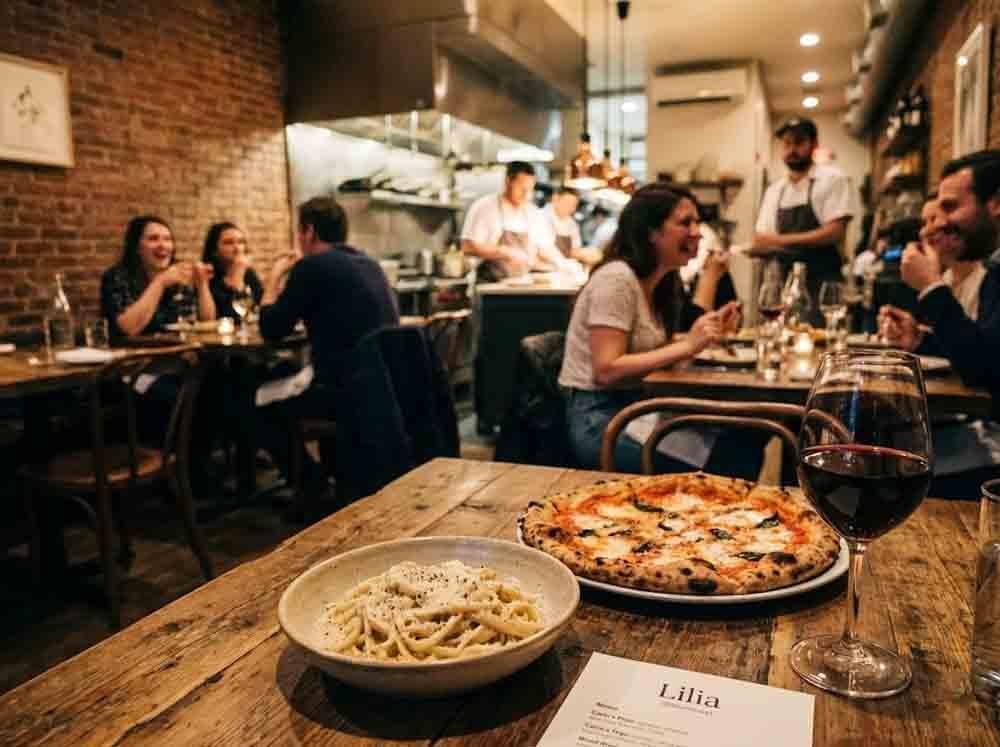
The 70-seat dining room pulses with energy that feels distinctly Mediterranean yet undeniably Brooklyn. Stacked firewood lines the walls alongside an all-Italian wine selection. A full-service bar anchors the front. An outdoor piazza offers seasonal seating that recalls the aperitivo culture of coastal Italy. Sean Feeney, Robbins’s business partner and co-founder of Grovehouse Hospitality, has spoken about how the design deliberately avoided the tropes that defined Williamsburg dining in the early 2010s — the exposed brick, the Mason jar water glasses, the performative provenance lectures (Resy, 2026). Lilia arrived as something entirely different: polished, warm, and uninterested in irony.
Missy Robbins: The Architect Behind the Pasta
Robbins’s path to Lilia was anything but direct. A Georgetown University graduate with a degree in art history, she entered the culinary world at 22 after being inspired by a college friend cooking at Charlie Trotter’s in Chicago. Formal training at Peter Kump’s New York School of Cooking — now the Institute of Culinary Education — was followed by early positions under Wayne Nish at March and Anne Rosenzweig at Arcadia. A formative trip to Northern Italy reshaped her entire trajectory. She worked in rustic trattorias and Michelin-rated kitchens across the Italian countryside, absorbing the regional traditions that would eventually define her cooking (StarChefs, 2023).
Five years as executive chef at Spiaggia in Chicago earned her the William R. Rice Most Promising Chef Award. She returned east to helm A Voce Madison and A Voce Columbus in Manhattan, maintaining Michelin stars at both locations throughout her tenure and earning a spot on Food & Wine’s Best New Chefs list in 2010. Then, at 42, she walked away. The burnout was real — physically, mentally, professionally. She has spoken candidly about the toll of decades on her feet and the need to redesign how she worked before building something of her own (Hello Gloria, 2024).
That three-year sabbatical of research, travel, and self-restoration culminated in Lilia’s January 2016 opening. Robbins was 44. The restaurant earned three stars from Pete Wells at The New York Times almost immediately. The James Beard Foundation named her Best Chef: New York City in 2018. Robbins has said repeatedly that Lilia would not be Lilia if she had opened it fifteen years earlier — that patience and accumulated wisdom made all the difference. Peter from the Heritage Diner understands this calculus intimately: you cannot rush the seasoning of a cast-iron skillet any more than you can rush the development of a chef who was not yet ready to become who she needed to be.
The Menu: Flour, Eggs, Water, Fire
Lilia’s menu operates on a principle that sounds deceptively simple: celebrate the ingredient, edit ruthlessly, and let the wood-fired grill and handmade pasta do the heavy lifting. The kitchen is organized around three pillars — handcrafted pastas, wood-fired seafood and meats, and seasonal vegetable preparations — each executed with the technical precision of someone who spent decades studying regional Italian cooking traditions across multiple provinces.
The pasta program has achieved something rare in the New York dining world: individual dishes with cult followings that persist across an entire decade. The sheep’s milk cheese agnolotti with saffron, dried tomato, and honey remains the restaurant’s best-selling pasta, a sunshine-colored arrangement of pillowy dumplings in melted butter that Pete Wells once described as a direct route to happiness. The mafaldini — ruffled Neapolitan noodles named for Princess Mafalda of Savoy — with pink peppercorns and Parmigiano run a close second. The cacio e pepe frittelle, three golden orbs of cheese-crusted dough with creamy, peppery interiors, have launched a thousand imitations across the city (The World’s 50 Best, 2025).
The wood-fired program draws from the massive grill that anchors the open kitchen. Whole fish, black bass with salsa verde, grilled clams with Calabrian chile and breadcrumbs, and juicy steaks rotate with the seasons. Robbins has credited her neighbor Peter Luger Steak House — located nearby in Williamsburg — with inspiring her to explore beef more seriously after memorable lunches there with industry colleagues (Resy, 2026). The all-Italian wine list is concise and focused, complemented by classic cocktails including Negronis and Milano Sours. Desserts carry their own gravitational pull — an olive oil cake, a chocolate torta with espresso zabaglione, and a selection of gelatos that close the meal with Mediterranean warmth.
Awards, Recognition, and Cultural Impact
The accolades that have accumulated around Lilia tell a story of consistent excellence rather than fleeting relevance. Three stars from The New York Times upon opening. Four separate James Beard Award nominations for the restaurant itself. Robbins’s personal James Beard win for Best Chef: New York City in 2018. A position on Pete Wells’s inaugural 100 Best Restaurants in New York City list at number 17 — a ranking the restaurant maintained across subsequent editions. A Travelers’ Choice designation from Tripadvisor. A feature in the World’s 50 Best Discovery collection.
More telling than any individual award is the restaurant’s influence on the broader dining landscape. Resy’s January 2026 retrospective on Lilia’s tenth anniversary documented how the restaurant fundamentally reshaped Williamsburg’s dining identity. Before Lilia, the neighborhood’s culinary reputation was built on a specific aesthetic — casual, artisanal, studiously unpolished. Robbins and Feeney rejected that template entirely, proving that a restaurant could be both neighborhood-rooted and genuinely world-class. In the decade since, destination-caliber restaurants have proliferated in Lilia’s geographic orbit — Gus and Marty’s, Huda, Bonnie’s — yet Lilia remains the anchor, the restaurant that demonstrated what Williamsburg dining could become.
Robbins’s influence extends beyond the dining room. Her 2021 cookbook PASTA: The Spirit and Craft of Italy’s Greatest Food, with Recipes, co-authored with partner Talia Baiocchi, earned a James Beard Award nomination and was recognized as one of the year’s best cookbooks by the San Francisco Chronicle, Boston Globe, Food52, and Epicurious. The book functions as both a love letter to Italian pasta tradition and a technical manual covering 40 handmade shapes and 100 recipes — the kind of authoritative, deeply researched work that separates genuine craft knowledge from surface-level content.
Grovehouse Hospitality: Building an Empire on Simplicity
Lilia was the first expression of what Robbins and Feeney have built into a formidable hospitality company. Grovehouse Hospitality, co-founded in 2014, now encompasses a constellation of Brooklyn-based concepts that all share a philosophical DNA rooted in Italian culinary tradition, warm hospitality, and careful growth.
Misi opened in 2018 on the site of the former Domino Sugar Refinery in South Williamsburg, earning its own three-star review from The New York Times. Where Lilia casts a wide net across Italian cuisine, Misi narrows its focus to handmade pasta and vegetable antipasti. Misipasta — born in early 2020 just before the pandemic — evolved into a retail storefront and aperitivo bar where guests can shop for fresh pasta, sauces, and Italian specialties while enjoying a spritz. MP Market extended the brand into specialty grocery. Fini Pizza, launched in 2022, is Feeney’s personal tribute to the neighborhood pizza shop tradition, now operating locations in Williamsburg, Amagansett on Long Island, and Barclays Center (Clover, 2025).
Robbins has described her long-term vision with characteristic ambition tempered by patience: a farm to feed the restaurants, a hotel, continued expansion of the MP brand. The throughline connecting every venture is what she and Feeney call making every day a good day — for staff, for guests, for the community they now call home.
Practical Information for Diners
Reservations are essential and highly recommended — Lilia remains one of the most difficult tables to secure in New York City. Bookings are available through Resy. The restaurant does not appear on OpenTable. Walk-ins can try their luck at the bar, which serves the full dinner menu.
Address: 567 Union Avenue, Brooklyn, NY 11211
Neighborhood: Williamsburg — North Side
Telephone: (718) 576-3095
Website: lilianewyork.com
Reservations: Resy
Hours: Monday – Thursday: 5:00 PM – 10:00 PM Friday – Sunday: 4:00 PM – 10:00 PM
Instagram: @lilianewyork (159K+ followers)
Transit: Approximately a 10-minute walk from the Bedford Avenue stop on the L train.
Dining Style: Casual with sophistication — no dress code, but the crowd tends toward smart casual.
Outdoor Seating: Available seasonally in the piazza area.
Private Events: Lilia is available for private dining during lunch, brunch, and dinner hours. Inquiries can be directed through the Grovehouse Hospitality website.
Health Score: A (NYC Department of Health)
Lilia endures because Missy Robbins understood something that most restaurateurs learn too late or never learn at all: excellence is not a single act but a sustained discipline. Flour, eggs, water — the ingredients of her pasta are as elemental as they are unforgiving. There is nowhere to hide when the recipe is that simple. Every imperfection reveals itself. The same principle governs any craft built on integrity — whether it is the hand-stitching of an English bridle leather briefcase at the Marcellino NY workshop or the daily rhythms of a quarter-century diner on Long Island’s North Shore. You commit to the unseen details, you honor the materials, and you trust that the work will speak for itself. Lilia speaks volumes.
Peter, Heritage Diner — Mount Sinai, NY. Graduate studies in Philosophy, Long Island University and The New School, NYC. 25 years behind the griddle and the pen.