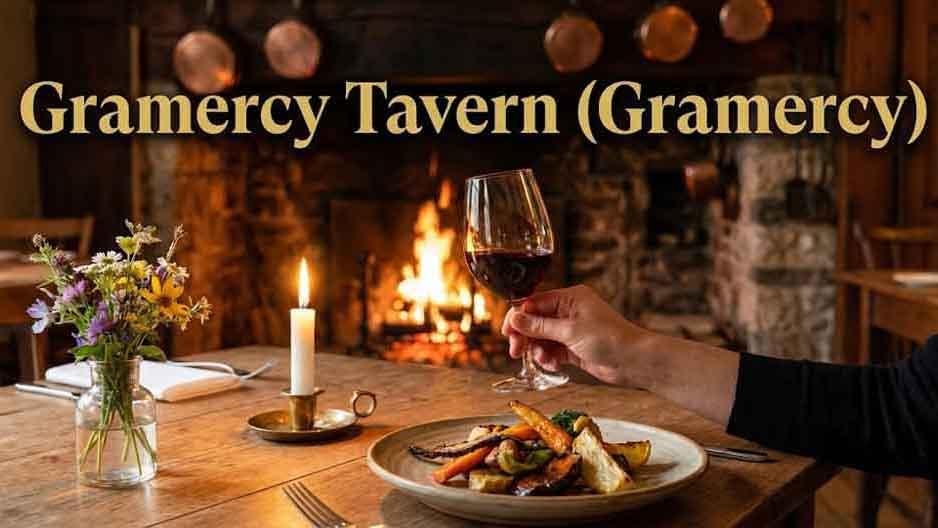
Thirty years into its existence, Gramercy Tavern does not need your permission to be great. It simply is. Nestled inside a gracefully aged industrial building in Manhattan’s Flatiron District — wedged between Broadway and Park Avenue South, just north of Union Square — this Michelin-starred institution has spent three decades refining the alchemy of American hospitality with a patience that most restaurants, and frankly most businesses, will never possess. As someone who has operated The Heritage Diner in Mount Sinai for a quarter century, Peter understands what it means to outlast trends, survive economic upheavals, and keep the lights warm when the world outside turns cold. Danny Meyer, the visionary behind Gramercy Tavern, understands it too — though his canvas stretches across the entire Manhattan skyline.
Food & Wine magazine called Gramercy Tavern “a Great American Restaurant” (Food & Wine, 2024). Pete Wells placed it eleventh in his authoritative 2023 ranking of the hundred best restaurants in New York City (The New York Times, 2023). The Michelin Guide awarded it one star, praising its ability to be “all things to all diners” (Michelin Guide, 2025). These accolades are not the point. They are the residue of something far more difficult to manufacture: a restaurant that has built trust the same way a Marcellino NY briefcase develops its patina — through daily contact with the world, one honest encounter at a time.
The Origin: A Partnership Born in Aspen
The story begins not in Manhattan but at the 1992 Food & Wine Classic in Aspen, Colorado, where restaurateur Danny Meyer met a rising chef named Tom Colicchio. Meyer had already established Union Square Cafe in 1985 at the age of twenty-seven, and for nine years he resisted the temptation to open a second restaurant. The resistance was personal. By the time Meyer was twenty-one, he had watched his father go bankrupt twice — an experience that hardwired in him a deep skepticism of expansion for expansion’s sake (CBS News, 2024). Meyer’s father, Morton, had been the president of a travel and real estate company in St. Louis. The elder Meyer’s flaw, as his son would later articulate, was that he rode the wave up without ever planning for the descent.
But Colicchio was compelling. And the concept they hatched together — blending European fine dining standards with the rustic comfort of an American tavern — was irresistible. On July 11, 1994, Gramercy Tavern opened its doors at 42 East 20th Street in a historic landmark building that Meyer imagined had been in his family since Gramercy Park itself was founded. “The origin story of Gramercy Tavern was, I imagined that this place had been in my family since Gramercy Park was founded,” Meyer has recalled. “So it’s been here forever” (CBS News, 2024).
The opening was anything but smooth. New York Magazine put the restaurant on its cover under the headline “The Next Great Restaurant?” — and New Yorkers were swift to answer in the negative. Critics pounced. The early reviews stung. Meyer later compared the experience to a brand-new baseball glove: you have to play catch for a long time before it breaks in. By the second year, the glove was softening. By the fifth, the rave reviews poured in and never stopped.
The Architecture of Welcome
Walk through the maroon awning at 42 East 20th Street and you enter a space designed by the New York-based architecture firm Bentel & Bentel — their first foray into hospitality design, a commission that would go on to define the firm’s trajectory (Bentel & Bentel Architects, 2024). The interior explores the tension between refined and rustic, between urbane sophistication and bucolic American warmth. Within a uniform column grid of lofty ceilings inside the gracefully aged industrial building, the architects established what they described as “a hybrid interior that is at once reminiscent of the past while being firmly rooted in the present” (Bentel & Bentel Architects, 2024).
The restaurant operates as two distinct experiences under one roof. The Tavern side — casual, energetic, centered around an open wood-burning grill — serves an à la carte menu of soulful fare and accepts walk-ins at the bar throughout the day. Artist Robert Kushner’s twenty-panel mural titled Cornucopia, a vibrant composition of vegetable motifs, adorns the walls and captures the restaurant’s farm-to-table ethos in paint. Seasonal floral arrangements by designer Roberta Bendavid rotate with the calendar, each installation a minor work of botanical art.
The Dining Room, by contrast, is a more formal affair — a graceful, timeless space where multi-course tasting menus and prix fixe offerings unfold with quiet precision. The restaurant seats 130 in the main dining room, accommodates 60 at the bar, and maintains a private dining room that seats 12 to 22 guests (Wikipedia, 2025). The neo-Colonial decor — wood-paneled walls, antique furniture, warm lighting — creates an environment where a birthday celebration feels as natural as a business negotiation. This is the rare Manhattan restaurant where the architecture serves the hospitality rather than competing with it.
Chef Michael Anthony: The Philosopher of Seasonality
When Tom Colicchio departed in the early 2000s — the two founders had amicably decided that one of them should take full ownership — the kitchen could have lost its center of gravity. Instead, Michael Anthony arrived in September 2006 and quietly initiated one of the most remarkable second acts in American restaurant history.
Anthony grew up in Cincinnati, graduated from Indiana University, then moved to Japan — not to cook, initially, but to immerse himself in the culture of food from the inside. He baked bread, worked in restaurants, spent time on farms. The experience made seasonality a working method before it became an aesthetic trend (Reporter Gourmet, 2026). From Japan he moved to Paris, training at the prestigious École Ferrandi and sharpening his technique in professional brigades. Back in the United States, he worked at Restaurant Daniel, served as chef de cuisine at March, then became executive chef at Blue Hill at Stone Barns, where his relationship with farmers and the surrounding landscape became structural to the menu (Harlem EatUp!, 2023).
Under Anthony’s leadership, Gramercy Tavern earned a three-star review from The New York Times in 2007, the James Beard Award for Outstanding Restaurant in 2008, Best Chef: New York City in 2012, and — the crown jewel — Outstanding Chef in America in 2015 (James Beard Foundation, 2015). His cookbook, V is for Vegetables, won the 2015 James Beard Award for Best Vegetable-Focused Cookbook, a book that celebrates over 150 plant-forward recipes written, tested, and photographed with home cooks in mind (Gramercy Tavern, 2015). Anthony’s philosophy — evolution over revolution — mirrors the approach that sustains any institution built for longevity. At The Heritage Diner, Peter calls this the “100-year philosophy”: the understanding that durability requires constant refinement, not periodic reinvention.
Anthony’s menu changes relentlessly with the seasons. The kitchen maintains deep relationships with local farms and purveyors — the Union Square Greenmarket, Norwich Meadows Farm in New Jersey, Island Creek Oysters — practicing whole-animal butchery and in-house processing of heritage proteins to minimize waste. Signature dishes like the ricotta gnudi, roasted chicken, and the ever-rotating vegetable-forward plates reflect a culinary intelligence that honors ingredients by refusing to overcomplicate them.
Enlightened Hospitality: The Meyer Doctrine
Danny Meyer codified his management philosophy in the 2006 New York Times bestseller Setting the Table: The Transforming Power of Hospitality in Business, a book that has influenced leaders far beyond the restaurant industry. The concept — what Meyer calls “Enlightened Hospitality” — inverts traditional business logic by prioritizing stakeholders in this order: employees first, guests second, community third, suppliers fourth, and investors fifth (HarperCollins, 2006).
The idea crystallized at Gramercy Tavern itself. Meyer has described a moment when a regular guest’s unpleasant experience forced him to articulate in writing what he had previously kept inside. “I was doing it all, but I’d never clarified,” Meyer recalled. “Following a staff meeting, I wrote down enlightened hospitality, and I wrote exactly what I meant. I started naming things that I’d previously kept inside. And that was the moment that things started to turn around” (University of Delaware, 2023).
For those of us who have worked in hospitality for decades, the distinction Meyer draws between service and hospitality is not academic — it is existential. Service, he argues, is a monologue: the restaurant decides how things will be done and sets its own standards. Hospitality is a dialogue: listening to the guest with every sense and responding with something thoughtful, gracious, and appropriate. At The Heritage Diner, Peter has lived this distinction for twenty-five years. At Gramercy Tavern, the distinction has been refined into institutional DNA.
This philosophy also extends into Meyer’s approach to staff development. Gramercy Tavern has produced an extraordinary alumni network — chefs, sommeliers, general managers who have gone on to lead some of the most important kitchens and dining rooms in the country. The restaurant’s “Tavern Takeover” series, launched during the 25th anniversary celebration in 2019, regularly invites alumni back to collaborate on special menus — a practice Meyer compares to museums exhibiting an artist alongside their apprentices (Michelin Guide, 2019).
The Menu: A Living Document
Gramercy Tavern’s menu is not a fixed document but a living organism that responds to the rhythms of the local growing season. The Dining Room offers a prix fixe lunch — either à la carte or a four-course option — and a dinner tasting menu that evolves continuously. The Tavern side serves an à la carte menu throughout the day featuring dishes from the open wood-burning grill, with the bar available for walk-ins at all times.
Signature preparations have included hamachi crudo, duck liver mousse, beef tartare, Arctic char, and corn agnolotti with shrimp and sungold tomatoes. Pastry Chef Karen Demasco’s desserts — including the beloved hummingbird cake — provide a closing note that matches the kitchen’s commitment to seasonal integrity. The wine program, overseen by a team of sommeliers, features a curated selection of wines from around the world designed to complement and elevate the seasonal dishes. Wine Spectator awarded the restaurant its Best Of Award of Excellence in 2009, 2010, 2011, 2012, and 2013 (Wine Spectator, 2013).
For those seeking to experience Gramercy Tavern’s cooking at home, the restaurant now delivers select items nationwide through Goldbelly — including their celebrated housemade sausages and prepared dishes that travel with remarkable fidelity.
Thirty Years and the Question of Legacy
In the summer of 2024, Gramercy Tavern celebrated its 30th anniversary. Danny Meyer and Tom Colicchio reunited at the Food & Wine Classic in Aspen, commemorating three decades alongside current Executive Chef Michael Anthony, Chef de Cuisine Aretah Ettarh, and Pastry Chef Karen Demasco. Founding pastry chef Claudia Fleming returned. The band, as Colicchio put it, got back together for one night only (CBS News, 2024).
Colicchio admitted he sometimes walks by the restaurant and wonders what might have been had he stayed. Meyer, characteristically, looked forward: Anthony has now led the kitchen longer than Colicchio ever did, and Ettarh represents the next generation upholding the founding vision. For its 30th anniversary, the restaurant collected memories from guests — handwritten recollections, personal stories, milestone celebrations that had unfolded within those wood-paneled walls over three decades (Gramercy Tavern, 2024).
At the same time, Anthony has opened a parallel chapter. He was announced as chef partner of Lex Yard, the brasserie at the newly restored Waldorf Astoria New York — a project that reprises his vision of contemporary American cooking rooted in simplicity and local supply chains (Reporter Gourmet, 2026). The expansion does not dilute the original. It validates it. When a craftsman’s work is mature enough to reproduce its principles in a new context without losing its soul, you know the original was built on bedrock rather than trend.
Nine James Beard Awards. One Michelin star. Three decades of continuous operation in the most punishing restaurant market on Earth. Over 140,000 followers on Instagram who document their meals with the reverence usually reserved for pilgrimages. Gramercy Tavern has earned all of it — and continues to earn it, nightly, with the quiet certainty of an institution that knows exactly who it is.
Contact & Practical Information
Address: 42 East 20th Street, New York, NY 10003 (between Broadway and Park Avenue South, Flatiron District)
Telephone: (212) 477-0777
Website: gramercytavern.com
Reservations: gramercytavern.com/reservations | Also available on Resy and OpenTable
Hours:
- Monday–Tuesday: 11:30 AM – 10:30 PM
- Wednesday–Saturday: 11:30 AM – 11:00 PM
- Sunday: 11:30 AM – 10:30 PM
Delivery: Select items available nationwide via Goldbelly
Instagram: @gramercytavern
Dress Code: Smart casual
Parent Company: Union Square Hospitality Group (ushg.com)
Michelin Rating: One Star — “High quality cooking” (Michelin Guide, 2025)
Price Range: $$$$
Dining Formats: The Tavern (casual, à la carte, walk-ins welcome at the bar) | The Dining Room (prix fixe and tasting menus, reservations recommended) | Private Dining (12–22 guests)
Recommended Viewing: CBS Mornings — “The Dish: Gramercy Tavern Turns 30” featuring Danny Meyer and Tom Colicchio (June 2024) — available at cbsnews.com
Peter from The Heritage Diner — restaurateur, bespoke leather craftsman at Marcellino NY, and real estate visionary preparing the 2026 launch of Maison Pawli with broker Paola — holds graduate degrees in Philosophy from Long Island University and The New School University in NYC. He writes from twenty-five years behind the griddle, where the only thing that outlasts a well-seasoned cast-iron skillet is the commitment to showing up, every single day, and doing the work that nobody sees.