Milan’s patron saint never expected his name to land on a vine-covered patio off Main Street in Southampton, but eighty-nine years after two pastry chefs opened a pasticceria within earshot of La Scala, that is precisely where the legacy of Sant Ambroeus continues to unfold. The Southampton outpost, operating since 1992 at 30 Main Street, represents something far more consequential than another Hamptons restaurant catering to the seasonal migration of Manhattan wealth. It is a living case study in how authentic craft — the kind built across decades, not marketing cycles — translates across oceans, cultures, and generations without losing its essential character. As someone who has spent twenty-five years at The Heritage Diner understanding what makes a restaurant survive beyond the enthusiasm of its first season, I can tell you that longevity like this does not happen by accident. It requires the kind of obsessive attention to detail that I recognize from my own work at the leather bench — the same philosophy I bring to every hand-saddle-stitched briefcase at Marcellino NY. Institutional excellence is never an event. It is a practice.
From a Milanese Pasticceria to Main Street, Southampton
The origin story of Sant Ambroeus reads like a parable about what happens when genuine craft meets genuine ambition. In 1936, two pastry chefs from the Cattaneo family opened an elegant café steps from the Teatro alla Scala in Milan, naming it after Sant’Ambrogio — the city’s patron saint — rendered in Lombard dialect as “Sant Ambroeus” (Sant Ambroeus, “Our Story,” santambroeus.com). The café became a gathering place for Milan’s intellectual and artistic elite, a salon where cappuccino and cornetti were consumed alongside conversations about opera, literature, and design. Under the Cattaneo family’s stewardship, then later the Pauli family in the 1970s and the Festorazzi family in the early 1980s, the brand evolved into something far more expansive than a corner bakery (VisitMilano, 2025).
The transatlantic leap came in 1982, when Sant Ambroeus opened on Madison Avenue in Manhattan, instantly becoming one of the Upper East Side’s defining institutions. Art lovers en route to the Metropolitan Museum, midtown executives, neighborhood families — all converged beneath glittering chandeliers to experience what was, at the time, a genuinely rare offering in New York: authentic Milanese cuisine that refused to Americanize itself into unrecognizability (Rizzoli, 2020). By 1992, the brand extended to Southampton, planting itself on Main Street and grafting the café’s Milanese DNA onto the sandy, salt-aired elegance of Long Island’s most storied summer village. For over three decades now, this location has remained an anchor of Southampton dining — not because it adapts to every passing culinary trend, but precisely because it doesn’t.
The Architects of a Hospitality Empire
Understanding Sant Ambroeus Southampton requires understanding the men who shaped the modern brand. In 2003, Dimitri Pauli — whose parents Hans and Francesca Pauli had previously owned the Milan location — partnered with Gherardo Guarducci to found SA Hospitality Group (WWD, 2021). Their mission was to expand the Sant Ambroeus legacy across the United States while preserving the rigorous standards that had defined the brand since the Cattaneo days. What followed was a carefully orchestrated expansion: locations in the West Village, SoHo, Brookfield Place, a coffee bar inside Sotheby’s headquarters, a restaurant in Palm Beach, and eventually a return to Milan itself in 2021 when SA Hospitality Group acquired the original Milanese café and commissioned architect Fabrizio Casiraghi to reimagine the interiors (Three Hills Capital, 2021).
Today, SA Hospitality Group operates eighteen restaurants under three brands — Sant Ambroeus, Casa Lever, and Felice — with current CEO Federico Turconi steering the company toward Aspen, Paris, and beyond (Dan’s Papers, 2025). The group received a €35 million investment from British fund Three Hills Capital, a testament to institutional investor confidence in a brand that has managed to scale without diluting quality. This trajectory mirrors something I think about constantly in my own work: how do you grow without sacrificing the handmade sensibility that made you worth knowing in the first place? At Marcellino NY, I have turned down opportunities to mass-produce because the hand-saddle stitch cannot be rushed. SA Hospitality Group appears to understand a parallel truth — that the cultural equity embedded in a brand like Sant Ambroeus is only as durable as the standards behind it.
Inside the Southampton Dining Room
The Southampton location was reimagined by designer Robert McKinley, whose portfolio includes the Surf Lodge and Ruschmeyer’s in Montauk — venues that understand the particular alchemy of Hamptons hospitality (Culinary Agents, 2024). McKinley’s redesign layered natural linen curtains over ivory leather banquettes and introduced the iconic black-and-white striped chairs that now define the room’s visual identity. Photographs from Clifford Ross’s acclaimed Hurricane series line the walls, creating a dialogue between the controlled elegance of the interior and the raw Atlantic energy just beyond the village borders.
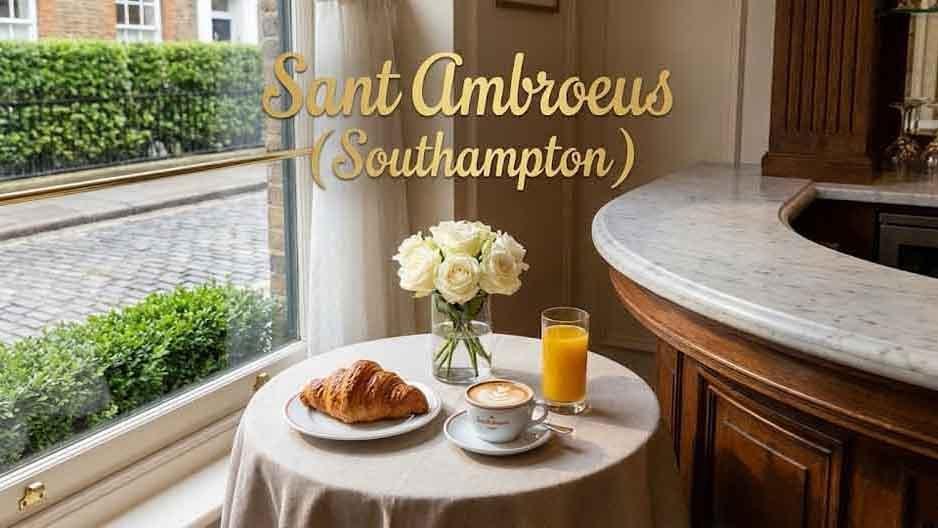
The front-of-house experience begins at a glass display counter lined with house-made pastries, biscotti, and imported confections — a direct echo of the original Milan pasticceria’s ritual of greeting guests with visual abundance before they’ve taken a seat. Further through, the main dining room achieves something rare in resort-town restaurants: intimacy without claustrophobia, sophistication without pretension. The outdoor vine-covered patio, accessible from a private lane off Main Street, seats approximately forty guests in a setting that has hosted everything from summer birthday celebrations to deal-closing dinners conducted over branzino and Barolo.
Elzbieta Zaleska, the Assistant General Manager, has been stewarding the hospitality at this location for over twenty years — a tenure that itself speaks volumes (Sant Ambroeus Journal, santambroeus.com). In the restaurant world, longevity of staff is the single most reliable indicator of a healthy operation. When your people stay, your standards stay.
The Menu: Milanese Authenticity Meets Hamptons Seasonality
Sant Ambroeus Southampton operates as a true all-day dining establishment, anchored by an espresso and cappuccino bar that opens each morning alongside pastries and cookies baked on-premises daily and handcrafted gelato produced in-house (santambroeus.com). The culinary program is overseen by SA Hospitality Group’s culinary director, Iacopo Falai, and corporate chef Andrea Pancani, with a local kitchen led by chef de cuisine Fabio Gutierrez. Menus draw heavily on locally sourced seafood and farmers’ market produce, grounding Milanese technique in the ingredient ecosystem of eastern Long Island.
Signature dishes command the kind of loyalty that borders on ritual for regular guests. The vitello tonnato — traditional slow-roasted veal tenderloin with tuna sauce and pickled capers — functions as a benchmark of Milanese culinary identity, executed here with the precision of a recipe that has been refined across nearly nine decades of institutional knowledge. The carpaccio di manzo, branzino alla griglia, insalata di mare, and linguine alle vongole round out the essential canon. Pasta courses range from Genovese pesto spaghetti to tagliatelle with filet mignon, while daily specials lean into whatever the Hamptons growing season and fishing boats deliver. The wine program prioritizes Italian selections from Tuscany, Sicily, and Piedmont, with French and American bottles available for those who prefer to wander.
Breakfast offerings include organic scrambled eggs with Parmigiano-Reggiano, French toast made from house-baked brioche, and the classic Italian frittata. The organic oats with rye, barley, and fresh market berries reflect the same philosophy I apply at The Heritage Diner — that morning food should nourish honestly, not perform for Instagram. For those ordering to-go, the counter offers panini on house-baked ciabatta, including the traditional breaded veal Milanese sandwich and a chicken salad with marinated artichokes that has quietly built its own following.
Cultural Footprint and the Art of the Neighborhood Institution
The broader cultural significance of Sant Ambroeus extends well beyond any single dish or location. In 2020, the brand published Sant Ambroeus: The Coffee Bar Cookbook through Rizzoli, a seventy-five-recipe volume covering coffee drinks, breads, panini, cookies, cakes, and the famed gelati and sorbetti (Rizzoli, 2020). The book distills into print what the restaurants embody in physical space: the proposition that quality, craftsmanship, and warmth are not abstract values but daily practices expressed through specific actions — the temperature of an espresso, the crumb structure of a cornetto, the timing of service.
Goop, the lifestyle platform founded by Gwyneth Paltrow, has recognized Sant Ambroeus Southampton as a destination essential for the Hamptons summer circuit, noting that for many Upper East Siders, the Saturday morning ritual simply transplants itself eastward when the season turns (Goop, 2024). Social Life Magazine included the restaurant in its 2026 guide to essential Hamptons dining, and TripAdvisor has awarded the location its Travelers’ Choice designation. OpenTable diners rate it 4.6 out of 5. Google reviews aggregate to 4.4 stars across over 545 reviews.
The connection to the art world runs particularly deep. The 2015 opening of a Sant Ambroeus coffee bar inside Sotheby’s auction house on York Avenue was described by Sotheby’s chairman Lisa Dennison as a natural marriage, given that the brand had already become a cornerstone of the New York art scene (artnet News, 2015). In Southampton, Clifford Ross’s Hurricane photographs on the walls extend this curatorial sensibility, positioning the restaurant not merely as a place to eat but as a place to see — an environment where design and gastronomy operate as a unified expression.
Practical Information for Visitors
Sant Ambroeus Southampton is located at 30 Main Street, Southampton, NY 11968. The restaurant operates year-round, though seasonal hours apply — abbreviated service from March through early June (typically Thursday through Sunday/Monday), expanding to full seven-day operation during summer months.
Current Regular Hours (subject to seasonal adjustment): Monday through Thursday: 9:00 AM – 9:00 PM | Friday and Saturday: 9:00 AM – 10:00 PM | Sunday: 9:00 AM – 9:00 PM
Phone: (631) 283-1233
Website: santambroeus.com
Reservations: Available through Resy
Online Ordering / Delivery: order.santambroeus.com via Toast
Private Events: The interior dining room and vine-covered patio accommodate approximately 40 guests for private gatherings. Inquiries may be directed to specialevents@santambroeus.com.
Price Range: $$$. Pastries and coffee run approximately $5–$9; entrées range from $16–$35+, with dinner for two with wine easily approaching $200.
Nearby: Cooper’s Beach (one of America’s highest-rated beaches), Parrish Art Museum (designed by Herzog & de Meuron), Southampton Historical Museum, and the boutique shopping corridor along Main Street and Jobs Lane.
The Unseen Standard
What makes Sant Ambroeus Southampton endure is the same thing that makes any institution endure: the refusal to let invisible standards become optional. The bread is baked on-premises. The gelato is handcrafted. The olive oil is imported from a specific producer in Lucca, Tuscany — the same oil served at every Sant Ambroeus table worldwide. These are not marketing points. They are operational commitments that compound over years into the kind of reputation that cannot be manufactured.
I think about this principle constantly, whether I am seasoning a flat-top at The Heritage Diner before a Saturday morning rush, selecting vegetable-tanned hides from Wickett & Craig for a Marcellino briefcase, or advising Paola on the long-view logic of boutique real estate as we prepare to launch Maison Pawli in 2026. The lesson from Sant Ambroeus — from Milan to Madison Avenue to Main Street in Southampton — is that craft scales when the people behind it refuse to treat consistency as a compromise. In an era saturated with algorithmic dining recommendations and influencer-driven hype, a restaurant that has been doing the same things extraordinarily well since 1936 is not just a place to eat. It is an argument for a certain way of being in the world.
That argument, served with a side of handcrafted gelato and a view of a vine-covered patio, remains deeply persuasive.
Peter — owner of The Heritage Diner in Mount Sinai, NY, founder of Marcellino NY bespoke leather goods, and co-founder of Maison Pawli boutique real estate. Graduate degrees in Philosophy from Long Island University and The New School in NYC.