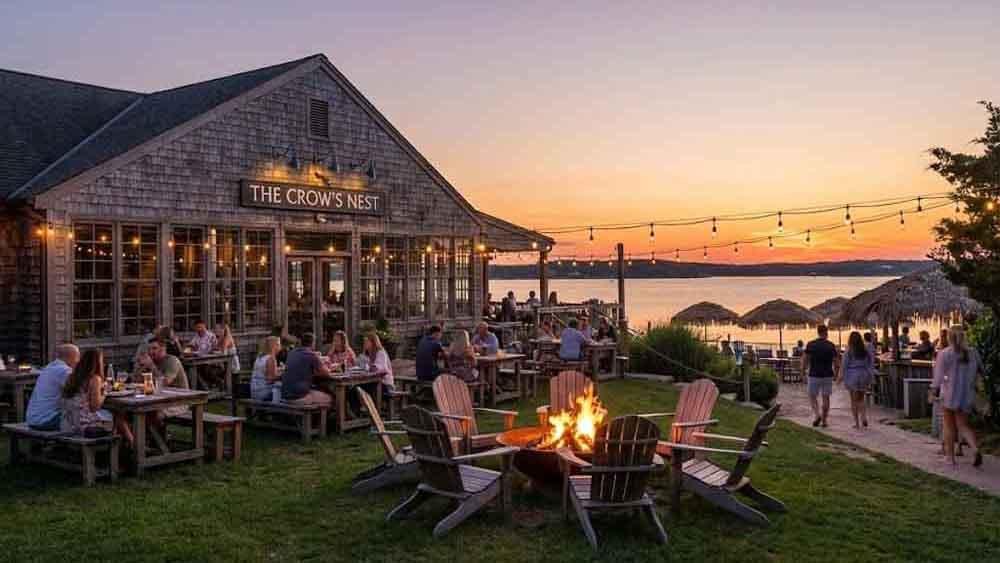
Lake Montauk holds its sunsets differently than the ocean side. The light doesn’t crash — it dissolves, spilling copper and rose across still water, catching the rigging of small boats and the edges of old wooden docks until the whole southern shore looks like something painted from memory. At the end of Old West Lake Drive, tucked into 3.35 acres of sloping lawn where the grass meets gravel and the gravel meets sand, The Crow’s Nest sits precisely at the point where Montauk stops performing for tourists and starts whispering to the people who actually understand it. This is a restaurant that never put up a sign when it opened. A hotel that lets chickens roam the yard. A property that somehow became the most coveted dinner reservation east of the Shinnecock Canal by doing almost nothing to announce itself. And that, of course, is entirely the point.
The Property: Three Acres Where the Lake Meets the Lawn
The land itself predates any of its current glamour by decades. The parcel on the southern shore of Lake Montauk was originally developed in the 1950s as the Montauk Motor Court — a modest collection of one-story buildings with paired rental units, a small office, and a residence, the kind of no-frills lodging that served the fishermen and beachgoers who made the long drive out to The End before Route 27 became a Friday afternoon parking lot (East Hampton Star, 2014). The property received its last certificate of occupancy in 1986 under that earlier incarnation. For years it sat in a kind of gentle decline, its waterfront position on Lake Montauk an increasingly valuable asset in a hamlet that was beginning to attract a very different kind of visitor.
The 170-seat restaurant, 14-room inn, and separate cottage that now comprise The Crow’s Nest occupy a footprint that feels simultaneously expansive and intimate — the kind of spatial generosity that Montauk once offered freely and now guards jealously. The lakefront lawn rolls downhill from the restaurant to the water’s edge, where fire pits glow after dark and a small beach bar serves cocktails against the backdrop of what Vinous wine publication described as one of the finest dining settings in the Hamptons (Vinous, 2024). Lake Montauk itself — a brackish tidal pond connected to Block Island Sound — provides a sheltered, almost Mediterranean calm that stands in stark contrast to the Atlantic pounding the beaches just minutes away at Ditch Plains.
Sean MacPherson: The Hotelier Who Reinvented Downtown and Then Went East
Understanding The Crow’s Nest requires understanding Sean MacPherson, and understanding MacPherson requires tracing a trajectory that runs from 1970s Malibu surf culture through the reinvention of lower Manhattan’s hospitality landscape and out to the easternmost point of Long Island. Born in New Zealand to a champion surfer mother and a father who appeared in the iconic surf film The Endless Summer, MacPherson grew up in California, graduated summa cum laude from the University of Southern California with a dual degree in philosophy and business, and spent his twenties building nightclubs and restaurants in Los Angeles before relocating to New York in 2000 (NZEDGE, 2015; Haute Living, 2015).
What followed was one of the most remarkable runs in American hospitality. With partners including Eric Goode, Richard Born, and Ira Drukier, MacPherson created or transformed a series of hotels that didn’t just fill rooms — they defined neighborhoods. The Maritime Hotel in Chelsea. The Bowery Hotel on the Lower East Side. The Jane in the West Village, where cabin-sized rooms in the 1907 building that once sheltered Titanic survivors were reimagined for a new generation of travelers with more style than budget. The Ludlow. The Marlton. The Waverly Inn. And in 2016, the crown jewel: the historic Hotel Chelsea, reopened with 158 rooms after years of painstaking restoration (Hospitality Design, 2025). Each property bore MacPherson’s signature philosophy — what he calls “individual, idiosyncratic, human taste” over the hyper-designed aesthetic that had dominated boutique hospitality since the Schrager-Starck era (Hotel Business, 2017).
MacPherson had been spending summers in Montauk since the 1990s, drawn by the same thing that draws anyone with salt in their blood: the waves at Ditch Plains, the emptiness of Culloden Point, the feeling that this particular stretch of Long Island still carried something raw and unmanicured. He negotiated for The Crow’s Nest property for a decade before finally purchasing it around 2010, a timeline that speaks to both the complexity of East Hampton Town real estate and MacPherson’s patience in pursuing properties that speak to him personally (Guest of a Guest, 2010).
The Reinvention: Sleepy-Chic on the Lake
When The Crow’s Nest Inn and Restaurant opened in the summer of 2010, there was no press release, no launch party, no velvet rope — barely even a sign out front. MacPherson’s approach was deliberately understated, a calculated quiet entrance into a Montauk dining scene that was rapidly heating up with the arrivals of The Surf Lodge, Navy Beach, and Ruschmeyers (Edible East End, 2011). The strategy was pure MacPherson: let the space do the talking.
He preserved the bones of the original motor court architecture while layering in what Hamptons Magazine described as a “New England prepster-meets-bohemian” sensibility — wrought iron headboards, indigo batik pillows, bare wood floors, tapestries along the walls, and a general air of curated casualness that takes enormous effort to achieve (Hamptons Magazine, 2014). The restaurant’s interior is warm and deliberate, with a buzzing bar, an airy dining room windowed to the twinkly-lit yard, and the sense of walking into a very stylish friend’s lake house rather than a commercial establishment. Bob Melet, the legendary Long Island vintage dealer, maintains a small outpost within the property, adding another layer of eclectic curation (W Magazine, 2016).
The property expanded to include the David Pharaoh Cottages — named after a chief of the Montaukett people, the indigenous nation whose presence on this land stretches back centuries — a grouping of eight units in six structures ranging from studios to a two-bedroom home, each with kitchenettes and access to a private beach. Guests receive complimentary beach parking passes, bicycles, and paddleboard rentals, reinforcing the informal, activity-driven ethos that separates Montauk hospitality from the more buttoned-up Hamptons experience further west.
The Kitchen: Mediterranean Instinct, Montauk Soul
The Crow’s Nest maintains a strict no-reservations policy — a decision that creates the famous two-hour-plus waits on peak summer weekends but also enforces a democratic, first-come-first-served energy that keeps the room from calcifying into a scene-only destination. Walk-ins only, even for large parties. Parking is extremely limited, and the restaurant actively recommends taxi service — practical advice that also underscores just how sought-after these tables have become.
The menu tilts Mediterranean with deep respect for local sourcing, emphasizing Long Island’s seasonal produce and the surrounding waters’ seafood. Beausoleil oysters open the menu alongside a mezze platter of hummus, babaganoush, tabouleh, olives, harissa, and naan. The Maple Brook burrata arrives with stone fruit, local cherries, beets, and a honey-strawberry rhubarb compote that bridges the gap between appetizer and something almost dessert-like. A spiced roasted cauliflower with white bean puree, tamarind, pomegranates, and tahini demonstrates the kitchen’s comfort with global flavor architecture grounded in local produce.
Entrées range from the coconut milk-braised vegetable curry with halloumi, black lentil rice, and saffron to a hemp heart-crusted fish preparation with curried potatoes and baby carrots — the kind of dish that signals both nutritional consciousness and genuine culinary ambition. Grilled double-cut lamb chops, organic chicken kebab, and the poached lobster tagliatelle with cherry tomatoes, Calabrian chilis, and olive oil round out a menu that one food critic noted would haunt diners through the long cold winter (Gourmadela, 2019). The fresh ricotta appetizer — prepared with white truffle, honey, and served with perfectly smoked grilled bread — has achieved near-legendary status among regulars. The restaurant also features cocktails from Montauk Brew Co. and a wine program that complements the Mediterranean-leaning kitchen.
The Social Currency: Where Fishermen Meet Fashion
Part of The Crow’s Nest’s enduring appeal is the improbability of its social mix. MacPherson once described Montauk’s appeal by comparing it to 1970s Malibu — the natural beauty paired with a “high-low” cultural collision that keeps the atmosphere honest (Whalebone Magazine, 2016). The restaurant delivers exactly that promise. On any given summer evening, the lawn and fire pits host a cross-section that ranges from local fishermen to gallery owners to fashion designers to tech founders — a social cocktail that defies the usual Hamptons stratification.
The property has hosted events drawing names like Ralph Lauren, Cynthia Rowley, David Zwirner, Athena Calderone, and Blake Mycoskie of TOMS Shoes, among others (Guest of a Guest, 2015). Dolce & Gabbana staged a Mediterranean-themed celebration on the grounds. MacPherson himself married Rachelle Hruska — co-founder and editor-in-chief of Guest of a Guest, the social media platform that chronicles the intersection of people, places, and parties — on Memorial Day weekend 2011, with the rehearsal dinner held at nearby Fishbar on the Lake (Edible East End, 2011). The couple built a beach shack in Ditch Plains and became Montauk’s defining power couple, their home life and professional ventures intertwined with the property’s identity. The restaurant’s catering operation has served events for prominent figures across the Hamptons, with their wedding and event capabilities featured across multiple national platforms including NBC Nightly News and The New York Times.
Yet for all its social wattage, The Crow’s Nest maintains what multiple observers have noted is an unpretentious, gracious service culture — a quality that distinguishes it in a Hamptons landscape where attitude often scales with the check average. The staff’s warmth has drawn consistent praise across review platforms, with Google reviewers awarding the restaurant a 4.3-star rating across more than 400 reviews and highlighting the Mediterranean-inspired cooking, sunset views, and cocktail program as particular strengths.
The Seasonal Rhythm: Closed Doors, Open Anticipation
The Crow’s Nest operates seasonally, a rhythm that mirrors the natural pulse of Montauk itself — a town that still, despite all the development pressure and weekend migration, fundamentally belongs to the calendar of tides and temperatures rather than the artificial perpetuity of year-round commerce. The restaurant is currently closed for winter and will reopen Thursday, May 21st, 2026. Hotel stays for the 2026 off-season can be booked through an automated system on the website, and event inquiries are accepted via online submission.
This seasonal model is both practical and philosophical. It allows the property to maintain quality by concentrating its energy rather than diluting it across twelve months. It preserves the Montauk tradition of the off-season — those quiet months when the town contracts back to its permanent population and the lake sits undisturbed. And it creates the kind of anticipation that no marketing campaign can manufacture: the understanding that The Crow’s Nest is available only when the conditions are right, like a certain quality of light or a particular swell at Poles.
What MacPherson Built — and What It Means for the East End
Sean MacPherson once told Hotel Business that he had become “less interested in provenance and codified design and far more interested in individual taste” — a statement that reads as both aesthetic philosophy and business strategy (Hotel Business, 2017). The Crow’s Nest is perhaps the purest expression of that principle in his entire portfolio. Unlike the Bowery or the Chelsea, which carry the weight of New York City mythology, The Crow’s Nest draws its power from a more elemental source: the particular quality of a Montauk sunset over still water, the smell of wood smoke from the fire pits mixing with salt air, the sound of gravel underfoot as guests cross the lawn toward a meal they couldn’t reserve and a view they couldn’t have predicted.
For those of us who spend our professional lives thinking about what makes a place endure — whether it’s a diner that’s weathered twenty-five years of changing neighborhoods, a leather workshop where the tools haven’t changed in a century, or a restaurant that refuses to take reservations because democracy of access matters more than the convenience of planning — The Crow’s Nest offers a particular kind of lesson. The unseen details define the masterpiece. The patience to negotiate for a property over ten years before purchasing it. The restraint to open without a sign. The confidence to let chickens roam the yard of a restaurant where Ralph Lauren has dined. These are not contradictions. They are the architecture of authenticity in an age that increasingly struggles to distinguish the genuine from the performed.
The Crow’s Nest 4 Old West Lake Drive, Montauk, NY 11954 Phone: (631) 668-2077 Website: crowsnestmtk.com Instagram: @crowsnestmtk Reservations: Walk-ins only — no reservations accepted Parking: Extremely limited; taxi/rideshare recommended Season: Opens May 21, 2026 Hotel: 14-room inn + David Pharaoh Cottages on Lake Montauk Events: Private dining and event inquiries accepted via website Delivery: Not available
Peter is the owner of The Heritage Diner in Mount Sinai, NY, where he has operated for twenty-five years, and holds graduate degrees in Philosophy from Long Island University and The New School in New York City.