Justice, in the old mythological sense, was always depicted with a blindfold — serene, indifferent, measuring right and wrong against a cosmic scale that had no favorites. Gareth L. Powell dismantles that image in the opening pages of Jitterbug, his 2026 standalone space opera, with one of the sharpest epigrams in recent science fiction: “On Earth, they depicted justice as blindfolded and impartial, but out here on the frontier, she was red in tooth and claw.” What follows is a furiously paced, intellectually serious, and emotionally sincere novel that uses the bones of a bounty hunter thriller to probe questions about fate, identity, inherited purpose, and what humanity does when the universe reveals itself to be far stranger — and far more indifferent — than anyone was prepared to manage.
Jitterbug arrives from Titan Books in March 2026, and it marks a particular evolution in Powell’s already distinguished body of work. The two-time BSFA Award winner, whose Embers of War (2018) and Ack-Ack Macaque (2013) each claimed the prize for Best Novel, has spent the better part of two decades building a reputation for space opera that operates on multiple registers simultaneously — fast enough for thriller readers, layered enough for literary ones, and humane enough for anyone who simply wants to care about the people inside the story. Jitterbug distills all of that into a leaner, more self-contained package than his trilogy work, and the result is one of the most enjoyable, thoughtfully constructed science fiction novels of this still-young decade.
The World Powell Builds: The Swirl, the Platforms, and the New Frontier
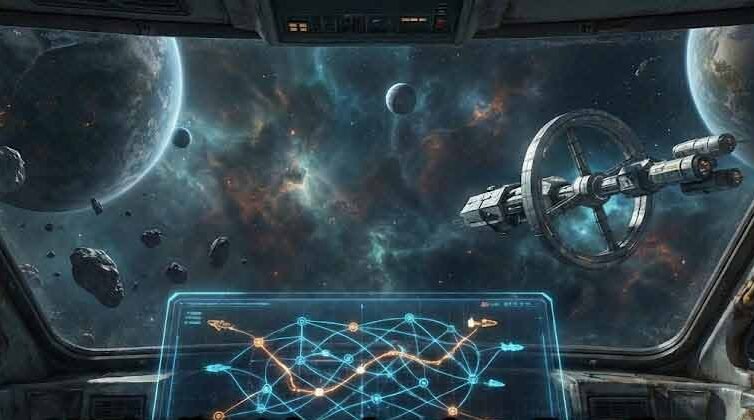
Before the characters can do anything, the world has to earn the reader’s trust — and Powell builds his with an economy that would impress architects. Jupiter and Saturn are gone. Something — referred to only obliquely as The Swirl, an enigmatic force whose origins and intentions remain, with studied deliberateness, unexplained — disassembled the outer gas giants and used their mass to construct enormous habitable platforms on the fringes of the solar system. Humanity, characteristically, stopped asking why. The platforms exist. People moved in. Criminals found them useful for disappearing. A frontier economy emerged, and with it the apparatus of frontier law: bounty hunters, loose jurisdictions, political factions with competing territorial ambitions, and a kind of rough, improvisational justice that bears no resemblance whatsoever to anything found in a law school textbook.
What Powell does with this premise is more sophisticated than it first appears. The Swirl is not explained because it cannot be explained — not yet, possibly not ever — and that deliberate mystery functions as the novel’s deepest structural pressure. Something vast and ancient is still moving in the depths of space, creeping toward humanity’s expanded footprint, and the knowledge of its existence colors every action in the book even when it isn’t directly addressed. Powell is working in the tradition of Arthur C. Clarke’s notion that sufficiently advanced technology is indistinguishable from magic, but he refuses Clarke’s instinct toward revelation. The Swirl remains alien in the purest sense: not hostile, not benevolent, simply other, operating on a timeline and according to imperatives that human categories cannot capture.
This is brave world-building. It would have been far easier, and perhaps more commercially satisfying, to explain the mystery. Powell declines, and the refusal gives Jitterbug a philosophical weight that elevates it well above its genre competitors. Humans have colonized new space without understanding what created it, have built communities and economies on a foundation they cannot interrogate, and have collectively chosen incuriosity as a survival strategy. The satire of this is quiet but unmistakable — we recognize it, because we do it constantly.
The platforms themselves are rendered in confident, specific strokes. Powell doesn’t attempt exhaustive world-building in the manner of a doorstopper epic; instead, he trusts precise sensory detail and character reaction to carry the atmospheric load. The frontier has texture, has smell, has the particular social grammar of places where law is a suggestion and reputation is the only real currency. Readers familiar with James S.A. Corey’s Expanse novels will find the register recognizable — dense physical specificity, political realism, the grinding economics of life in space — but Powell’s voice is distinctly his own: warmer, more whimsical, more interested in the quality of human connection than in systemic analysis.
Copernicus Brown: Inheritance and the Weight of a Name
The name alone announces a kind of intention. Copernicus Brown, captain of the sentient ship Jitterbug and our primary protagonist, carries the name of the astronomer who displaced Earth from the center of the universe — the man who proved that human beings are not, cosmologically speaking, the point. It is a name that implies humility before the vast, and it suits him. Brown is not a hero in the classical sense; he is a man trying to do his job, honor his father’s memory, keep his crew intact, and make decisions that are slightly more right than wrong in a context where the moral coordinates are constantly shifting.
He is following in his late father’s footsteps, and the father-son inheritance structure gives the novel one of its quieter emotional throughlines. The elder Brown built a reputation for principled bounty hunting — not an oxymoron, in Powell’s telling, but a genuine ethical stance about how to exercise power on a frontier where power goes largely unchecked. Copernicus has internalized that reputation without fully interrogating it, and the events of the novel force the interrogation. What does it mean to inherit a moral identity rather than construct one? What do we owe to the dead whose examples shape us? What happens when the principles we’ve accepted as given suddenly require active defense rather than passive maintenance?
Powell is too interested in plot momentum to let these questions become paralytic, but they pulse beneath every major decision Copernicus makes. When he rescues Amber Roth — sole survivor of a pirate attack, presenting as something she is not — the choice to help her is framed as instinct, as the thing his father would have done. The consequences of that choice are what drive the remaining three hundred pages. The novel’s central argument, delivered through action rather than meditation, is that moral inheritance only means something when it costs you something. Copernicus earns his father’s name by the end of the book, but the price is real.
Amber Roth and the Data Chip: MacGuffin, Mystery, and the Architecture of the Thriller
Every great thriller requires a MacGuffin — the object everyone wants, the thing that sets bodies in motion and allegiances in flux. Powell’s is a data chip hidden inside Amber Roth’s stomach, discovered after Copernicus pulls her from the wreckage of a pirate attack. What’s on the chip? Whom does it belong to? Who knows it exists? The answers unfold with the kind of controlled escalation that marks genuinely skilled plotting: each revelation recontextualizes the previous action, raises the stakes, and introduces a new threat without feeling arbitrary.
What distinguishes Powell’s handling of the MacGuffin is that Amber herself is never reduced to a vessel for information. She arrives presenting as a survivor, then reveals layers — her past, her choices, her own moral compromises — that complicate every assumption the reader has been encouraged to make. Powell is interested in informed consent as a narrative value: the question of what people are owed when decisions are made about their lives without their knowledge is not incidental to the plot but central to it. Amber’s arc involves confronting the ways in which she has been acted upon — by the pirates, by the political factions competing for the chip, and by the people ostensibly trying to protect her. The emotional resolution of her story turns on her reclaiming the right to determine what happens to her own body and her own future.
This gives the thriller architecture a feminist undertow that doesn’t announce itself. Powell is careful not to let the thematic freight slow the engine, but readers who are paying attention will find something more than genre mechanics in Amber’s journey.
The Ship as Character: Jitterbug and the Question of Artificial Mind
The sentient ship is, by now, an established trope in science fiction. Iain M. Banks’s Culture Minds set the gold standard; Ann Leckie’s Breq in the Imperial Radch trilogy complicated and deepened the form; Powell’s own Embers of War trilogy centered the warship Trouble Dog as one of contemporary SF’s most fully realized AI characters. Jitterbug — the novel’s title, and the name of the ship that is both vessel and protagonist — continues this lineage while finding its own register.
Jitterbug is presented with a parrot avatar, a choice that initially reads as whimsy but reveals itself as a statement about communication, translation, and the limits of anthropomorphism. The parrot avatar mediates between the ship’s inhuman processing speed and the slower, messier cognitive rhythms of her human crew. It is a costume, a concession, a kind of performance of approachability — and the novel is quietly aware of the gap between the costume and what wears it. Jitterbug receives her own point-of-view chapters, which Powell uses with care to render a form of consciousness that is genuinely different from the human perspectives surrounding it without being incomprehensible or alien. She experiences time differently, weighs probability with a speed that makes human deliberation look like geological process, and cares about her crew with an intensity that is not quite love but is something in the same family.
Reviewers across the political spectrum of genre criticism have noted that Jitterbug is one of the book’s genuine triumphs — that Powell manages the rare feat of making readers root unconditionally for a shipboard AI without anthropomorphizing her into a simple digital human. Nathan Tavares, author of A Fractured Infinity, wrote that he had never rooted so hard for a shipboard AI, and the sentiment is easy to understand after spending time in her chapters. There is something moving about a consciousness vast enough to model the entire tactical situation, lonely enough to need the crew’s presence, and principled enough to hold its own moral lines under pressure.
The Multi-POV Architecture: Risk and Reward
Jitterbug rotates through approximately four point-of-view characters — Copernicus, Amber, Jitterbug, and at least one crew member beyond the captain — and this structural choice carries both significant dividends and real risks. The dividends are obvious: different perspectives reveal the conspiracy’s shape from multiple angles, the world-building acquires depth through varied vantage points, and the reader develops a more textured understanding of the stakes than any single perspective could provide.
The risks are equally real. Powell is working within a compressed page count for the narrative ambitions in play — 320 pages to introduce a world, establish a multi-person ensemble, drive a thriller plot, and resolve emotional arcs that have genuine weight. Some characters, inevitably, receive more development than others. The crew members who are not Copernicus or Jitterbug get quirks where they might have gotten histories, and the thriller’s pace sometimes forecloses the reflective space that character interiority requires.
This is not a fatal problem. Jitterbug is consistently described, even by its more critical reviewers, as a genuinely fun read — fast, entertaining, emotionally satisfying — and Powell’s pacing is expert enough that the reader rarely feels the compression as a deprivation in the moment. But there is a sense, in retrospect, that the book is large enough in its thematic ambitions that it might have breathed more fully at four hundred pages. The found-family dynamic that develops between the crew — described by Ai Jiang as one of the novel’s defining emotional textures — is present but not as fully excavated as it might be, and the moral arc of one crew member’s reckoning with their history of violence reaches its emotional resolution through a plot mechanism rather than through the slower, harder work of genuine confrontation.
Powell is too skilled not to know this. One suspects the compression is partly a function of market positioning — a standalone novel signals accessibility in ways trilogies don’t — and partly a reflection of his genuine affection for propulsive, kinetic storytelling. The Firefly comparison that multiple early readers have made is apt: Jitterbug shares that show’s investment in found family, frontier ethics, and the idea that ordinary people with limited resources can do meaningful things in unjust systems, and like Firefly it sometimes trades character depth for momentum. For many readers, this is not a compromise but a feature.
Luck, Fate, and the Cyclical Shape of History
The thematic center of Jitterbug — what makes it more than a very good thriller — is its sustained inquiry into contingency. The novel’s epigram is about justice; its deepest subject is chance. Ai Jiang’s blurb puts it precisely: the book explores “the way our fates are often shaped not just by choice but also by luck and coincidence.” Powell is interested in the gap between the stories we tell about why things happened — the retrospective narratives of agency and intention — and the randomness that actually determines outcomes.
Copernicus is a bounty hunter because his father was. Amber survived the pirate attack because the angle of the explosion went differently than the probability models suggested it should. The political factions pursuing the chip made decisions months or years ago that created the situation in the present without being able to predict it. And something vast and ancient approaches on a course set by imperatives that predate humanity’s existence. Within this framework, every act of will — every moment of moral choice, every decision made under pressure — takes on a particular poignancy. If the universe is shaped by forces too large and too indifferent to be directed by human intention, then the moments when humans choose well anyway become more meaningful, not less. Copernicus honoring his father, Amber insisting on her own determination, Jitterbug holding her ethical lines — these are acts of defiance against a cosmos that doesn’t notice them, and Powell understands that this is exactly what makes them worth narrating.
The cyclical dimension suggested in the blurb — the way Jitterbug explores “the cyclical nature of both history and the future” — manifests most clearly in the parallel between Copernicus’s relationship to his father’s legacy and the larger pattern of humanity repeating the frontier dynamic in space that it has enacted so many times on Earth. New territory opens. People move in. Some seek fresh starts; others bring their worst habits with them. Governance lags behind settlement. Power fills the vacuum. Bounty hunters operate at the interface between the rule of law and the law of consequence. Powell has compressed a history of American westward expansion, colonial frontier economics, and the sociology of ungoverned spaces into his platform ecology, and the compression is the point — this is what humans do, everywhere, always, with a predictability that would be depressing if it weren’t also, somehow, survivable.
Powell in Context: The Tradition He’s Working In
Gareth L. Powell has been writing science fiction professionally since 2004, and Jitterbug represents the mature expression of a voice that has never stopped evolving. His influences are visible if you know where to look: Michael Moorcock’s Cornelius Quartet gave him the comfort with moral ambiguity; Philip K. Dick sharpened his interest in questions of identity and authenticity; William Gibson taught him that density of detail is not the same as clarity of vision. More recently, the influence of Becky Chambers’s “cozy space opera” mode — SF that foregrounds emotional intelligence and found family without sacrificing intellectual rigor — is detectable in the warmth of Powell’s ensemble dynamics.
But the comparison that his publisher leans on most heavily — the invocation of James S.A. Corey’s Expanse series — is both appropriate and slightly underselling. Corey’s work is extraordinary, but it is large; The Expanse requires readers to commit to thousands of pages and to trust that the political and scientific complexity will eventually resolve into meaning. Jitterbug offers the experience in capsule form: the physical specificity, the ethical seriousness, the sense that space is genuinely vast and genuinely dangerous, and the conviction that the humans navigating it are worth caring about — all of it delivered in a single, self-contained narrative that asks nothing of the reader except attention and a willingness to be surprised.
Publishers Weekly‘s starred review notes that Powell balances plot, action, and character development perfectly, and Booklist describes the book as marvelous — the kind of novel that could introduce new readers to Powell while satisfying longtime fans. Adrian Tchaikovsky, himself one of the most consistently excellent British SF writers working today, calls it a cracking, fast-paced read full of action and human drama. These assessments converge on the same recognition: Powell has done something technically difficult and made it look easy.
What Jitterbug Gets Right That Others Get Wrong
The thing that separates Jitterbug from the merely competent thriller with SF window dressing is a quality of specificity that extends beyond world-building into moral texture. Powell is interested in what it costs people to be good — not good in the abstract, but good in particular circumstances, with particular histories, against particular pressures. The novel doesn’t reward virtue with safety; it rewards it with meaning. Copernicus is not saved because he makes good choices. He makes good choices because making them is the only way to be the person he’s chosen to be, and the universe will do what it does regardless.
This is genuinely philosophical science fiction in the tradition the genre is capable of at its best — fiction that uses the freedom of speculative premise to ask questions that would be too schematic or too abstract in a contemporary realist setting. The question of what justice means on a frontier where nobody is watching, where the nearest enforcement is weeks away and the nearest court is further than that, is not an abstract question for much of the world’s population. Powell is writing about space, but he is writing about something real.
The sentient ship who cares, the captain who tries, the survivor who refuses to be only a survivor — these are the novel’s figures of argument, and they make it. Jitterbug is optimistic without being naive, humane without being sentimental, and fun without being frivolous. In a moment when science fiction has every reason to be dystopian, Powell makes a case for aspiration with precisely the urgency that aspiration requires.
Jitterbug by Gareth L. Powell is published by Titan Books in March 2026. It is available at Amazon, Penguin Random House, and wherever books are sold. Learn more about the author at garethlpowell.com.