 275 Route 25A, Mt Sinai, NY 11766

The cheapest instrument in a 2026 physics paper about cranberry bogs was a bag of frozen supermarket berries. Caroline M. Barotta of Brandeis University and Jack-William Barotta of Brown University’s Center for Fluid Mechanics wrote in their preprint, The physics of cranberry bogs, that they used store-bought frozen cranberries costing roughly $5 a bag, and they thanked an Ocean Spray cranberry bog in Foxborough, Massachusetts, for a public harvest event that inspired the work. Their opening line sets the tone: “The common New England sight of a cranberry bog presents a rich tapestry of fluid dynamics and soft matter phenomena.”
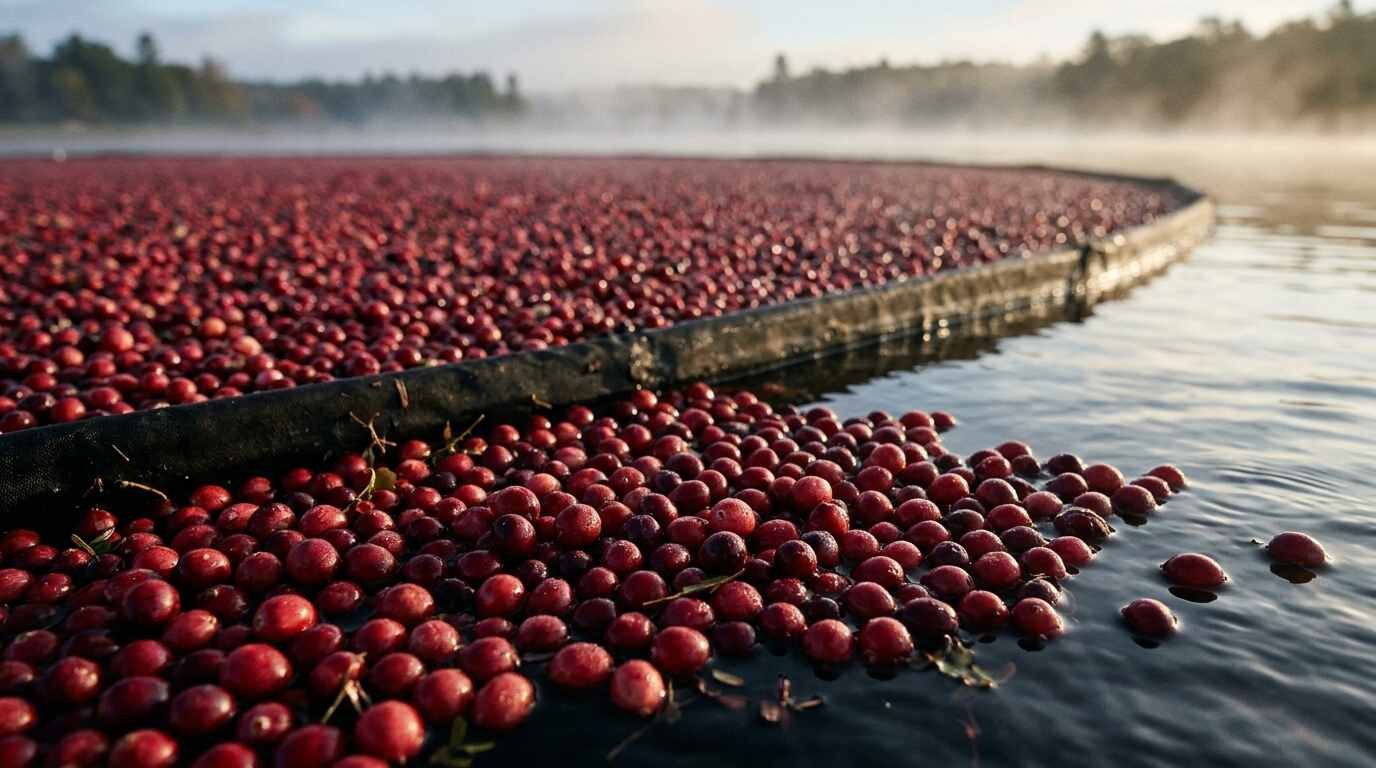
@@YOUTUBE@@ Each November the photographs come back around: a field turned into a red lake, workers in waders, a tide of fruit pressed against a floating line. It looks like a crop growing in water. It is actually a crop that has been lifted off its vines by its own air supply, then herded, pumped and trucked away. The berry on the Thanksgiving table took a short swim to get there, and the swim works because of something built into the fruit before anyone flooded anything.
Four small rooms of air inside a sour berry
The berry is lighter than water before the water arrives.
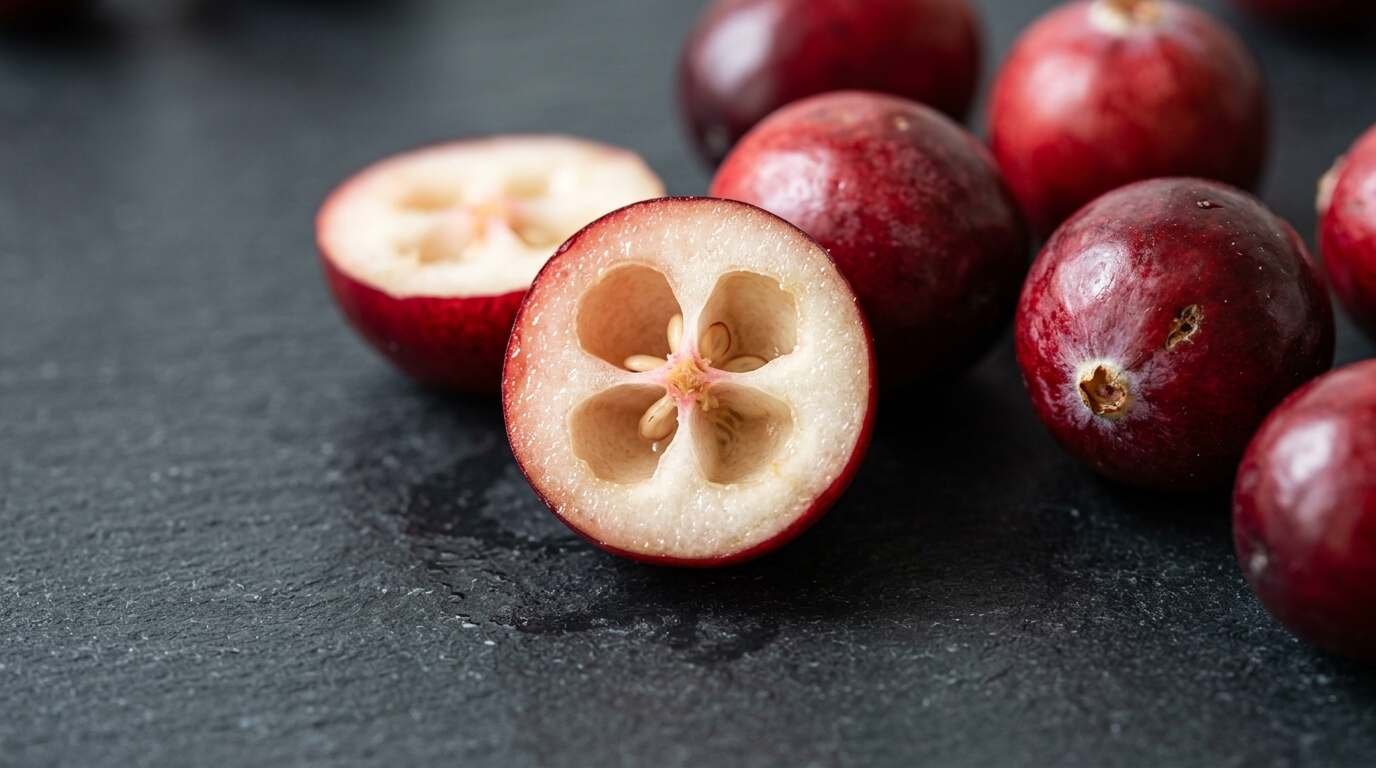
US Cranberries, the industry site based in Carver, Massachusetts, puts it plainly: four air chambers in the cranberry’s center allow it to float to the water’s surface. Botanists call those compartments locules. A 2019 study in PLoS ONE by researchers from the University of Wisconsin-Madison, the USDA Agricultural Research Service and a Wisconsin grower, Comprehensive analysis of the internal structure and firmness in American cranberry, measured all four of them from imprints of sliced fruit, describing locule size in terms of the fruit’s air pockets. The same authors hypothesized that firmness, the thing a buyer squeezes for, is tied to that internal structure.
From the hollow, the physics follows. The Barottas give the cranberry a typical effective density of about 0.7 grams per cubic centimeter against water’s 1.0, with a range of roughly 0.6 to 0.9 across berries, according to their paper. Anything with a density below water’s floats. A cranberry is a sealed room with a skin on it.
Those chambers were not put there for the harvest crew. Serina DeSalvio of Texas A&M University, writing in The Conversation, notes that the pockets let berries float down rivers and streams to scatter their seeds, and that they also make raw cranberries bounce on a hard surface. A dispersal strategy evolved for creeks happens to match a harvest method designed by people with pumps. The plant solved the logistics problem long before agriculture showed up to borrow the answer.
Flooding a field that never grows underwater
The water arrives in the fall and leaves when the fruit does.
Despite the photographs, cranberries do not grow underwater, and US Cranberries says the fields are flooded only at harvest time. The vines live in low, impermeable beds layered with sand, peat, gravel and clay, the same source says, and the season runs generally from mid-September through mid-November. The bog is less a pond than a shallow concrete basin made of earth, a place that can be filled and drained on schedule like a commercial sink.
The Cape Cod Cranberry Growers’ Association describes wet harvest as typically a three-day process. On the first day water is released onto the bog with enough depth to just cover the vine tips. On the second, water reels are driven onto the bog and knock fruit from the vines. On the third, the fruit is corralled and taken off with pumps or conveyors into waiting trucks. The association’s fall page adds that the reels are nicknamed “egg-beaters” and that they stir the water so the dislodged berries float up.
Depth is where the sources part ways slightly. The growers describe water just over the vine tips, while the Barotta paper models bogs flooded to approximately half a meter and calculates that a freed berry rising from that depth typically reaches the surface in one to two seconds, at a terminal velocity measured around 0.35 meters per second. The two descriptions are not necessarily in conflict, since a grower’s minimum and a physicist’s model are built for different jobs. They do mean that no single depth should be quoted as the depth of a cranberry bog.
What happens in those seconds is the part a camera rarely catches. The reel’s paddles shake loose a berry, the air in its four chambers pulls it upward against the drag of the water, and it breaks the surface like a fishing float. Multiply that by an acre and the red lake assembles itself.
Booms, rafts and the Cheerios effect
A floating berry wants company.
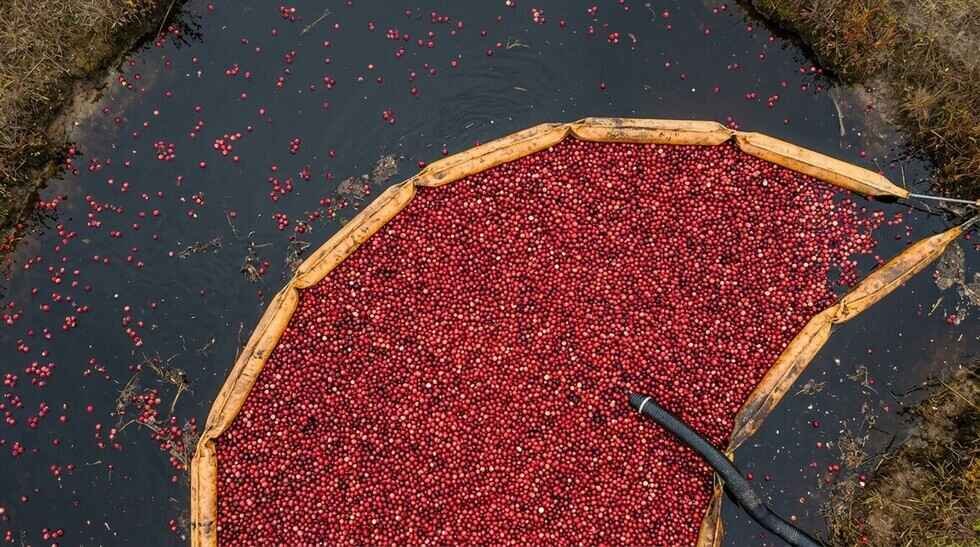
Once the fruit is up, it has to be gathered. At the UMass Cranberry Station in Wareham, crews from the A.D. Makepeace Company corralled the 2026 harvest with vinyl booms into large circles, then used a harvester, pumps, a wide suction hose and a conveyor to move berries into truck beds. The station’s 10.97-acre state bog yielded 2,200 barrels, topping the state bog’s 2,000 average and making it the second-largest harvest on record there, according to the university.
Those booms do more than fence the crop. The Barottas describe what happens when floating berries settle: they start interacting through the water’s surface and form clumps. Each berry dents the surface slightly, and neighboring dents pull toward each other. Physicists call this the Cheerios effect, named for the way cereal pieces gather in a bowl of milk. In a cranberry bog the attraction is weak, but it is real, and it means the red raft has some cohesion of its own before any worker touches it.
Their simulations then model a boom shrinking over time. When the confining circle halves its radius, the berries pack densely, which the paper ties directly to the harvest strategy of slowly decreasing the boom’s radius to aggregate the fruit. A crew walking a boom inward is, in physics terms, compressing a two-dimensional granular material. The crew calls it Tuesday.
Even out of the water, the berries keep behaving like a physics problem. The paper measured a pile of wet cranberries standing at an angle of about 27 degrees, steeper than the 23.8 degrees predicted from geometry alone, and attributes the difference to capillary bridges, thin films of water between berries acting like mortar between bricks. It is the same trick that lets wet sand hold up a castle wall.
This is also where the canned jellied cranberry sauce begins. A raft of wet-harvested berries is headed for processing, not the produce aisle, and the ridged log on the holiday plate is one of the places it ends up.
The five percent that stays dry
Fresh berries never touch the flood.
According to the Cape Cod Cranberry Growers’ Association, dry harvesting now represents about 5% of the Massachusetts crop, while the other 95% is picked wet and turned into juice, sauce and dried cranberries. Dry-harvested fruit is what reaches farmers markets, roadside stands and grocery shelves as fresh berries, and the vines must be completely dry before picking starts.
Its list of machines reads like a row of old tractor brands: mechanical pickers called Darlington, Furford and Western, self-propelled harvesters that comb through the vines and convey fruit into burlap bags or wooden boxes. Some growers empty the bags into plastic bins holding about 300 pounds each, then stack three bins and fly them off the bog by helicopter to waiting flatbed trucks. Of all the ways to move a sour fruit, airlift is the least expected.
Moisture explains the split. On the food podcast Gastropod, hosts Cynthia Graber and Nicola Twilley reported that wet-harvested berries cannot be sold fresh because they mold too quickly, and that wet harvesting, whose inventor nobody knows, first took off in Wisconsin. Wisconsin is now the largest producer, with roughly 60% of the U.S. harvest, according to DeSalvio’s piece in The Conversation. Water makes the harvest fast and the berry perishable. The flood is a trade, not a free lunch.
Gastropod’s hosts also noted that for most of the history of cranberry farming, berries were harvested dry, by people walking the vines with scoops. The red lake that shows up on every November feed is the newer method. The bagged berries in the produce case are the older one, mechanized.
Peg Leg Webb and the stairs
The legend says bounce. The 1876 patent says momentum.
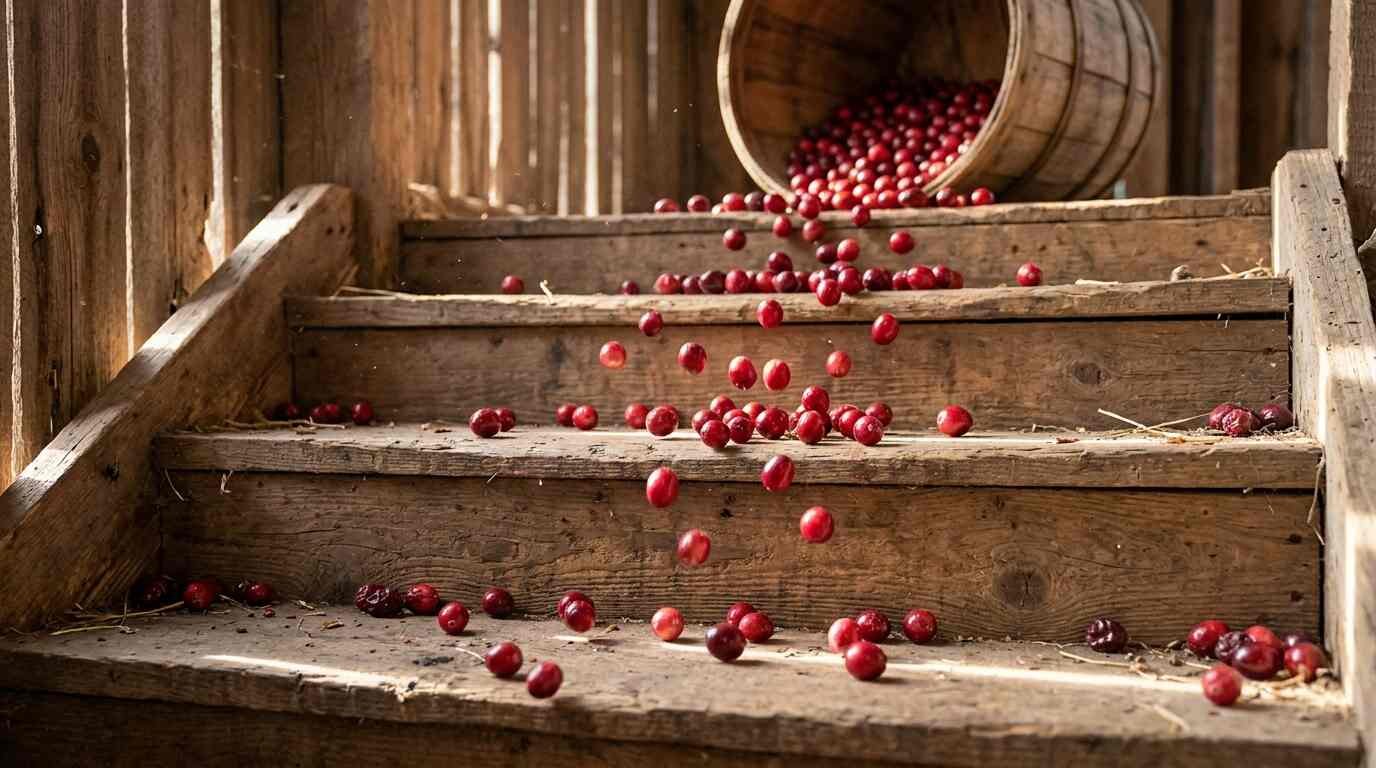
Sooner or later, cranberry lore arrives at a staircase in New Jersey. A Central Jersey newspaper article by Greg Saitz, Cranberries in New Jersey: a long and rich history, credits the bounce idea to a forerunner from the 1840s, a New Jersey grower named John “Peg Leg” Webb, and calls it an oft-repeated story that comes in slight variations. In the usual telling, Webb and his peg leg had difficulty bringing a barrel of cranberries down some steps, and the fruit sorted itself on the way. Ned Lipman, director of the Rutgers Office of Continuing Professional Education, who has researched the history of New Jersey cranberry farming, described the result: “The bad ones would stay on the steps and the good ones would bounce to the bottom.” Lipman also told the paper the discovery led to bounce sorters still used today.
It is a good story, and its own teller frames it as one told many ways. No primary record of the barrel or the stairs turned up in research for this post, so it belongs in the legend column.
Patent records tell a slightly different tale. In 1876, Edward Buzby of Shamong, New Jersey, received U.S. Patent 180,838 for an improvement in cranberry separators. His machine sent berries down a stack of reversed, overlapping inclined chutes. The key sentence reads: “The sound berries, having greater momentum or an easier rolling action than the unsound ones, will be carried over.” Buzby’s design even includes aprons meant to check the berries’ rebound from the sides of the case. The 19th-century inventor was sorting on how fruit rolls and carries, and spent some effort keeping it from bouncing around.
Bounce does show up as the working principle later. A 1996 patent by Jerome J. Zdroik, Soft cranberry and undersize cranberry separator and method, describes earlier sorters as separating soft from hard berries by resilience, dropping fruit onto an angled hard surface, because hard berries bounce and soft ones do not. Then it lists the flaw that justified a new invention: “The sorting devices that rely on bouncing, to separate cranberries, clog.”
So the folk version and the engineering record disagree in a useful way. A firm berry with intact air chambers does bounce, and growers did build machines around that. The first patented separator in this story, though, sorted on momentum and rolling, and a later inventor found the bounce machines jammed. The legend compresses a long run of tinkering into one man and one staircase. That is what legends do with engineering: they hand the credit for a whole workshop to one man on one afternoon.
Red gold on the Peconic
Long Island grew this fruit, then stopped.
Not every bog was in New England or Wisconsin. Kathy Kennedy of the Peconic Land Trust, in They Called It Red Gold, writes that by the late 1800s dozens of cranberry farms were operating on Long Island, with the Woodhull, Brown and Davis bogs as the largest. The Peconic River supplied the water, and growers dug trenches to move it to the vines in dry spells. By the late 1970s, Kennedy writes, Long Island cranberry farming was over, unable to match the economies of scale in New Jersey and Massachusetts.
What remains is the 165-acre Cranberry Bog Nature Preserve on Lake Avenue in Riverhead. Suffolk County describes it as what remains of an abandoned cranberry-growing operation, with the remnants of an old pump house from when the Woodhull family farmed the bog, and a loop trail with a wooden bridge over the old beds. The pump house is the detail that matters for this story. A cranberry operation is a plumbing system with fruit attached, and when the plumbing stops, the farm turns into a park.
Water-bound harvests have come and gone on Long Island before, as the history of the ice harvest that fed New York shows. Ponds and bogs tend to outlast the businesses built on them.
Closing the Riverhead bogs did not change the physics. Every cranberry still carries its four chambers of air, still rises in a second or two, still drifts toward its neighbors on the surface, a fluid puzzle as ordinary and as stubborn as the head on a glass of beer. What changed was the scale it takes to make a living from that fact. The county now describes the Riverhead preserve as part of the Peconic River’s drainage system, a job with no harvest at the end of it. Is there anyone on the North Shore or East End old enough to remember a red lake on Long Island, and where was it?
You Might Also Like
- Islay Scotch Tastes Like a Peat Bog on Fire. That’s a Feature, Not a Bug. Here’s the Science.
- Mock Apple Pie: How Ritz Crackers Fooled the Palate During the Great Depression
- The Pumpkin Spice Economy Has Almost Nothing to Do With Pumpkin
Sources
- Caroline M. Barotta and Jack-William Barotta, “The physics of cranberry bogs,” arXiv preprint 2601.11593, January 2026: https://arxiv.org/html/2601.11593
- US Cranberries, “Cultivation”: https://www.uscranberries.com/about-cranberries/cultivation/
- Luis Diaz-Garcia et al., “Comprehensive analysis of the internal structure and firmness in American cranberry (Vaccinium macrocarpon Ait.) fruit,” PLoS ONE, 2019: https://pmc.ncbi.nlm.nih.gov/articles/PMC6760784
- Serina DeSalvio, “Cranberries can bounce, float and pollinate themselves,” The Conversation: https://theconversation.com/cranberries-can-bounce-float-and-pollinate-themselves-the-saucy-science-of-a-thanksgiving-classic-216326
- Cape Cod Cranberry Growers’ Association, Frequently Asked Questions (wet harvest): https://www.cranberries.org/node/168
- Cape Cod Cranberry Growers’ Association, “How Cranberries Grow: Fall”: https://www.cranberries.org/fall
- Cape Cod Cranberry Growers’ Association, “How Cranberries Grow: Dry Harvest”: https://cranberries.org/dry-harvest
- University of Massachusetts Amherst, College of Natural Sciences, “UMass Cranberry Harvest 2026”: https://www.umass.edu/natural-sciences/stories/umass-cranberry-harvest-2026
- Gastropod, “Crantastic: The Story of America’s Berry” (transcript): https://gastropod.com/crantastic-story-americas-berry-transcript/
- Greg Saitz, “Cranberries in New Jersey: a long and rich history,” Central Jersey archive: https://archive.centraljersey.com/?p=199273
- Edward Buzby, U.S. Patent 180,838, “Improvement in cranberry-separators,” August 8, 1876: https://patents.google.com/patent/US180838
- Jerome J. Zdroik, U.S. Patent 5,544,761, “Soft cranberry and undersize cranberry separator and method,” 1996: https://patents.google.com/patent/US5544761
- Kathy Kennedy, “They Called It Red Gold: Exploring the Cranberry Bog Nature Preserve,” Peconic Land Trust, November 17, 2022: https://peconiclandtrust.org/blog/they-called-it-red-gold
- Suffolk County Parks, “Cranberry Bog Nature Preserve”: https://www.suffolkcountyny.gov/Departments/Parks/Our-Parks/Cranberry-Bog-Nature-Preserve
- TRUE FOOD TV, “CRANBERRY | How Does It Grow?” (YouTube): https://www.youtube.com/watch?v=XZPXQ7nw_9Y
Suggested category: Food History
Leave a Reply