Unapologetic is not a marketing tagline. It is a philosophy of resistance, a declaration that the full emotional and regional complexity of a billion-person culinary tradition does not need to be sanded down for anyone’s comfort. At Adda Indian Canteen — the restaurant that launched one of the most transformative dining movements in modern New York City — that philosophy was forged in real time, on a forgettable stretch of Thomson Avenue in Long Island City, under a rumbling subway overpass, beside a 7-Eleven, with menus printed on A4 paper and distributed by hand to nearby office buildings. What emerged from that improbable genesis has since earned two New York Times stars, a James Beard semifinal nod for Best New Restaurant, placement on virtually every major national “best of” list, and in January 2026, Time Out’s designation as the number one restaurant in New York City. That a restaurant built on the premise that Indian food should taste exactly like Indian food — no concessions, no dilutions, no apologies — could claim that throne tells you everything about where the American palate is heading, and why the old model of ethnic cuisine served through a filter of appeasement has finally run its course.
I understand the weight of those kinds of stakes. Twenty-five years running The Heritage Diner on Route 25A in Mount Sinai has taught me that authenticity is not a brand strategy — it is a structural commitment embedded in every decision, from which oil hits the flat-top at 5 a.m. to whether you source your bread from a local bakery or a distributor three states away. The Marcellino NY workshop operates on the same axis: English bridle leather, hand-saddle stitched, vegetable-tanned, built for a hundred years of use. No shortcuts. No substitutes. Adda’s founders, restaurateur Roni Mazumdar and chef Chintan Pandya, have built an empire on this same refusal to compromise, and their story deserves to be told in full.
The Origins: Kolkata, Mumbai, and One Battery Park Plaza
The backstory of Adda Indian Canteen is inseparable from the life of Roni Mazumdar, a Kolkata-born entrepreneur whose family immigrated to the United States in 1996. His father, Satyen Mazumdar — a former traffic cop with an extraordinary gift for cooking — arrived in New York and began selling fruit at One Battery Park Plaza, a hustle born from immigrant pragmatism and the kind of unrelenting drive that doesn’t wait for permission (The Ink, 2023). As Roni later recalled, his father was the sort of man who would walk up to a Mughlai paratha vendor in Calcutta and offer to pay for forty just to watch them being made. That obsessive curiosity with food eventually led to the opening of Masalawala on the Lower East Side in 2011, a tiny operation on what neighborhood regulars called “the corner of death” (Brooklyn Magazine, 2022). Neither Mazumdar had any restaurant experience. They put Kolkata dishes on the menu. Nobody ordered them. Everyone wanted chicken tikka masala. They caved to survive.
That capitulation haunted Roni Mazumdar for years. He met Chef Chintan Pandya — a Mumbai-born, Oberoi-trained culinary professional who had worked at Michelin-starred Junoon in Manhattan — through a mutual friend in 2017 (Fine Dining Lovers, 2025). The two bonded over a shared frustration: Indian cuisine in America had been reduced to a handful of dishes that bore little resemblance to the actual food Indians cook and eat at home. Their first collaboration, Rahi in the West Village, opened that same year to little fanfare. The restaurant served upscale Indian fare and went largely unnoticed.
Then, in September 2018, they opened Adda.
The Long Island City Era: A Canteen That Changed the Game
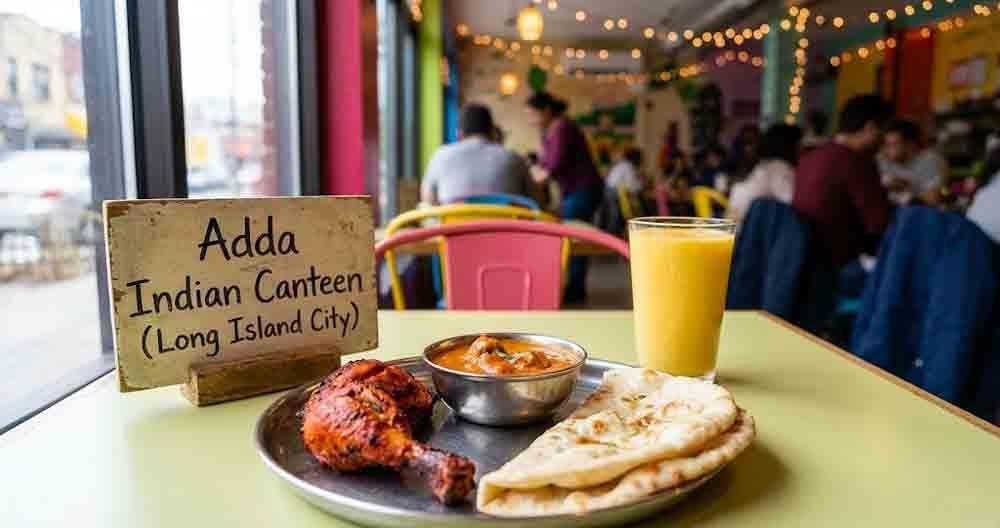
The original Adda at 31-31 Thomson Avenue was a small, casual space plastered with a collage of Indian newspaper front pages — a deliberate aesthetic statement that signaled this was not the sanitized, white-tablecloth Indian dining New Yorkers were accustomed to. The name “adda” translates from Hindi as “a place where people hang out,” and the room lived up to that promise with its bright, unpolished energy (Yelp, 2018). Students from nearby LaGuardia Community College ate lunch for seven dollars. Office workers from the surrounding buildings wandered in for keema pao and kale pakoras. And within weeks, something unexpected happened: Manhattan started crossing the East River to eat here.
Pete Wells of The New York Times gave Adda a prestigious two-star review, calling it a full-throated defense of traditional cooking (LIC Talk, 2018). The accolades cascaded from there. Food & Wine named it one of the ten best new restaurants of 2019. Bon Appétit placed it among the top fifty new restaurants in America. Eater National, CNN, and Timeout followed suit. The restaurant was a James Beard semifinalist for Best New Restaurant (Astoria Patch, 2019). Pandya was later named a StarChefs Rising Star. The word “unapologetic” — first used by a Queens journalist in a local newspaper headline about Adda — became the name of the entire restaurant group that followed: Unapologetic Foods (Fine Dining Lovers, 2025).
What made Adda revolutionary was not sophistication or spectacle. It was radical honesty. Pandya’s menu was, as he described it, the food he actually likes to eat — bheja fry (goat brains with ginger and red onion), tawa kaleji (seared chicken livers), Lucknowi dum biryani, junglee maas, tandoori poussin with chile and black salt (Nation’s Restaurant News, 2024). When a customer around his mother’s age told Pandya he owed her an apology because the food was too spicy, he refused. That refusal became the ethos of an empire.
The Unapologetic Foods Empire
Adda was the inflection point. From that small Queens canteen, Mazumdar and Pandya built what is now one of the most celebrated restaurant groups in the United States. The portfolio currently includes Dhamaka at Essex Street Market on the Lower East Side — which The New York Times and Esquire both named the number one restaurant of the year, and where Pandya won the James Beard Award for Best Chef: New York State in 2022, the first Indian chef to win in that category (Heritage Radio Network, 2024). Semma in the West Village earned a Michelin star and was named the number one restaurant in New York by The New York Times for 2025 (Fine Dining Lovers, 2025). Masalawala & Sons in Park Slope is a deeply personal project built around Satyen Mazumdar’s food memories from 1950s Kolkata. Rowdy Rooster serves unapologetically scorching Indian fried chicken. Naks, a Filipino restaurant on First Avenue, was born when Dhamaka’s former chef de cuisine Eric Valdez told Pandya he wanted to build something that was “unapologetically Filipino.”
Each of these restaurants operates on a distinct regional and philosophical premise. Dhamaka’s guiding phrase was “the forgotten side of India.” Semma’s was the food of southern India. The original Adda was “canteen food of India.” And when three of Unapologetic Foods’ restaurants simultaneously appeared on The New York Times’ list of the one hundred best restaurants in New York, it became clear that this was no longer an experiment — it was a movement (The Ink, 2023).
Adda Reborn: The East Village Chapter
The COVID-19 pandemic took a significant toll on Long Island City, a neighborhood populated largely by students and working professionals whose patterns were disrupted for years. In early 2025, the original Adda quietly closed its Thomson Avenue doors. But rather than mourn, Mazumdar and Pandya channeled the closing into reinvention. On May 1, 2025, Adda reopened at 107 First Avenue in the East Village — a larger, more stylish space that retained the original’s newspaper-plastered walls (some clippings were physically transferred from the LIC location) and handwritten Adda sign, while dramatically expanding the culinary ambition (Resy, 2025).
The new Adda’s guiding phrase is “reimagined classics,” with a particular focus on northern Indian traditions. Chef de cuisine Neel Kajale now leads the kitchen, carrying forward Pandya’s vision while bringing his own sensibility to the line. The menu retains beloved staples — bheja fry, baby goat biryani, chacha’s lamb chops — but introduces new dimensions: scallops cooked in coconut milk with green chile, slow-braised beef cheeks in puff pastry, chicken curry made with housemade lime pickles, and a Nagaland pork fry featuring Niman Ranch heritage pork belly with bamboo rice (Bloomberg, 2025).
The centerpiece of the new Adda is the Butter Chicken Experience — a tableside presentation available to six tables per night, where a chef wheels a smoker of charred heritage-breed chicken to the table, still steaming, allowing diners to choose which wood their bird is cooked over and which flavored butter finishes the dish. An optional butter chicken cocktail accompanies it (Time Out, 2026). Mazumdar has described this as a deliberate reclamation: where many Indian restaurants had grown embarrassed of butter chicken as a cliché, Adda is taking it back with full force and elevating it into a communal experience.
The Michelin Guide has recognized the new location, praising its roasted bone marrow with peppercorn sauce and coconut pao, and its seabass fish curry (Michelin Guide, 2025). Eater named Adda to its 2025 awards. The Infatuation and Condé Nast Traveler followed with glowing endorsements.
The Philosophy of “Unapologetic” and Why It Matters
Running The Heritage Diner for a quarter century has given me a particular lens on what it means to be unapologetic in the food business. Every diner operator in America faces the same pressure Mazumdar and Pandya confronted: do you make the food the way it should be made, or do you dilute it to match what the broadest possible audience expects? At the Heritage, the answer has always been the same as Adda’s — you cook honestly. You season the cast iron properly. You source ingredients with integrity. You do not apologize for the heat, the richness, or the complexity. This is the same principle that governs every briefcase I build at Marcellino NY: English bridle leather does not need to explain itself. Its quality is self-evident to anyone who touches it.
What Mazumdar articulates so powerfully — and what resonates deeply with anyone who has staked their livelihood on craft — is that when you look down on a cuisine, you are dismissing a culture. Indian cuisine is one of the oldest and most complex culinary traditions on earth, yet as Mazumdar has observed, there are people who have gone their entire lives without trying it, and that remains socially acceptable (Fine Dining Lovers, 2025). Adda was the first crack in that wall. Everything Unapologetic Foods has built since — from Dhamaka’s goat testicles and rabbit to Semma’s Michelin star — has widened that crack into an open door.
For those of us operating in the world of artisanal craftsmanship and local hospitality, the lesson is transferable. Paola and I are building Maison Pawli on the same foundation: the belief that Long Island’s North Shore does not need to be compared to the Hamptons or Manhattan to justify its worth. Its value is inherent, rooted in community, in history, in the kind of provenance that no marketing budget can manufacture. Adda understood this about Indian food before anyone else in America was willing to say it out loud.
Dining at Adda: What You Need to Know
Current Location: 107 First Avenue, New York, NY 10003 (East Village) Original Location (Closed): 31-31 Thomson Avenue, Long Island City, NY 11101
Website: addanyc.com Reservations: Available via Resy — reservations drop 15 days in advance at 9:00 a.m. Phone: (917) 502-3396 Instagram: @addanyc (27K+ followers) Press Contact: press@uafoods.nyc
Hours: Currently open for dinner service. Walk-ins are possible but reservations are strongly recommended given the restaurant’s popularity.
Signature Dishes: Butter Chicken Experience (tableside, pre-order required), bheja fry, baby goat biryani, chacha’s lamb chops, roasted bone marrow with peppercorn sauce and coconut pao, seabass fish curry, kharda scallop, Nagaland pork fry, mushroom haleem, bharwan mirchi murgh.
Price Range: Moderate to upscale. The Butter Chicken Experience runs approximately $38-$42 per person.
Dietary Options: Extensive vegetarian menu including gucchi morel pulao, bhatti kumbh (charred mushrooms with yogurt and Kashmiri chili), and cauliflower with cream, dry fruits, and pomegranate. Halal options available. Zero-proof cocktail selections available.
Atmosphere: Warm wood tones, basket light fixtures, the signature newspaper-covered walls carried over from the LIC original. Larger and more stylish than its predecessor, with Le Creuset Dutch ovens used for tableside presentations and roaming chaatwala servers carrying trays of chaats around the dining room.
Parent Group: Unapologetic Foods — also operates Dhamaka, Semma (Michelin-starred), Masalawala & Sons, Rowdy Rooster, Naks, and Kebabwala.
A Place Where People Hang Out
The word “adda” describes a gathering place — not a formal institution, but the kind of spot where conversation flows as freely as the food. Every great neighborhood has one. The Heritage Diner has been Mount Sinai’s version of that for twenty-five years: the place where regulars sit at the counter and talk about their kids, their commutes, their property taxes, their lives. Adda occupies that same emotional territory, scaled to the ambitions of a city that never stops moving.
What Roni Mazumdar and Chintan Pandya have built, from a fruit stand at One Battery Park Plaza to a James Beard Award to the number one restaurant in New York City, is not merely a collection of successful restaurants. It is proof that the most powerful force in hospitality remains the one that has always mattered most: the courage to serve what you believe in, exactly the way you believe it should be served, without apology. In an era of algorithmic optimization and focus-grouped menus, that kind of conviction is the rarest ingredient of all.
Peter — Heritage Diner, Mount Sinai, NY | Marcellino NY, Huntington, NY | Graduate degrees in Philosophy, Long Island University & The New School, NYC