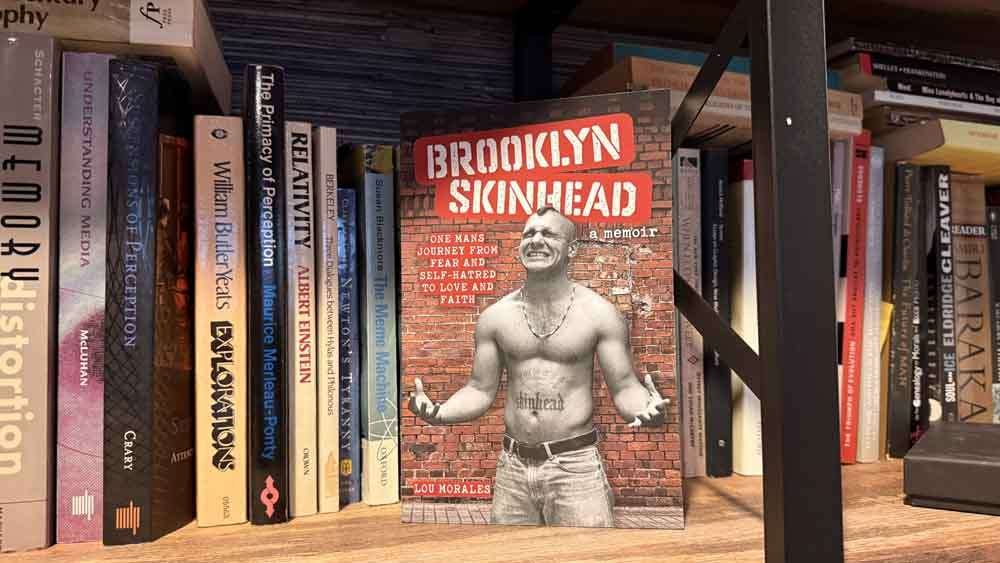
Sunset Park in the late 1980s did not produce philosophers. It produced survivors. The blocks between Third and Fifth Avenue were governed by a logic that predated anything you could find in a classroom — territorial, visceral, calibrated to fear. You learned the grammar of the streets the way you learned to breathe: involuntarily, and because the alternative was suffocation. Lou Morales grew up inside that grammar, and Brooklyn Skinhead is the document he produced once he finally found the language to describe it.
I know this because I was there. Not with the Sunset Skins specifically — Lou ran with that crew out of Sunset Park, a predominantly Puerto Rican skinhead gang that became notorious across the NYHC scene from roughly 1987 through the early nineties. But I was in the same orbit. We went to the same punk rock shows. We ran the same streets. We shared the same anger, which at that age felt less like an emotion and more like a weather system — constant, ambient, shaping everything it touched. I watched a lot of people lose themselves in that weather. Some lost their lives. Lou got out. I got out. The paths we took to the exit could not have been more different.
A Word About the Word “Skinhead”
Before going any further, something needs to be said for readers who only know the word “skinhead” through its ugliest association. The skinhead subculture was never intended to be a racist thing. It was stolen by racists, and the theft has been so successful that most people now assume the two are synonymous. They are not, and the history matters.
The original skinheads emerged in late-1960s London as a working-class youth movement rooted in cultural exchange. White English kids from council estates and Jamaican immigrants who had settled in the same neighborhoods found common ground through music — ska, rocksteady, reggae, and soul. Artists like Desmond Dekker, the Skatalites, and the Pioneers were the soundtrack. The fashion — Doc Martens, braces, cropped hair, Fred Perry shirts — was borrowed equally from British mod culture and Jamaican rude boy style. Class mattered more than race. The original scene was, by every credible historical account, multiracial at its core.
That changed in the late 1970s when Britain’s far-right National Front began deliberately recruiting working-class youth at football matches and punk shows, exploiting economic frustration to push ethno-nationalist politics. A segment of the skinhead revival got co-opted. Bands like Skrewdriver, which had started as a non-political Oi! group, were absorbed into the white power orbit. The media latched onto the most violent and hateful version of the subculture and broadcast it as the whole story. By the mid-1980s, “skinhead” in the popular imagination meant neo-Nazi, full stop.
But that was never the whole story, and in New York City it was barely the story at all. The NYHC skinhead scene was overwhelmingly multiracial — Puerto Rican, Black, white, everything in between. The Sunset Skins themselves were a predominantly Latino crew. In 1987, a New York City skinhead named Marcus Pacheco founded SHARP — Skinheads Against Racial Prejudice — specifically to reclaim the subculture from the racists who had hijacked it. NYC Oi! bands threw their support behind the movement. SHARP spread from New York to the UK and then globally, and it remains active to this day. When white power skins showed up at New York venues, they got dealt with — Lou describes one such incident at Lamour’s in Brooklyn in vivid detail. The idea that skinhead equals racist is not just wrong. It is an erasure of the very people — many of them Black and Latino — who built and defended the culture.
So when you read the title Brooklyn Skinhead, understand what it actually means. It means working-class. It means punk shows at CBGB’s. It means brotherhood forged under pressure. It does not mean what cable news taught you it means.
Fourteen Years Old at the Matinee
Lou was the youngest member of the Sunset Skinhead Crew, a detail that carries more weight than it might seem. Being fourteen and walking into CBGB’s matinees alongside guys who had already earned reputations for serious violence means you were either fearless or desperate, and in Sunset Park those two things were often indistinguishable. The memoir opens in that declining neighborhood — gangs controlling the street corners, the public school system barely functioning, and a generation of kids with no clear route toward anything that looked like a future. Lou captures this atmosphere without self-pity or nostalgia. He writes the way he lived it: direct, unsentimental, and close to the bone.
What makes the early chapters of Brooklyn Skinhead so effective is the granular specificity of the world Lou reconstructs. He describes his childhood friend Sob coming up the block one day freshly shaved, wearing black Docs and a flight jacket, and how the aesthetic alone was enough to pivot an entire group of aspiring metalheads into skinheads overnight. That moment — where identity shifts not through ideology but through the sheer magnetism of appearance — is something anyone who came up in a subculture will recognize instantly. You did not arrive at punk or skinhead or hardcore through a literature review. You saw someone who looked like they had figured something out, and you followed them into the fire.
Sunday at CBGB’s, Monday Back on the Block
The book’s most vivid passages trace Lou’s immersion in the New York hardcore scene — the Sunday matinees, the clubs that opened and closed like wounds, the alliances between crews from Park Slope, Jackson Heights, Westchester, and Long Island that would merge into a single volatile organism every weekend. Lou writes about Animal Hall in Park Slope, a biker joint where he saw his first show, and the way the music hit him with the force of revelation. Breakdown. Sheer Terror. Outburst. For a kid from Sunset Park surrounded by bikers and Nazi flags, the sound was less entertainment than confirmation — proof that the rage inside him had a frequency, and that other people were already broadcasting on it.
This is where the memoir functions as more than personal narrative. It is a street-level history of NYHC during one of its most turbulent and creative periods. Lou moves through it not as an observer but as a participant embedded in the chaos, which gives his account a credibility that retrospective histories often lack. One Amazon reviewer — someone who was around for the hardcore scene in the late eighties — noted that this is not the revisionist version of events that so many former participants peddle now. It is the unvarnished record, told by someone who has no interest in cleaning it up.
Thank God, Thank Luck
The second half of the book tracks Lou’s conversion to Christianity and his subsequent life as a missionary in Eastern Europe, Africa, and beyond. This is where readers unfamiliar with the first half of the story might lose the thread — the pivot from skinhead violence to mission work can seem abrupt, even implausible. But Lou writes about faith the way he writes about the streets: without performance. He does not dress it up. He does not try to sell you on it. He simply tells you what happened to him and lets you sit with it.
I have my own relationship with this part of the story, because Lou and I kept in touch over the years. He became religious. I went the other direction — philosophy, science, the kind of secular framework that tries to explain existence through evidence and reason rather than revelation. He would say “Thank God” about making it out alive. I would say “Thank luck.” To me, we had simply arrived at different philosophical understandings of the same experience. I have always completely respected the religious life Lou lives, and I still do, because it is real. That is the word that keeps surfacing when I think about him — real. He was real as a kid on 43rd Street, and he is just as real in his beliefs now.
I am always reminded, when I think about Lou’s faith, of Nietzsche calling Christ the only true Christian — because Nietzsche thought most believers were performing rather than living their convictions. Lou is not performing. This book proves that. The sincerity of his transformation is what gives the memoir its structural integrity — without it, the story would be just another tale of street life. With it, the story becomes something closer to testimony, in both the legal and the spiritual sense of the word.
Honesty Instead of Craft
Brooklyn Skinhead works because Lou Morales does not try to be a writer. He tries to be honest, and the writing follows. The prose is spare and unpretentious — no literary flourishes, no attempts to elevate the material beyond what it is. This is the right instinct for a story like this. The material is already elevated by the sheer extremity of the life it describes. What it needs is a narrator willing to stay out of the way, and Lou provides exactly that.
The book also benefits from its refusal to moralize. Lou does not condemn his younger self from the safety of hindsight. He does not turn the skinhead years into a cautionary tale wrapped in a bow. He acknowledges what happened, takes responsibility for his part in it, and then shows you where the road led. The reader is left to draw their own conclusions, which is the mark of a memoir that trusts its audience.
Sweat, Steel Toes, and the Taste of Adrenaline
If you grew up in New York in the eighties, particularly in the boroughs where the line between subculture and survival was nonexistent, this book will hit you in places you thought you had sealed off. If you did not grow up in that world, it will show you what it felt like from the inside — not the romanticized version, not the documentary version, but the version that smells like sweat and beer and adrenaline and the particular metallic taste of fear that comes from knowing you are in over your head and having nowhere else to go.
Lou Morales wrote this book because he believed his story might help someone. Having known him for close to forty years, I can tell you that impulse is genuine. Brooklyn Skinhead is available on Amazon in paperback. It is a fast read — most people finish it in a day or two — but it will stay with you considerably longer than that.
Sources:
- Morales, Lou. Brooklyn Skinhead: A Memoir. Independently published, 2024. Amazon
- Alva, Freddy. “Brooklyn Skinhead: An Interview with Lou Morales.” Creases Like Knives, September 1, 2024. creaseslikeknives.com
- Alva, Freddy. “The Sunset Skins, NYHC Crew: A Chat with Lou Morales, Minus, and Jorge Rosado.” No Echo. noecho.net
- “Skinhead.” Wikipedia. wikipedia.org
- “Skinheads Against Racial Prejudice.” Wikipedia. wikipedia.org