Around six o’clock on Smithtown’s East Main Street, the light takes on a character all its own — a brief, golden shift that feels like the town exhaling before the night begins. It catches the brick facade of a building at number 47, throws long amber shadows across hardwood floors visible through plate glass, and illuminates the kind of scene that Richard “Bull” Smith himself might have recognized as the essential purpose of a town center — a place where people gather, not out of obligation, but out of appetite. Chop Shop Bar & Grill occupies that light. It occupies that corner of Smithtown’s civic life with the quiet authority of a restaurant that has figured out what it is and refuses to apologize for it: a butcher-forward, neighborhood steakhouse that treats a Tuesday prix fixe dinner with the same seriousness that the old chop houses of Manhattan once reserved for power lunches.
I have spent twenty-five years behind the counter of The Heritage Diner in Mount Sinai, twelve miles and a philosophical world away from Smithtown’s increasingly sophisticated Main Street dining corridor. I know what it takes to keep the lights on and the griddle hot for a quarter century. I know what it costs — in fatigue, in sacrifice, in the particular loneliness of a 4:00 AM kitchen. And I know excellence when I see it across a table. Chop Shop is excellent.
The Room: Brick, Hardwood, and the Anti-Steakhouse
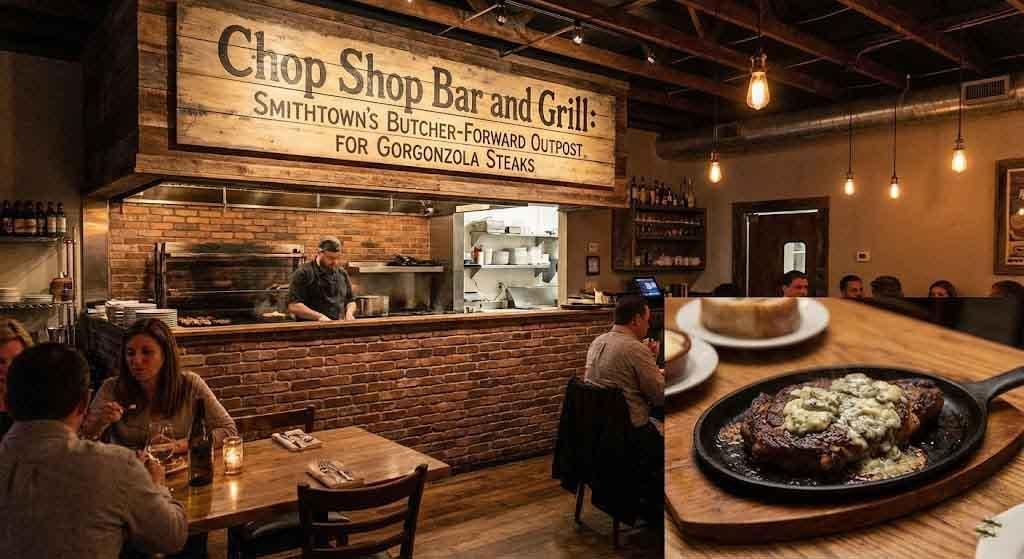
Walk through the front door and the first thing that strikes you is what is absent. There are no taxidermied heads on the walls. No oxblood leather banquettes sagging under the weight of masculine cliché. Chop Shop’s design language speaks a dialect that reviewers have aptly described as a balance of masculine and feminine sensibility — exposed brick walls and hardwood flooring grounded by oversized retro lamp fixtures that cast the kind of warm, directional light you associate with a well-curated SoHo loft rather than a suburban steak joint (OpenTable, 2026).
A hand-painted mural anchors the dining room, providing the sort of visual identity that tells you someone with taste made decisions here. The bar, which runs along one wall beneath large flat-screen televisions, manages the trick of feeling both professionally operated and genuinely convivial. It is the kind of bar where a CPA from down the road recommends the place to clients after tax season, where three couples from Commack rotate through on their weekly dining circuit, and where a fiftieth birthday party unfolds without anyone needing to shout (TripAdvisor, 2025).
The layout is smart. The main dining room flows into that long bar area with tables and booths claiming the remaining two-thirds of the footprint. A private function room accommodates gatherings of six to twenty — corporate dinners, engagement celebrations, the kind of milestone occasions that demand a room with a door you can close. As someone who has watched Paola and me plan our own boutique real estate venture for 2026, I appreciate the intelligence of flexible space. A room that can be a Tuesday happy hour at 4:00 PM and a private rehearsal dinner at 7:00 PM is a room that earns its rent twice.
The Gorgonzola Steak Flatbread: Signature and Statement
Every serious restaurant needs a dish that functions as both signature and thesis statement. At The Heritage Diner, it is the burger — unadorned, executed with twenty-five years of griddle wisdom. At Marcellino NY, the equivalent is the English bridle leather briefcase stitched by hand: a single object that communicates everything about materials, process, and philosophy without requiring a word of explanation.
At Chop Shop, that dish is the Gorgonzola Steak Flatbread.
The construction is deceptively straightforward: sliced marinated skirt steak, melted gorgonzola, spinach, caramelized onions, and a balsamic reduction drizzle assembled on flatbread. But the execution reveals a kitchen that understands layering. The skirt steak must be marinated long enough to tenderize the grain without overwhelming the beef’s natural minerality. The gorgonzola — a blue cheese originally from the town of Gorgonzola near Milan, recognized as one of the world’s oldest blue cheese varieties — must melt into the flatbread without liquefying into a puddle. The caramelized onions must achieve true caramelization, not the rushed browning that passes for it in lesser kitchens. And the balsamic reduction must walk the razor’s edge between sweet and acidic.
This is a dish that appears on the happy hour bar menu alongside sea-salted kettle chips with melted gorgonzola and a ten-ounce sirloin burger, and it also anchors the private party appetizer selections. That dual citizenship — casual enough for a Monday afternoon at the bar, refined enough for a sit-down event — is the mark of a kitchen operating with genuine range (Chop Shop Bar & Grill Menu, 2026).
The Steak Program: Porterhouse to Filet, Medium Rare Only
The name promises a chop shop, and the menu delivers. The steak program at Chop Shop reads like a love letter to the American steakhouse tradition, filtered through the North Shore’s particular appetite for quality without pretension. The Porterhouse — ordered medium rare, the only way a serious steak should arrive — delivers contrasting textures: the buttery tenderness of the filet side against the robust chew of the strip, with a caramelized crust that speaks to proper searing technique and well-maintained equipment (ET Week Media, 2025).
The Filet Mignon, served with mashed potatoes and seasonal vegetables, earns consistent praise from diners who describe the beef as remarkably tender. The N.Y. Shell Steak, served with charred onion and steakhouse fries, represents the classic New York cut that built the city’s chophouse reputation. The Surf and Turf Filet marries land and sea in the grand American tradition.
But the menu is not a one-trick operation. The Slow Braised Lamb Shank — boneless, porcini-dusted, served over portobello mushroom risotto with applewood bacon chive mashed potatoes and fresh asparagus — reveals a kitchen comfortable with long, slow cooking. The Double Cut Pork Chop announces itself with the confidence of a twenty-five-dollar centerpiece. And the Sesame Seared Tuna, served over sushi rice with baby bok choy, crispy noodles, wasabi, and soy, demonstrates the kind of Pacific Rim fluency that has quietly become standard on the North Shore’s better menus.
This is a restaurant that understands what I have learned across three decades in food service: the steak is the anchor, but the ship needs more than an anchor to sail.
The Seafood and Pasta: Locally Sourced, Globally Influenced
Chop Shop’s relationship with seafood reflects the North Shore’s geographic blessing. Long Island’s proximity to some of the Eastern Seaboard’s richest fishing grounds — the waters off Montauk, the clam beds of the Great South Bay, the lobster territories of New England — gives restaurants like Chop Shop access to product that inland steakhouses can only approximate.
The Sautéed Littleneck Clams with bacon, bell peppers, garlic, and parsley represent the kind of straightforward clam preparation that rewards quality sourcing over culinary acrobatics. The Clams Oreganata — Long Island littlenecks with seasoned breadcrumbs, fresh oregano, and lemon — update a classic that has graced Italian-American tables on Long Island since the postwar suburban expansion brought Southern Italian cooking to Suffolk County. The Maryland Style Crab Cake, served with lump crab meat and lemon caper remoulade, nods to the mid-Atlantic tradition while maintaining the clean, uncluttered plating that defines Chop Shop’s aesthetic (Uber Eats Menu, 2026).
The pasta program holds its own. The Rigatoni alla Vodka, the Grilled Chicken Parmigiana, and the Angel Hair with Spinach and Garlic rotate through the dining room with the frequency that suggests these are not afterthoughts but genuine draws. The Short Rib Grilled Cheese — barbecued pulled short rib with caramelized onions and melted cheddar on toasted ciabatta — occupies the increasingly important territory between sandwich and entrée that smart restaurants have learned to exploit.
The Prix Fixe: Tuesday and Wednesday Value That Defies the Market
In an era when the National Restaurant Association reports average check sizes climbing relentlessly — driven by food cost inflation, labor pressures, and the slow erasure of mid-market dining — Chop Shop’s Tuesday and Wednesday prix fixe dinner stands as a deliberate act of neighborhood loyalty. For fifty-five dollars per person, the menu offers a selection of appetizers, entrées from both land and sea, and desserts that include the house-made crème brûlée and the Italian Rainbow Cake that has achieved something approaching cult status on review platforms (ET Week Media, 2025).
This is not a loss leader. This is a strategic decision to fill midweek seats by offering genuine value — the kind of value that builds a Tuesday habit, which builds a Saturday reservation, which builds the word-of-mouth that no advertising budget can replicate. I have watched this dynamic play out at The Heritage Diner for twenty-five years. The customer who discovers you on a quiet Wednesday becomes the customer who celebrates every anniversary with you for the next decade.
The dessert program deserves particular attention. Chop Shop employs a pastry chef who produces everything in-house — the Raspberry Sorbet, the Crème Brûlée with its properly caramelized sugar crust, the Italian Rainbow Cake that stacks sponge layers with almond paste and chocolate in the tradition that Southern Italian bakeries brought to New York in the early twentieth century. In a market where most restaurants outsource dessert production, this commitment to in-house pastry is a tell. It tells you that the kitchen takes the end of the meal as seriously as the beginning.
The Bar: Happy Hour, Martinis, and the Art of the Third Place
The sociologist Ray Oldenburg coined the term “third place” to describe the communal spaces — neither home nor work — where civic life and social connection happen. I have written extensively about The Heritage Diner as a third place, about how a twenty-five-year-old neighborhood institution becomes a kind of secular cathedral where the rituals of coffee, conversation, and community sustain something that no algorithm can replicate.
Chop Shop’s bar functions as precisely this kind of third place. The happy hour runs Monday through Friday from 4:00 to 6:00 PM, offering specialty-priced cocktails and select wines alongside the bar menu — the Gorgonzola Steak Flatbread, the Kettle Chips, the Chop Shop Cheese Burger, the Chipotle Shrimp Flatbread with manchego cheese, fresh avocado, cilantro, heirloom tomatoes, and chipotle drizzle.
The exclusive martini menu suggests a bar program with ambition. The wine list, which reviewers describe as extensive and well-curated, offers both familiar varietals and discoveries by the glass. This is not a bar that exists merely to hold customers until their table is ready. This is a bar that is a destination in its own right — the kind of place where a Fig Martini and a Black & Tan appear on the same ticket without irony, where the bartenders know the difference between shaken and stirred, and where the after-work crowd transitions seamlessly into the dinner crowd because the quality never drops when you move from barstool to table (TripAdvisor, 2025).
The Location: Main Street, Smithtown, and the Future of North Shore Dining
Smithtown, founded in 1665 by Richard Smith — whose legendary bull ride around the land he claimed remains one of Long Island’s most enduring origin stories — has evolved from colonial farming settlement to one of Suffolk County’s premier North Shore communities. The town’s Main Street corridor, anchored by institutions like Insignia Prime Steak & Sushi and newcomers like Bull Smith’s Tavern, represents a dining ecosystem that increasingly rivals the density and quality of the more celebrated South Fork restaurant scenes.
Chop Shop sits at the heart of this evolution. At 47 East Main Street, it occupies the kind of Main Street commercial real estate that — as Paola and I understand intimately from our work in North Shore property markets — functions as a bellwether for community vitality. When a restaurant of this caliber thrives on a Main Street address, it signals something larger about the town’s trajectory: rising household incomes, increasing demand for quality-of-life amenities, and the kind of demographic sophistication that attracts further investment.
The restaurant’s 4.7-star rating across more than one thousand OpenTable reviews is not an accident. It is the cumulative result of consistent execution across what reviewers repeatedly identify as the three pillars: food quality, service excellence, and atmospheric intelligence (OpenTable, 2026). The Tripadvisor Travelers’ Choice award, which recognizes the top ten percent of properties globally, confirms what the locals already know.
Parking can present a challenge — Main Street is Main Street — but the LIRR’s Smithtown station on the Port Jefferson Branch puts the restaurant within reach of commuters returning from Manhattan, creating a natural catchment for the kind of post-commute dinner that has become a North Shore ritual.
Chop Shop Bar & Grill 47 East Main Street, Smithtown, NY 11787 Phone: (631) 360-3383 Website: chopshopbarandgrill.com Instagram: @chopshopbarandgrill Reservations: OpenTable Delivery: Available via DoorDash and Uber Eats
Hours: Monday–Friday: 12:00 PM – 10:00 PM (Friday until 11:00 PM) Saturday: 1:00 PM – 11:00 PM Sunday: 4:00 PM – 10:00 PM
Private Events: Function room available for 6–20 guests, Monday–Sunday. Contact for catering and party packages.
Peter from The Heritage Diner writes about the restaurants, craftsmen, and neighborhoods that make Long Island’s North Shore one of the most compelling corridors in the New York metropolitan area. The Heritage Diner has served Mount Sinai since 2000 at 275 Route 25A. Marcellino NY handcrafts bespoke English bridle leather briefcases in Huntington at marcellinony.com.