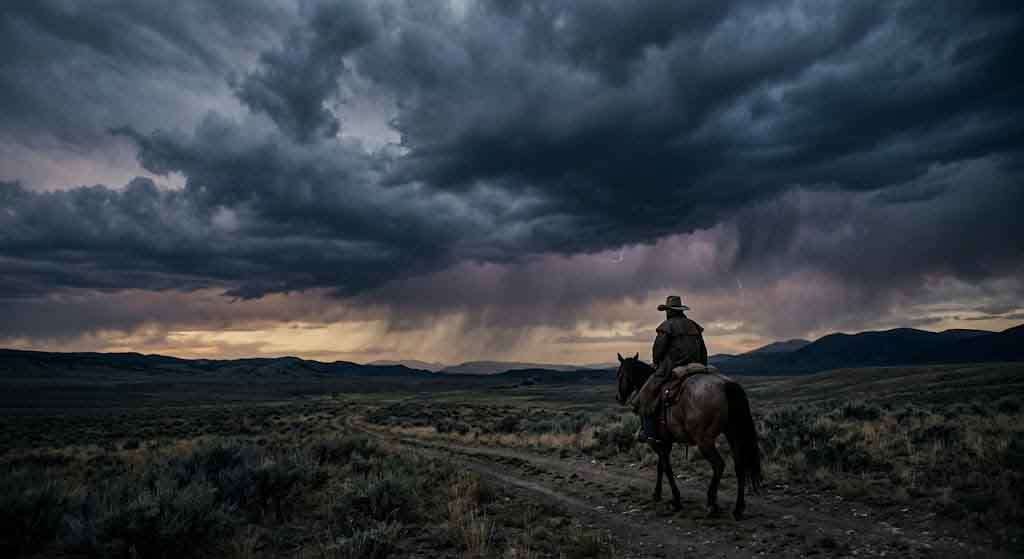
Thirty-three years after its release, Unforgiven still hasn’t loosened its grip. Not on critics, not on filmmakers, not on anyone who watched William Munny ride into the rain at the end of a story that refused — absolutely refused — to let anyone off the hook. Clint Eastwood’s 1992 masterpiece won four Academy Awards, including Best Picture and Best Director, and sits at 96% on Rotten Tomatoes. But statistics don’t explain why the film feels less like entertainment and more like a reckoning. For that, you have to look at what Eastwood actually did: he used the Western genre — the very genre that made him famous — to systematically dismantle everything the Western had always promised.
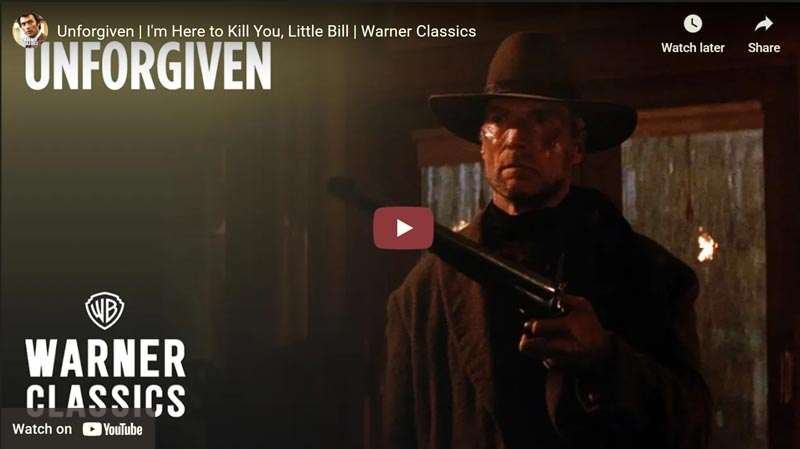
Watch the clip below. Then we’ll talk about what it means. <!– WordPress Embed Block –>
A Genre at the Edge of Its Own Grave
By 1992, the Western was in trouble. Hollywood had largely moved on — science fiction owned the multiplex, action franchises ruled the summer. The mythology of the Old West, once the backbone of American cinema, had been stripped of its grandeur by revisionist films throughout the 1970s. What was left felt tired. Eastwood knew this. He had spent decades inside that mythology — the Man with No Name in Leone’s spaghetti westerns, the lone gunfighter, the silent avenger. He had been the genre’s promise for thirty years. And then he made a film designed to break that promise, frame by frame.
Unforgiven is set in 1880, at what Roger Ebert described as “that moment when the old West was becoming new.” Professional gunfighters had become relics. Men who once slept under stars were building houses. The violence that once defined masculine identity was quietly becoming embarrassing — a thing to be managed, not celebrated. Eastwood placed his film at that precise threshold, and then populated it with men who hadn’t gotten the memo.
The Myth of the Righteous Killer
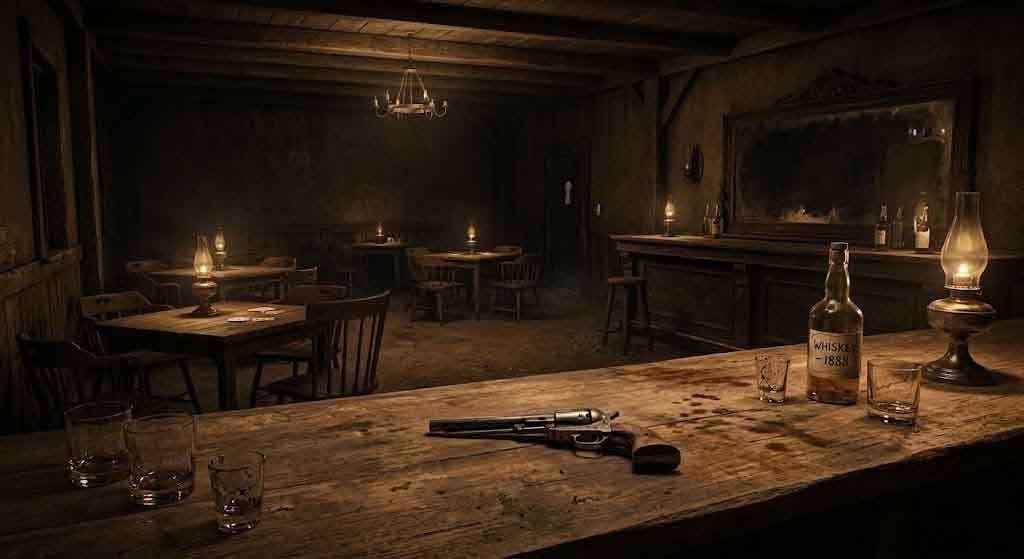
William Munny (Eastwood) is introduced face-down in the mud, failing to pen a sick hog. He was once, by all accounts, a man of monstrous capacity — a killer of women and children, drunk and vicious. His late wife, Claudia, softened him into something resembling a farmer. Now she’s dead, his farm is failing, and two young children depend on him entirely. When a brash young gunfighter called the Schofield Kid arrives with a bounty offer — a thousand dollars split between men willing to kill two cowboys who disfigured a prostitute in a Wyoming town called Big Whiskey — Munny initially declines. Then reconsiders. He recruits his old partner, Ned Logan (Morgan Freeman), and rides out.
The screenplay, written by David Webb Peoples (who also wrote Blade Runner), was ranked by the Writers Guild of America as the 30th-greatest script ever written. What Peoples understood, and what Eastwood rendered so precisely, is that the Western myth had always relied on a single lie: that violence could be clean. That a man could kill for righteous reasons and walk away whole. Unforgiven exists to prove that lie false — not by avoiding violence, but by showing exactly what it costs.
Every kill in the film lands with weight. The Schofield Kid, who spent the ride to Big Whiskey bragging about men he’d shot, falls apart completely after his first actual killing. “It’s a hell of a thing, killing a man,” Munny tells him, quietly. “You take away all he’s got and all he’s ever gonna have.” There is no music swelling beneath it. No catharsis. Just two men sitting with what they’ve done.
Little Bill and the Corruption of Order
The film’s antagonist, Sheriff Little Bill Daggett (Gene Hackman, who won the Oscar for Best Supporting Actor), is not a cartoon villain. He is something more troubling — a man who genuinely believes he is building something decent. When two cowboys brutally slash the face of a prostitute named Delilah, Little Bill’s version of justice is to make them hand over some ponies to the saloon owner as compensation. Not for Delilah. For the saloon owner, whose property value she represents.
It is a perfectly articulated critique of how power administers itself — through whatever frameworks protect its own continuity. Little Bill beats men in the street. He tortures Ned Logan. He is, underneath the badge, exactly the kind of violent man he claims to be containing. Hackman plays him with enough complexity that you understand him even as you reject everything he stands for. He builds a famously terrible house on the edge of town — a recurring image of a man whose sense of order has no real foundation.
“Deserve’s Got Nothing to Do with It”
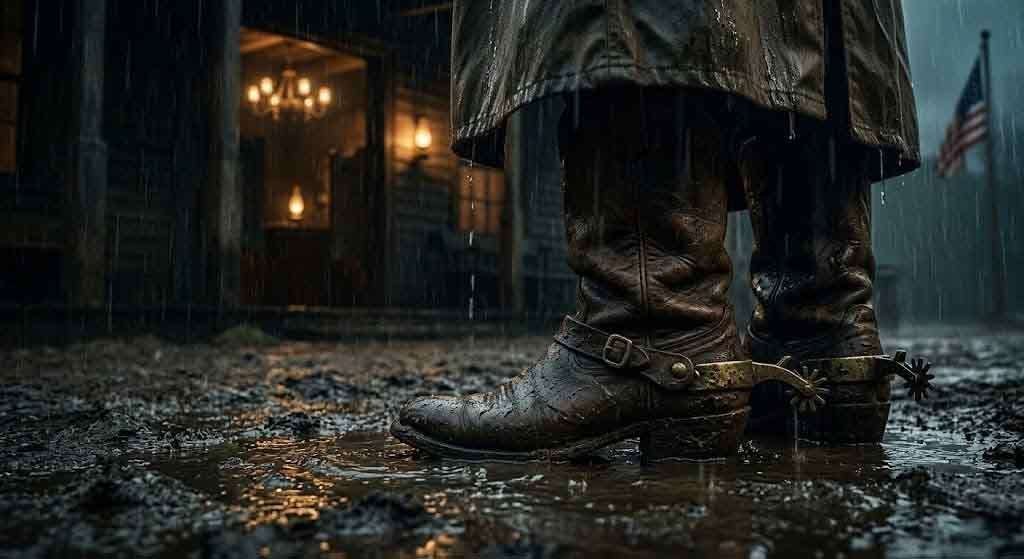
The film’s climax — the scene most people mean when they talk about Unforgiven — arrives in a saloon at night, in the rain. Munny has learned that Ned Logan was beaten to death and put on public display outside the saloon. Something in him that had been dormant, barely, finally surfaces completely.
He takes a drink of whiskey. The first since his wife straightened him out. And then he walks in.
What follows is not heroic in any traditional sense. He shoots an unarmed man. He kills Little Bill’s deputies. And when Little Bill, mortally wounded on the floor, says “I don’t deserve this. To die like this. I was building a house,” Munny answers with the most devastating line in the film:
“Deserve’s got nothing to do with it.”
It is the film’s thesis, delivered at point-blank range. The Western had always operated on a moral economy — heroes earned their victories, villains got what was coming to them, justice arrived on horseback with a clean conscience. Eastwood and Peoples blow that economy apart entirely. Deserve has nothing to do with it. Violence doesn’t balance moral ledgers. It just leaves more dead.
Little Bill fires back: “I’ll see you in hell, William Munny.”
Munny says: “Yeah.”
And pulls the trigger.
What Eastwood Was Really Saying
Eastwood dedicated Unforgiven to two directors: Sergio Leone, who gave him the Man with No Name, and Don Siegel, who directed him in Dirty Harry. Both men died shortly before the film was made. The dedication is not just personal — it’s a kind of cinematic eulogy. Eastwood was saying goodbye to the mythology those men helped build, and acknowledging that the mythology was never entirely honest.
He has said in interviews that he held onto the script for years, waiting until he was old enough to play Munny believably. An actor in his thirties playing a reformed killer trying to outrun his nature would read as dramatic posturing. An actor in his sixties — one whose face itself carries decades of implication — plays the same role as something closer to tragedy.
The film ends with a title card noting that Munny “disappeared with the children” and was rumored to have prospered later in dry goods in San Francisco. The shot accompanying it is Munny’s silhouette against a dark sky, standing at his wife’s grave. Whether he found peace is left deliberately unclear. Whether he deserved it is, by the film’s own logic, beside the point.
Why It Holds
Films that rely on gunfights age. Films that rely on moral complexity don’t. Unforgiven has held its position in the American cinema canon because it understood something most genre films avoid: that the myth and the truth of violence are two entirely different countries, and that most popular entertainment lives permanently in the first one.
The Western, at its worst, told audiences that killing had a legitimate economy — that some men deserved it, some men were built for it, and the ones who could draw fastest were, in some essential way, the right ones. Unforgiven demolished that with a single sentence delivered in a dark room by a broken man who hadn’t wanted any of it, and who was going to carry it the rest of his life regardless.
Clint Eastwood has made many films. This is the one that will last longest. Not because it’s the most entertaining, but because it’s the most honest.