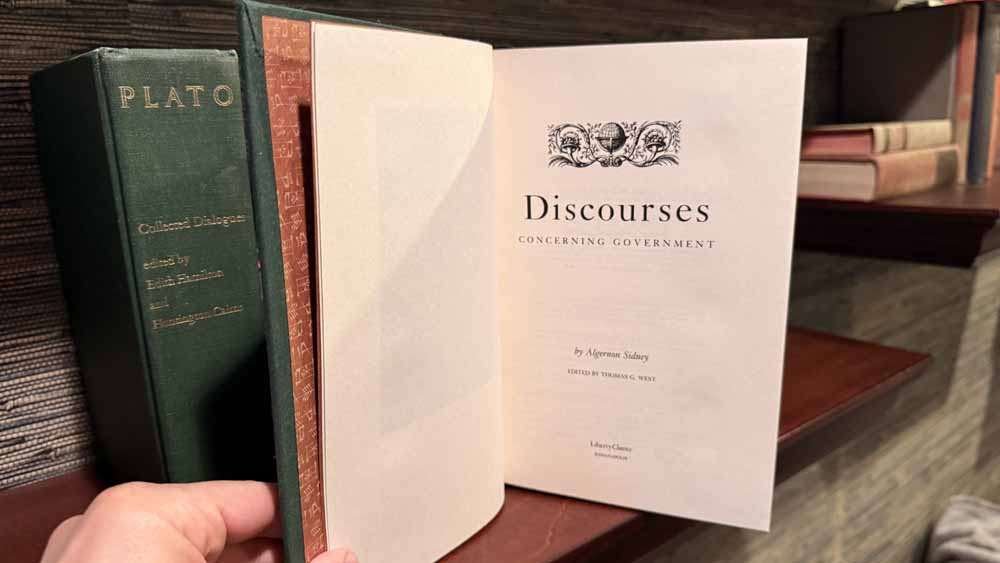
Every schoolchild learns Locke. They learn Montesquieu. They learn Jefferson, who borrowed from both. What almost no one learns — in school, in college, in any of the civic education we still pretend to take seriously — is the name Algernon Sidney. And that omission is not a minor gap in the curriculum. It is a distortion of the entire story.
Discourses Concerning Government, written in the 1680s and published posthumously in 1698, is one of the foundational texts of Anglo-American political philosophy. It is the book Thomas Jefferson called — alongside Locke’s Second Treatise — one of the two best sources for the “elementary books of public right.” John Adams read it. James Madison knew it. The framers of the American republic did not simply absorb Sidney’s ideas secondhand through other writers. They read him directly, argued with him, and built on him. And then, somehow, he fell out of the story.
Reading the Liberty Classics edition edited by Thomas G. West is to recover something that should never have been lost.
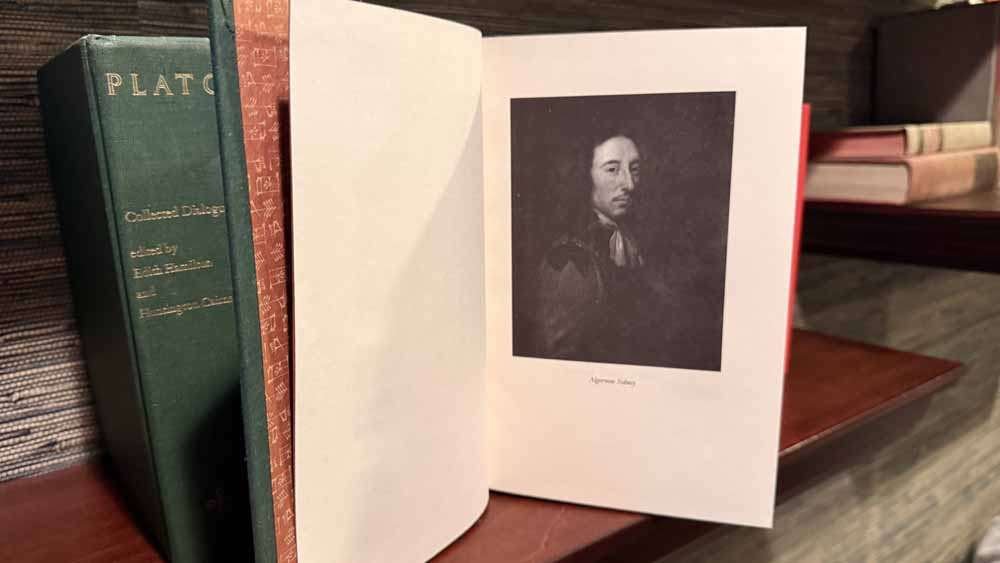
Who Sidney Was, and Why He Died for This Book
Algernon Sidney (1623–1683) was an English republican — not in the party sense, but in the classical sense: a man who believed that legitimate government derived from the consent of the governed, that tyranny was not merely unjust but philosophically incoherent, and that the right to resist it was not a last resort but a moral obligation. He fought against Charles I in the English Civil War. He spent years in exile rather than submit to a monarchy he considered illegitimate. And when he finally returned to England, he kept writing.
The manuscript that would become the Discourses was written as a private rebuttal to Sir Robert Filmer’s Patriarcha — a royalist defense of absolute monarchy that grounded royal power in divine right and patriarchal descent from Adam. Filmer argued that kings ruled by God’s design, that this authority was inherited like property, and that any resistance to it was both sin and sedition. Sidney thought this was nonsense, and he said so at considerable length.
He never published it. He didn’t have to. In 1683, Sidney was arrested for alleged involvement in the Rye House Plot against Charles II. There was little credible evidence of direct participation. What the crown used to convict him was the manuscript itself. The prosecution argued — and the court accepted — that writing the document constituted treason. The judge, the infamous George Jeffreys, declared that “scribere est agere” — to write is to act. Sidney was beheaded on Tower Hill on December 7, 1683.
He was executed for an unpublished book arguing that tyranny was wrong. Let that land for a moment.
The Argument: What Sidney Actually Said
The Discourses are organized as a direct refutation of Filmer, which gives them an occasionally scholastic structure — Sidney quotes Filmer, then dismantles him, passage by passage. To modern readers, some of this can feel like settling a seventeenth-century score. But beneath the polemical scaffolding is a coherent and radical political philosophy.
Sidney’s core argument is this: political authority is not natural, not divine, and not inherited. It is a creation of human reason and human choice. People form governments to protect themselves and secure their liberty. A government that fails at this task — that turns against the people it was constituted to serve — forfeits its legitimacy. The right to alter or abolish such a government is not rebellion. It is the exercise of the very principle that made government legitimate in the first place.
This sounds familiar because it is familiar. Jefferson paraphrased it in 1776. But Sidney made the argument sharper in one important respect: he refused to limit resistance to passive non-compliance or petition. A people subjected to genuine tyranny had not merely the right but the duty to act. For Sidney, liberty was not a privilege granted by rulers. It was a natural condition that preceded political authority and continued to make demands on it.
He also argued for a kind of constitutional pluralism well ahead of his time. Different peoples, Sidney observed, had organized themselves in different ways — republics, mixed constitutions, monarchies with limited power. None of these was inherently superior in the abstract. What mattered was whether the form of government suited its people and protected their fundamental rights. This flexibility, this empirical rather than dogmatic approach to political structure, was deeply influential on the founding generation precisely because it offered room to build something new rather than merely transplant an English model.
The Founding’s Debt — and Its Selective Memory
The historical case for Sidney’s influence on the American founding is not speculative. It is documented. Jefferson’s famous 1825 letter identifying the intellectual sources of the Declaration explicitly names Sidney alongside Locke as a primary authority. John Adams, in his Defence of the Constitutions of the United States, engaged Sidney’s arguments directly and at length. The Discourses were in the libraries of the founders. They were cited in pamphlets circulating in the years before the Revolution. The rhetoric of American independence was saturated with Sidney’s vocabulary — natural rights, consent of the governed, the right of resistance — whether or not his name was always attached to it.
So why did Locke become the standard reference and Sidney disappear from the public story? Several reasons, probably. Locke survived his radicalism; Sidney was executed for his, and a martyred philosopher makes for awkward civic mythology. Locke’s prose, while dense, is more systematically organized for philosophical argument. Sidney writes like a polemicist with philosophical instincts — brilliant in places, repetitive in others, and occasionally maddening in his determination to refute Filmer on every conceivable point. He is not always easy to read. And his explicit republicanism — his hostility to monarchy in any strong form — became less rhetorically useful once the founders had to actually govern and negotiate with the British crown’s legacy institutions.
But none of that fully explains the erasure. Part of it may simply be the contingency of intellectual history — who gets anthologized, who gets assigned, which names stick and which don’t through the accidents of pedagogy and publication. The Liberty Classics edition, edited with care by West, is a direct attempt to correct that drift. West’s introduction situates Sidney’s thought in its historical context without reducing it to a period piece, and the text itself — while challenging — rewards the effort.
Reading Sidney Alongside the Shelf
If you’ve spent time with Thomas More’s Utopia or Nietzsche, you’ll notice how differently Sidney understands the relationship between individual will and political order. More is ironic and evasive — his ideal commonwealth is a thought experiment, not a program. Nietzsche tears the question of legitimacy up by the root, rejecting the social contract tradition entirely. Sidney is neither: he is a true believer in the rational foundations of republican liberty, writing with the urgency of someone who knows exactly what the stakes are.
What is striking, reading the Discourses in 2026, is how little the underlying problem has changed. The question Sidney was answering — who gets to say what government is for, and who gets to hold it accountable when it fails — is not a seventeenth-century question. It is the permanent question of political life. Filmer’s answer was: no one, because the king answers only to God. Sidney’s answer was: everyone, because the people are the source of whatever authority government possesses. That argument is still live. It is, in some ways, more contested now than it was when he wrote it.
The Book Worth Recovering
Discourses Concerning Government is not a casual read. It requires patience and some familiarity with the political debates of seventeenth-century England. But it is not inaccessible, and the Liberty Classics edition makes it as approachable as it is likely to get — clean text, useful introduction, no scholarly apparatus that buries the argument.
What you get, at the other end of the effort, is a reminder that the ideas underneath the American experiment did not arrive fully formed from some inevitable intellectual consensus. They were fought for — debated, refined, and in Sidney’s case, paid for in blood. There is something bracing about reading a man who was killed for writing a book arguing that no one should be killed for disagreeing with power.
His name deserves to be in the conversation.
You Might Also Like:
- Utopia by Thomas More: Read in One Sitting, Carried for a Lifetime
- Thus Spoke Zarathustra by Friedrich Nietzsche — The Book That Rewired My Understanding of Everything
- An Introduction to Logic and Scientific Method by Morris R. Cohen & Ernest Nagel — A Review
Sources:
- Sidney, Algernon. Discourses Concerning Government. Edited by Thomas G. West. Liberty Classics, Indianapolis, 1990. https://oll.libertyfund.org/title/sidney-discourses-concerning-government
- Jefferson, Thomas. Letter to Henry Lee, May 8, 1825. Library of Congress. https://www.loc.gov/resource/mtj1.048_0254_0257/
- Adams, John. A Defence of the Constitutions of Government of the United States of America. 1787. Online Library of Liberty. https://oll.libertyfund.org/title/adams-a-defence-of-the-constitutions-of-government-of-the-united-states-of-america-vol-1
- Scott, Jonathan. Algernon Sidney and the Restoration Crisis, 1677–1683. Cambridge University Press, 1991.
- West, Thomas G. Introduction to Discourses Concerning Government. Liberty Classics, 1990.
- Houston, Alan Craig. Algernon Sidney and the Republican Heritage in England and America. Princeton University Press, 1991.