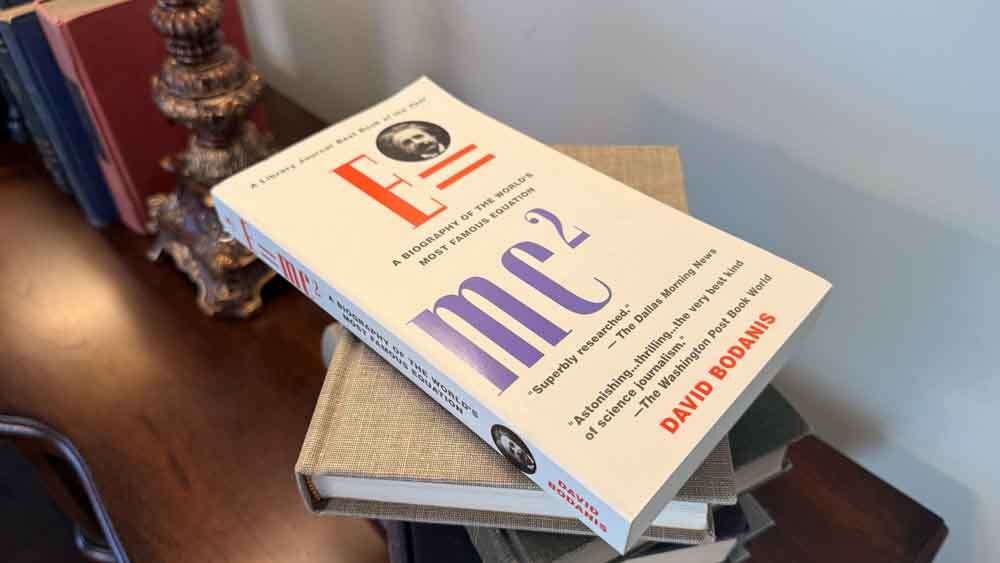
Five letters and a superscript. No punctuation. No explanation required. Of all the intellectual achievements of the twentieth century, Einstein’s mass-energy equivalence may be the only one that transcended science entirely — landing on coffee mugs, tattoos, and the lips of people who couldn’t define a joule if their life depended on it. What David Bodanis accomplishes in E=mc² is something genuinely rare: he takes that famous shorthand and unpacks it not as a physics lesson, but as a biography — a full human drama spanning centuries of curiosity, obsession, and consequence.
The Equation as a Story
Bodanis structures the book unconventionally. Rather than building toward Einstein the way most popular science books do, he treats the equation itself as the protagonist. Each component — the E, the m, the c, the squaring — gets its own lineage traced through history. Michael Faraday’s work on electromagnetic fields, Antoine Lavoisier’s stubborn insistence on conservation of mass, Ole Rømer’s first credible measurement of the speed of light: these are not footnotes. They are the chapters through which the equation slowly assembles itself, one idea at a time, over generations of scientists who never knew what they were collectively building.
It’s a remarkably effective structure. By the time Einstein appears — relatively late in the book — you understand that the equation didn’t arrive from nowhere. It arrived from everywhere, all at once.
What Bodanis Gets Right
The writing is clean without being thin. Bodanis has a gift for the concrete image that makes abstract physics legible. His description of what it means to square the speed of light — not merely to double it, but to multiply it by itself, producing a number so astronomically large that even modest quantities of mass release staggering energy — lands with real weight. As he puts it, the speed of light is already about 670 million miles per hour. Squaring that is the difference between a spark and a star.
He is equally strong on the human costs. The later chapters, which trace the equation’s dark inheritance — fission, the Manhattan Project, Hiroshima — never moralize, but they don’t flinch either. There is a section on Lise Meitner, the Austrian physicist who co-discovered nuclear fission and was denied the Nobel Prize that went to her collaborator Otto Hahn, that reads with the quiet fury of an injustice that still hasn’t fully settled. Bodanis lets the facts do the condemning.
Where It Could Go Deeper
No book is without limits. Readers with a serious physics background will find the science deliberately simplified, occasionally to the point of imprecision. Bodanis is aware of this and unapologetic — his stated goal is accessibility, not rigor. The equation’s quantum mechanical implications, its role in general relativity’s geometry, the relationship between mass-energy and the Higgs field: these are barely touched. That’s the trade-off of popular science, and Bodanis makes it knowingly.
The epilogue, which speculates on the equation’s future applications — antimatter propulsion, nuclear fusion as clean energy — has dated somewhat since the book’s original publication, though the underlying science remains sound.
Who Should Read This
Anyone who has ever felt vaguely intimidated by physics but curious about it. Anyone who wants to understand why the twentieth century unfolded the way it did, why cities were obliterated in seconds, why the Cold War was shaped as much by physics labs as by politics. And anyone who believes, as Bodanis clearly does, that science is not separate from history — it is history, written in a different language.
E=mc² won’t make you a physicist. But it will make you understand, in a way that stays with you, exactly what that tiny equation authorized the world to do — for better and for catastrophic worse.
Pick up E=mc² on Amazon | Browse more book reviews
Sources
- Bodanis, David. E=mc²: A Biography of the World’s Most Famous Equation. Berkley Books, 2000. Amazon
- American Institute of Physics — Lise Meitner profile: https://www.aip.org/history-programs/niels-bohr-library/oral-histories/meitner
- Nobel Prize — Otto Hahn, 1944: https://www.nobelprize.org/prizes/chemistry/1944/summary/
- NIST — Speed of Light: https://physics.nist.gov/cgi-bin/cuu/Value?c