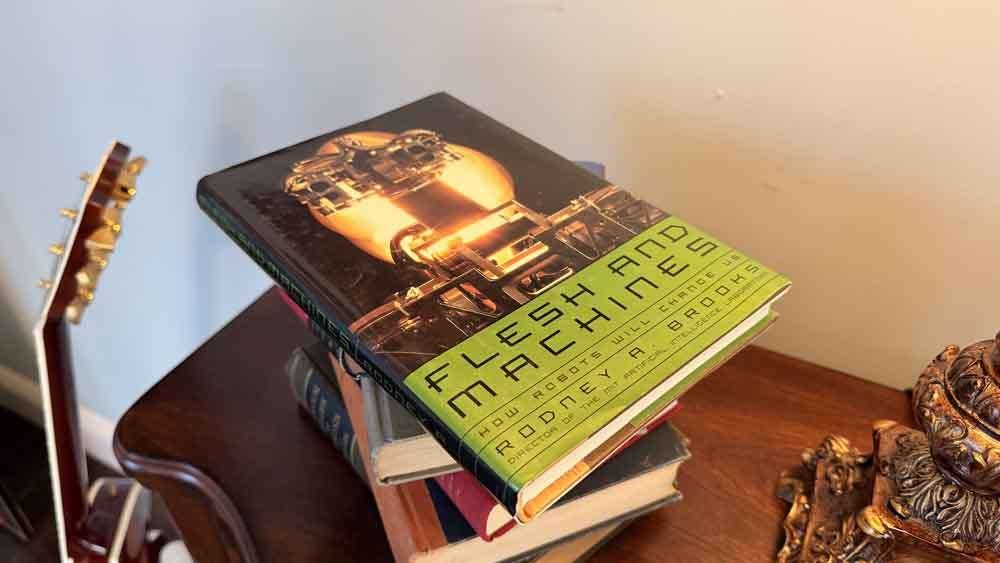
Rodney Brooks does not write like a man who wants to impress you. He writes like a man who has spent decades building things that move, react, and fail — and has arrived at a set of hard-won convictions he is no longer interested in softening. Flesh and Machines: How Robots Will Change Us (Pantheon Books, 2002) is not a breathless manifesto about the robot future. It is something rarer: a clear-eyed examination of what machines actually are, what we actually are, and why the line between the two is far less stable than we assume.
Brooks was the director of MIT’s Computer Science and Artificial Intelligence Laboratory and the co-founder of iRobot — the company behind the Roomba. He built robots. Small ones, insect-like ones, robots that did not think in any traditional sense but nonetheless behaved as if they did. That experience gives the book its particular authority. He is not speculating. He is reporting from the floor of the lab.
The Creature on the Table
The first half of Flesh and Machines reads almost like field notes. Brooks walks the reader through his early work on behavior-based robotics — a paradigm shift that rejected the dominant AI approach of centralized planning and symbolic reasoning in favor of layered, reactive systems. His robots did not build internal models of the world. They responded to the world directly, through simple stimulus-response loops stacked on top of one another. And they worked.
“I believe that human and other animal intelligence is not a disembodied, logical reasoning process,” Brooks writes. It is something that evolved, layer by layer, across hundreds of millions of years — embedded in bodies, shaped by physical constraints, inseparable from the act of being in the world. This is not a new philosophical claim. It echoes Heidegger’s Being and Time, the phenomenological tradition, and more recently the embodied cognition research of Varela, Thompson, and Rosch. But Brooks arrives at it not through philosophy seminars but through watching his robots bumble across a lab floor, reacting to light and obstacle and gravity in ways that looked, uncannily, alive.
The Hard Problem, Stated Plainly
Where Brooks earns his place on the shelf is in the second half of the book, when he turns toward the harder territory: consciousness, emotion, and what happens when machines begin to acquire the markers we associate with inner life. He does not resolve the hard problem of consciousness — no one has — but he refuses to dismiss it. He takes seriously the possibility that sufficiently complex robotic systems might, at some threshold, deserve some form of moral consideration.
This is not sentiment. Brooks is a materialist. He believes the human brain is, at bottom, a machine — extraordinarily complex, evolved rather than engineered, but a machine. “We are machines,” he states, “and as such we are not different in kind from other machines.” If that is true, then the question of robot consciousness is not a category error. It is simply a question about thresholds and architecture.
The discomfort this produces is intentional. Brooks wants the reader to sit with it. He references the difficulty of attributing inner states to systems we did not build for that purpose — and notes that we are already willing, almost automatically, to attribute inner states to his robots when they behave in certain ways. A robot that turns toward you when you speak. A robot that pauses before a staircase. We cannot help but read intention into it. That readiness, Brooks suggests, says as much about us as it does about the machine.
What the Book Gets Right — and Where It Shows Its Age
Flesh and Machines was published in 2002, and some of it reads that way. The specific predictions about timelines have not held. The humanoid robots Brooks imagined populating elder care facilities by 2020 are still more aspiration than reality. The technical landscape has shifted dramatically, particularly with the rise of deep learning and large language models — architectures that Brooks’s behavior-based framework did not anticipate and which have produced capabilities that would have surprised him.
But the philosophical core of the book holds. The argument that intelligence is embodied, that behavior can emerge from simple layered systems without central planning, that the boundary between machine and organism is a matter of complexity rather than kind — these ideas have aged well. If anything, the explosion of AI capability since 2020 has made the ethical questions Brooks raises more urgent, not less. His early willingness to ask, without flinching, whether machines might someday matter morally looks prescient now.
For anyone working through the current moment in AI — the models, the agents, the autonomous systems spreading across every industry — this book remains a useful corrective to both the utopian and dystopian framings. Brooks is neither triumphalist nor alarmed. He is curious. He has built things that surprised him, and he wants you to understand why that surprise matters.
If you’ve been following the recent writing here on AI and emerging technology, Flesh and Machines offers a grounding perspective that most current AI commentary lacks: the voice of someone who got their hands dirty building the things the rest of us are now theorizing about.