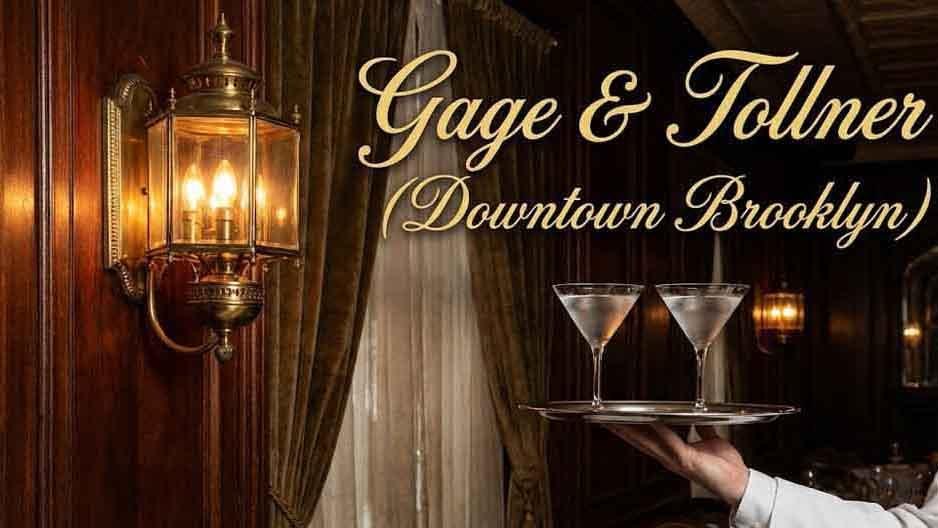
Gas flames once hissed in brass chandeliers above this dining room when Brooklyn was still its own city, when horse-drawn carriages delivered women in silk gloves to a doorstep on Fulton Street, and when the word “restaurant” carried an almost sacred weight it has long since surrendered to the pace of modern life. That Gage & Tollner exists at all in 2026 — not as a museum, not as a nostalgia project, but as a vital, packed, critically celebrated chophouse serving dry-aged porterhouse and she-crab soup to a new generation of Brooklynites — ranks among the most improbable restaurant stories in American history. Founded in 1879 by an oysterman named Charles M. Gage, resurrected in 2021 by three Red Hook restaurateurs who stumbled upon it during a real estate search, this is a place that has died twice and refused to stay buried. The building at 372 Fulton Street holds both exterior and interior New York City landmark designations — only the third interior ever landmarked in the city’s history, following the New York Public Library and Grant’s Tomb (NYC Landmarks Preservation Commission, 1975). It is the only standalone restaurant in the city to hold both designations. When I think about what it means to build something that outlasts you, something where the craftsmanship is the argument for its own survival, Gage & Tollner speaks that language fluently.
As someone who has run The Heritage Diner for twenty-five years at the same address on Route 25A in Mount Sinai, I carry a particular reverence for institutions that refuse the easy death. Restaurants are fragile organisms. They depend on the daily convergence of supply chains, human labor, neighborhood economics, and the fickle appetites of a public that moves on quickly. For a restaurant to endure one generation is an achievement. For one to endure one hundred and forty-five years — across eight ownership changes, two world wars, the collapse of Downtown Brooklyn’s retail corridor, a hostile conversion to a TGI Friday’s, an Arby’s, a costume jewelry store, and then a global pandemic — is something else entirely. That is not a business. That is a testament to what the built environment can mean when the people inside it care enough to fight.
An Oysterman, a Cigar Salesman, and the Birth of Brooklyn’s Table
Charles M. Gage opened his eating house at 302 Fulton Street in November 1879, four years before the Brooklyn Bridge was completed and nearly two decades before the independent city of Brooklyn would merge with New York in the consolidation of 1898 (Brooklyn Public Library, 2017). In those early years, the restaurant served ale, lager, and dishes like lobster Newberg for seventy-five cents — roughly twenty-six dollars in today’s money (Wikipedia, 2025). A year later, a likable cigar salesman named Eugene Tollner, one of Gage’s regulars, joined as partner. By 1882, the business carried both their names. Tollner’s family connections ran deep into the fabric of nineteenth-century American commerce — his father, Charles Tollner, had founded the hardware concern that would eventually become Hammacher Schlemmer under the stewardship of Eugene’s cousin, William Schlemmer (Wikipedia, 2025).
In 1889, Gage & Tollner relocated to 372-374 Fulton Street, a four-story Italianate brownstone that would become its permanent and now legendary home. The new space featured a Neo-Grec storefront and an ornate interior characteristic of late Victorian design — cherry wood arches, mahogany-framed mirrors, Lincrusta-Walton wall panels crafted by machines that were already a century old when the current restoration team contacted the original manufacturer, and brass chandeliers wired for both gas and electricity since the building’s earliest days (Untapped New York, 2024). A 1930 restaurant guide declared that Gage & Tollner was to Brooklyn what the Statue of Liberty was to New York Harbor (Untapped New York, 2024). Another proclaimed it nothing less than Brooklyn’s main contribution to civilization.
The restaurant’s clientele in the early twentieth century read like a civic roster — department store executives from Abraham & Straus, Supreme Court judges, local politicians, and theatrical figures from Brooklyn’s nearby playhouses. Mae West, Jimmy Durante, Truman Capote, and the infamous “Diamond” Jim Brady all dined beneath the gaslit chandeliers (Robb Report, 2020). According to the Brooklyn Eagle, an oysterman reported that the restaurant went through approximately 50,000 oysters a month during its peak years, discarding thousands of pearls in the process (Frommer’s, 2025). A 1919 menu offered twenty-four varieties of oysters alone (Brooklyn Eagle, 2022). The house signature — broiled soft clam bellies, a dish invented and named by later owner Seth Bradford “Brad” Dewey — became so beloved that it was frequently sold out before the dinner rush (Gage & Tollner, 2025).
The Dewey Dynasty and the Long Twentieth Century
When Gage and Tollner retired in 1911, they sold the restaurant to Alexander Hogg Cunningham and Marcus J. Ingalls, who agreed to preserve the founders’ name and customs. Tollner, however, could not stay away. He un-retired almost immediately, returning as a fixture of the dining room until his death in 1935 at age eighty-six — he collapsed while boarding a trolley on his way to work (Resy, 2023). Both Gage, who died in 1919, and Tollner are buried at Brooklyn’s Green-Wood Cemetery.
Shortly after World War I, Cunningham and Ingalls sold the restaurant to Seth Bradford Dewey, backed by his father Hiram S. Dewey, from a prominent family of American restaurateurs and winemakers. The sale carried a condition that now seems almost prophetic: the Deweys were required to uphold the name, customs, and traditions established by the restaurant’s founders (Gage & Tollner, 2025). The Dewey family would honor that covenant for nearly seventy years.
Under Dewey stewardship, Gage & Tollner received one of the first annual Restaurant Awards from Holiday Magazine in the 1950s, which heralded it as one of the world’s best seafood restaurants and the only Brooklyn establishment to make the list — a distinction it held for three consecutive decades (Gage & Tollner, 2025). Headwaiter Leon Gaskill celebrated his fiftieth year with the restaurant during this era and continued working for another eleven years, earning the distinction of longest-serving employee in Gage & Tollner history. The restaurant’s annual reopening each September — it traditionally closed from June through August when oysters were out of season — was a major social event on the Brooklyn calendar.
The 1970s brought both recognition and difficulty. John B. Simmons joined Ed Dewey in ownership in 1973, and in 1975, the Landmarks Preservation Commission granted the restaurant both exterior and interior landmark status. The centennial in 1979 was a milestone, and the building was listed on the National Register of Historic Places in 1982 (Wikipedia, 2025). But the pedestrian conversion of Fulton Street into Fulton Mall in 1976, the departure of anchor retailers like Abraham & Straus, and the neighborhood’s declining safety after dark devastated business. From 1981 to 1988, the restaurant lost more than half its patronage, and the Deweys reduced staff from fifty to thirty (Wikipedia, 2025).
Edna Lewis, the Grande Dame Who Changed Everything
Gage & Tollner’s most transformative culinary chapter began in 1988, when new owner Peter Aschkenasy — an established New York restaurateur who purchased the business for $1.8 million — made a decision that would reverberate through American food history. He hired seventy-two-year-old Edna Lewis, the legendary African American chef and author widely regarded as the godmother of Southern cooking, as executive chef (Robb Report, 2020). Lewis had co-founded the highly acclaimed Café Nicholson on Manhattan’s East Side and authored seminal works including The Taste of Country Cooking, which redefined how Americans understood the rural Southern pantry.
Lewis’s arrival carried particular weight given the restaurant’s troubled racial history. Until 1960, Gage & Tollner refused to serve Black customers, despite the fact that its entire waitstaff was composed of Black men — many of whom served the restaurant for decades (Wikipedia, 2025). The Brooklyn Eagle later wrote that Aschkenasy’s decision to hire Lewis was quite the statement for a restaurant where African Americans had once been barred from dining (Wikipedia, 2025). Lewis brought cornbread, catfish, and her famous Charleston she-crab soup to the menu, sourcing ingredients from local greenmarkets while Aschkenasy traveled to the Fulton Fish Market. The New York Times credited Aschkenasy with reviving the restaurant through the Lewis hire (Wikipedia, 2025).
Lewis retired in 1992 as promised, when she turned seventy-five. She died in 2006, but her legacy at Gage & Tollner endures in the most tangible way possible: the current restaurant’s second-floor private dining room is named the Edna Lewis Room, and her she-crab soup — made with blue crab, crab roe, and sherry — remains a signature dish on the 2026 menu (Gage & Tollner, 2025). Her influence reverberates in current chef Sohui Kim’s approach to the entire kitchen, and Kim has publicly called Lewis her professional and personal inspiration (Robb Report, 2020).
Death, Indignity, and the Miracle of Resurrection
Despite Lewis’s impact, the economics of Fulton Mall proved insurmountable. The restaurant filed for bankruptcy in 1993 with $1.37 million in liabilities. Final owner Joe Chirico purchased the restaurant in 1995 and poured over half a million dollars into a loving restoration, but the neighborhood’s shift toward discount retail made the Victorian grandeur of Gage & Tollner feel like a relic in the wrong zip code. On Valentine’s Day 2004, Chirico served the last meal. One hundred and twenty-five years of continuous operation ended over dessert.
What followed was a sequence of indignities that anyone who cares about the built environment would find physically painful. The Jemal family purchased the building for $2.8 million. A TGI Friday’s moved in, covering the landmarked interior with pink partitions. An Arby’s followed. Then a costume jewelry store. A nail salon occupied the upstairs. Chirico, passing the location years later, reportedly felt sick looking through the windows at what had been done to the space (Brooklyn Eagle, 2022).
The rescue party arrived accidentally. St. John Frizell, owner of the Red Hook bar Fort Defiance, was frequenting the Brooklyn Supreme Court Building during divorce proceedings and wanted nothing more than a decent drink upon exiting. Gritty Court Street and grittier Fulton Mall offered little. Frizell saw an opportunity and enlisted his longtime friends — husband-and-wife team Ben Schneider and chef Sohui Kim, of The Good Fork and Insa — to search for a space. After numerous fruitless visits to unpromising locations, a broker led them down a suspiciously familiar block of Fulton. Frizell turned to Schneider and thought: are they taking us to Gage & Tollner? They were. Kim’s response when the two men called her would become the stuff of New York restaurant lore: “I send you boys out for a carton of milk, and you come home with a cow” (Resy, 2023).
The trio launched a Wefunder campaign that raised over $400,000 from 336 small investors and 48 equity participants. Renovations began in February 2019. Architect Eric Safyan devised subtle changes to furniture, wall coverings, and lighting fixtures that satisfied the landmark requirements while making the space operational for modern service. The original revolving door from 1919 was restored. The bar — the oldest piece of furniture in the current restaurant — was preserved. The Lincrusta-Walton wall panels, manufactured by a company whose machines are now 150 years old, were cleaned and revealed beneath layers of gaudy wall coverings (Untapped New York, 2024; Brooklyn Based, 2019).
Gage & Tollner was set to reopen on March 15, 2020 — the exact day New York City shut down due to COVID-19. It opened for takeout and delivery in February 2021, and finally welcomed indoor diners on April 15, 2021. The restaurant had risen from the dead not once, but twice.
The Menu: Archival Reverence Meets Twenty-First-Century Craft
Chef Sohui Kim’s approach to the Gage & Tollner menu is an exercise in what I would call informed reverence — the same discipline required when restoring a piece of antique furniture or, as I practice at Marcellino NY, when working a hide of English bridle leather that has been vegetable-tanned for months. You respect what the material already is before you impose what you want it to become.
The menu anchors itself in traditional raw bar offerings: a rotating daily selection of East Coast oysters, clams on the half shell, classic shrimp cocktail, and caviar service. Parker House rolls — routinely cited by diners as among the best in the city — and cheese twists sprinkled with paprika open the bread program. Appetizers include roasted bone marrow, Caesar salad with crisp crackers in place of croutons, and a rich chicken liver mousse (OpenTable, 2025; MICHELIN Guide, 2025).
Kim’s Korean heritage surfaces with subtlety and purpose throughout the menu. The Clams Kimsino — a signature dish — features clams enriched with kimchi butter. Broiled clam bellies, the house classic dating back to the Dewey era, arrive with miso butter. Hen-of-the-woods mushrooms pair with black garlic aioli and pickled chilies. These are not fusion gestures; they are a chef’s authentic fingerprints on a tradition she has inherited with deep seriousness (Robb Report, 2020).
The chophouse program centers on grass-fed, dry-aged steaks — bone-in ribeye for two, New York strip, T-bone — alongside a superb platter of fried chicken with cornmeal fritters that explicitly honors the Edna Lewis tradition (MICHELIN Guide, 2025). The she-crab soup, made with blue crab, crab roe, and sherry, connects three eras of the restaurant in a single bowl. Desserts are essential: the coconut layer cake and the baked Alaska are praised by critics as worthy closing statements to an already theatrical meal.
The cocktail program, designed by Frizell, spotlights mid-century American classics — martinis, sherry cobblers, Manhattans, and the now-famous “teeny ‘tinis” served during happy hour. The New York Landmarks Conservancy honored the restoration with a Lucy G. Moses Preservation Award in 2022, and the restaurant has appeared on The New York Times Best Restaurants list every year since reopening from 2021 through 2024 (OpenTable, 2025; Brooklyn Eagle, 2022).
The Sunken Harbor Club and the Upstairs World
On the second floor, behind a secret doorway connecting the Edna Lewis Room and the Dolphin Bar — two private dining rooms restored in the style of Victorian parlors with ornamental marble fireplaces and original brass chandeliers — lies one of the most delightfully eccentric bars in New York City. The Sunken Harbor Club is a tiki-style cocktail lounge born from Frizell’s fictional creation at Fort Defiance, where he had written an elaborate backstory about a nineteenth-century social club in Downtown Brooklyn that disappeared in the mid-twentieth century. The bar features purposefully off-kilter ceiling beams, mermaid murals, taxidermic blowfish, pirate memorabilia, and a five-page cocktail menu of tipples served in amusingly strange vessels (Frommer’s, 2025).
The Sunken Harbor Club operates on a separate reservation system from the main dining room — guests can book independently or add their names to the walk-in list upon arrival. Hours run Sunday through Thursday from 5:00 PM to 11:00 PM and Friday through Saturday from 5:00 PM to midnight. The juxtaposition of the buttoned-up Victorian grandeur downstairs and the nautical fantasy upstairs captures something essential about the sensibility of this ownership group: they are serious about history without being imprisoned by it.
The full second floor accommodates up to one hundred guests for standing events, with the Edna Lewis Room seating thirty-five to forty, the Dolphin Bar seating twenty-two, and the Sunken Harbor Club holding twenty-five. The rooms can be connected through original sliding pocket doors. Private dining, cocktail parties, film shoots, and marketing activations are all available — weddings and receptions have been held in the space for over a hundred and fifty years (Gage & Tollner, 2025).
Why Gage & Tollner Matters Beyond the Plate
The real estate dimension of Gage & Tollner’s story carries implications that resonate deeply with what Paola and I are building through Maison Pawli, our boutique real estate venture launching on Long Island’s North Shore in 2026. The building at 372 Fulton Street was purchased in 2004 for $2.8 million by the Jemal family, who converted the top two floors to office space while the ground level cycled through fast-food tenants. The landmark designation — which some might view as a constraint — became the building’s salvation. The cherry wood arches, the brass panels, the Lincrusta walls all survived beneath the pink partitions of a Friday’s because the law said they could not be destroyed. When the right stewards arrived, the room was waiting.
This is the argument for preservation that I make constantly in my own work — whether it is the vegetable-tanned leather that develops character over decades at Marcellino NY, the griddle seasoning built up through twenty-five years of continuous use at The Heritage Diner, or the Craftsman bungalows along the North Shore that represent an architectural integrity worth protecting against the pressure of teardown development. The landmark designation did not prevent Gage & Tollner from becoming an Arby’s. But it ensured that when someone with vision and commitment finally arrived, the bones of the thing were still intact. Preservation is not a guarantee of resurrection. It is the precondition for it.
Gage & Tollner now holds a 4.3-star rating on Google from over 1,300 reviews, a 4.6-star rating on OpenTable, a Tripadvisor Travelers’ Choice Award, and recognition in the MICHELIN Guide as an iconic Brooklyn destination (Google, 2025; OpenTable, 2025; MICHELIN Guide, 2025). The Wefunder campaign that launched the restoration involved 336 community investors — ordinary Brooklynites who put their own money behind the belief that this room deserved another chance. That is not just a restaurant story. That is a story about what a neighborhood owes to its own history.
Practical Information
Address: 372 Fulton Street, Brooklyn, NY 11201
Phone: (347) 689-3677
Website: gageandtollner.com
Reservations: Available via OpenTable, Resy, and Tock — exploretock.com/gage–tollner-brooklyn
DoorDash: doordash.com/store/gage-tollner-brooklyn-1493620
Instagram: @gage.and.tollner — 49K+ followers
Hours (Gage & Tollner): Monday: 5:00 PM – 10:00 PM Tuesday: Closed Wednesday – Friday: 5:00 PM – 10:00 PM Saturday – Sunday: 11:00 AM – 10:00 PM (lunch & dinner)
Hours (Sunken Harbor Club): Sunday – Thursday: 5:00 PM – 11:00 PM Friday – Saturday: 5:00 PM – 12:00 AM
Cuisine: American chophouse — oysters, dry-aged steaks, seafood, Southern-influenced dishes
Price Range: $$$ — Expect $80–$150+ per person for dinner with drinks
Dress Code: Casual — no formal requirements, though guests frequently dress for the occasion
Private Dining: Edna Lewis Room (35-40 seated), Dolphin Bar (22 seated), Sunken Harbor Club (25 seated). Full second floor capacity: 100 standing. Inquiries via gageandtollner.com/private-dining
Nearest Transit: Jay Street–MetroTech (A/C/F/R), Borough Hall (2/3/4/5), DeKalb Avenue (B/Q/R)
Health Score: A (NYC Department of Health)
Landmark Status: NYC Individual Landmark (exterior), NYC Interior Landmark (1975), National Register of Historic Places (1982)
Ownership: St. John Frizell, Sohui Kim, and Ben Schneider
Head Chef: Sohui Kim
Peter from The Heritage Diner — 275 Route 25A, Mount Sinai, NY — has spent twenty-five years learning that the restaurants worth writing about are the ones where someone cared enough to fight for the invisible things. Peter holds graduate degrees in Philosophy from Long Island University and The New School University in New York City. He is the founder of Marcellino NY (marcellinony.com), a bespoke English bridle leather workshop in Huntington, and co-founder with his wife, Broker Paola, of Maison Pawli, a boutique real estate venture launching on Long Island’s North Shore in 2026.