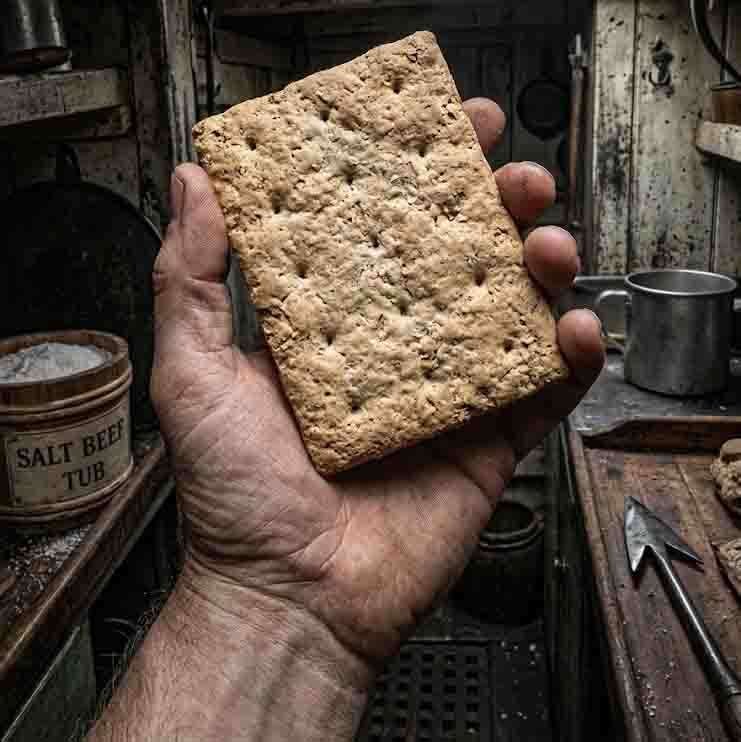
Flour. Water. Heat. That is the entire recipe for the food that sustained one of the most dangerous, grueling, and economically vital industries in American history. No salt. No yeast. No butter. No grace. Just two ingredients pressed flat, baked twice until they could survive the apocalypse, and loaded by the barrel-full into the holds of ships that left the harbor at Sag Harbor, Long Island — and sometimes didn’t come back for four years.
To understand what the 19th-century whaler actually ate is to understand the primal relationship between food and human endurance. Not food as pleasure. Not food as culture. Food as fuel — barely enough of it, often spoiled, crawling in some instances with weevil larvae — consumed by men who were burning thousands of calories a day hauling ropes, rendering blubber, and rowing open boats toward sixty-ton sperm whales with nothing but a hand-forged harpoon and a terrifying amount of courage.
Sag Harbor, at its peak in the early 19th century, was one of the most important whaling ports in the United States — rivaling New Bedford and Nantucket in ambition if not ultimately in scale. Ships left that deep-sea harbor on the North Fork of Long Island’s South Shore and circumnavigated the globe in pursuit of whale oil, the liquid gold that lit the lamps of an industrializing world. What those men ate — or more accurately, what they suffered through eating — is a story that deserves to be told.
The Biscuit That Refused to Die
Before the 19th century gave it the evocative name “hardtack,” the hard sea biscuit was simply called “bisket” in period documents, a practical object with a purely practical purpose: to not rot. Bread molds within days at sea. Stored flour goes rancid and bug-ridden in the damp belly of a ship. The hard biscuit — baked dry, baked hard, and baked sometimes four times over — was born out of the singular challenge that faced every ship’s captain setting out on a multi-year voyage: how do you keep men fed when the refrigerator won’t be invented for another century?
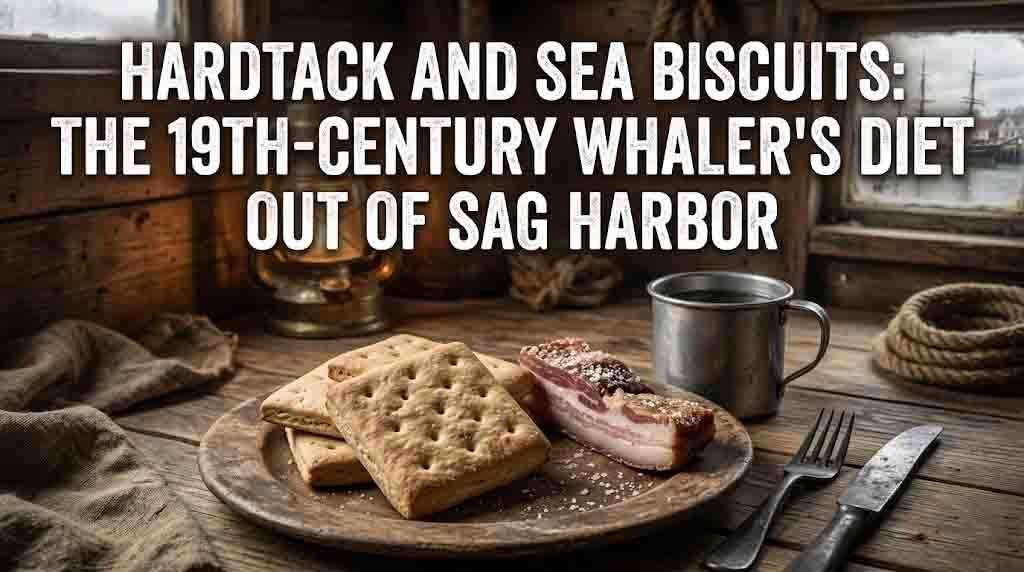
The answer was a dense, unleavened cracker roughly the size and density of a hockey puck, made from coarse wheat flour and water. Nothing else. Bakers did not add salt or yeast. The resulting object was less a food than a vehicle for calories — nearly indestructible if kept dry, and capable of remaining nominally edible for years. Sailors called it “worm castle” when they were being unkind, which was most of the time. They tapped it on the mess table before eating to knock out the weevil larvae that had taken up residence in its chambers, a ritual so common it became unremarkable.
The insects were rarely the worst part. What truly tested a man was the monotony — the psychological weight of eating the same impossible object day after day, month after month, while the ocean stretched out identically in all directions. Herman Melville, who sailed on a whaler himself before writing Moby-Dick, knew this intimately. In chapter fifteen of that novel, his narrator Ishmael rhapsodizes over a bowl of chowder in Nantucket — made, notably, with “pounded ship biscuits” softened in broth — as though it were the most transcendent thing he had ever consumed. For a man who had lived on hardtack at sea, it very well may have been.

Out of Sag Harbor: The Provisioning of a Voyage
When a whaling ship prepared to leave Sag Harbor in the early 1800s, provisioning it was a logistical undertaking of considerable scale. A vessel carrying a crew of thirty men, potentially for two to four years, needed thousands of pounds of non-perishable provisions loaded into its hold — a logistical equation with very little margin for error and almost no room for optimism.
The barrel was the basic unit of whaling-era food storage. Salt beef and salt pork came packed in brine in heavy wooden casks. Dried beans, rice, and flour filled others. Hardtack was loaded in hundredweight bags — one hundred pounds each — and stored wherever dry space could be found. Molasses arrived by the barrel. Coffee and tea, often more hope than reality, were stowed near the galley.
The ship’s cook — one of the most important and most frequently cursed men on the voyage — was tasked with turning these raw materials into something resembling daily meals. The weekly menu recorded by Albert Peck, a foremast hand on the whaler Covington in 1856, reads like an exercise in culinary minimalism: Monday, rice with beef and pork. Tuesday, boiled beans. Wednesday, peas (or more rice when the peas ran out). Thursday, a boiled flour pudding called “duff.” Friday, beans again. Saturday, codfish and potatoes. Sunday, duff again. Breakfast was usually “scouse” — ship bread soaked overnight and boiled up with beef and sliced potatoes, finished with coffee — or a hash of meat and potatoes. Supper was hard bread, salt beef, tea, and molasses.
It was not a menu that inspired poetry. It was a menu engineered to keep thirty men alive and working.
The Slow Catastrophe of Salt
Salt pork and salt beef were the protein anchors of every whaling voyage, and they created a cascade of physiological problems that the 19th century was only beginning to understand. The salt preserved the meat, yes. It also made the men desperately thirsty, forced them to drink the often brackish and deteriorating barrel water, and contributed to the disease that haunted every long voyage: scurvy.
Scurvy — the breakdown of connective tissue caused by severe vitamin C deficiency — was the shadow that followed every extended sea voyage. Medical professionals of the era recognized the connection between monotonous salt-heavy diets and the disease, even if they couldn’t fully explain the mechanism. The symptoms were horrific: swollen gums, loosened teeth, reopened old wounds, joints so painful a man could barely move. Captains who understood the threat stocked their ships with whatever citrus could be procured at port — limes, oranges, lemons — and grog was sometimes laced with fruit juice for exactly this reason.
Fresh provisions, when a ship called at port, were received with something close to reverence. Log entries from whalers record the joy of taking on fresh hogs, fowl, and fruit at the Cape Verde Islands or the Azores with a specificity and gratitude that makes the contrast with shipboard life painfully clear. The first mate of the Charles W. Morgan in 1864 noted the acquisition of “six hogs, four fowl, and some oranges” at Brava with the same weight a general might give to the arrival of reinforcements. Then he noted that the cook had deserted. The universe, aboard a whaling ship, maintained its sense of dark irony.
Duff, Lobscouse, and the 1,000-Barrel Doughnut
The whaling diet was not entirely without its consolations — small, irregular, and fiercely anticipated as they were. Sunday’s duff was a genuine morale event. A boiled pudding made with flour and raisins, steamed in a cloth bag, duff bore a passing resemblance to a dense fruitcake. After six days of beans and salt beef, it was the culinary equivalent of a holiday.
Lobscouse — a thick stew of chopped salt meat, hardtack, and whatever vegetables were still viable — occupied a similarly elevated position on the informal hierarchy of shipboard pleasures. Burgoo, a thin oatmeal-and-water porridge, was another rotation staple. Hardtack was frequently dipped in the ship’s try-pots — the enormous iron cauldrons used to render whale blubber into oil — and fried, borrowing some of the fat left behind by the rendering process. It was, by all accounts, considerably better than eating it dry.
And then there was the 1,000-barrel doughnut. When a whaling ship’s crew had tried out and stowed its first thousand barrels of oil, a tradition on some ships called for the cook to fry doughnuts for the entire crew — using pure spermaceti oil, clear as water and nearly tasteless, skimmed from the head cavity of the sperm whale. The fried dough was a small, grease-spattered ceremony celebrating the fact that the voyage was paying off, that the men’s brutal labor had produced something of value, that perhaps they would eventually go home. In the context of whaling life, it was euphoria.
The Hierarchy of Hunger
Not everyone on a whaling ship ate the same food. Class had its dietary expression even in the middle of the Pacific. Officers and boatsteerers ate in the stern cabin and received materially better provisions — fresh eggs, occasional chicken, the pork from whatever livestock had been brought aboard and hadn’t died yet. The captain, at the apex of the ship’s social order, ate best of all, and on successful voyages might maintain a table that looked almost civilized by comparison.
The foremasthands — the common sailors who did the most dangerous work for the smallest share of the voyage’s profits — ate forward, in the cramped and often fetid forecastle, and subsisted almost entirely on the hardtack-and-salt-meat rotation. The ship’s social structure encoded itself in the daily reality of food, as it almost always does in human hierarchies. The man who owned the most risk, ate the worst.
When provisions deteriorated beyond tolerance — and they did, regularly — the crew was not always silent about it. Journal entries from multiple voyages describe the smell of putrid beef opened from casks that had long since turned. In at least one recorded case, the crew of the St. Peter refused as a collective body to eat the rotten meat they were served, staging what amounted to a shipboard labor action. The captain was not pleased. The beef was eventually used anyway.
What Sourdough and Hardtack Share
There is a strange kinship between the hardtack of the 19th-century whaler and the slow-fermented sourdough bread that has made its way onto menus and into home kitchens today. Both are exercises in stripping bread back to its essentials — grain, water, time. Hardtack achieved longevity through the brutal elimination of all moisture and the denial of fermentation. Sourdough achieves its character through the patient cultivation of the same wild fermentation that makes the bread alive with flavor.
At The Heritage Diner in Mount Sinai, we bake our sourdough using a long, slow fermentation process — the kind that takes days rather than hours. The result is a three-pound loaf with a crust that shatters and a crumb that holds. It is bread that takes time seriously. The whaler’s hardtack took time seriously in a different way — it was built to outlast the journey, not to make the journey worth taking. That distinction, between food that merely sustains and food that nourishes and gives pleasure, is exactly the distance between the hardtack biscuit and what bread can become when there is no emergency, no ocean, and no barrel of spoiled pork to negotiate.
The Legacy in the Harbor
Sag Harbor today is boutique galleries and weekend houses and excellent restaurants. The deep-sea harbor that launched those whaling ships into two-year, four-year, occasionally eleven-year voyages is now lined with pleasure craft. The Sag Harbor Whaling and Historical Museum, housed in the 1845 Greek Revival mansion of the Huntting family — whalers who made a considerable fortune from the industry — preserves what remains of that world: harpoons, scrimshaw, log books, the material evidence of an industry that powered American economic growth for a century before petroleum made it obsolete.
What the museum cannot quite preserve is the texture of daily life in those ships’ galleys. The smell of the hardtack barrel. The particular sound of a weevil-infested biscuit rapped against a mess table. The relief of Sunday duff after six days of beans. The moment someone’s line came up with a skipjack or an albacore — a fresh fish, a meal that didn’t come from a cask — and the cook actually had something worth cooking.
Food at sea, on those voyages, was not a pleasure. It was a contract: the ship will feed you enough to keep you functional, and you will endure whatever it takes to fill the hold with oil. The hardtack held up that contract in its dense, loveless, nearly inedible way, one biscuit at a time, across hundreds of thousands of miles of ocean that had no interest in the appetite of the men sailing it.
Long Island’s waters remember these ships. The harbor at Sag Harbor holds the shape of that history even now, even with the yachts and the summer light on the water. The 19th-century whaler’s diet was the price of admission to one of the most extraordinary enterprises in American history — and hardtack, that two-ingredient monument to human ingenuity and human misery, was the coin they paid it with.
Sources:
- Sag Harbor Whaling and Historical Museum
- Hardtack — Wikipedia
- Salt Pork, Ship’s Biscuit, and Burgoo — Colonies, Ships, and Pirates
- What Did the Crew Eat on a Whaling Journey? — The Day
- Daily Life on a Whaler — Silas J. Costello / Whaling History Essays
- Life on a Whaling Ship — Shipwreck Library
- The Ship’s Biscuit — Royal Museums Greenwich
- Coastal Cultural Experience: Sag Harbor Whaling Museum — Stony Brook SoMAS