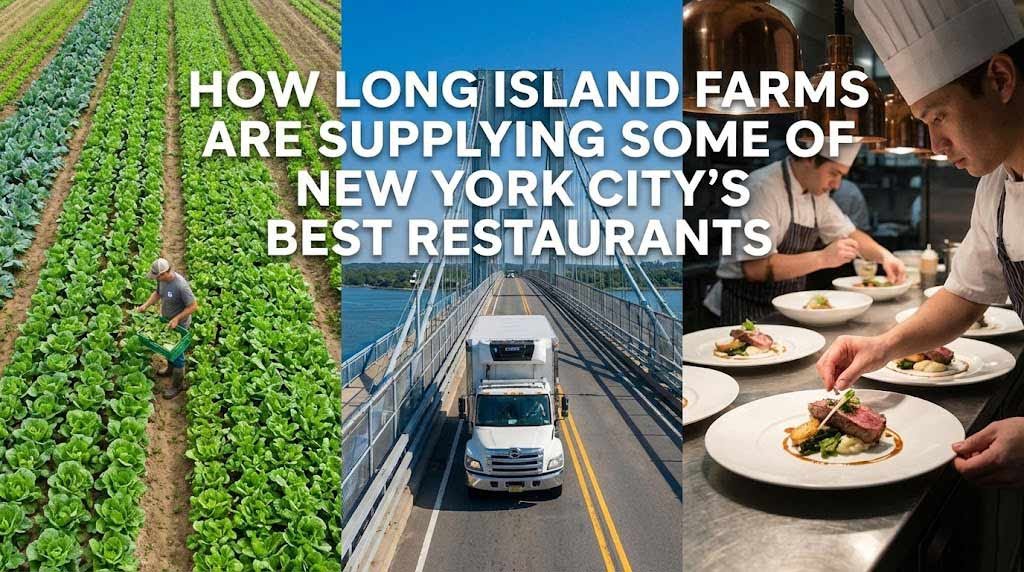
In the walk-in cooler of some of Manhattan’s most celebrated restaurants, between the imported French butter and the overnight-shipped Copper River salmon, you’ll find something far more local: crates of vegetables, eggs, and artisan cheese bearing the names of farms located barely two hours east on the Long Island Expressway. The farm-to-table movement isn’t new, but what’s happening between Long Island’s fields and New York City’s kitchens has evolved from a marketing buzzword into a genuine economic relationship—one where chefs don’t just buy produce but collaborate with farmers on what to grow, and where a single county’s direct-to-consumer agricultural sales exceed a quarter of a billion dollars. Suffolk County, according to the 2024 NYS Comptroller${ap}s agriculture report, leads the entire state in sales of products directly to consumers, local retailers, and food processors, with more than $268 million in such sales in 2022. The farm-to-restaurant pipeline is one of its most dynamic channels.
Balsam Farms: The Montauk Operation That Feeds the Hamptons’ Finest
Few farms exemplify the chef-farmer symbiosis better than Balsam Farms in Montauk. Co-owner Ian Calder-Piedmonte told Elliman Insider that Balsam tailors some of what it grows to the specific needs of the restaurant community. The relationship is bidirectional: chefs don’t just purchase produce; they share knowledge with farmers, forming what Calder-Piedmonte describes as an “information ecosystem.” He adds: “We’re lucky to farm in one of the best places in the world to grow food. Our soils and climate are conducive to producing a wide variety of high-quality crops. We’re also lucky to have some of the best chefs in the world working in some of the finest restaurants here.” Balsam’s produce appears on the menus of Nick & Toni${ap}s in East Hampton (a Hamptons institution since 1988), Almond in Bridgehampton, and numerous other East End restaurants.
Amber Waves Farm: From Amagansett Field to Restaurant Plate
Founded by Amanda Merrow and Katie Baldwin, Amber Waves Farm in Amagansett is a working organic farm with its own kitchen and café—and a supplier to some of the region’s most acclaimed restaurants. Merrow told Elliman Insider that Amber Waves works closely with a select group of restaurants, including Almond in Bridgehampton, Il Buco al Mare in Amagansett (the East End outpost of the famed Manhattan restaurant), and Hamptons Aristocrat in Westhampton. The farm also sources from neighboring operations: Quail Hill, Balsam Farms, Briermere Farms, Goodale Farms, Catapano Dairy Farm, Mecox Bay Dairy, Acabonac Farms, and Indian Neck. This web of interconnected farms creates a local food network whose combined output rivals the sourcing infrastructure of a small city.
Wölffer Estate: When the Vineyard Is the Restaurant
Joey Wölffer, co-owner of Wölffer Estate Vineyard and Wölffer Kitchen Amagansett, describes sustainability as a core value extending beyond the vineyard. At Wölffer Kitchen, the menu showcases local, seasonal cuisine: oysters served with the estate’s own verjus mignonette, local catch of the day, and dishes built around whatever the surrounding farms are producing that week. The concept—a wine estate that also operates a restaurant sourcing hyperlocally—represents a vertical integration model that larger wine regions worldwide are only now beginning to adopt.
North Fork Table & Inn: Michelin Stars Meet Local Soil
Located in a historic countryside home in Southold, North Fork Table & Inn is operated by restaurateur and Michelin-starred Chef John Fraser, a chef recognized by the State of New York as one of its foremost vegetable-centric culinary voices. The menu changes based on seasonality and the immediate availability of produce from surrounding farms. According to I Love NY, Fraser is “putting the Long Island farm bounty to good use” with dishes like Long Island Duck, grilled yellowfin tuna, and Montauk tilefish alongside the latest vegetables pulled from the rich North Fork soil. There’s even a farm-to-table food truck in the parking lot for casual meals.
Perennial in Garden City: Bringing Farm-to-Table to the Suburbs
The farm-to-restaurant pipeline isn’t limited to the East End. In Garden City, chef-owner Peter Mistretta runs Perennial, a neighborhood restaurant with serious farm-to-table credentials. A Manhattan veteran of acclaimed restaurants Hearth and Back Forty, Mistretta moved to Long Island because he saw “untapped potential” for locally sourced dining outside the high-end East End scene. As he told Edible Long Island, “Farm to table to me is being transparent, giving credit to that farmer, focusing on the produce, giving money back into the local community, to small and mid-sized farmers who work incredibly hard.” Mistretta’s approach includes jarring and canning summer produce to extend the local season into winter—because a Long Island winter menu built only on what’s growing locally would, as he candidly admits, “center around potatoes and cabbage.”
The Pipeline to Manhattan: How Long Island Produce Reaches City Kitchens
The connection between Long Island farms and New York City restaurants is facilitated by several channels. The Union Square Greenmarket—the city’s most famous farmers market—has featured Long Island growers for decades, and restaurants like Danny Meyer’s Union Square Cafe have built their identities around sourcing from it. Farms like Golden Earthworm Organic Farm in Southold, the first certified organic farm on the North Fork (founded by Maggie Wood and Matthew Kurek), supply both local markets and city-bound distribution networks. The relatively short distance—under 120 miles from Southold to Manhattan—means produce can leave the field in the morning and be on a restaurant prep table by evening. The Marshal in Hell’s Kitchen has featured an all-New York wine list for over a decade, including North Fork bottles, reminding New Yorkers they live in the heart of a thriving wine country.
Why This Matters for Long Island Communities
Every dollar that flows from a New York City restaurant to a Long Island farm stays in the regional economy. The 2024 comptroller’s report underscores this: Long Island’s $373 million in agricultural sales supports not just the 607 farms directly but an entire ecosystem of farm workers, equipment suppliers, trucking companies, and retail operations. With farmland values in Suffolk County running at four times the state average—and in Nassau at fifteen times—the economic case for agriculture must be continually justified. The restaurant pipeline helps make that case, demonstrating that Long Island farmland is not just a scenic amenity but a productive economic asset. For those who want to live at the intersection of agricultural heritage and modern convenience, explore Long Island homes here.
Related Posts: The North Fork Food Trail: Farms, Wineries, and Roadside Stands Worth Stopping For | Long Island’s Best Farmers Markets and What to Buy at Each One
Video: Farm to Table on Long Island${ap}s North Fork (YouTube)Sources: NYS Comptroller DiNapoli Agriculture Report (Nov. 2024), Elliman Insider, Edible Long Island (2019), I Love NY, North Fork Table & Inn, Organic Produce Network (2024), USDA Census of Agriculture (2022), Huntington Now (Jan. 2025).