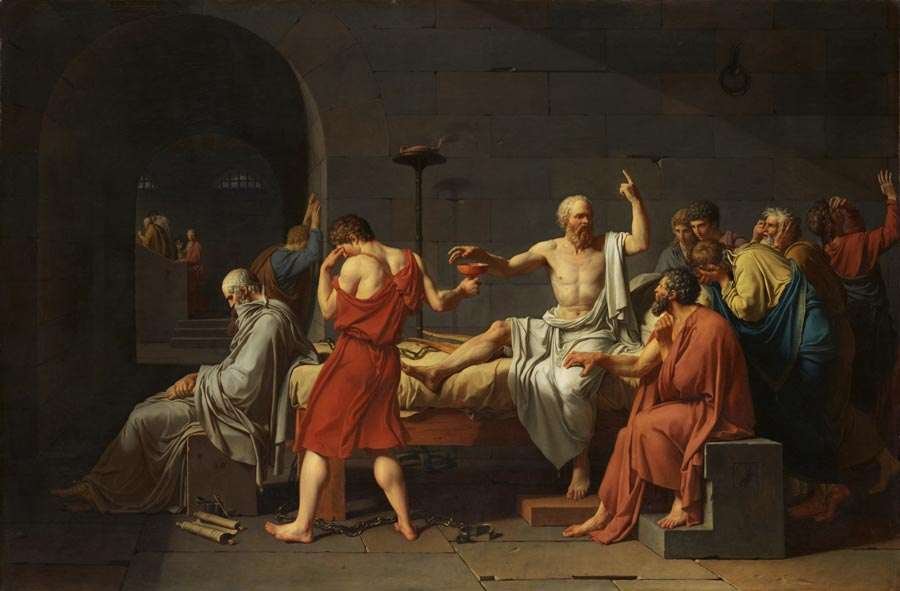
Painted in 1787, two years before the guillotine became the symbol of French revolutionary justice, Jacques-Louis David’s The Death of Socrates hangs in the Metropolitan Museum of Art as one of the most morally charged images in Western painting. It doesn’t need context to land. You walk into the room, and the geometry of it stops you — the horizontal slab of the deathbed, the vertical reach of Socrates’ arm, the hemlock cup suspended in the air between them like a question still waiting to be answered. Then you start reading the faces, and the painting opens into something you could spend an hour inside.
David was at the height of his neoclassical powers. The composition is almost theatrical in its austerity — stripped of ornament, flooded with cold light, every figure placed with the precision of a philosophical argument. He didn’t stumble into this subject. He chose it, and the choice was a provocation aimed directly at the court of Louis XVI.
The Scene Plato Left Us
The source material is Plato’s Phaedo — one of the most extraordinary documents in the history of human thought. It records the final hours of Socrates in 399 BC, the day he was executed by the city of Athens on charges of impiety and corrupting the youth. The method was hemlock: a slow poisoning that begins in the legs and moves upward until the heart stops. Socrates spent his last hours doing what he had always done — talking, reasoning, arguing that the soul is immortal and that death holds nothing to fear for a man who has lived well.
What Plato gives us is not a tragedy in the Greek dramatic sense. It is something stranger and more unsettling — a man facing death with such equanimity that his friends are more distraught than he is. They weep. He lectures. He is, to the last, the most alive person in the room.
David captures this inversion with complete fidelity to the text and absolute mastery of the canvas.
Reading the Room
Socrates sits upright at the center — not lying down, not slumped, but erect and almost energized, his body already half-turned toward the cup as if he’s been waiting for it. His left hand points upward, toward what he has spent the Phaedo arguing for: the immortality of the soul, the Forms, the life of the mind persisting beyond the body. His right hand reaches for the hemlock with the casual confidence of a man picking up a glass of wine at dinner.
Around him, every other figure collapses into grief. The disciples are draped, folded, turned away — some covering their faces, some hunched at the foot of the bed. Plato himself sits at the far left, notably apart from the group, rendered as an old man (David took a liberty here — the historical Plato was young at the time, but the aged figure lends gravity and perhaps signals the retrospective weight of what Plato would later make of this day). Crito, Socrates’ oldest friend, grips his knee with the desperation of a man who knows he cannot stop what is coming.
The figure handing over the cup turns his face away entirely, unable to watch. He is the only one in the painting who cannot bear to be present for what he is participating in. In that single gesture, David places the moral burden precisely where it belongs — not on the man drinking, but on the society that demanded it.
The Geometry of Conviction
David’s formal choices are not decorative — they are argumentative. The composition is rigorously horizontal, built on the plane of the stone bed like a bas-relief, which is entirely intentional: neoclassical painting drew heavily from ancient Roman sarcophagi and friezes, and the deathbed here reads as monument before the man has even died. The figures are arranged in a single plane with almost no depth recession, which flattens the space and forces the eye to read left to right, like a sentence.
The cold, even light eliminates shadow as mystery. Everything is exposed, nothing is hidden. This is a painting about clarity — about a man who has nothing to conceal, who has lived so transparently that death is simply the logical conclusion of the argument. The light doesn’t dramatize. It illuminates.
Contrast this with Rembrandt’s approach to philosophical portraiture — the warm amber shadows, the brooding interiority, the sense of a mind working in private. Where Rembrandt’s Aristotle with a Bust of Homer turns inward, David’s Socrates faces outward, toward us, toward the argument, toward the cup. The difference in light is the difference in temperament: one philosopher contemplating, the other performing the final act of a life’s philosophy.
What Socrates Was Actually Dying For
It is worth pausing on the charges themselves, because they matter to how we read the painting. Socrates was not executed for a crime in any modern sense. He was convicted for asking questions — specifically, for the practice that has since borne his name: the Socratic method, the relentless cross-examination of assumptions, the refusal to accept received wisdom without subjecting it to scrutiny. He made powerful people look foolish. He did this in public. He did it repeatedly. And when given the chance to propose his own punishment and effectively buy his way out, he reportedly suggested the city of Athens pay him a salary for his services.
The jury was not amused.
What David understood — and what made this painting politically explosive in pre-revolutionary France — is that Socrates is not a victim. He is a man who chose this. He could have fled Athens before the trial. He could have accepted exile afterward. He stayed, he argued, and he drank the hemlock because he believed that a man who had spent his life arguing that unjust laws should be challenged through reason rather than evasion could not, at the end, simply run away. The integrity of the argument required the death.
This is the examined life pushed to its terminal conclusion: not just living by your convictions but dying by them. In the years I’ve spent reading through the Stoics — Epictetus, Marcus Aurelius, Seneca — this willingness to hold the line regardless of cost appears again and again as the defining feature of the philosophical life. My review of No Exit by Sartre touches on a related but darker theme: what happens when self-deception makes such clarity impossible. Socrates is the counterpoint — the man who saw himself without illusion and acted accordingly, all the way to the end.
David’s Political Gambit
The timing of this painting was not accidental. France in 1787 was two years from revolution, already crackling with Enlightenment philosophy, with Voltaire and Rousseau, with arguments about civic virtue and the corruption of power. David was deeply embedded in that world — he would go on to become the official painter of the Revolution and later of Napoleon, a man who understood that images were arguments and that the right image at the right moment could change how people thought about what was possible.
The Death of Socrates was that kind of image. It held up a man who died rather than compromise his principles and placed him in a room full of people who couldn’t match his courage. The implicit question, aimed squarely at the aristocratic patrons and court officials who would have seen this painting at the Salon of 1787, was not subtle: what are you willing to die for? Or more pointedly: what are you willing to live for, if not this?
The painting was an enormous success. The American Founding Father John Adams, who saw it, reportedly called it among the greatest paintings he had ever encountered. The philosophe Denis Diderot had died the year before it was completed, but David’s circle was Diderot’s circle, and the painting breathes his influence — the idea that art should instruct, elevate, and challenge, not merely please.
The Cup at the Center
Every element in this painting radiates outward from a single object: the hemlock cup, suspended between the figure handing it over and Socrates’ reaching hand. It is not yet grasped. That moment of suspension — the cup in transit, the act not yet completed, the last possible instant before the irreversible — is where David plants his flag.
He could have painted the moment after. He could have shown Socrates already drinking, or already dead, his friends gathered in mourning. He chose the threshold instead. The painting lives in the last second of possibility, the moment where conviction either holds or breaks. Socrates’ hand is already moving. There is no hesitation in that arm, no tremor in the fingers. The question was settled long before the cup was poured.
That, finally, is what makes this image so difficult to look away from. It is not a painting about death. It is a painting about what a life of genuine intellectual honesty costs — and about a man who, when the invoice arrived, paid it without flinching.
Standing in front of it at the Met, with David’s cold light falling across that extended arm, the cup still suspended, the philosopher still reaching — you feel the weight of that transaction. Not as history. As a question addressed directly to you.
You Might Also Like:
- A Kierkegaard Anthology — The Thinker Who Refused to Let Me Go
- The Ghost in the Machine: Descartes, Dennett, and the Mind That Built the Modern World
- Thus Spoke Zarathustra by Friedrich Nietzsche — The Book That Rewired My Understanding of Everything
Sources
- Metropolitan Museum of Art — The Death of Socrates, Collection Record: https://www.metmuseum.org/art/collection/search/436105
- Plato. Phaedo. Trans. G.M.A. Grube. Indianapolis: Hackett, 1977.
- Rosenblum, Robert. Transformations in Late Eighteenth Century Art. Princeton: Princeton University Press, 1967.
- Johnson, Dorothy. Jacques-Louis David: Art in Metamorphosis. Princeton: Princeton University Press, 1993.
- Crow, Thomas. Painters and Public Life in Eighteenth-Century Paris. New Haven: Yale University Press, 1985.
- Epictetus. Discourses and Selected Writings. Trans. Robert Dobbin. London: Penguin Classics, 2008.