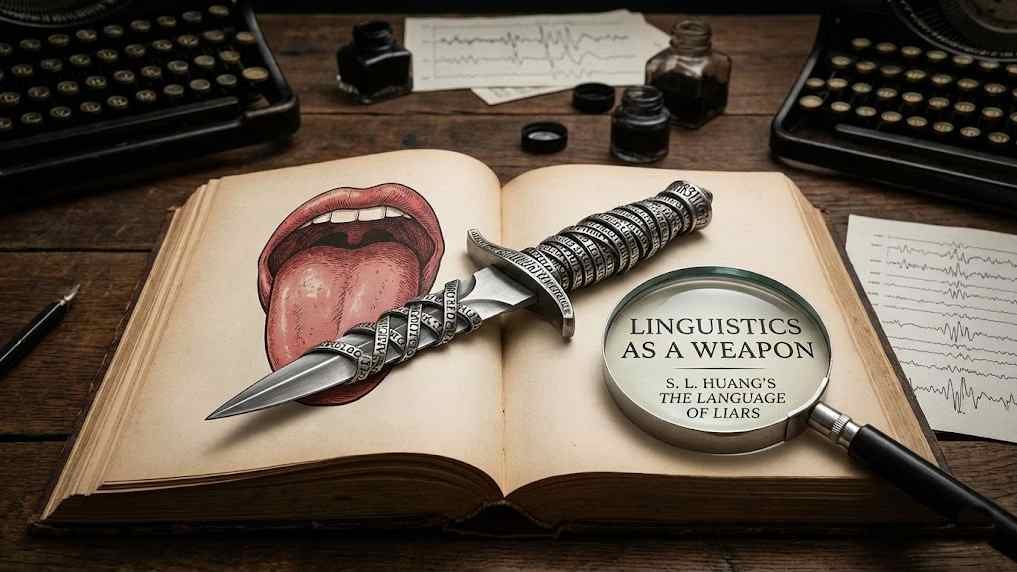
Every culture believes, at some level, that understanding another people’s language is an act of grace — a bridge thrown across the chasm of difference in the hope of connection. S. L. Huang’s The Language of Liars burns that bridge down, examines the ashes, and asks a question that lands with the weight of a philosophical indictment: what if learning someone’s language is not an act of solidarity, but the most refined instrument of their destruction?
Published in 2026 and already named a New Scientist Best of the Year, this slim, detonating novella has earned starred reviews from both Publishers Weekly and Library Journal, prompted comparisons to R.F. Kuang’s Babel, China Miéville’s Embassytown, and Denis Villeneuve’s Arrival, and provoked the kind of stunned silence readers report after encountering a book that reframes something they thought they already understood. Huang — a Hugo Award winner, MIT-trained mathematician, and former Hollywood stunt performer — has written a book that works simultaneously as propulsive science fiction and as a cold, clear-eyed philosophical treatise on the violence that can be encoded in the act of knowing.
The Architecture of the Story
The novella’s protagonist is Ro, a four-legged, fur-covered alien linguist from a hive-based civilization called Orro. Ro desperately wants to be the first Linguist in generations to make a “jump” — that is, take over the mind and body of another being, a Star Eater, on a spy mission that would also serve as a one-way trip away from his home hive. Publishers Weekly The Star Eaters are the only species in the galaxy capable of harvesting the meridian element that enables faster-than-light travel — making them simultaneously the most essential and most mysterious civilization in existence. They are the species all others crave to know more of, but who have notoriously shared so very little. Amazon
The jump itself requires what Huang frames as a moment of perfect psychic communion — not merely the acquisition of vocabulary and grammar, but a total dissolution of self into the other’s cognitive architecture. Ro studies the Star Eaters not as a scholar studies a text, but the way a method actor disappears into a role: entirely, dangerously, with no guaranteed exit. When Ro succeeds, the discovery waiting on the other side of that communion does not illuminate — it destroys. The nefarious history of these jumps comes to light, causing Ro to question all the received wisdom about both the Star Eaters and Ro’s own civilization. Publishers Weekly
Huang refuses to make this a story of malicious actors and obvious villains. What makes The Language of Liars genuinely unsettling is that Ro’s devastation arrives not through the discovery of overt cruelty, but through the revelation of consequence — of how earnest, reverent, even loving acts of linguistic study can produce catastrophic harm at scale.
The Sapir-Whorf Dimension
To read The Language of Liars without understanding the intellectual tradition it’s engaging would be to hear the music without the counterpoint. The book is in direct, sustained dialogue with what linguists call the Sapir-Whorf Hypothesis — the theory, developed in the early 20th century by anthropological linguists Edward Sapir and his student Benjamin Lee Whorf, that the structure of a language shapes the cognitive reality of its speakers. The strong hypothesis of linguistic relativity, now referred to as linguistic determinism, holds that language determines thought and that linguistic categories limit and restrict cognitive categories. Wikipedia
For Sapir and Whorf, these conclusions were not abstract ideas but emerged directly from relationships they believed to exist in their own data. ScienceDirect Whorf, notably, was not an academic by profession — he was an insurance investigator who observed, on the job, how the labeling of something as “empty” led workers to treat it as inert, when the residue inside made it explosive. Language, he argued, does not merely describe the world. It conditions behavior toward it. It shapes what is seen, what is safe, what can be destroyed without guilt.
Huang extrapolates this proposition to its most devastating logical conclusion. In her galaxy, the jump is not metaphor — it is the Sapir-Whorf hypothesis rendered literal. To speak a language with perfect fluency is to dissolve the boundary between self and other. And that dissolution, Ro discovers, has been weaponized for generations by civilizations that believed they were merely seeking understanding.
Colonialism Encoded in Grammar
The book’s deepest argument — the one that has critics reaching for Babel and Avatar as reference points — is that linguistic mastery is not neutral. It carries the geometry of power within it. Anthropology at the time of the Sapir-Whorf debates was often deeply inflected by racist, colonialist, and imperialist ideas. EBSCO The very act of studying another culture’s language had historically served, in practice, to decode it for extraction — to render the foreign legible to those with the power to exploit the newly acquired knowledge.
Huang transposes this historical reality into interstellar space. The Star Eaters are dying — unable or unwilling to reproduce — and the galaxy’s other civilizations desperately want access to the meridian element they control. The jump, framed as an act of science and even of reverence, is revealed to be something closer to trespass. To enter another being’s consciousness without their full comprehension of what that entry means — even with the best intentions — is to commit an act whose consequences cannot be contained by the purity of the intention.
This is the novel’s surgical edge: it does not comfort the reader by making the wrongdoers monstrous. Ro is sympathetic, earnest, academically passionate. His civilization is not depicted as uniquely evil. What Huang suggests instead is that the violence was structural — encoded in the very framework of the jump program, in what was never questioned because it was never named. The lie of the title is not one told by a particular character so much as one told by an entire epistemological tradition.
Huang as Craftsman of the Devastating Twist
In formal terms, this is a novella — approximately 176 pages — and Huang uses the compression of the form the way a jeweler uses a smaller setting to intensify a stone’s fire. The pacing is relentless without being breathless. The worldbuilding — Ro’s four stomachs, two hearts, his hive’s social structure, the Star Eaters’ physiology — is presented with the calm confidence of an author who has thoroughly imagined this universe and is content to let the reader discover it rather than receive it as an infodump.
Yoon Ha Lee, the New York Times bestselling author of Ninefox Gambit, offered perhaps the most precise description of the book’s emotional impact: it is pitch-perfect science fiction about linguistics and consequences, the kind that leaves a reader briefly unable to speak. Samantha Mills, a Nebula and Locus Award winner, called it an absolute gem packed with great ideas and an ending that arrives like a physical blow. Multiple readers report that one of the most emotional, wrenching endings they’ve ever read left them silently staring at the wall. Goodreads
The twist at the novella’s center — deliberately left unexamined here — works not because it is clever but because it is earned. Every detail Huang plants in the early sections acquires retrospective weight. It is the kind of structural achievement that reveals a writer operating at a level of control that feels mathematical, which, given Huang’s MIT background, may not be coincidental.
The Company It Keeps
Comparisons to Embassytown are not incidental. China Miéville’s 2011 novel — set on a planet where the alien hosts can only process speech made by beings capable of lying — similarly treats language as ontology rather than communication. Both books ask whether understanding across radical difference is possible, and both arrive at answers that are more complicated than hopeful. Where Miéville is interested in the semiotics of truth, Huang is interested in the ethics of knowledge. What you are owed when someone learns you so thoroughly they can inhabit you?
The comparison to Arrival — specifically Ted Chiang’s short story “Story of Your Life” from which the film derives — runs even deeper. Chiang’s linguist protagonist learns an alien language that restructures her experience of time itself, a rigorous extrapolation of the Sapir-Whorf hypothesis into the realm of temporal cognition. Huang extends the same tradition but introduces a moral accountability that Chiang’s story, luminous as it is, sidesteps. The question in Chiang is existential — what would it mean to know the future? The question in Huang is ethical — what right did we have to enter in the first place?
Babel, R.F. Kuang’s 2022 novel set in an alternate-history Oxford where translation magic runs the British Empire, is perhaps the most structurally resonant parallel. Both books argue that the colonial project has always been, at bottom, a linguistic project — that the extraction of meaning from another culture’s language is inseparable from the extraction of labor and resources from their bodies. Huang makes this case with greater formal economy than Kuang does, and with the additional vertigo of full alien alterity — there is no human protagonist here onto whom the reader can anchor their discomfort.
Why This Book Matters Now
The Language of Liars arrives at a moment when the question of what it means to truly understand another mind has acquired new technological urgency. Large language models now process billions of words across hundreds of human languages, producing fluent text in tongues their designers did not speak. The promise is connectivity — the democratization of translation, the narrowing of distances. The risk, which Huang identifies with uncanny precision, is that fluency is not the same as consent. That to model a language is not the same as to honor the consciousness it expresses.
The book is in conversation with Babel, with Ender’s Game, with James Cameron’s Avatar, with a whole tradition of science fiction grappling with contact, extraction, and the ethics of knowing. Goodreads What distinguishes Huang’s contribution is the specificity of the mechanism — the jump — and the care with which she refuses to make the harm legible until the moment it cannot be looked away from.
Sue Burke, the author of Semiosis, put it plainly in her endorsement of the novel: language is also a technology, and technologies can destroy. The Language of Liars is the rare book that earns the right to say so, because it has done the philosophical work required to show precisely how.
The Verdict
This is not a comfortable read, nor is it meant to be. It is a work of high formal intelligence and genuine moral seriousness, dressed in the kinetic machinery of science fiction so that it moves at speed rather than lecturing from the podium. For readers who approached Arrival and wanted more ethical consequence, who found Babel overly long but urgently right about its central argument, who believe the best speculative fiction illuminates something true about the human condition by removing the human from the equation entirely — The Language of Liars delivers.
At 176 pages, it costs almost nothing in time. What it costs in the days afterward, while the ending continues to work on the reader like an enzyme, is another matter entirely. The book does not leave. It simply changes address, moving from the page into the architecture of how one thinks about knowing, about entering, about what is owed to a mind when you have learned to speak it perfectly.
The Language of Liars is available in hardcover, paperback, and ebook through Amazon, Bookshop.org, and wherever books are sold. Published by Tor Books, 2026. ISBN: 9781250405333.