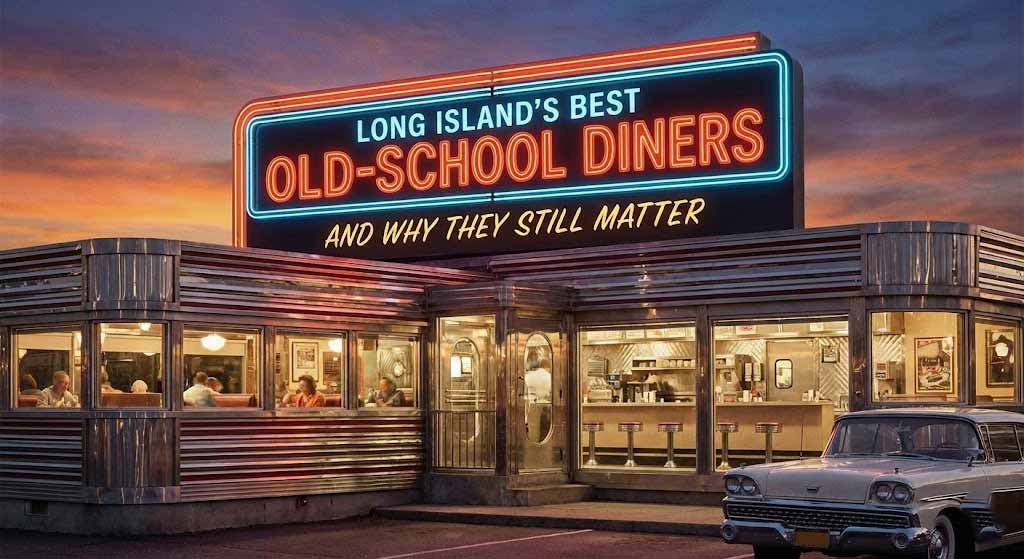
There is a particular quality of light inside a diner at six in the morning that cannot be replicated anywhere else on earth. It is not the fluorescent hum of a hospital corridor nor the amber warmth of a cocktail lounge. It is something between the two—clinical enough to read a menu, forgiving enough to forgive a sleepless night. Edward Hopper understood this when he painted Nighthawks in 1942, placing four strangers inside a Greenwich Village diner’s glass aquarium, bathed in that very light, each of them alone and yet somehow together. The Art Institute of Chicago bought the painting for three thousand dollars within months of its completion (Art Institute of Chicago, 1942). Eighty-three years later, the painting remains one of the most recognized works in American art, and the diner it depicts—an amalgamation, Hopper admitted, merely “suggested by a restaurant on Greenwich Avenue where two streets meet”—has become the visual shorthand for something the country is quietly losing.
That something is the diner itself. And nowhere is that loss felt more acutely than on Long Island, where the diner was never merely a place to eat but a civic institution, a confessional booth, a second living room. Between 2009 and 2019, seventeen diners closed across Nassau and Suffolk counties. In the four years following the pandemic, twelve more shuttered their doors (Lolis, 2024). In Sayville, the closure of the Sea Crest Diner left the entire hamlet without a single diner for the first time in decades—residents had to drive twenty minutes to West Islip just to sit at a counter. The mathematics of this erosion are straightforward: rising food costs, labor shortages, the generational fatigue of family-owned businesses. But the cultural mathematics are far more complex, because when a diner closes, something irreplaceable vanishes from the neighborhood’s connective tissue.
I have operated The Heritage Diner in Mount Sinai since 2000—twenty-five years on Route 25A, through recessions and pandemics and the wholesale transformation of how Americans eat. I have watched chains colonize the landscape and food-delivery algorithms attempt to reduce the restaurant experience to a cardboard box on a doorstep. And yet The Heritage still opens its doors every morning. The regulars still come. The counter still holds. What I have learned in a quarter-century is that the diner’s survival is not sentimental—it is strategic. The old-school diner is one of the last authentically local institutions in American life, and its persistence matters far more than nostalgia alone can explain.
The Horse-Drawn Origins of an American Institution
The diner did not begin as a building. It began as a wagon. In 1872, a Providence, Rhode Island entrepreneur named Walter Scott converted a horse-pulled cart into a mobile food service, selling sandwiches, coffee, and pie to night-shift newspaper workers (Viveiros, 2000). The concept spread quickly through New England, and by the 1890s, manufacturers like T.H. Buckley of Worcester, Massachusetts, were mass-producing elaborate “lunch cars” with frosted glass, decorative murals, and overhangs that gave them a theatrical presence on the street. Charles Palmer received the first patent for the design in 1893, calling it a “Night-Lunch Wagon” (Wikipedia, 2025).
The transformation from mobile wagon to stationary restaurant happened in the early twentieth century. In 1912, Jerry O’Mahony founded his namesake diner company in Elizabeth, New Jersey, and began manufacturing prefabricated structures that could be shipped by rail and installed with minimal on-site construction. Between 1917 and 1952, the O’Mahony company alone produced approximately two thousand diners (Gabriele, 2023). Other New Jersey manufacturers—Kullman, Silk City, Fodero, Paramount, Mountain View—followed, making the state the undisputed manufacturing capital of the American diner. By the 1940s, New Jersey housed more diner builders than any region in the world, and their products were being shipped across the country and eventually to Europe, where, as diner historian Michael Gabriele has noted, Americans’ chrome-and-neon eateries became synonymous with rock-and-roll culture itself (New Jersey Monthly, 2025).
The postwar boom was the diner’s golden age. Returning GIs craved comfort food and communal spaces. The interstate highway system created corridors of hungry travelers. And the diner’s essential promise—good food, fair prices, no pretension, open to everyone—dovetailed perfectly with the middle-class optimism of the 1950s. Long Island, exploding with suburban development in the Levittown era, became fertile ground. Diners sprouted along Route 25A, Jericho Turnpike, Sunrise Highway, and Middle Country Road, each one becoming a landmark in its own right.
The Long Island Diner Landscape: Survivors and Icons
To drive the length of Long Island today with an eye for old-school diners is to read a palimpsest of suburban history—layers of survival, adaptation, and loss written in stainless steel and Formica.
Start on the North Fork, where the Cutchogue Diner has occupied its spot on Main Road since 1941. Built by the Kullman Dining Car Company, the structure itself is a museum piece—a pristine example of the streamlined, railcar-style diner that defined mid-century American roadside architecture. The family that currently operates it has been doing so since 1987, serving breakfast and lunch seven days a week in an interior that looks almost exactly as it did eighty-four years ago (OnlyInYourState, 2023). Sitting at the Cutchogue Diner’s counter, with coffee in a thick ceramic mug and the sound of eggs hitting a flat-top griddle, you understand immediately that this is not a “retro” experience. There is nothing self-conscious about it. It simply never changed.
Move west along the North Shore to Tim’s Shipwreck Diner in Northport, which carries a distinction few restaurants anywhere can claim: it began as an actual railroad dining car, wheeled on trolley tracks into its current location in 1924. Originally called the Northport Diner, the structure has been expanded over the decades but retains its original bones. The diner earned national recognition on the Food Network’s American Diner Revival and was renovated by television host Ty Pennington, yet its essential character—cash only, dog-friendly patio, breakfast that draws lines on weekend mornings—remains unchanged (Retro Finds on Long Island, 2024). The Shipwreck is a lesson in how a diner can modernize its surface without abandoning its soul.
In Nassau County, Krisch’s in Massapequa has been operating since 1920—over a century of continuous service. Featured on the Food Network’s Diners, Drive-Ins and Dives, Krisch’s represents the diner as full-spectrum institution: breakfast counter, lunch spot, ice cream parlor, and community gathering place all under one roof (Long Island Pulse, 2017). Hildebrandt’s in Williston Park, open since 1927, carries a similar pedigree, with a 1920s-themed interior and a signature burger featured in the documentary Hamburger America. And in Glen Cove, Henry’s Confectionery, a family-owned operation since 1929, continues to serve as the kind of “true local hangout” where, as one visitor noted, you see the same familiar faces every time you walk in (Nassau County Tourism, 2024).
Suffolk County’s survivors tell equally compelling stories. Thomas’s Ham ‘N’ Eggery on Old Country Road in Carle Place has been a breakfast destination for over seventy years, specializing in skillet eggs and pancakes with a no-frills charm that has earned it a devoted following. Holbrook Diner, approaching its fiftieth year, represents the diner as genuine community anchor. Its general manager, Anthony Tymvios, has described the relationship in familial terms: “Our guests here are like family. You see the parents bringing in their child in a car seat and then now they’re coming back to eat with their girlfriends” (Lolis, 2024).
And then there is The Heritage Diner in Mount Sinai—our diner, my diner, the place where I have spent twenty-five years learning what it means to feed a neighborhood. At 275 Route 25A, we sit at the crossroads of the North Shore’s residential communities, a position that has made us part of the daily rhythm of thousands of lives. We are not the oldest diner on Long Island. We are not the most famous. But we are here, and we are open, and that continuity is its own kind of accomplishment in an industry where the median lifespan of a restaurant is five years.
The Economics of Disappearance
The restaurant industry in the United States is projected to reach $1.5 trillion in total foodservice sales in 2025, with eating and drinking establishments directly contributing $1.1 trillion—a four-percent increase over 2024 (National Restaurant Association, 2025). Employment in the sector is expected to reach 15.9 million jobs. These headline numbers suggest robust health. But the aggregate conceals a brutal sorting mechanism that disproportionately punishes independent, family-owned establishments.
Full-service operators reported a median labor cost of 36.5 percent of sales in 2024—a figure well above historical averages and one that the National Restaurant Association directly linked to reduced profitability (NRA, 2025). Meanwhile, 48 percent of operators reported declining customer traffic, even as same-store sales rose, suggesting that price increases rather than volume growth are driving revenue. For a diner operating on already thin margins, this combination is devastating: you are paying more for labor and ingredients, charging more per plate, and seeing fewer people walk through the door.
The diner’s specific vulnerability lies in its economic model. Unlike fine dining, which can absorb cost increases through premium pricing, or fast-casual chains, which leverage scale and supply-chain efficiencies, the independent diner occupies a middle ground where prices must remain accessible but costs continue to rise. A Heritage Burger cannot cost twenty-two dollars. A cup of coffee cannot cost six. The diner’s social contract is built on affordability, and breaking that contract means breaking the institution itself.
Add the generational succession crisis—Peter Sedereas, a third-generation New Jersey diner owner, told NPR in 2024 that his children have no interest in the business, preferring careers in medicine—and you begin to see the structural forces at work (NPR, 2024). The diner was built by immigrant families, primarily Greek-American, who passed the business from generation to generation. When that chain breaks, the diner typically does not find a new owner. It finds a demolition crew.
On Long Island, the pattern is unmistakable. The Golden Coach Diner in Huntington closed in 2025 after forty-five years. Two diners in Nassau County shuttered the same month. In each case, the owners cited the same trifecta: pandemic aftershocks, food-cost inflation, and the impossibility of staffing a kitchen at wages the business model can support (News 12, 2025).
The Diner as Third Place: Why Survival Is a Civic Act
The sociologist Ray Oldenburg coined the term “third place” to describe the public spaces that exist between home (the first place) and work (the second place)—the cafés, barbershops, bookstores, and pubs where community life unfolds informally. The diner is perhaps the most democratic third place in American culture. Unlike a bar, it requires no alcohol. Unlike a coffee shop, it does not demand a laptop or a performance of productivity. Unlike a private club, it enforces no membership. You walk in, you sit down, you are served. The counter especially—as Gabriele has observed—is where “you meet truck drivers and salespeople and politicians. It’s all ships passing in the night. That’s where all Americana conversations start” (New Jersey Monthly, 2025).
This is what I have witnessed for twenty-five years at The Heritage Diner. The morning regulars who know each other’s names and medical histories. The high school students who gather after Friday night football games. The elderly widower who comes in alone at seven every morning because the diner is the only place left where someone says good morning to him. These are not transactions. They are relationships, and they are built on the diner’s particular architecture of intimacy: the open kitchen, the counter seating, the waitstaff who remember your order.
When a diner closes, this social infrastructure does not relocate to a Panera Bread. It simply disappears. The woman from Sayville who told a reporter that her town’s diners were “a staple, a community hub” wasn’t being sentimental—she was describing a sociological reality (Lolis, 2024). The diner functions as a pressure-release valve for suburban isolation, a place where the atomized existence of car-dependent communities finds a corrective. You cannot replicate this with a delivery app.
At The Heritage, I have seen this function compound over the years. The diner is where local real estate transactions are discussed over eggs, where North Shore families celebrate milestones that don’t quite warrant a reservation at a restaurant with tablecloths, where the texture of Mount Sinai’s daily life is woven together one breakfast at a time. Paola and I, as we prepare to launch our boutique real estate venture Maison Pawli in 2026, understand this intimately: community is not an abstraction. It is built in specific places, over specific counters, by people who show up every day.
The Craft of the Diner: What Mass-Market Dining Cannot Reproduce
There is a paradox at the heart of the diner’s current crisis: the very qualities that make diners economically vulnerable are the same qualities that make them culturally irreplaceable. A diner is handmade in a way that a chain restaurant is not. The menu is curated by a person, not an algorithm. The specials reflect what the cook found at the market, not what a corporate test kitchen determined would optimize throughput. The coffee is brewed in a machine that someone actually watches, not dispensed from a pod.
This is a principle I understand deeply from my work at Marcellino NY, where I craft bespoke English bridle leather briefcases for a global clientele of lawyers, doctors, and discerning professionals. The parallel between a handmade briefcase and a handmade diner meal is not superficial. Both depend on the quality of materials, the skill of the maker, and the willingness to prioritize craft over efficiency. A Marcellino briefcase is hand-stitched with saddle-stitching technique, using leather that develops a patina over decades of use. A Heritage Diner breakfast is cooked on a griddle that has been seasoned by twenty-five years of continuous use, by cooks who understand that the difference between a good omelet and a great one lives in thirty seconds of timing and a quarter-turn of the wrist.
The mass-market alternative—the IHOP, the Denny’s, the Cracker Barrel—offers consistency, which is a real value. But consistency is the enemy of character. Every Denny’s Grand Slam tastes the same whether you order it in Tulsa or Tacoma. That is, in a sense, the point. But it is also the limitation. The diner’s irregularities—the slightly different pancake, the waitress who knows you prefer your toast dark, the cook who throws in an extra strip of bacon because it’s Tuesday and you look like you need it—are not flaws in the system. They are the system. They are what makes the experience human rather than transactional.
In a world increasingly mediated by screens and algorithms, the diner’s stubborn humanity is not a weakness. It is its greatest competitive advantage. This is the same insight that drives the bespoke economy in luxury goods: people will pay for, and return to, experiences that feel made for them rather than manufactured at them. The Heritage Diner and Marcellino NY operate at vastly different price points, but they share a philosophical foundation—the belief that unseen details define a masterpiece, whether that masterpiece is a briefcase that will outlast its owner or a plate of eggs that makes a stranger feel at home.
What the North Shore Owes Its Diners
The North Shore of Long Island is undergoing a transformation that anyone in real estate can read in the listing prices and zoning variances. Mount Sinai, Port Jefferson, Stony Brook, Northport—these communities are evolving from quiet suburban enclaves into destinations with their own cultural identities. Property values are rising. New restaurants are opening. Young families are arriving.
But the character of these communities—the thing that makes them desirable in the first place—was not created by the newcomers. It was created by the institutions that were already here. The diner, the hardware store, the barbershop, the volunteer fire department. These are the load-bearing walls of community identity, and you cannot remove them without weakening the entire structure.
I think about this constantly as Paola and I develop Maison Pawli, our boutique real estate venture launching in 2026. The properties we will represent are not just buildings with square footage and lot lines. They are positions within a community’s social architecture, and that architecture is partially defined by the presence of places like The Heritage Diner. A buyer choosing Mount Sinai is choosing, in part, the experience of having a neighborhood diner where the owner knows their name. Remove that diner, and you have subtracted something from the property’s value that no renovation can restore.
This is not theoretical. Studies in urban planning have consistently shown that local independent businesses contribute more to neighborhood identity and economic resilience than chains (Institute for Local Self-Reliance, 2019). The diner, specifically, functions as what planners call a “social anchor”—a business whose value to the community exceeds its commercial footprint. When the Sayville Modern Diner closed in 2015, and the Sea Crest followed years later, the hamlet did not simply lose two restaurants. It lost its informal town square.
The North Shore still has its diners. The Heritage is here. The Shipwreck is in Northport. Thomas’s Ham ‘N’ Eggery endures. But the margin is thin, and the trajectory is clear. If we want these institutions to persist, we need to do more than feel nostalgic about them. We need to eat at them.
The Unseen Details That Define a Masterpiece
Marcus Aurelius wrote in his Meditations that “the object of life is not to be on the side of the majority, but to escape finding oneself in the ranks of the insane.” In the context of American dining in 2026, the insanity is the belief that convenience and efficiency are adequate substitutes for craft and community. The diner rejects this premise. It insists, stubbornly and sometimes unprofitably, that a meal is not merely fuel. It is a social act, a daily ritual, a small rebellion against the algorithmic flattening of human experience.
At The Heritage Diner, I have spent twenty-five years in that rebellion. Every morning when I open the doors at 275 Route 25A, I am not just operating a restaurant. I am maintaining a space where Mount Sinai comes together—where the retired schoolteacher and the construction worker and the teenage kid with the earbuds all share the same counter, the same coffee, the same light. It is the same impulse that drives me to hand-stitch a Marcellino briefcase: the conviction that the things we make with care outlast the things we make with speed, and that the communities we build around shared tables outlast the ones we build around shared algorithms.
Edward Hopper’s Nighthawks endures not because it depicts a beautiful diner but because it depicts the human need for one—the need for a lit room on a dark street, a place where strangers sit close enough to touch and yet remain free to be alone. Long Island’s old-school diners are those lit rooms. Some have been shining for a century. They deserve to shine for a century more.
The question is not whether diners still matter. Stand at any counter on Long Island at six in the morning—at The Heritage, at the Cutchogue, at Holbrook, at Krisch’s—and the answer is self-evident in every cup of coffee poured, every order called, every door held open for the next regular walking in. The question is whether we will recognize what we have before it is gone, or whether we will do what Americans have always done with the things we love most: take them for granted until the morning we wake up and they are not there.
The Heritage Diner is located at 275 Route 25A, Mount Sinai, NY. Open daily. Visit heritagediner.com for hours and menu.
Marcellino NY handcrafts bespoke English bridle leather briefcases from its workshop in Huntington, Long Island. Visit marcellinony.com to explore the collection.
Sources Cited:
- Art Institute of Chicago. (1942). Nighthawks by Edward Hopper. Collection records.
- Gabriele, Michael. (2023). The History of Diners in New Jersey. The History Press.
- Institute for Local Self-Reliance. (2019). The Multiplier Effect of Local Independent Businesses.
- Lolis, Marie. (2024). “These Long Island Diners Survived Covid-19.” Independent reporting.
- National Restaurant Association. (2025). 2025 State of the Restaurant Industry Report.
- New Jersey Monthly. (2025). “Why New Jersey Is the Diner Capital of the World.”
- News 12 Long Island. (2025). “2 More Diners Closing on Long Island.”
- NPR. (2024). “New Jersey Diners Adapt to Survive.”
- OnlyInYourState. (2023). “The Cutchogue Diner Is an Old School Eatery on Long Island.”
- Viveiros, Daniel Robert. (2000). “The Rise and Fall of the American Diner, 1920–1960.” Doctoral Dissertation, Salve Regina University.