The first thing that strikes you about Smithtown’s West Main Street is that it refuses to surrender its identity. In an era when strip malls and franchise signage have homogenized the American suburban corridor into a beige blur of predictability, this stretch of road retains something increasingly rare on Long Island: character. And nestled into it, at 133 West Main Street, sits Luso — a Portuguese and Brazilian churrascaria that has become one of Suffolk County’s most compelling arguments for why the immigrant kitchen remains the beating heart of American dining.
This is not a restaurant that announces itself with neon or gimmick. Luso earns its reputation the old way — through fire, through meat, through the kind of culinary tradition that predates marketing departments by several centuries. With a 4.5-star rating across more than 1,200 Google reviews, Luso has quietly ascended into the upper tier of Long Island’s dining landscape, not by chasing trends, but by honoring something far more durable: provenance.
The Churrasco Tradition: Fire as Philosophy
To understand Luso, you must first understand churrasco — and to understand churrasco, you must abandon every preconception you hold about “barbecue.” American barbecue, for all its regional glory, is fundamentally a story about smoke, low temperatures, and patience measured in half-days. The Brazilian churrasco is an entirely different discipline. It is a story about open flame, salt, and the precise relationship between radiant heat and protein at its molecular edge.
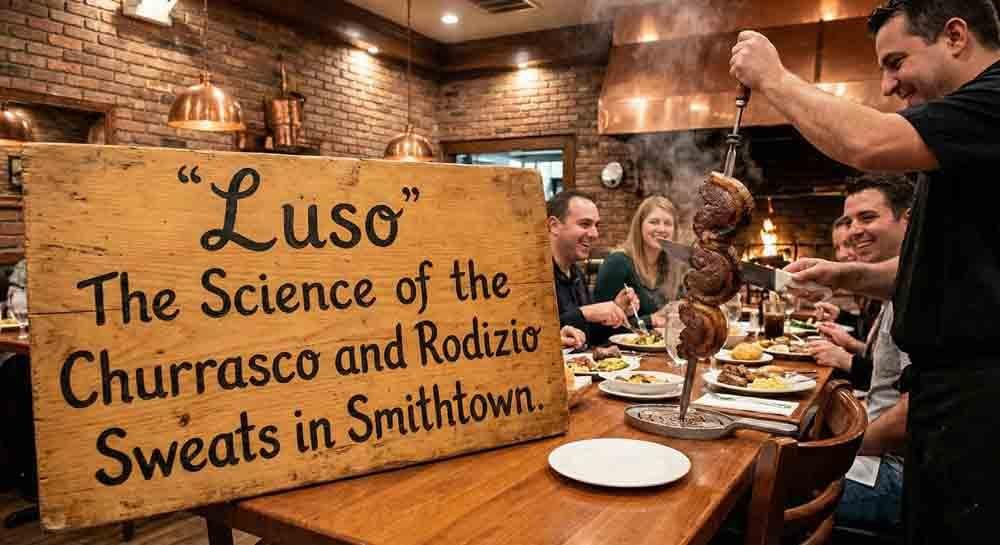
The churrasco tradition traces its lineage to the gauchos of southern Brazil — the cattlemen of Rio Grande do Sul who, centuries before the invention of the thermometer probe or the pellet smoker, understood that the quality of grilled meat begins not at the grill but at the pasture. The gaucho method is elemental: coarse salt, an open fire of natural hardwood, and cuts of beef impaled on long skewers — espetos — that are rotated by hand over glowing coals. There is no rub. There is no sauce. There is only the conversation between fire and flesh, mediated by the skill of the churrasqueiro.
At Luso, this tradition is alive. The kitchen operates with the kind of disciplined heat management that separates serious churrascarias from their imitators. When diners report that the beef arrives “rare to medium rare, perfectly cooked and packed with flavor” (Google Reviews, 2024), they are describing not luck but expertise — the result of churrasqueiros who understand that the Maillard reaction, which produces the deeply caramelized crust on properly seared meat, occurs optimally between 280°F and 330°F, a window that requires constant attention and adjustment.
The Rodízio Model: Abundance as Cultural Statement
Luso operates on the rodízio model — the all-you-can-eat Brazilian meat service that has become one of the most misunderstood dining formats in America. At lesser establishments, rodízio devolves into a volume play: mediocre cuts delivered at a pace designed to fill stomachs before quality becomes a question. At Luso, the rodízio is something different. It is an exercise in curated abundance.
The format works like this: diners receive a double-sided card or indicator — green on one side, red on the other. Green means “bring the meat.” Red means “I need a moment.” Between these two colors lies the entire drama of the rodízio experience. Servers circulate with skewers of freshly grilled proteins — multiple cuts of beef including picanha (the prized top sirloin cap), alcatra, costela, and fraldinha, alongside pork, lamb, chicken, linguiça sausage, and grilled shrimp — carving directly onto your plate tableside. The sides arrive family-style: Brazilian black beans, fragrant rice, pão de queijo (cheese bread), farofa, fried plantains, and a salad bar that functions as a palate cleanser between waves of protein.
What reviewers consistently praise at Luso is the generosity of the service. “They didn’t try and be skimpy with it,” one patron noted. “You truly ate and ate until you couldn’t” (Google Reviews, 2024). This is not accidental. In the Brazilian dining tradition, generosity is not a marketing tactic — it is a cultural imperative. The churrascaria table is a communal space, and the abundance of the rodízio is an expression of hospitality that predates the restaurant industry itself. It harkens back to the fazendas — the large estates of rural Brazil — where feeding guests lavishly was a matter of honor.
Beyond the Grill: The À La Carte Testament
While the rodízio rightfully commands attention, Luso’s à la carte menu reveals the full breadth of the kitchen’s Portuguese-Brazilian identity. The branzino — European sea bass — has emerged as something of a signature, with diners calling it “one of the best fish dishes I’ve had in the U.S.” and “absolutely heavenly” (Google Reviews, 2025). This is significant. Branzino, when handled properly, is a study in restraint: a delicate, flaky white fish that punishes heavy-handedness and rewards precision. The fact that Luso executes it at this level alongside the muscular intensity of the churrasco program speaks to a kitchen with genuine range.
The Portuguese influence surfaces in preparations that Long Islanders who have traveled to Lisbon or the Algarve will recognize immediately — the seafood-forward dishes, the careful use of olive oil and garlic, the understanding that simplicity in Portuguese cooking is not a deficit but a declaration. Portugal’s culinary tradition, shaped by centuries of maritime trade, is one of the most underappreciated in Europe, and restaurants like Luso serve as cultural ambassadors on Long Island’s North Shore corridor.
The Smithtown Context: Why Location Matters
Smithtown occupies a particular position in Suffolk County’s culinary geography. It sits at the intersection of the North Shore’s historic village culture and the broader suburban dining economy that defines much of central Long Island. West Main Street, where Luso resides, has historically been a corridor of independent businesses — the kind of street where proprietors know their regulars by name and the dining experience is shaped by personality rather than corporate playbook.
For those of us who have spent decades in the Long Island restaurant trade — and twenty-five years behind the counter at The Heritage Diner in Mount Sinai has taught me more about the sociology of dining than any textbook could — the survival and success of a restaurant like Luso is instructive. It tells you something about what this community values. Smithtown diners are not naive. They have access to Manhattan. They have access to every delivery app and franchise operation on the planet. When they choose, repeatedly, to fill a 1,200-plus-review restaurant that serves salt-crusted beef carved tableside from a skewer, they are making a statement about what they believe dining should be: experiential, communal, rooted in tradition.
This is the same principle that animates every serious craft enterprise on Long Island. Whether it is the hand-stitching of an English bridle leather briefcase at Marcellino NY or the seasoning of a cast-iron flat-top at Heritage, the thread is identical: when you commit to a process that cannot be automated or abbreviated, the market eventually finds you. Luso has been found.
The Experience: What to Expect
Luso operates Tuesday through Sunday, with Monday reserved as a day of rest — a tradition that anyone in the hospitality industry respects. The schedule reflects a kitchen that takes preparation seriously: Tuesday through Thursday service runs from 4:00 PM to 9:30 PM, Friday opens earlier at 3:00 PM and extends to 10:00 PM, Saturday spans a full day from noon to 10:30 PM, and Sunday rounds out the week from noon to 9:00 PM. The price point sits in the moderate range — remarkable given the quality and volume of protein involved in the rodízio format.
The atmosphere is family-friendly without being chaotic, warm without being cloying. Multiple reviewers describe the staff as attentive and the service as “on point” (Google Reviews, 2024). The restaurant also operates catering services and offers takeout and delivery for those occasions when the rodízio must come to you rather than the other way around.
A few practical notes for first-time visitors: arrive hungry. The rodízio is not a format that rewards tentative appetites. Pace yourself through the sides — the black beans and rice are excellent, but they are supporting actors, not the headliners. And if you are the kind of diner who prefers your beef cooked beyond medium, understand that churrascaria tradition favors rare to medium-rare preparations. This is not stubbornness; it is science. The intramuscular fat in cuts like picanha renders optimally at lower internal temperatures, producing the juiciness and tenderness that define the churrasco experience. Luso’s kitchen knows this, and they cook accordingly.
A Living Tradition on Long Island’s Table
What Luso represents on West Main Street in Smithtown is something larger than a single restaurant. It is evidence that Long Island’s dining culture, when given room to breathe, produces establishments of genuine distinction — places where culinary traditions that have been refined over centuries find new audiences without losing their essential character.
The Portuguese and Brazilian communities have been part of Long Island’s fabric for generations, and their culinary contributions — from the fish markets of the South Shore to the churrascarias of Suffolk County — have enriched this island’s table in ways that deserve far more recognition than they typically receive. Luso stands as one of the finest examples of this contribution: a restaurant that honors its heritage, respects its ingredients, and delivers an experience that, at its best, reminds you why we sit down to eat together in the first place.
In an age of algorithmic recommendation and frictionless delivery, there is something deeply satisfying about a restaurant that still operates on the oldest algorithm of all: build a fire, season the meat, and feed the people who show up. Luso does exactly this, and Smithtown is better for it.
Luso Restaurant Address: 133 West Main Street, Smithtown, NY 11787 Hours: Tuesday–Thursday 4:00–9:30 PM | Friday 3:00–10:00 PM | Saturday 12:00–10:30 PM | Sunday 12:00–9:00 PM | Monday: Closed Cuisine: Portuguese & Brazilian | Churrascaria | Rodízio | Seafood Price Range: Moderate ($$) Rating: 4.5 stars (1,200+ reviews) Services: Dine-in, Takeout, Delivery, Catering DoorDash: Order on DoorDash Website: lusorestaurant.com
Written for the Heritage Diner Blog — heritagediner.com/blog Peter from the Heritage Diner | Mount Sinai, NY