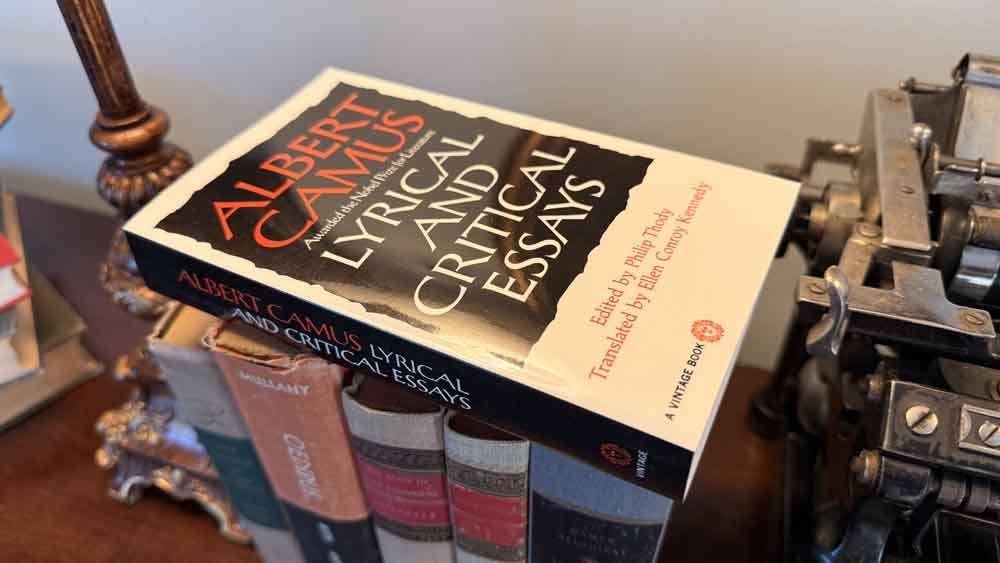
Few writers have made the tension between ecstasy and despair feel so livable. Albert Camus — Algerian-born, Nobel Prize-winning, dead at forty-six in a car crash on a French road — spent his entire literary life refusing to resolve that tension, and Lyrical and Critical Essays, a posthumous collection assembled from his early lyric essays and later critical writings, is perhaps the most intimate record of why. It collects works from The Wrong Side and the Right Side (1937), Nuptials (1939), and Summer (1954), alongside a gathering of prefaces, reviews, and literary criticism. What emerges is not a theory but a sensibility — one so precisely drawn that it reads less like an essay collection and more like a long, honest conversation with a man who is still working things out.
That is its greatest gift. And its most instructive lesson.
The Algerian Sun as Philosophical Argument
Before Camus became the writer of The Stranger and The Plague, before Paris claimed him and existentialism tried to draft him, he was a young man from Belcourt, a working-class neighborhood in Algiers, pressing his body against the hot stones of the Mediterranean shore and finding in that physical act something close to religious experience. Nuptials, written at twenty-six, is the record of that finding. In the title essay he writes about Tipasa, an ancient Roman ruin on the Algerian coast, and what he discovers there is not history or philosophy but presence — the overwhelming, indifferent, gorgeous fact of being alive in a body under a burning sky.
He described the sensation as a “nuptial” — a marriage between man and the world that requires no God, no afterlife, no narrative of progress. The world simply is, radiant and without mercy, and the appropriate response is not prayer but full attention. “I do not want to believe in death,” he wrote in that early period, “though I carry its seeds within me.” It is a young man’s statement, headlong and brave, but it contains the entire architecture of everything that came after.
What makes these early lyric essays extraordinary is their refusal to treat beauty as decoration. For Camus, the Algerian sun was not a backdrop. It was the argument itself. The warmth on your skin, the smell of absinth and salt water, the particular quality of afternoon light on white stone — these were not distractions from serious thinking but the very substance of it. You cannot think honestly about mortality if you have never let the fact of being alive wash over you without immediately reaching for a concept to contain it.
That discipline — staying in the sensation long enough to learn something true — is rarer than it sounds.
The Wrong Side and the Right Side: Poverty Without Romance
The opening section of the collection, drawn from his first published work, is harder going and more emotionally exposed. Camus wrote The Wrong Side and the Right Side while living in genuine poverty, watching his mother — deaf, nearly mute, worn thin by domestic labor — move through their small apartment as though the world had already half-forgotten her. He did not romanticize any of it. The essays in this section look directly at old age, silence, and the slow indignities of a life without comfort, and they refuse both sentimentality and despair.
In the preface he wrote for a later edition, Camus described these early pages as the source of everything he ever did. “I know that my source is in The Wrong Side and the Right Side,” he wrote, “in that world of poverty and light in which I long lived, whose memory still saves me from two opposite dangers that threaten every artist: resentment and self-satisfaction.” That sentence alone is worth keeping. Resentment and self-satisfaction — the twin poisons of the creative life. The discipline of remembering where you actually came from, not as trauma to be processed but as a living anchor to what is real.
His mother appears throughout these early pages without ever being fully described. She is more presence than portrait — a woman who endured, who said almost nothing, who kept her inner life so concealed that her own son could not be certain what she felt. Camus did not explain her. He simply rendered her with the same full attention he gave the Algerian coastline, and the effect is devastating in the quietest possible way.
Absurdism as a Love Affair, Not a Diagnosis
One of the persistent misreadings of Camus is to treat the absurd as a condition to be cured — something close to clinical despair that his philosophy nobly overcomes. Lyrical and Critical Essays makes clear that this reading is exactly backwards. The absurd, for Camus, was not a problem. It was a relationship.
He defined it in The Myth of Sisyphus as the confrontation between the human hunger for clarity and the world’s absolute silence in response. But in these lyric essays, that confrontation is not grim. It is erotic. The world’s refusal to give meaning is also what makes beauty so fierce, what makes the present moment so irreplaceable, what makes the warmth of a particular afternoon in Algiers something that cannot be improved upon by any amount of philosophical progress. You cannot have the radiance without the silence behind it.
This is what separates Camus from the existentialists with whom he is so often grouped. Sartre found the world’s indifference nauseating. Camus found it clarifying. He wrote of Tipasa: “Here I understand what is called glory: the right to love without measure.” That sentence has the structure of a philosophical claim and the temperature of a lyric poem. He was doing both things simultaneously, and insisting that you could not properly do either without the other.
The Critical Essays: Honesty as an Aesthetic Standard
The second half of the collection gathers Camus’s literary criticism, and here the sensibility shifts register without shifting values. He writes about Brice Parain’s philosophy of language with the same attentiveness he brought to the Algerian coast. He writes about René Char, whose compressed, oracular poetry he admired and championed through decades of Paris literary fashion. He writes about his own artistic development with a frankness that is unusual in the genre — no performance of humility, no strategic self-deprecation, just an honest accounting of where he thought he had succeeded and where he thought he had failed.
The critical essays share one consistent standard: honesty. Not factual accuracy, though that matters too, but emotional honesty — the refusal to strike an attitude, to perform profundity, to substitute a borrowed philosophical framework for genuine engagement with the thing in front of you. He admired writers who looked directly at their subject. He was suspicious of abstraction that floated free of sensory reality. He distrusted literature that taught you how to feel before it showed you what it saw.
That standard is worth borrowing. It applies far beyond literary criticism.
What the Silence of His Mother Taught Him
Return, for a moment, to the figure of his mother. She moves through The Wrong Side and the Right Side as a kind of negative space — all the meaning that cannot be said, all the inner life that has no channel for expression. Camus does not pity her. He watches her with something closer to awe, and what he takes from her, I think, is this: that a person can carry an entire world inside them and never articulate it, and that this is neither failure nor waste. The interior life is not diminished by silence. It is sometimes deepened by it.
This is a strange lesson for a writer to have absorbed from his most formative relationship. And yet it explains something essential about Camus’s prose — the restraint, the refusal to explain too much, the willingness to let a scene or an image carry more weight than any amount of commentary could. He learned to trust the image. He learned that the reader’s silence in the face of a precisely rendered moment is worth more than their nodding agreement with a perfectly articulated idea.
The Mediterranean Against the Northern Dark
There is a geographical argument running through all of Camus’s work, and it surfaces explicitly in several of these essays. He was suspicious of what he called the “northern” tradition in European thought — the tendency toward abstraction, system-building, the sacrifice of lived experience on the altar of historical necessity. He associated this tendency with Hegel, with German idealism, with eventually and most dangerously with the totalitarianisms of the twentieth century, which required men to submit their actual lives to the logic of some imagined future.
Against this, he placed the Mediterranean — not as a geographical fact but as a moral posture. To be Mediterranean, in Camus’s sense, was to insist on the priority of the body, the present moment, the particular human life, the warmth of noon. It was to refuse the seduction of any system that required you to stop looking at the man in front of you and start seeing instead the representative of a historical category. This is not a comfortable position in any intellectual climate. It requires you to be suspicious of your own most attractive ideas, to keep returning to the specific, the sensory, the stubbornly individual.
It is, in that sense, a discipline not unlike what you find in any craft practiced over time — the insistence that the material in your hands matters more than the theory of what you are making.
You Might Also Like
If the philosophical texture of Camus speaks to something in you, the blog has explored similar territory in Thus Spoke Zarathustra by Friedrich Nietzsche: The Book That Rewired My Understanding of Everything — another writer who insisted that ideas must be lived, not merely argued. And for a meditation on presence, mortality, and the unexpected weight of beautiful things, the piece on The Fermi Paradox and the Great Filter takes the silence of the cosmos and asks what we owe it.
A Book That Does Not Resolve
Lyrical and Critical Essays does not end with answers. It ends — as Camus’s life ended, abruptly, mid-sentence in some sense — with the feeling that the questions were the point all along. Not as a philosophical trick, not as a gesture of fashionable uncertainty, but because the questions themselves, held with enough honesty and enough bodily presence, are the form that meaning takes in a life that refuses to wait for a better world before it begins to live in this one.
He wrote, in the late essay “Return to Tipasa,” of going back to those ruins after years of war and occupation and Paris winters, and finding the sun still there, the sea still indifferent, the light still capable of the same annihilating beauty. Nothing had been resolved. Everything had survived.
That, in the end, is what Camus was arguing for — not a system, not a program, not a philosophy to be adopted, but a quality of attention. The capacity to stand in front of the world without flinching, without reaching immediately for an explanation, and to let what is beautiful be beautiful and what is tragic be tragic, and to keep looking.
It is the hardest discipline of all. And the most necessary.
Lyrical and Critical Essays by Albert Camus, translated by Ellen Conroy Kennedy, is available from Vintage Books.
Sources
- Camus, Albert. Lyrical and Critical Essays. Translated by Ellen Conroy Kennedy. Vintage Books, 1970. Penguin Random House
- Lottman, Herbert R. Albert Camus: A Biography. Doubleday, 1979.
- Todd, Olivier. Albert Camus: A Life. Translated by Benjamin Ivry. Knopf, 1997.
- Foley, John. Albert Camus: From the Absurd to Revolt. McGill-Queen’s University Press, 2008. Publisher link
- The Nobel Prize. “Albert Camus — Biographical.” nobelprize.org