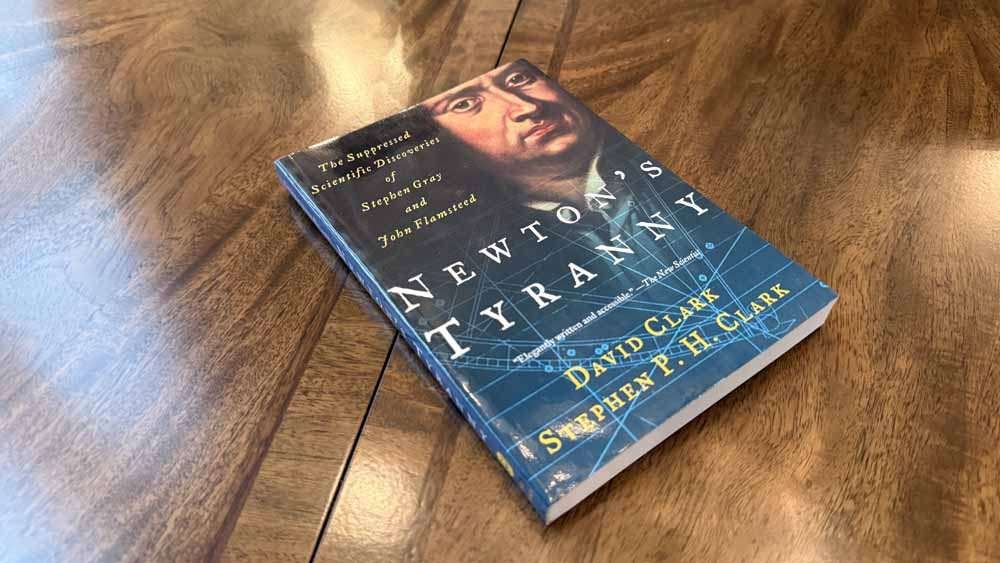
David H. Clark and Stephen P.H. Clark — W.H. Freeman & Co., 2001
Most of us learned about Isaac Newton the same way: the apple, the calculus, the Principia Mathematica, the genius who cracked the code of the physical universe. He is held up as the gold standard of what a scientist can be — singular, disciplined, almost otherworldly in intellect. What we are rarely told is what he was like as a colleague. What he did when someone else’s work threatened his standing, or when a rival — real or imagined — had access to data he wanted. Newton’s Tyranny, written by physicist David H. Clark and his son Stephen P.H. Clark, answers that question in careful, documented detail. The portrait is not flattering.
The book follows two men whose careers collided with Newton’s ego: John Flamsteed, the first Astronomer Royal of England, and Stephen Gray, a dyer by trade and a self-taught experimenter who became one of the quiet pioneers of electrical science. Neither man came from Newton’s world of institutional prestige. Flamsteed was a meticulous observer who spent decades building the most accurate star catalog ever assembled, work that required grinding patience and obsessive precision. Gray was poorer still — a craftsman-scientist who lacked formal credentials but whose curiosity and hands-on ingenuity led him to discoveries that should have made him famous. Together, they form a kind of counternarrative to the triumphalist version of scientific history we usually get.
The Astronomer Royal and the Man Who Wanted His Data
Flamsteed’s conflict with Newton is the more documented of the two, and the Clarks reconstruct it using actual correspondence — letters that reveal a Newton very different from the marble bust in the textbook. Newton needed Flamsteed’s star data to verify his lunar theory, and when Flamsteed was slow to provide it — protective of his work-in-progress, unwilling to release incomplete observations — Newton’s response was not patience or professional courtesy. He went around Flamsteed entirely, arranging through the influence of Edmond Halley to have the catalog published without Flamsteed’s consent, in a form Flamsteed considered riddled with errors and premature. Flamsteed called it theft. The historical record is difficult to argue with.
What makes this more than a personal squabble is what it reveals about how power operates inside institutions. Newton at this point was President of the Royal Society, the most politically powerful position in English science. He had leverage, connections, and the credibility to make anyone who crossed him look like an impediment to progress rather than a victim of it. Flamsteed had his integrity and his telescope. The asymmetry was brutal. When I read about Flamsteed fighting for decades to maintain ownership of observations he had personally funded, personally made, and personally catalogued, it calls to mind something I’ve encountered across multiple domains: the person who does the foundational work is rarely the one who gets to define how that work is used.
The Clarks are careful not to write this as a simple villain story. They acknowledge Newton’s intellectual stature and never suggest that his science was fraudulent. The critique is narrower and, because of that, more damning — that a man of such verified genius was simultaneously capable of sustained, calculated cruelty toward lesser-known peers. That the same mind that understood gravity could not extend basic professional decency to a man who had given his life to the sky.
The Dyer Who Preceded Franklin
Stephen Gray’s story is less well known and, in some ways, more troubling. Gray demonstrated that electricity could be transmitted over distance — an observation that predates Benjamin Franklin’s famous experiments and effectively launched the science of electrical communication. He did this not in a well-funded laboratory but with hemp string, gunpowder flasks, and the kind of improvised ingenuity that characterizes people who solve problems because they have no other resources. His work was eventually recognized by the Royal Society, though late and grudgingly — and the Clarks make a credible case that Newton’s antipathy toward Gray, rooted partly in class disdain and partly in the territorial instincts of a man who liked to control the boundaries of legitimate inquiry, kept Gray on the margins longer than his discoveries warranted.
Gray’s position in this book resonates beyond science. He is the craftsman-intellect, the outsider whose rigor exceeds that of the gatekeepers but who lacks the credentials they require to take him seriously. He didn’t have a fellowship. He didn’t have a patron. He had a workbench and a mind, and in the early eighteenth century, that combination was only as good as whoever controlled the institution decided it was. Newton controlled the institution.
This connects to something worth sitting with: the history of science is not simply a history of ideas. It is a history of power — who gets to publish, who gets credited, whose work gets replicated, whose gets buried. The Clarks don’t editorialize excessively on this point; they largely let the primary sources do the work. But the pattern they document — Newton suppressing, delaying, or misattributing work that inconvenienced him — is not merely a historical curiosity. It is a structural argument about what happens when genius and institutional authority land in the same pair of hands without adequate checks on either.
Flawed Genius as a Category
There is a tendency, when reading books like this, to conclude that Newton was simply a bad person — to subtract the monster from the myth and be left with a smaller, meaner figure. The Clarks resist that reduction, and they’re right to. The more uncomfortable conclusion is that Newton was exactly what the record shows him to be: a towering intellect and a deeply difficult human being, and that neither fact cancels the other out.
This is a harder thing to hold. We prefer our geniuses to be symmetrically excellent, as though mastery in one domain should confer decency in all others. Newton is a useful corrective to that assumption. The same ferocity of focus that allowed him to sit with a problem until it cracked — the near-pathological concentration that produced the Principia — appears to have made him equally relentless when it came to protecting his reputation and destroying rivals. The traits were not separate. They were the same trait aimed in different directions.
What the Book Gets Right — and What It Doesn’t
The Clarks are strongest when they are closest to the primary sources. The reconstructed letters, the accounts of specific disputes, the documentation of Halley’s role in the unauthorized publication of Flamsteed’s catalog — these sections are genuinely absorbing. The father-and-son co-authorship produces prose that is clean and readable, though occasionally dry in a way that keeps the book from achieving the narrative propulsion of, say, Dava Sobel’s Longitude, a comparison the publisher’s blurb invites and that the book does not quite earn.
There is also a structural asymmetry: Flamsteed’s story gets considerably more space and depth than Gray’s, and the Gray sections occasionally feel like a second act that was assembled from thinner documentation. The Clarks acknowledge working from limited sources on Gray, but the imbalance is noticeable. Gray deserved a fuller treatment, and his absence of surviving correspondence — a consequence, in part, of the same obscurity this book is trying to correct — is a real limitation.
These are criticisms of execution, not premise. The premise is sound and the scholarship is credible. Newton’s Tyranny is the kind of book that rewards anyone who came up through a scientific education believing that the pursuit of truth was somehow self-purifying — that genius, by its nature, elevated the people who possessed it. Newton is a reminder that intelligence is morally neutral. It goes where the ego points it. That might be the most important lesson here, and it is one that applies far beyond the early Royal Society.
Sources
- Clark, David H. and Clark, Stephen P.H. Newton’s Tyranny: The Suppressed Scientific Discoveries of Stephen Gray and John Flamsteed. W.H. Freeman & Co., 2001. Amazon
- Flamsteed, John. Historia Coelestis Britannica (1725). Background context via Stanford Libraries catalog: searchworks.stanford.edu
- Sobel, Dava. Longitude. Walker & Company, 1995.
- Rees, Martin (blurb). Sir Martin Rees, Astronomer Royal — quoted in publisher materials, W.H. Freeman & Co.
- Goodreads reader reviews and editorial commentary: goodreads.com/book/show/230736