5032 Jericho Turnpike, Commack, NY 11725
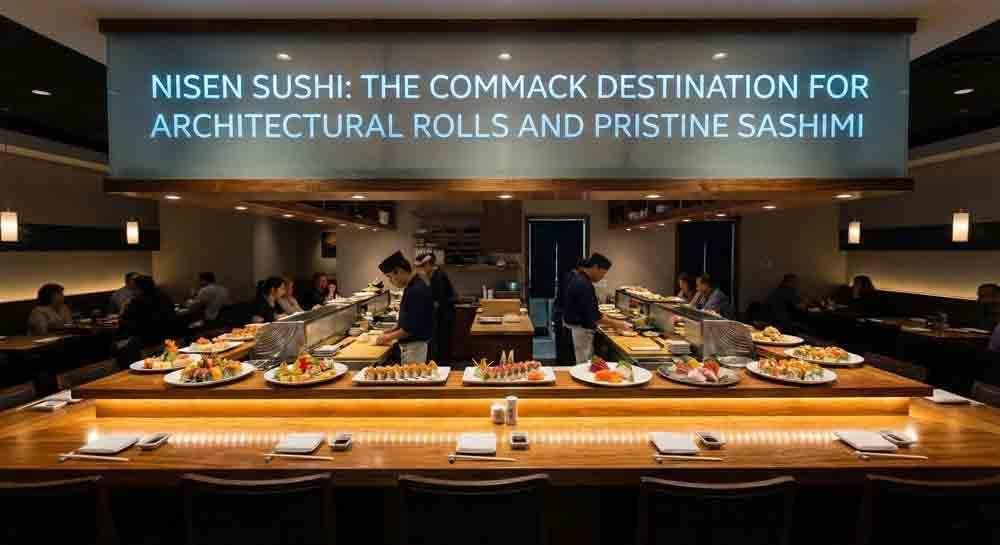
There is a particular quality of light inside Nisen Sushi that announces, before a single piece of fish touches your lips, that you have entered a space designed with the same intentionality as the cuisine it houses. The glow is warm but deliberate, filtered through a layered ceiling of floating zebra wood panels, casting soft geometries across walls of smooth and rough-cut blackstone. This is not the fluorescent democracy of a strip-mall sushi joint. This is architecture in service of appetite—an environment conceived by Doug Horst of Horst Design International to embody what he has called the Japanese aesthetic of “less is more” (Visual Merchandising and Store Design, 2021). And within that space, for a quarter of a century, Chef Tom Lam and co-founder Robert Beer have been quietly revolutionizing the way Long Island thinks about raw fish, cooked protein, and the entire theater of Japanese dining. Opened in August 2000—the same year, incidentally, that The Heritage Diner was settling into its own rhythm on Route 25A—Nisen has endured economic downturns, pandemic shutdowns, and the relentless churn of Long Island’s restaurant scene not by playing it safe, but by refusing to stand still.
The Origin: From Manhattan’s Meatpacking District to Jericho Turnpike
Every great restaurant has a creation myth, and Nisen’s begins not on Long Island but in the industrial grit of Manhattan’s Meatpacking District, back when that neighborhood still smelled more of rendering plants than Michelin-starred prix fixe menus. Tom Lam started as a sushi helper at Suibi Japanese Restaurant, one of the district’s early fine-dining pioneers. Under the tutelage of five master chefs specializing in traditional and modern Japanese technique, Lam spent nearly a decade absorbing the foundational discipline of the craft—the wrist angle of the knife cut, the precise vinegar ratio in shari rice, the near-spiritual attention to temperature and timing that separates competent sushi from transcendent sushi (NisenSushi.com, 2025). By 1998, Lam had ascended to Executive Chef at Oyama Modern Japanese Restaurant in Great Neck, a suburb that served as a proving ground for his ambitions. Two years later, he and business partner Robert Beer took the leap, opening the original Nisen in East Northport before relocating to its current home on Jericho Turnpike in Commack in 2003 (Long Islander News, 2016). That move proved prescient. Situated at the corner of Larkfield Road and Jericho Turnpike—across from the AMC Huntington Square 12 and adjacent to a bustling retail corridor—Nisen found the foot traffic, the parking, and the demographic sweet spot that would sustain its growth for two decades and counting.
The Interior: Where Horst Design Meets the Philosophy of Ma
Anyone who has spent time studying Japanese aesthetics understands the concept of ma—the purposeful use of negative space that gives form its meaning. The interior of Nisen Sushi is a masterclass in this principle, translated into a 6,000-square-foot American restaurant without losing its spiritual essence. Horst Design International, the firm behind both the Commack and the former Woodbury locations, executed a transformation that industry publications have documented in detail: fabric-covered arches five feet wide usher guests from a spa-like reception area into a lounge and bar where wavy gypsum panels evoke the movement of the sea (Visual Merchandising and Store Design, 2021). In the main dining room, uplights dramatize the contrasts between polished and raw stone, while those signature zebra wood ceiling panels define distinct dining zones and, critically, deaden sound—a practical luxury that any restaurateur who has battled acoustics will appreciate. Private and semi-private rooms accommodate groups of ten to fifty, with customizable lighting configurations that shift the mood from corporate dinner to celebration with the adjustment of a dial. There is outdoor patio seating for warmer months, full wheelchair accessibility, and a bar area that transforms, as evening deepens, from a pre-dinner cocktail destination into something closer to a lounge scene—complete with DJ sets on weekends and live music on Friday nights.
The Menu: Where Tsukiji Market Meets Long Island Audacity
The defining characteristic of Nisen’s kitchen is its refusal to choose between tradition and innovation. Weekly specials feature fish flown directly from Tokyo’s legendary Tsukiji market—the same wholesale hub that supplied Jiro Ono’s three-Michelin-star Sukiyabashi Jiro and that food critic Masuhiro Yamamoto has called the beating heart of global sushi culture (The New York Times, Zagat). This is not a marketing flourish. It is a supply chain commitment that connects a shopping center on Jericho Turnpike to the most exacting seafood distribution network on Earth. The sashimi platters reflect this sourcing discipline: buttery cuts of yellowtail, king salmon, bluefin toro, sweet shrimp, and California uni arrive pristine, presented on ice with the kind of sculptural attention that makes you pause before eating. Richard Scholem, writing for The New York Times, singled out the inventive special rolls and the Tsukiji-sourced weekly fish as the restaurant’s headline attractions, awarding Nisen the coveted “Excellent” rating. Zagat was equally emphatic in its praise, and across platforms the sentiment holds: 4.5 stars from 561 OpenTable diners, 4.3 on TripAdvisor, and consistent acclaim across 337 Yelp reviews.
But Nisen’s genius lies in what happens beyond the traditional. The Crispy Rice Spicy Tuna appetizer layers jalapeño, black caviar, and spicy cream aioli over a base of flash-fried rice that shatters on contact—a study in textural contrast. The White Tuna Truffle pairs lightly seared fish with actual truffle peelings and yuzu soy, producing what Long Islander News described as a bold, almost barbecue-like depth balanced by Japanese mountain plum and cucumber (Long Islander News, 2016). The entrée menu ventures confidently into New American territory: blackened Cajun Chilean sea bass with wasabi aioli, rack of lamb with butter teriyaki, Kobe beef meatballs kissed with wasabi and teriyaki glaze. For the health-conscious and the adventurous alike, Naruto rolls replace rice entirely with cucumber wrapping, and options for brown rice, black rice, and soy paper ensure that dietary specificity never means flavor compromise. The lunch specials—including a sushi assortment with chef-selected nigiri—remain one of the best-value fine-dining experiences on Long Island’s central corridor.
The Catering Empire and the Country Club Circuit
A restaurant’s influence can be measured not only by the guests it seats but by the occasions it elevates beyond its own walls. Nisen Catering has become a fixture of Long Island’s most prestigious private events, with a client roster that reads like a social register of the Gold Coast and beyond: Sebonack Club, Piping Rock Club, Meadow Brook Club, Cold Spring Country Club, The Hamlet Golf & Country Club, Raphael Vineyard, and Fox Hollow (NisenCatering.com, 2025). The catering operation’s innovation lies in its logistics. Sushi stations are prepared entirely in Nisen’s restaurant kitchen, then enclosed in custom chilled, see-through containers and transported directly to the event site. This eliminates the on-location prep that typically compromises freshness and presentation quality at catered affairs—a solution that reflects the same engineering mindset that, in my own world at Marcellino NY, insists that a briefcase’s internal structure be as considered as its visible exterior. The result is sushi that arrives at a Hamptons golf outing or a North Shore vineyard wedding with the same precision it would have at the Commack bar. The brand’s expansion also includes sushi-making classes—beginner through advanced—where participants work alongside professional chefs, learning rice seasoning, fish breakdown, plating technique, and sake pairing. It is experiential dining as education, and it reinforces the philosophy that great food is not merely consumed but understood.
The Culture: Nightlife, Happy Hour, and the Third Place
One of the reasons Nisen has thrived for twenty-five years while so many Long Island restaurants have cycled through identities and ownership is that it understood, early, the concept of the “third place”—the social anchor that is neither home nor office. Between five and seven o’clock every evening, the bar becomes a decompression chamber for the Jericho Turnpike corridor’s professional class: half-price appetizers, drink specials, and the particular relief of sliding into a seat where the lighting flatters and the cocktail menu includes a Lychee Martini that balances sweet and floral notes with surgical accuracy, alongside a Tokyo Mule spiked with ginger and yuzu. The sake selection spans Junmai, Ginjo, Dai Ginjo, and Nigori varieties, complemented by a full bar offering Japanese whiskies and an intelligently curated wine list—one so familiar to regulars that, as one TripAdvisor reviewer noted, the staff once ordered an entire case of a particular wine simply to have it on hand for a returning couple. As the evening deepens past the dinner hours, particularly on Fridays and Saturdays, Nisen shifts register. The DJ takes over. The bar scene intensifies. The energy pivots from contemplative dining to something more electric—a phenomenon that has made Nisen a dual-purpose destination for the date-night-to-nightlife demographic that sustains Long Island’s most durable hospitality brands.
The Legacy: Twenty-Five Years and the Discipline of Reinvention
In the restaurant industry, survival past five years is an achievement. Survival past ten is rare. A quarter-century of continuous operation, with critical acclaim intact and customer loyalty deepening, belongs to a different category entirely—one that demands not just consistency but perpetual reinvention. Tom Lam has described his philosophy in characteristically understated terms: “We are very different. I keep finding something new and exciting. You never know if it’s a success or not, but you always keep trying” (Long Islander News, 2016). That willingness to experiment within a framework of uncompromising quality is the throughline connecting Nisen’s Tsukiji-sourced omakase experiences to its Kobe beef sliders, its traditional nigiri to its truffle-oil-drizzled architectural rolls. It is the same philosophy that has kept The Heritage Diner relevant on Route 25A for twenty-five years, and it is the philosophy that, in my experience, separates institutions from establishments. The Nisen brand expanded at its peak to include additional locations—Nisen 110, Nisen 347, and a Woodbury outpost—though the Commack flagship remains the definitive expression of the vision. The restaurant continues to serve contemporary Japanese cuisine infused with New American sensibilities, anchored by a commitment to sourcing, craftsmanship, and spatial design that elevates the act of eating from sustenance to experience.
Essential Information
Address: 5032 Jericho Turnpike, Commack, NY 11725
Telephone: (631) 462-1000
Website: nisensushi.com
Catering: nisencatering.com
Reservations: Available via OpenTable
Delivery: Available on DoorDash and Uber Eats
Online Ordering: nisensushi.orders2me.com
Instagram: @nisensushili
Hours:
- Monday: Closed
- Tuesday–Thursday: Lunch 11:30 AM–2:30 PM | Dinner 5:00–9:45 PM
- Friday: Lunch 11:30 AM–2:30 PM | Dinner 4:30–10:45 PM
- Saturday: Dinner 4:30–10:45 PM
- Sunday: Dinner 4:30–9:00 PM
Happy Hour: Daily 5:00–7:00 PM — Drink specials and half-price appetizers
Private Events: Rooms available for 10–50 guests with customizable lighting and full buffet options
Parking: Free lot at corner of Larkfield Road and Jericho Turnpike, adjacent to TJ Maxx/Skechers shopping center
Accessibility: Wheelchair accessible entrance, dining areas, and restrooms
Cuisine: Contemporary Japanese, Sushi, Sashimi, New American-influenced
Price Range: Moderate to upscale
Sushi Classes: Available for individuals and groups — inquire for pricing and scheduling
For twenty-five years, Nisen Sushi has occupied a singular position in Long Island’s dining landscape: the place where the discipline of Tokyo’s fish markets meets the creative ambition of a chef who refuses to stop evolving. In a corridor of Jericho Turnpike defined by convenience and commerce, Tom Lam and his team built something that transcends both—a destination where the architecture serves the food, the food honors its origins, and every evening carries the possibility of becoming an occasion. That is not a business model. That is a philosophy. And on Long Island, philosophies that endure for a quarter century deserve to be recognized as exactly what they are: landmarks.
Recommended Viewing:
For those interested in the deeper traditions of Japanese sushi craftsmanship that inform Nisen’s approach, David Gelb’s acclaimed documentary Jiro Dreams of Sushi remains essential viewing—a meditation on perfection, family legacy, and the spiritual dimension of working with raw fish at the highest level: