Most plays ask you to watch. No Exit makes you confess. You sit there in the dark, watching three dead strangers try to destroy each other in a locked room with no mirrors and no sleep, and somewhere around the second act you stop pitying them and start recognizing yourself. That discomfort is the point. It was always the point.
Jean-Paul Sartre wrote Huis Clos — translated variously as No Exit, In Camera, Dead End — in 1944, during the German occupation of Paris. He composed it in weeks, allegedly to give his friends acting roles. The backstory doesn’t matter much. What matters is what he put inside it: one of the most precise and unforgiving examinations of human self-deception ever staged. Three people. One room. No windows, no mirrors, no eyelids to close. And each other.
The Setup Is Deceptively Simple
Garcin is a pacifist journalist executed for cowardice — or so the women in the room insist on believing. Inès is a postal worker who destroyed everyone she touched and knows it. Estelle is a socialite who drowned her own child and cannot face it. They are, we slowly understand, not just dead. They are each other’s torturers. Hell, Sartre tells us through Garcin’s famous last line, is other people.
That line has been misread for eighty years. People take it as misanthropy, a shrug of contempt at the inconvenience of human company. It is nothing of the sort. Sartre is making a far more precise and troubling claim: that we require other people to exist as selves, and that very requirement is what makes existence so maddening. We cannot see our own faces. We cannot escape our own subjectivity. We need the gaze of others to give us shape — and the gaze of others is never under our control. Garcin needs Inès to believe he is not a coward. She will not. She cannot be made to. And without her absolution, he cannot leave the room even when the door swings open.
That is the trap. Not the locked door. The door was never the point.
Bad Faith Is the Real Subject
The philosophical engine under the play is Sartre’s concept of mauvaise foi — bad faith — developed more rigorously in Being and Nothingness, but dramatized here with a cruelty that prose philosophy rarely achieves. Bad faith is not simple dishonesty. It is the particular human trick of pretending to be a fixed thing, a noun, when existence is always and irreducibly a verb.
Garcin spent his life performing bravery because he suspected he was a coward. Estelle performed innocence because she could not tolerate what she had done. Inès is the only one with the terrifying clarity to see her own emptiness, which makes her the most dangerous person in the room. She has no illusion left to protect, so she becomes a pure instrument of destruction. They are all, in Sartre’s terms, fleeing from their freedom — from the horrifying openness of what they could have been and still chose not to be.
The play’s structural cruelty is that hell, for Sartre, is precisely the place where you have become your past. The living still have the exit of becoming. The dead are finished. Every choice has crystallized. Garcin will always be the man who ran from the border. Estelle will always be the woman who looked into the water. There is no further action possible, no revision, no tomorrow in which the self might be otherwise. They are nouns now. And nouns, Sartre believed, are what we live our whole lives pretending to be — and what we only truly become when it is too late to change anything.
What the Mirror Means
The room has no mirrors. This is not set design. Sartre understood that mirrors are how we manage the performance of selfhood — we check, adjust, rehearse the face before releasing it into the world. Without mirrors, the characters are forced to see themselves only through each other’s eyes. Estelle, vanity-sick and terrified, keeps asking Inès to tell her she is beautiful. Inès agrees, then torments her with what she actually sees. The mirror becomes a weapon. Seeing becomes domination.
There is a reading of social media in this that Sartre could not have anticipated but would have recognized instantly. We have built a civilization of mirrors — a room in which everyone is simultaneously observer and observed, performing selves for audiences who are performing selves back. The feedback loop is the same one in that small hell. We curate, we check, we adjust. And when the response we need doesn’t come, we are Garcin at the locked door: technically free to leave and constitutionally unable to.
I’ve thought about this more than once behind the counter, watching the morning crowd come in with their phones face-up on the table, glancing at screens between bites. There’s a specific restlessness there — a checking that never quite settles into satisfaction. Sartre would have something to say about it. It probably wouldn’t be flattering.
Why Bad Faith Is the Most Honest Diagnosis
The play holds up not because Sartre’s existentialism is fashionable — it isn’t, particularly — but because the psychology is airtight. We all live in some version of the room. We all have a Garcin narrative: a version of ourselves we need others to ratify, a self-concept so dependent on external confirmation that when that confirmation fails, we cannot move. We call it insecurity, anxiety, imposter syndrome, attachment wounds. Sartre called it the fundamental structure of consciousness in relation to others. The clinical vocabulary has changed. The condition hasn’t.
What Sartre demands of us, in No Exit and in all his serious work, is what he called authenticity — not positivity, not self-acceptance in the therapeutic sense, but a radical and unflinching ownership of our freedom and our choices. To say: I did this. I chose this. I am not a fixed type or a victim of circumstance. I am the sum of my actions, and I can always act otherwise. It is the hardest thing he asks. The characters in the play cannot do it. That is why they are in hell.
The door opens for a moment. They could walk out. They stay.
The Translation Question
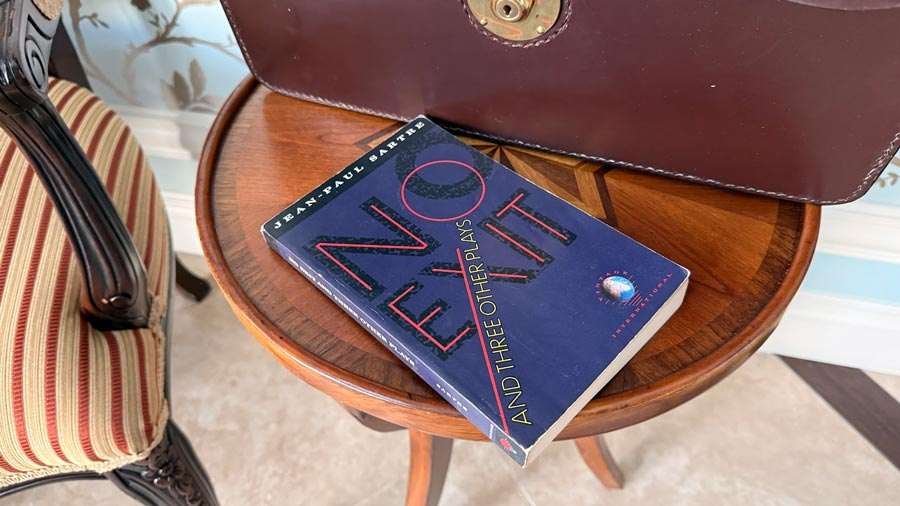
The English translation matters more than it usually does for drama. The Maria Jolas and Justin O’Brien translations served the mid-century reader. The Stuart Gilbert version, widely available, is serviceable. For a contemporary reader, the Vintage Books edition that pairs No Exit with The Flies, Dirty Hands, and The Respectful Prostitute is the most useful, giving the play its proper context within Sartre’s broader political theater. Read it as part of that collection and the philosophical stakes become clearer. Read it alone and it plays almost as a psychological horror story, which it also is.
The text itself runs barely sixty pages. It asks for a long afternoon, a quiet room, and the willingness to sit with what it stirs up.
A Play Worth Returning To
Sartre was thirty-eight when he wrote this. It reads like the work of someone who had spent a long time watching people — really watching, with the kind of attention that makes subjects uncomfortable. The insight into how we use each other as mirrors, how we need each other for the story of ourselves, how the gaze can be both sustenance and prison — none of it has dated. If anything, the digital age has given No Exit a second life it didn’t need but absolutely deserves.
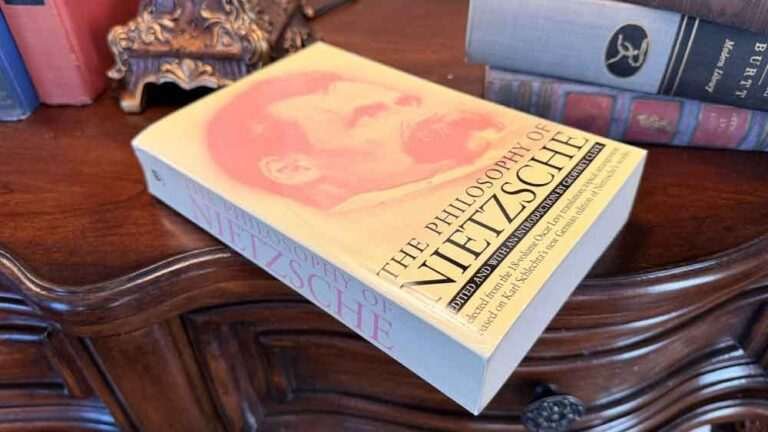
If you’ve read my review of Thus Spoke Zarathustra — Nietzsche’s call to become what you are — No Exit reads almost as the warning label. Sartre shows you what happens when you never answer that call. It’s not fire and brimstone. It’s a beige room in Paris with two people who will not give you what you need, for eternity.
Start there and see if you can put it down.
You Might Also Like:
- The God Delusion by Richard Dawkins — A Review
- The Boltzmann Brain Paradox: When Statistical Physics Predicts You Shouldn’t Exist
Sources
- Sartre, Jean-Paul. No Exit and Three Other Plays. Vintage Books, 1989. https://www.penguinrandomhouse.com/books/5760/no-exit-and-three-other-plays-by-jean-paul-sartre/
- Sartre, Jean-Paul. Being and Nothingness. Washington Square Press, 1984. https://www.simonandschuster.com/books/Being-and-Nothingness/Jean-Paul-Sartre/9780671867805
- Flynn, Thomas R. “Jean-Paul Sartre.” Stanford Encyclopedia of Philosophy, 2023. https://plato.stanford.edu/entries/sartre/
- Morris, Katherine J. “Bad Faith.” Oxford Bibliographies in Philosophy, 2020. https://www.oxfordbibliographies.com/display/document/obo-9780195396577/obo-9780195396577-0379.xml
- Hayman, Ronald. Sartre: A Life. Simon & Schuster, 1987.