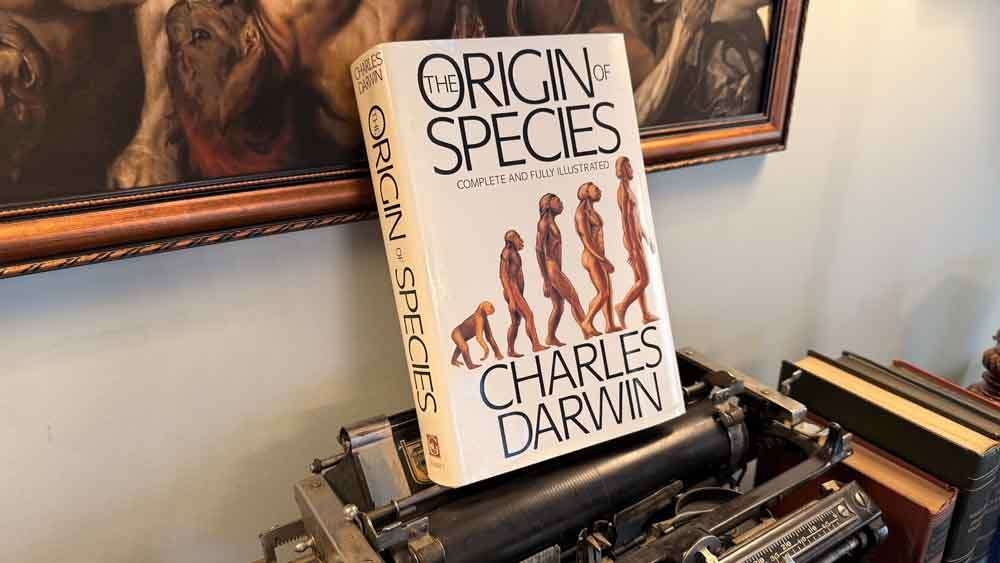
Darwin did not set out to destroy God. He set out to explain pigeons.
That is the part of the story most people miss — the painstaking, obsessive, decades-long accumulation of evidence: barnacle dissections, pigeon breeding experiments, letters exchanged with botanists across four continents, notebooks filled with the kind of quiet certainty that only a man who has seen something irrefutable can sustain. When On the Origin of Species was finally published on November 24, 1859, all 1,250 first-edition copies sold out the same day. The world was not ready. The world also could not look away.
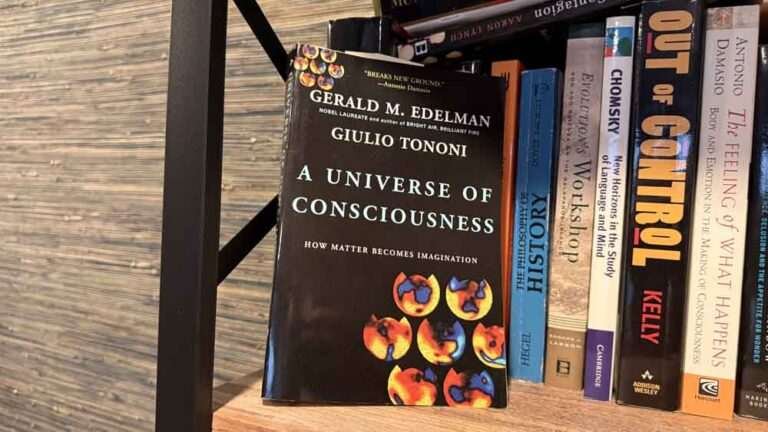
Reading it now — more than 165 years later — the book does not feel like a relic. It feels like a reckoning. I came to it after finishing Richard Dawkins’ The Selfish Gene, which had already rewired much of how I understood biology, behavior, and the long, indifferent engine of heredity. If Dawkins was the translation, Darwin was the original manuscript. And once I closed it, I did something I had never done after reading a book: I drove to the American Museum of Natural History in New York City to stand inside the Hall of Human Origins and simply look. I had been there many times before. But after Darwin, it felt like a different place entirely — less like a museum and more like a cathedral, a place where you finally understand the sermon being preached.
What Darwin Actually Argued (And Why It Still Gets Misunderstood)
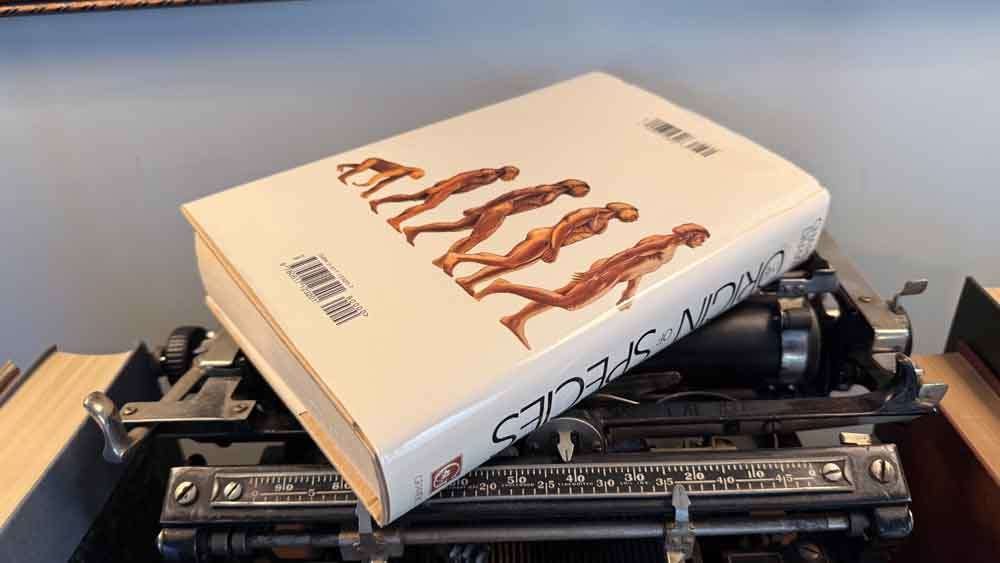
The full title — On the Origin of Species by Means of Natural Selection, or the Preservation of Favoured Races in the Struggle for Life — already contains the argument in compressed form. Darwin proposed that all species of life have descended from common ancestors through a process he called natural selection: heritable variations arise within populations, and those variations that confer an advantage in survival or reproduction are passed on at higher rates over successive generations. Given enough time, this produces not just variation within a species but entirely new species.
What Darwin did not have — and what haunted him — was a mechanism for how traits were inherited. That would come later, through the rediscovery of Gregor Mendel’s work on genetics and, eventually, the discovery of DNA’s double helix structure by Watson and Crick in 1953. Darwin worked with the observable fact of inheritance without knowing its machinery. That he built so coherent and durable a theory on that foundation is itself a testament to the power of rigorous observation.

The common misreading is that Darwin argued life moves toward something — toward complexity, toward intelligence, toward humanity as a crown. He argued nothing of the sort. Natural selection has no foresight, no goal, no preference. It is, as the biologist Richard Lewontin described it, a blind algorithm. Variations that happen to fit the current environment persist; those that don’t, disappear. “Survival of the fittest” — a phrase Darwin borrowed from the philosopher Herbert Spencer — has been catastrophically misread. Fitness in the Darwinian sense means reproductive success relative to environment, nothing more. The bacterium that has outlasted every mass extinction is, in this sense, far more “fit” than any primate.
The Argument Darwin Built — And How He Built It
The book’s structure is itself a masterclass in scientific rhetoric. Darwin opens not with grand claims but with the most familiar ground imaginable: the breeding of domestic animals. Any Victorian reader knew that pigeon fanciers could, through selective breeding, produce wildly different varieties in just a few generations. Darwin uses this as a lens: if human-directed selection could achieve such visible results over decades, what might undirected natural selection accomplish over millions of years?
From there he moves through variation in nature, the struggle for existence, natural selection itself, laws of variation, difficulties with the theory (which he addresses head-on, a move that still reads as intellectually courageous), instinct, hybridism, the geological record, and finally the geographical distribution of species. The book’s famous concluding sentence — about life “having been originally breathed into a few forms or into one” and the grandeur of the view that “whilst this planet has gone cycling on according to the fixed law of gravity, from so simple a beginning endless forms most beautiful and most wonderful have been, and are being, evolved” — remains one of the most astonishing sentences in the English language.
Darwin’s willingness to confront his theory’s weaknesses is part of what makes the book so persuasive. He devotes entire chapters to the gaps in the fossil record, to the apparent irreducible complexity of the eye, to the difficulties posed by sterile worker insects in social colonies. He does not wave these objections away. He works through them, sometimes incompletely, always honestly. It reads like a man thinking in real time, not performing certainty he doesn’t possess.
What Comes After Darwin: The Modern Synthesis and Beyond
Darwin could not have anticipated molecular biology, but the discoveries of the twentieth century have only deepened and extended his framework, not overturned it. The Modern Evolutionary Synthesis of the 1930s and 1940s merged Darwinian natural selection with Mendelian genetics, producing the foundation of contemporary biology. Ernst Mayr, Theodosius Dobzhansky, and George Gaylord Simpson brought paleontology, population genetics, and systematics into a coherent unified theory.
Since then, the picture has grown more intricate. Horizontal gene transfer — the movement of genetic material between organisms outside of traditional reproduction — has complicated the clean branching tree Darwin envisioned, as explored in Horizontal Gene Transfer: Why Darwin’s Tree of Life Is Actually a Tangled Web. Epigenetics has revealed that gene expression is more plastic than the early synthesis imagined. Evolutionary developmental biology (evo-devo) has shown how small changes in developmental timing can produce dramatic morphological shifts. None of this dismantles Darwin. All of it sits on the foundation he laid.
Stephen Jay Gould and Richard Lewontin’s famous 1979 paper “The Spandrels of San Marco and the Panglossian Paradigm” complicated the strict adaptationist reading of natural selection, arguing that not every feature of an organism is an adaptation — some are architectural byproducts. Gould’s later concept of punctuated equilibrium challenged the strictly gradualist picture Darwin favored. These are refinements and debates within Darwinism, not departures from it. As the geneticist Theodosius Dobzhansky wrote in 1973 — a line that has since become something close to scientific scripture — “Nothing in biology makes sense except in the light of evolution.”
The Hall of Human Origins: Where the Book Becomes Real
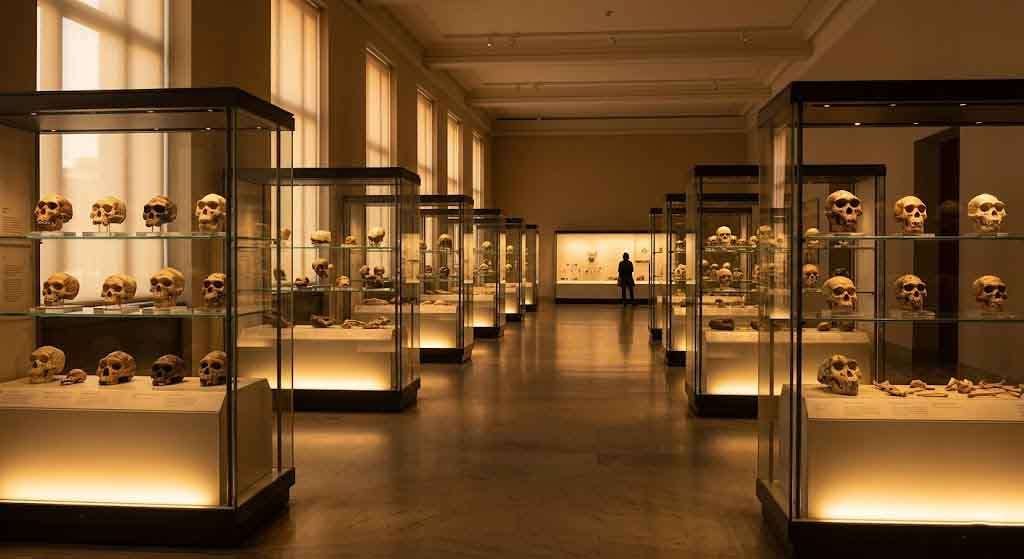
I want to be specific about what happens when you read On the Origin of Species and then stand in front of the hominid skull casts at the American Museum of Natural History’s Hall of Human Origins. The experience is qualitatively different from any prior visit.
Before Darwin — or before truly absorbing Darwin — the skulls are fascinating curiosities, exotic, labeled, taxonomically arranged. After Darwin, they are family. Australopithecus afarensis, Homo habilis, Homo erectus, Homo neanderthalensis — each cast is a chapter in a story that is also your story. The slight recession of a brow ridge, the expansion of a cranial vault, the gradual refinement of the jaw — you are watching natural selection’s work across millions of years, rendered in bone. The AMNH’s Hall of Human Origins, reopened in its current form in 2007, presents the human lineage across six million years of evidence. Standing there after Darwin, it is hard not to feel what I can only describe as a kind of secular reverence — the recognition that you are temporary, continuous, and improbably here.
I have been to the Hall many times. I keep going back. Each visit lands differently now, weighted by the reading. It is what a great book does: it changes not just what you know but what you see.
Darwin’s Influence on Philosophy, Culture, and How We Understand Ourselves
The tremors from On the Origin of Species did not stay confined to biology. They spread into philosophy, economics, psychology, anthropology, literature, and theology — in some cases productively, in others catastrophically. Social Darwinism — the grotesque misapplication of natural selection to justify economic inequality, racism, and eventually eugenics — has nothing to do with Darwin’s actual science and everything to do with ideologues reaching for a scientific imprimatur they had not earned. Darwin himself was explicit that his theory described mechanisms, not moral prescriptions.
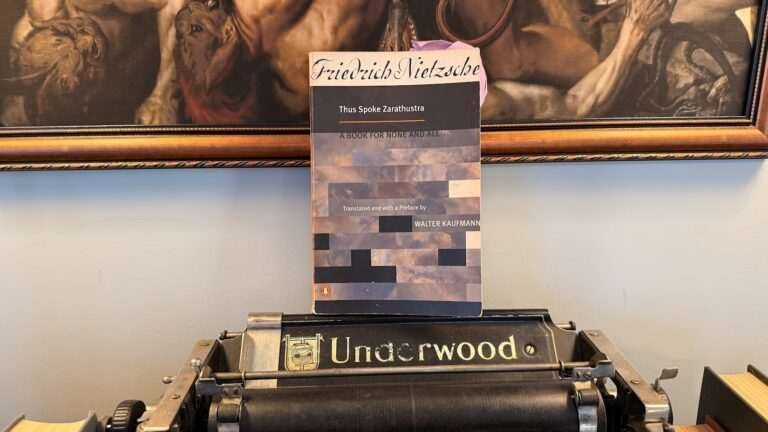
The philosophical implications, however, are genuine and still unresolved. If humans are the product of the same undirected process that produced the hagfish and the orchid, what becomes of human dignity, moral agency, consciousness? Nietzsche, who absorbed evolutionary thinking through a particular German lens, drew the conclusion that if God was dead and nature was indifferent, the response was not despair but the radical affirmation of life — the creation of values rather than their reception. Existentialism, in various forms, can be read as philosophy’s attempt to answer the question Darwin made unavoidable: if we were not designed, what do we owe ourselves?
These questions sit at the center of the book review I wrote about Thus Spoke Zarathustra — a piece that begins where Darwin ends, at the question of what a human being does with the knowledge that it is alone in constructing its meaning. The two books read together form a kind of intellectual double helix.
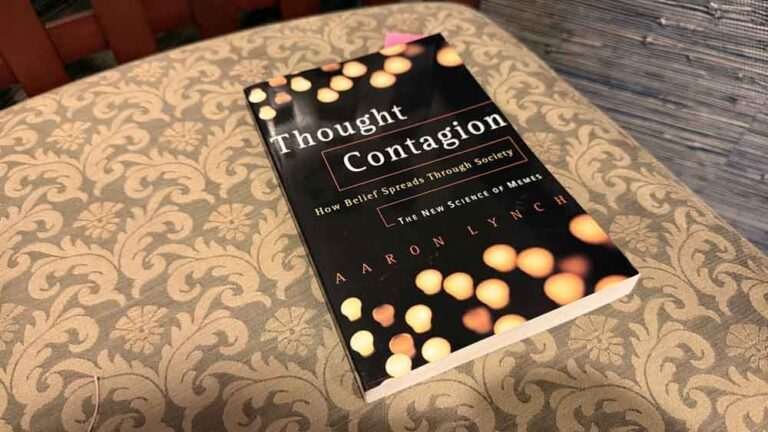
Richard Dawkins extended Darwin into the gene’s-eye view in The Selfish Gene (1976), arguing that the fundamental unit of selection is not the organism but the gene — that bodies are, in a sense, survival machines built by genes to perpetuate themselves. Dawkins also introduced the concept of the meme as a cultural analog to the gene: a unit of information that replicates, mutates, and spreads through human minds the way genes spread through populations. The memetic framework has become increasingly relevant in the age of social media, where ideas propagate with a speed and fidelity that would have astonished Darwin — and perhaps not surprised him at all.
Why This Book Still Matters in 2026
Science does not work by authority. Darwin’s ideas are not accepted because Darwin was Darwin. They are accepted because 165 years of evidence — from genetics, paleontology, comparative anatomy, molecular biology, biogeography, and direct observation of evolution in real time — has confirmed, extended, and refined the core framework beyond any reasonable doubt. Evolution is not a belief system. It is the most well-supported theory in the history of science.
And yet functional scientific illiteracy remains widespread. A 2023 Gallup poll found that 45 percent of Americans believe God created humans in their present form within the last ten thousand years — a number that has barely shifted in four decades of polling. This is not a trivial cultural footnote. It has consequences for science education, public health policy, and the quality of civic reasoning in a world where biological questions — about pandemics, gene editing, antibiotic resistance, climate adaptation — press harder every year.
Reading On the Origin of Species is not just an intellectual exercise. It is a form of civic preparation. It trains the mind to follow evidence, to sit with uncertainty, to distinguish between a theory that has been tested and one that has merely been asserted. These are skills that transfer far beyond biology.
The book is also, simply, a great piece of writing. Darwin’s prose is patient, measured, occasionally rapturous. He does not condescend to the reader. He invites you into his reasoning and trusts you to follow. That trust — the respect for the reader’s intelligence implicit in every page — is its own kind of argument.
Darwin finished the book in 1859 knowing it would cost him something. He had delayed publication for more than twenty years, aware of what he was releasing into the world. He released it anyway, because the evidence demanded it. That combination — intellectual courage meeting intellectual rigor — is what makes On the Origin of Species not just a scientific document but a human one. The book does not diminish humanity. It places us exactly where we belong: inside the story, not above it, the product of the same deep time and deep accident that produced every living thing on this planet. Stand in front of those skulls at the AMNH and feel that. It is something close to awe.
You Might Also Like
- Horizontal Gene Transfer: Why Darwin’s Tree of Life Is Actually a Tangled Web
- The God Delusion by Richard Dawkins — A Review
- Thus Spoke Zarathustra by Friedrich Nietzsche: The Book That Rewired My Understanding of Everything
Sources
- Darwin, Charles. On the Origin of Species by Means of Natural Selection. John Murray, 1859. Project Gutenberg
- Dawkins, Richard. The Selfish Gene. Oxford University Press, 1976.
- Dobzhansky, Theodosius. “Nothing in Biology Makes Sense Except in the Light of Evolution.” The American Biology Teacher, 1973. JSTOR
- Gould, Stephen Jay, and Lewontin, Richard. “The Spandrels of San Marco and the Panglossian Paradigm.” Proceedings of the Royal Society B, 1979. Royal Society Publishing
- Gallup. “Evolution, Creationism, Intelligent Design.” Gallup Poll, 2023. Gallup
- American Museum of Natural History. Hall of Human Origins. AMNH
- National Center for Science Education. “Understanding Evolution.” NCSE