2 Pulaski Road, Kings Park, NY 11754
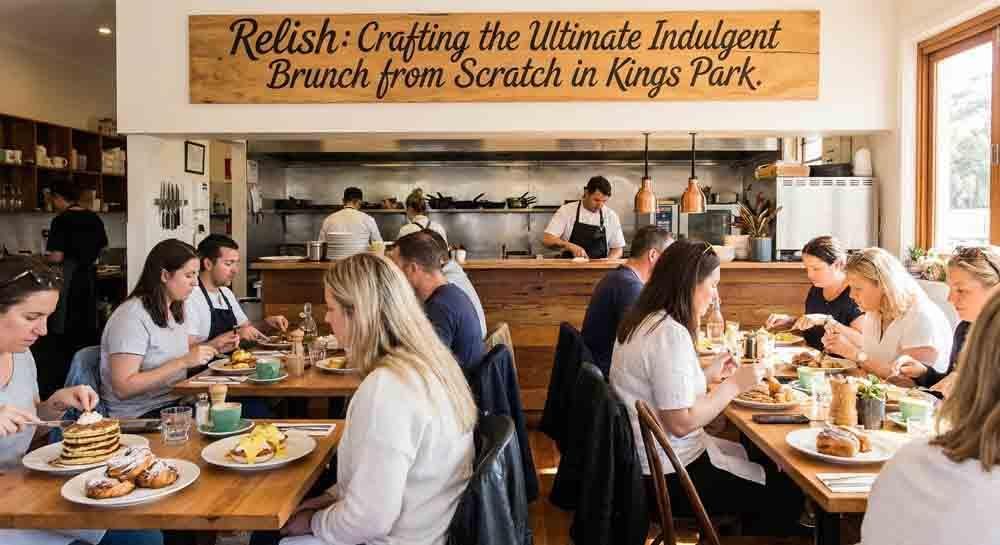
The first time you walk through the door at 2 Pulaski Road, you are struck by a contradiction that, upon reflection, is no contradiction at all. From the outside, the building reads as a classic Long Island diner — modest, unassuming, rooted in the sidewalk like it has always been there. But one step inside, and the pear-green banquettes, the bead-board walls, the oversized fork-and-spoon mounted above the counter, and the unmistakable aroma of free-range eggs crackling in cast iron tell a different story entirely. This is Relish, and since opening its doors in September 2011, it has quietly become one of the North Shore’s most essential dining destinations — a place where the words “scratch kitchen” are not a marketing slogan but a daily operational mandate, executed by a French Culinary Institute-trained chef who once loaded his Toyota Camry so full of farmers’ market produce that he could not see out the back window (Edible Long Island, 2013).
In an era when the term “farm-to-table” has been diluted into near-meaninglessness — a phrase slapped on menus from Montauk to Manhattan with varying degrees of sincerity — Relish represents something stubbornly authentic. It is a restaurant that sources its eggs from a poultry farm less than two miles away, whose specials menu is dictated not by corporate food distributors but by whatever Chef Steve Cardello hauls back from the Kings Park Farmers Market on Sunday mornings. It is a place that has survived the infrastructural neglect of downtown Kings Park, weathered the pandemic, expanded to a second location, launched a seafood market across the street, and now has its sights set on a waterfront dining experience that could redefine the hamlet’s culinary identity. For those of us who believe that the character of a community is forged at its tables — that the places where we break bread together are the places that give a neighborhood its soul — Relish is not merely a restaurant. It is an institution.
The Origin Story: From Mrs. Brown’s Kitchen to a North Shore Landmark
Every great restaurant has a founding myth, and Relish’s begins with a partnership between two men who approached the same building from opposite directions. Don Brown, a Kings Park native born and raised, owned the property that had previously operated as Mrs. Brown’s Kitchen. He was looking to step away from the day-to-day demands of the restaurant business. Steve Cardello, a graduate of Manhattan’s French Culinary Institute with executive chef experience at Bayport’s Grey Horse Tavern and stints at Lincoln Center, was looking to step in. Their timing was serendipitous, their philosophies complementary. Cardello brought classical technique, an obsessive commitment to local sourcing, and an intuitive understanding of the neighborhood restaurant as a form of community infrastructure. Brown brought deep local roots, business acumen, and an intimate knowledge of what Kings Park needed (Kings Park Patch, 2013).
The space they inherited had been built in 1940, and Cardello made the deliberate decision not to stray too far from the diner-style establishment that the community had embraced. The renovated interior was warm but minimalist — the kind of design that lets the food do the talking. Wood floors. A bluestone counter with swivel stools where regulars could read the paper over coffee. And on the back of every staff member’s shirt, a three-word philosophy that would become the restaurant’s unofficial creed: “Food, Family, Life” (Edible Long Island, 2013).
The Scratch Kitchen Philosophy: What It Actually Means at 2 Pulaski Road
The term “scratch kitchen” gets thrown around with such promiscuous frequency in the restaurant industry that it has nearly lost its meaning. At Relish, scratch cooking is not aspirational — it is operational. It means that every soup is made from a base that was built in-house, not poured from a bag. It means that the hollandaise draped across Relish’s celebrated Eggs Benedict lineup — the Classic, the Smoked, the Avocado, the Chicken Chorizo — is emulsified fresh each morning, not reconstituted from a powder. It means that when the kitchen runs its daily specials briefing, Chef Cardello personally walks the serving staff through each dish, describing where the ingredients were sourced, how they were prepared, and what makes them worth the price on the plate (Smithtown Matters, 2015).
This commitment to transparency extends from the kitchen to the dining room. Relish’s omelettes are prepared exclusively with free-range organic eggs from Raleigh’s Poultry Farm, located on Old Indian Head Road in Kings Park — literally a short drive from the restaurant’s back door. At peak volume, the kitchen burns through 210 dozen eggs per week from Raleigh’s alone (Kings Park Patch, 2013). The daily specials incorporate locally sourced fruits and vegetables, and when the Kings Park Farmers Market is in full swing during the warmer months, Cardello treats it as an extension of his walk-in cooler. The specials menu is developed directly from what comes back from the market on Sunday — heirloom tomatoes find their way onto burgers and sandwiches, local lettuces anchor the salads, and stone fruits and berries end up in desserts that change with the season (Edible Long Island, 2013).
This approach to sourcing is not merely romantic. It is economically and ecologically strategic. By building relationships with local producers — Raleigh’s Poultry Farm, the vendors at the Kings Park Farmers Market, regional seafood purveyors — Relish reduces its dependence on national supply chains and the price volatility that comes with them. The result is a menu that is simultaneously more flavorful and more resilient, a point that the National Restaurant Association has repeatedly emphasized in its annual State of the Industry reports as a competitive advantage for independent operators (National Restaurant Association, 2024).
The Menu: A Deep Dive into Relish’s Greatest Hits
Relish’s menu operates on three registers — breakfast (served all day), lunch, and dinner — and each one demonstrates a kitchen that takes comfort food seriously enough to elevate it without pretension. The breakfast program is the restaurant’s crown jewel, and it is built on the foundation of those Raleigh’s Farm eggs and a Benedict lineup that has achieved something approaching cult status on the North Shore.
The Classic Benedict arrives on a toasted English muffin with Canadian bacon and a poached egg buried under a cascade of house-made hollandaise — rich, lemony, with the kind of velvet consistency that separates a scratch hollandaise from its powdered imposters. The Smoked Benedict swaps in smoked salmon, adding a briny depth that plays beautifully against the richness of the sauce. The Avocado Benedict nods to contemporary breakfast culture without pandering to it. And the Chicken Chorizo Benedict — spicy, hearty, unapologetically bold — is the kind of dish that makes you understand why some regulars visit several times a week (Yelp, 2025).
Beyond the Benedicts, the omelette program is a study in restrained creativity. The Brooklyn Omelette and the Burlington Omelette — proprietary combinations that have become signature items — demonstrate Cardello’s ability to build flavor through ingredient pairing rather than volume. The Maple Bacon and Grits, meanwhile, is a Southern-inflected breakfast dish that has no business being as good as it is on the North Shore of Long Island, yet somehow transcends its geographic improbability. The Mediterranean Omelette, loaded with fresh vegetables and herbs, has become a go-to for the health-conscious brunch crowd.
For lunch and dinner, the menu pivots to overstuffed sandwiches, hand-ground burgers, fresh seafood, crisp salads, and home-made soups. Cardello’s linguine and clams with spicy homemade sausage is a crowd-pleaser, and his traditional meatloaf — fresh-ground beef, pork, and veal prepared exactly as his grandmother made it, served with mashed potatoes and brown gravy — is the kind of dish that makes the restaurant feel less like a business and more like an extension of someone’s family kitchen (Kings Park Patch, 2013). Desserts are sourced from a local bakery and rotate daily, ranging from pies and bread puddings to brownies and a chocolate cheesecake that has inspired more than one late-night return visit.
Expansion and Evolution: Hauppauge, Reel Kitchen, and The Inlet
A restaurant that stands still is a restaurant that is dying, and Relish has never been content with stasis. In the fall of 2019, Cardello and Brown opened a second Relish location in Hauppauge, taking over a long-vacant Pizza Hut space on Route 111. The new location featured a significantly larger kitchen — a meaningful upgrade from the Kings Park original, whose kitchen infrastructure dates to 1940 — along with outdoor seating, garage doors that bring fresh air into the dining room, Hamptons-style decor, and a full bar. The expanded kitchen allowed for a broader menu and the cultivation of sous chefs, with Cardello articulating a vision of turning talented line cooks into executive chefs (Edible Long Island, 2019).
Before the Hauppauge expansion, the Relish team had already demonstrated its willingness to take creative risks with Reel Kitchen, a seafood market and takeout shop that opened in 2015 just 112 steps across Main Street from the original Relish location. Reel Kitchen was not a traditional fish market — it was a chef-helmed operation where CIA-trained cooks prepared chemical- and preservative-free seafood, offered cooking advice to home cooks, and hosted intimate pop-up dinners with guest chefs like Elliot Lopez of Capital Grille on Wall Street. The concept embodied Cardello’s philosophy of transparency and education: he wanted customers not just to eat great seafood but to understand it, to learn from his staff, and to feel empowered in their own kitchens (Edible Long Island, 2015). The operation was named one of Newsday’s 10 Best Cheap Eats on Long Island in 2015.
Most recently, the Relish ownership announced plans for The Inlet, a waterfront dining experience at the former Old Dock Inn property at 798 Old Dock Road in Kings Park. The property — a half-acre site with views of the Nissequogue River and Long Island Sound that previously seated about 80 diners — was acquired by the Relish team approximately three years ago and has been in development in coordination with the Smithtown Town Board. Renderings suggest a breathtaking waterfront venue that could bring an entirely new caliber of dining to Kings Park’s shoreline (Long Island Restaurants, 2024).
Kings Park’s Renaissance: Sewers, Revitalization, and the Future of Main Street
Relish’s trajectory cannot be understood apart from the broader story of Kings Park itself — a hamlet that has spent years navigating the tension between its small-town character and its hunger for economic revitalization. The hamlet’s reliance on aging cesspool and septic infrastructure had long constrained downtown development, limiting the kinds of water-intensive businesses — restaurants, cafes, apartment buildings — that typically anchor vibrant commercial districts. For years, Don Brown has been a vocal advocate for infrastructure investment, arguing that Kings Park should follow the revitalization playbook that transformed Patchogue, Babylon, and Farmingdale from struggling downtowns into thriving destinations (Citizens Campaign for the Environment, 2025).
That investment is finally materializing. A $101 million sewer expansion project, funded by a combination of state and county grants including a $20 million allocation from New York State’s Transformative Investment Program, is nearing completion as of spring 2025. The project will provide approximately 120 new sewer hookups, the vast majority connecting to commercial properties. Combined with the $10 million Kings Park Downtown Revitalization Initiative awarded by Governor Hochul, the infrastructure improvements are expected to catalyze a wave of new business development centered around the LIRR station and the Main Street corridor (Smithtown Development, 2025).
For Relish, the implications are significant. Brown has been candid about the toll that years of underinvestment have taken on downtown Kings Park businesses, and the sewer connections represent a structural shift that could unlock the kind of walkable, mixed-use commercial district that draws visitors from across the North Shore. The Inlet project, positioned on the waterfront at Old Dock Road, is perhaps the most ambitious expression of this optimism — a bet that Kings Park’s natural beauty, combined with the kind of culinary excellence that Relish has spent over a decade cultivating, can make the hamlet a genuine dining destination (Long Island Restaurants, 2024).
The Community Table: Why Relish Matters Beyond the Menu
There is a philosophical dimension to what Relish represents that transcends the mechanics of eggs and hollandaise. In his seminal work on “third places” — the social environments separate from home and work where community bonds are forged — sociologist Ray Oldenburg argued that the health of a neighborhood can be measured by the vitality of its gathering spaces: its cafes, its diners, its barbershops, its taverns (Oldenburg, “The Great Good Place,” 1989). By this metric, Relish is not merely a successful restaurant. It is a civic institution.
The evidence is in the details. It is in the way Cardello runs pre-service tastings for his staff, not because it is required, but because he believes that a server who understands the provenance of a dish can communicate its value to the diner. It is in the way Don Brown has used his platform as a business owner to advocate for infrastructure that benefits the entire commercial district, not just his own properties. It is in the way Relish has opened its doors to local Cub Scout troops for behind-the-scenes kitchen tours, treating culinary education as a form of community service. It is in the wrap-around patio that Brown added in 2021, making Relish the first restaurant in Kings Park with genuine year-round outdoor seating — and openly encouraging other restaurant owners in town to do the same, on the theory that a rising tide lifts all boats (Greater Long Island, 2021).
As someone who has spent twenty-five years running The Heritage Diner in Mount Sinai — another North Shore institution built on the belief that a neighborhood restaurant is more than a place to eat — I recognize in Relish a kindred spirit. The commitment to scratch cooking, the obsessive local sourcing, the understanding that a restaurant’s relationship with its community is its most valuable asset: these are not just business strategies. They are expressions of a philosophy that the unseen details — the provenance of the egg, the hand that stirred the hollandaise, the relationship between the chef and the farmer — are what separate a meal from an experience, and a restaurant from a landmark.
Relish — Essential Information
📍 Address: 2 Pulaski Road, Kings Park, NY 11754
📞 Phone: (631) 292-2740
🌐 Website: eatatrelish.com | relishkingspark.com
📱 Instagram: @relish_longisland
🕐 Hours:
- Monday: 8:00 AM – 1:45 PM
- Tuesday–Saturday: 8:00 AM – 7:30 PM
- Sunday: 8:00 AM – 3:00 PM
🚗 Parking: Free lot on premises
🍽️ Services: Dine-in, Takeout, Delivery, Reservations
♿ Accessibility: Wheelchair accessible with ramp entrance and accessible restroom
💳 Payment: Credit cards, Apple Pay, Android Pay, cryptocurrency accepted
🥗 Dietary Options: Vegan, Vegetarian, Gluten-free options available
📦 Delivery: Available via Seamless, Uber Eats, and DoorDash
⭐ Ratings: 4.1/5 on TripAdvisor (182 reviews) | 533 reviews on Yelp | Ranked #3 of 29 restaurants in Kings Park
🏆 Recognition: Newsday 10 Best Cheap Eats on Long Island (2015)
Recommended Viewing:
- French Cooking Academy — Classical Sauce Techniques — For those interested in the classical foundations behind Relish’s scratch hollandaise and mother sauces.
- Edible Long Island — Farm-to-Table on the North Shore — Edible’s ongoing coverage of Long Island’s local food movement, including profiles of Relish and Reel Kitchen.
Established 2011. Scratch-cooked. Locally sourced. Kings Park proud.
— Peter, The Heritage Diner, Mount Sinai