There is a reproduction of this painting mounted on wood in my living room — a canvas print I made after standing in front of the original at the Metropolitan Museum of Art and realizing I wasn’t going to move for a while. That’s a rare thing. Most paintings, even great ones, you absorb in a pass. This one held me.
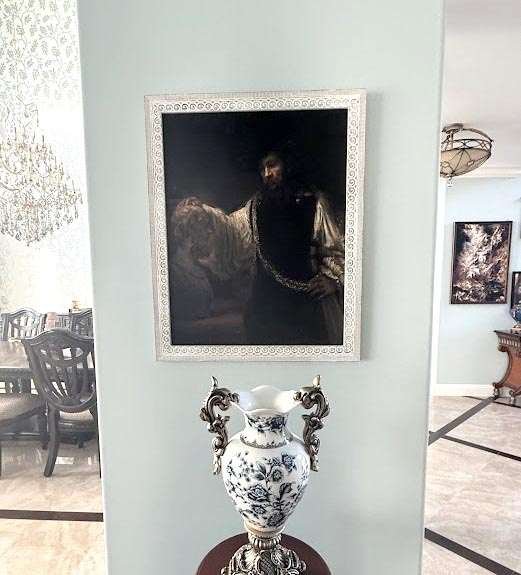
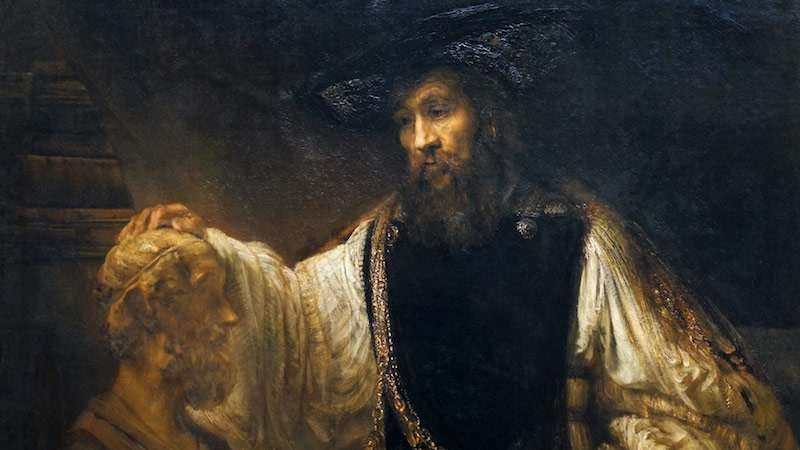
Rembrandt van Rijn completed Aristotle with a Bust of Homer in 1653, commissioned by the Sicilian nobleman Don Antonio Ruffo, who apparently wanted a painting of “a philosopher.” What he got was something far less tidy than that brief suggests — not a celebration of knowledge, but a portrait of a man caught between two versions of himself, one hand resting on a marble bust, the other near a gold chain he doesn’t seem entirely comfortable wearing. It is, I’d argue, one of the most psychologically honest paintings ever made, and it lives at the Met on Fifth Avenue in Manhattan, Room 964, where I’ve returned to it more than once.
Who Is This Man, Really?
The figure is traditionally identified as Aristotle, student of Plato, tutor of Alexander the Great, founder of logic, biology, ethics, and about a dozen other disciplines that still shape how we think. The gold chain he wears bears a medallion with the portrait of Alexander — a gift from his most powerful pupil, a symbol of wealth, influence, and worldly success. Aristotle’s hand rests on it almost absently, the way you might touch a necktie you put on because you had to, not because you wanted to.
Below that hand, his other rests on the marble head of Homer — the blind poet, the singer of the Iliad and the Odyssey, a man who owned nothing and whose name may not even belong to a single historical person. Homer represents pure creative vision, the kind of knowledge that lives in the blood rather than in the syllabus. Aristotle touches both. That’s the whole painting, right there.
What Rembrandt understood — and what makes this image so enduring — is that Aristotle’s gaze is not triumphant. It is contemplative to the point of melancholy. He isn’t celebrating what he has; he seems to be measuring what it cost. The philosopher who built the scaffolding of Western reason is looking at a blind poet and, if I’m reading that face right, wondering who got the better deal.
The Chain and What It Weighs
I’ve read and thought about Aristotle enough to know that this tension isn’t something Rembrandt invented — it was there in the man himself. Aristotle distinguished between theoria (contemplative knowing, knowing for its own sake) and what he called the life of political engagement, of honors and influence. He valued both, but he was clear that theoria was the higher mode. The philosopher who truly understood the good life would eventually choose contemplation over acclaim.
The gold chain, then, is not just a prop. In 17th-century Dutch culture, gold chains were given by patrons and rulers to honor artists, scholars, and courtiers. Rembrandt himself received one. For a painter who understood that dynamic from the inside — the tension between making work you believe in and satisfying the people who pay for it — loading Aristotle with that chain was a pointed choice. It is the weight of patronage, of compromise, of success that arrives with strings attached.
In my review of Nietzsche’s Thus Spoke Zarathustra, I wrote about the difference between the man who climbs toward his own vision and the man who accepts the summit others point him to. Rembrandt’s Aristotle is living exactly that tension. He has reached the summit. He’s not sure it was the right mountain.
Rembrandt’s Light Is an Argument
The technical achievement here is inseparable from the philosophical one. Rembrandt paints Aristotle emerging from shadow — his face catches the light from the upper left, warm and direct, while the rest of the canvas retreats into amber darkness. This is chiaroscuro in its most purposeful form, not decoration but meaning. The light falls on the face that thinks, the hands that touch, and leaves the body — the gold, the robes, the symbols of status — in relative shadow.
Homer’s bust, by contrast, is luminous from within the painting’s logic. White marble, cool and still, catching light from the same source but reflecting it differently — as if the poet’s stone face holds the light more honestly than the philosopher’s living one. It’s a quiet inversion. The dead man glows. The living man broods.
Rembrandt was 47 when he painted this, already past the peak of his commercial success, moving through financial difficulties that would end in bankruptcy four years later. He knew something about the gap between reputation and reward, between the work you’re proud of and the market’s verdict on it. That knowledge is in every brushstroke — loose, confident, thick with impasto in the highlights and thin as a whisper in the shadows.
What Aristotle Is Actually Looking At
The bust of Homer is not merely a prop or a symbol of the classical tradition. In Aristotle’s own thought, Homer occupied a complicated position. He cited the Iliad and Odyssey extensively in his Poetics, treating Homer as the supreme model of unified narrative structure, of mimesis — the imitation of human action in its fullest form. But Aristotle also believed that poetry worked through pleasure and emotion in ways that pure reason could not, and could not entirely control. Homer got to the truth through feeling. Aristotle got there through method. They were not the same journey.
The hand on the bust, then, is something like reverence — the logician acknowledging the poet who did something logic alone cannot do. I think about this often when I’m working with my hands, whether in the kitchen or at a leather bench, doing something that no amount of theoretical knowledge fully prepares you for. Craft knowledge — the kind that lives in the fingers and only arrives through repetition — is its own form of wisdom, and it has a different texture than the kind you can write down. Aristotle seems to know this. He’s touching the evidence.
Ruffo, the Met, and a Room in the History of Collecting
Don Antonio Ruffo commissioned this painting sight unseen from Amsterdam, paying 500 florins — a substantial sum — and was so pleased with the result that he later commissioned two more works from Rembrandt, including an Alexander the Great that would have completed a trio of great historical figures. The three paintings were eventually separated; Aristotle passed through various collections over three centuries before arriving at the Met in 1961, purchased for $2.3 million — at the time the highest price ever paid at auction for a painting. The acquisition made international headlines and sparked a genuine public debate about whether a museum should spend that kind of money on a single work.
Standing in front of it now, that debate seems almost quaint. What the Met bought wasn’t a painting so much as a permanent invitation to think. It anchors its room the way a great book anchors a shelf — not loudly, but with a gravity you feel before you can name it.
The version on my living room wall is a canvas print, transferred to wood, and it holds up well in a domestic setting in a way not every museum painting does. Something about the warm palette, the intimacy of the composition — it wasn’t made for a cathedral. It was made for a room where a person sits and thinks.
The Portrait as Philosophy
What Rembrandt achieved in 1653 is something that philosophy itself often struggles to do: he made an argument you can feel. The painting doesn’t tell you that worldly success and genuine wisdom are in tension — it shows you a man living inside that tension with full awareness, one hand on the gold chain, one hand on the poet’s cold stone face, and a look in his eyes that has no easy translation.
I’ve read a fair amount of Aristotle — the Nicomachean Ethics, the Poetics, enough of the Metaphysics to respect how hard it is — and the figure Rembrandt paints feels true to what I understand of the man: rigorous, worldly, capable of great warmth, and never quite satisfied with the answers his own system produced. That’s not a criticism. That’s what makes a thinker worth returning to. The ones who close the loop on everything are usually the ones who’ve stopped asking.
The painting asks. It keeps asking. That’s why it’s on my wall.
You Might Also Like:
- A Kierkegaard Anthology — The Thinker Who Refused to Let Me Go
- Thus Spoke Zarathustra by Friedrich Nietzsche — The Book That Rewired My Understanding of Everything
- An Introduction to Logic and Scientific Method by Morris R. Cohen & Ernest Nagel
Sources
- Metropolitan Museum of Art — Aristotle with a Bust of Homer, Collection Record: https://www.metmuseum.org/art/collection/search/436105
- Liedtke, Walter. Dutch Paintings in The Metropolitan Museum of Art. New York: The Metropolitan Museum of Art, 2007.
- Schama, Simon. Rembrandt’s Eyes. New York: Knopf, 1999.
- Aristotle. Nicomachean Ethics. Trans. Terence Irwin. Indianapolis: Hackett, 1999.
- Aristotle. Poetics. Trans. Malcolm Heath. London: Penguin Classics, 1996.
- The New York Times — “Met Buys Rembrandt for Record $2.3 Million” (1961 archive coverage): https://www.nytimes.com/