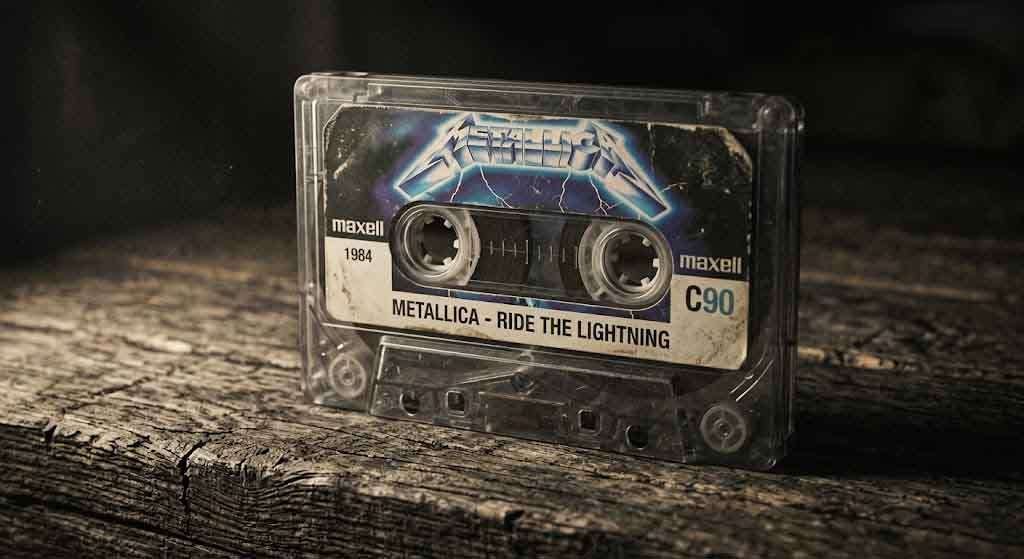
Metallica · Ride the Lightning · Megaforce Records / Elektra Records · Released July 27, 1984
Every kid growing up in Brooklyn in the 1980s had a soundtrack. For most of the neighborhood it was whatever was coming out of boomboxes on the stoop — freestyle, hip-hop, the tail end of disco if you were at the wrong block party. But somewhere around thirteen or fourteen, I got my hands on a cassette tape that had no business existing in the same borough as any of that. The cover was stark: an electric chair splitting apart under a bolt of lightning, the band’s name forged in metal font like something off the side of a steel mill. Ride the Lightning didn’t look like music. It looked like a warning.
It was one of the first Metallica albums I ever owned, and I mean owned — the way a thirteen-year-old owns a thing that explains something about himself he didn’t have words for yet. That tape got played until the ribbon stretched. I’m not sure I fully understood what I was hearing at the time. I’m not sure anyone that age could. But it did something to my nervous system that I’ve never quite undone.
A Sonic Leap No One Saw Coming
To understand what Ride the Lightning meant, you have to know what it was responding to. Metallica’s debut, Kill ‘Em All (1983), was a battering ram — pure aggression, no apologies, the kind of music that arrived like a fist through drywall. It was remarkable for what it was. But Ride the Lightning, recorded just a year later at Sweet Silence Studios in Copenhagen over a ferocious three-week session, was something else entirely. It was the sound of a young band suddenly aware that they could do more than destroy — they could build.
The shift had a name: Cliff Burton. The bassist who would die tragically just two years later in a tour bus accident in Sweden was the intellectual engine behind this album’s ambition. Burton had introduced the band to the fundamentals of music theory — chord structure, harmonic movement, the idea that heaviness and sophistication were not enemies. His fingerprints are everywhere on this record, and his absence, when you know what came after, haunts every listen.
The result was an album that peaked at only number 100 on the Billboard 200 with virtually no radio airplay and went on to sell six million copies in the United States alone. It wasn’t promoted the conventional way. It didn’t need to be. It traveled the way all genuinely important things travel — hand to hand, tape to tape, bedroom to bedroom.
Track by Track
Fight Fire with Fire
The opening move is one of the great misdirections in heavy metal history. The song begins with a delicate, fingerpicked acoustic passage — unhurried, almost pastoral, the kind of thing you’d expect from a folk record. Then the silence. Then the detonation. “Fight Fire with Fire” erupts into one of the fastest, most technically demanding pieces of thrash ever recorded, its lyrics drawn from the terror of nuclear annihilation, the cold-war dread that was ambient background noise for an entire generation of American kids. The contrast between that gentle opening and what follows is not a trick. It’s a thesis statement: this band contains multitudes, and they will use all of them against you.
Ride the Lightning
The title track wears its influences openly — Dave Mustaine, who had already been fired from the band by this point, still holds a co-writing credit here alongside James Hetfield, Lars Ulrich, and Burton, a testament to how far back these riffs go. The song is written from the perspective of a man awaiting execution in the electric chair, wrongly condemned, powerless against the machinery of the state. Hetfield’s vocal performance is extraordinary — not polished, but raw in the right way, the sound of someone genuinely wrestling with mortality on tape. The groove-heavy main riff is hypnotic in the way a verdict is hypnotic: inevitable, repeating, closing in.
For Whom the Bell Tolls
Burton’s bass opens this one alone. A single distorted note, held and manipulated until it sounds like a foghorn at the end of the world. Then the drums drop, and the tempo becomes something geological — massive, slow, tectonic. The song takes its title from John Donne’s meditation on human interconnection and reworks it into a war elegy, soldiers dying in an unnamed conflict while the bell tolls indifferently. This is where the album begins to feel like literature. There are bands that write songs about war, and then there is For Whom the Bell Tolls, which makes you feel the weight of a corpse.
Fade to Black
No track on this album carries more emotional gravity, and no track in Metallica’s catalog has touched more people in darker moments. “Fade to Black” was the band’s first ballad — a word that almost seems wrong applied to a song with this much internal structure. It begins spare and acoustic, building through Kirk Hammett’s lead work into a finale that opens up like a cathedral. The lyrics deal with suicidal ideation, written, Hetfield has said, from a place of genuine desperation after the band’s equipment was stolen in Boston during the Kill ‘Em All tour. The song was controversial in 1984 — parent groups worried it would harm vulnerable kids. What it actually did was give those kids something to hold onto. There’s a difference between music that endorses despair and music that witnesses it. This is the latter.
Trapped Under Ice
The album’s most kinetic track returns to the speed of the opener. The subject — a person frozen alive, conscious inside a cryogenic chamber, unable to communicate their awareness to the outside world — is the kind of horror-adjacent concept that could tip into camp in lesser hands. Here it drives a riff that Hammett had developed during his time with his previous band Exodus, repurposed into something genuinely claustrophobic. The fastest song on the record by most measures, it functions as a necessary exhale between the emotional weight of “Fade to Black” and what comes after.
Escape
The odd duck of Ride the Lightning — more melodic, slightly more accessible, the closest the album gets to traditional heavy metal structure. The band themselves grew to dislike it enough that it wasn’t performed live for nearly three decades; the first full live performance came at the 2012 Orion Music Festival when they played the album in its entirety. I’ve always had a soft spot for it. Not every track on an album needs to be the hardest thing on the record. “Escape” earns its place as the breath before the storm.
Creeping Death
Hetfield looked to the Book of Exodus for this one — specifically the tenth plague, the angel of death passing through Egypt to kill the firstborn sons, told from the perspective of the plague itself. The song’s breakdown, where the crowd has always chanted die, die, die in unison for decades of live shows, is one of heavy metal’s great communal rituals. As a kid at my first Metallica show, I had no idea it was coming. When it arrived, and the room became one voice, I understood something about collective experience that philosophy classes would try to teach me later and never quite get there the same way.
The Call of Ktulu
The album closes with an eight-minute-and-fifty-four-second instrumental drawn from H.P. Lovecraft’s mythology — the ancient, sleeping, incomprehensible entity whose name alone can unhinge the mind. Mustaine holds a co-writing credit here as well. The song builds with the patience of something enormous and old, cycling through themes without resolution, refusing the catharsis a conventional song would offer. It ends not with a bang but with a slow dissolution, the musical equivalent of something massive sinking beneath black water. At thirteen, I didn’t know what Lovecraft was. I just knew the song felt like it knew something I didn’t, and that this was appropriate.
Why This Album Still Matters
Ride the Lightning came out forty-one years ago. In those four decades it has been certified six times platinum in the United States, ranked on virtually every serious list of essential heavy metal albums, and influenced more bands than could be counted honestly. What gets less attention is the why — not why critics like it, but why a Brooklyn kid with a cassette player heard something in it that reorganized him.
The album takes seriously the things adolescents are told not to take seriously: death, injustice, the machinery of power, the fragility of consciousness, the indifference of the universe. It does not offer comfort exactly. What it offers is acknowledgment — the sense that someone else felt the weight of those things and decided to make something from it instead of looking away. That is not a small thing. That is, in many ways, the whole of it.
I still play this record. Not often, but deliberately — the way you return to a place that shaped you to see what it’s still telling you. The electric chair on the cover has never stopped looking like a warning. I think now it’s warning about something different than I thought at thirteen. Probably I’m still figuring it out.
You Might Also Like
- The Heritage Diner Blog — Long Island History & Culture
- Science, Technology & Ideas on the Heritage Diner Blog