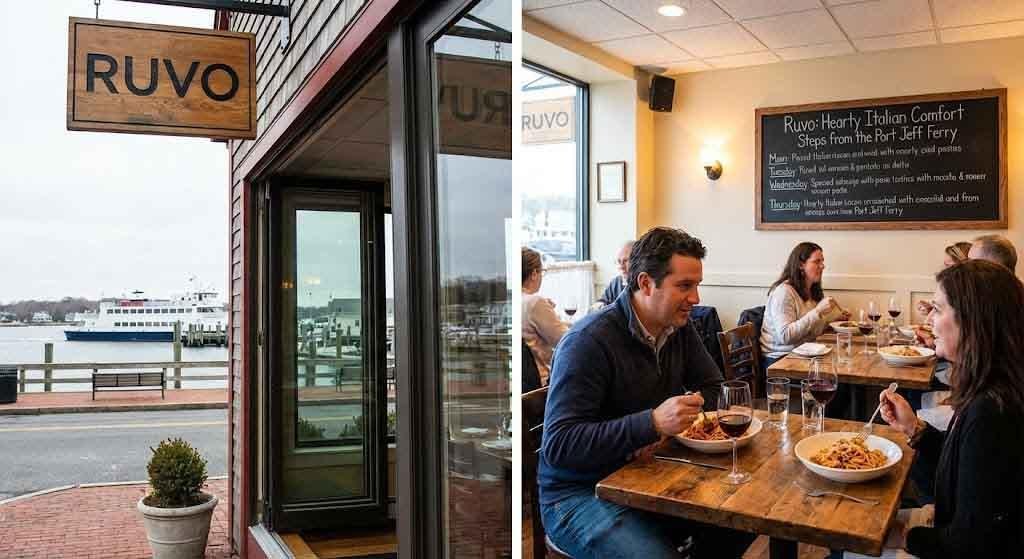
The salt air off Long Island Sound carries something more than brine when you step off the Bridgeport ferry and walk the sloping streets of Port Jefferson Village. It carries a particular alchemy of maritime history, colonial ambition, and the stubborn insistence of immigrant families who have shaped these North Shore communities for over a century. Tucked down Wynn Lane — a quiet alley just steps from Main Street and mere blocks from the ferry terminal where P.T. Barnum’s steamship company has been shuttling passengers since 1883 — sits Ruvo, a southern Italian restaurant that has become one of the most enduring dining destinations in all of Suffolk County. It is a place where the culinary legacy of four brothers, a century-old family, and a small hill town in Puglia converge into something far greater than the sum of its parts.
The DeNicola Legacy: 110 Years on Long Island
The story of Ruvo is inseparable from the story of the DeNicola family, who settled on Long Island in 1915 — a full decade before the Great Gatsby would mythologize these very shores. For over a century, the DeNicolas have cultivated a tradition of fine Italian fare rooted in the freshest ingredients and the kind of generational knowledge that no culinary school can replicate. Brothers Jim, Leo, Douglas, and Joe — the architects of DeNicola Brothers Concepts — built their restaurant empire not with venture capital or franchise consultants, but with the same hands-on ethos that their forebears brought from the old country.
Joseph DeNicola, the managing member, earned the prestigious American Culinary Federation Award of Excellence. His trajectory through the restaurant industry reads like a masterclass in apprenticeship: from busboy to general manager, from dishwasher to chef, through some of the finest kitchens on Long Island and in Manhattan (ZoomInfo, 2025). Brother Leo, likewise an ACF Award of Excellence recipient, built his credentials from The Kitchen Catering Corp at Time Warner to establishing Crossroads Bar & Grill, bringing unmatched operational expertise to the family’s growing portfolio. The DBC portfolio now encompasses multiple restaurant brands across Long Island — Ruvo, Del Fuego, NOCO, and the recently reimagined MĒNA Mediterranean — each representing a distinct culinary tradition (Greater Long Island, 2024).
This is not the story of a corporate restaurant group expanding through spreadsheets. This is the story of four brothers who physically built their first restaurant with their own hands, using reclaimed wood from their uncle’s barn in upstate New York.
The Name and the Soul: Ruvo di Puglia
The restaurant takes its name from a small hill town in southern Italy — Ruvo di Puglia, in the province of Bari — the ancestral home of part of the DeNicola extended family. In 1972, James DeNicola Sr., a lifelong artist who spent his career on Long Island, made a pilgrimage to the family’s ancestral village and was so moved by its warmth and vitality that he produced a series of woodcut prints of Ruvo. Those original prints, evoking the terra-cotta light and ancient stone of the Pugliese countryside, hang in both restaurant locations today. A reproduction adorns the cover of every dinner menu, a quiet reminder that what you hold in your hands is not merely a list of dishes but a family’s story.
Puglia itself is the breadbasket of southern Italy — the region that accounts for nearly forty percent of Italy’s olive oil production, the birthplace of orecchiette and burrata, and the cradle of cucina povera, the so-called “kitchen of the poor” that transformed simple ingredients into transcendent dishes through patience and technique (Thinking Traveller, 2025). This philosophy of making more from less, of honoring the ingredient rather than masking it, runs through every plate that leaves Ruvo’s kitchen.
As someone who has spent twenty-five years at The Heritage Diner understanding what it means to run a place that feeds a community — not just stomachs, but souls — I recognize the DeNicola approach immediately. There is something irreplaceable about a restaurant built on generational knowledge rather than trend-chasing.
Port Jefferson: The Village as Context
To understand Ruvo, you must understand the village that houses it. Port Jefferson is one of the original colonial settlements of Long Island, first settled in the seventeenth century under the Native American name Sowaysset, meaning “place of small pines.” It was later renamed Drowned Meadow before Jeffersonian Democrats christened it Port Jefferson in 1835 (Wikipedia, 2026). By the mid-1800s, it had become Suffolk County’s largest shipbuilding center — four out of every ten ships built on Long Island were constructed in this harbor.
Today, the village’s ninety-eight-building historic district, listed on the National Register of Historic Places since 2005, spans architectural styles from Greek Revival to Italianate, built between 1800 and 1915. The Bridgeport & Port Jefferson Ferry, co-founded by circus impresario P.T. Barnum himself in 1883, continues to shuttle over 1.15 million passengers annually across the Long Island Sound (Long Island Guide, 2025). The LIRR’s Port Jefferson Branch terminates here, connecting the village to the arterial network that pulses with commuters, weekend visitors, and the curious.
Ruvo sits at the nexus of all of this — steps from the ferry terminal, a short walk from Theatre Three, within the orbit of the Mather House Museum and Harborfront Park. It is a restaurant that benefits enormously from its setting, but that also contributes to the setting in return. Villages like Port Jefferson survive because of places like Ruvo — establishments that give people a reason to linger, to return, to make an evening of it rather than a transaction.
The Kitchen: Chef Anthony D’Amico and the Menu
The creative force behind Ruvo’s menu is Chef Anthony D’Amico, who brings over two decades of experience cooking in Long Island’s top restaurants. For the past fifteen years, Anthony served as Executive Chef of Ruvo before expanding his role across the entire DeNicola Brothers Concepts portfolio. Each item on the menu is uniquely created by Chef D’Amico and the DBC team, utilizing the finest available ingredients with an emphasis on freshness and seasonality.
The menu is a carefully curated journey through southern Italian cuisine with distinctly Long Island sensibilities. The starters alone tell a story: baked short rib mac and cheese with a horseradish crumb crust speaks to the kind of creative fusion that honors both Italian tradition and American comfort. Seared scallops arrive atop bacon-fig risotto with butternut squash purée and balsamic reduction — a dish that demonstrates a kitchen operating at full command of texture, sweetness, and acidity. The calamari fritti, served with both spicy marinara and horseradish rémoulade, nods to the dual heritage of Italian technique and Long Island seafood culture. The mini rice balls with fennel sausage, sharp provolone, and tomato ragù are Pugliese through and through — arancini with an unmistakable DBC signature.
Among the entrees, the slow-cooked Angus beef short rib with mashed potatoes, asparagus, and crispy onions demonstrates the patience of a kitchen that understands braising as a form of devotion. The roasted half duck with an apricot Grand Marnier glaze over orzo and wild rice is the kind of dish that announces itself without pretension. The orecchiette — Puglia’s iconic “little ears” pasta — with sliced sausage, broccoli rabe, cannellini beans, and cherry peppers is perhaps the most direct expression of the restaurant’s ancestral connection.
Wednesday Steak Night has become something of a local institution, and the Sunday Brunch menu offers a refined take on the tradition, complete with thoughtfully crafted cocktails and mocktails that have earned a following of their own.
The Space: Atmosphere as Craft
The Port Jefferson location, which opened in 2006 as Ruvo “East,” five years after the original Greenlawn flagship, occupies a warm and inviting space just off the village’s main thoroughfare. Rich fabrics and authentic Italian pottery define the interior, creating an atmosphere that the New York Times’ Joanne Starkey once called “a standout” (OpenTable, 2019). The cozy dining room, open atrium, and welcoming bar create flexible spaces that accommodate everything from intimate dinners to larger private events.
The design is deliberate and considered — candle-lit tables, live greenery, Italian accents — without ever tipping into theme-restaurant territory. It is a space that feels simultaneously like a rustic trattoria in the Puglian countryside and a sophisticated North Shore evening out. Live music on select evenings adds another layer to the experience, transforming a dinner into an event. James DeNicola Sr.’s original artwork, including his beloved Ruvo woodcut prints, provides the visual throughline that connects every table to the family’s story.
From a real estate perspective — and as someone preparing to launch a boutique venture on the North Shore with my wife Paola — I can tell you that restaurants like Ruvo do something invaluable for their surrounding communities. They create what sociologists call “third places” — neither home nor work, but essential gathering spaces that give a neighborhood its identity. Port Jefferson’s enduring appeal as a destination is inseparable from the presence of establishments like this one.
Practical Information: Everything You Need to Know
Address: 105 Wynn Lane, Port Jefferson, NY 11777
Phone: (631) 476-3800
Website: ruvorestaurant.com
Hours: Monday – Thursday: 11:30 AM – 10:00 PM Friday: 11:30 AM – 11:00 PM Saturday: 11:30 AM – 11:00 PM Sunday: 11:00 AM – 9:00 PM
Reservations: Available online for parties of five or fewer. Larger parties up to ten should call the restaurant directly. Reservations are recommended, especially on weekends.
Delivery & Takeout: Available through DoorDash (doordash.com/store/ruvo-port-jefferson-960331) and Uber Eats, as well as direct ordering through the restaurant’s website. Rated 4.8 stars on DoorDash with over 200 reviews.
Ratings: #2 of 40+ restaurants in Port Jefferson on TripAdvisor (Travelers’ Choice Award). 4.2 stars on TripAdvisor with 290 reviews. 4.7 stars on DoorDash. 556 reviews on Yelp.
Parking: Town parking lot adjacent to the restaurant is free during winter months. Street parking available in the village.
Social Media: Instagram: @ruvorestaurant — 6,200+ followers
Catering: Full on-site and off-site catering available. Family-style packages offered for gatherings of all sizes.
Gift Cards: Available through the restaurant’s website.
Dietary Accommodations: Vegetarian, vegan, and gluten-friendly options available. While Ruvo is not a certified gluten-free kitchen, items marked with “g” on the menu are prepared with gluten-free considerations.
Closed: Thanksgiving Day, Christmas Day, Memorial Day, Fourth of July, and Labor Day.
Sister Location: Ruvo Greenlawn — 63 Broadway, Greenlawn, NY 11740 — (631) 261-7700. The original location, opened in 2001, featuring a gourmet market in the back with ready-made meals, catering options, and specialty Italian products.
Getting There: Port Jefferson is accessible via the Long Island Expressway (Exit 64, north on Route 112), Route 25A, or the Bridgeport & Port Jefferson Ferry from Connecticut. The LIRR Port Jefferson Branch terminates approximately one mile from the village center.
The Larger Truth: Why Restaurants Like This Matter
There is a particular arrogance in the modern food landscape — a belief that disruption, novelty, and algorithmic efficiency can replace what a family of four brothers has spent generations perfecting. In a world of ghost kitchens and AI-generated menu optimization, Ruvo represents something stubbornly, beautifully analog. It is a restaurant where the woodcut prints on the wall were created by the owners’ father during a 1972 pilgrimage to the ancestral village. Where the bar was built by hand from barn wood. Where the orecchiette on your plate carries the same genetic code as the pasta shaped by nonnas on the streets of Bari for centuries.
From my own vantage point — as someone who has watched the North Shore evolve over twenty-five years from behind the counter of The Heritage Diner, who understands what Marcellino NY’s bespoke leather represents in terms of uncompromising craft, and who sees with Paola every day how authentic local businesses anchor the real estate values and community character of towns like Mount Sinai — I can say with confidence that Ruvo is the kind of establishment that makes a village worth living in.
Port Jefferson has its ferry, its harbor, its shipbuilding ghosts, and its Dickens Festival. But when you step off Main Street, duck down Wynn Lane, and push open the door at Ruvo, you find something the village has always done best: welcome strangers as neighbors, and feed them as family.
Peter from The Heritage Diner covers North Shore dining, bespoke craftsmanship, and the culture of Long Island’s maker economy. The Heritage Diner has served Mount Sinai at 275 Route 25A since 2000. For more on luxury leather goods, visit marcellinony.com. For apps and digital projects, visit x9m8.com.