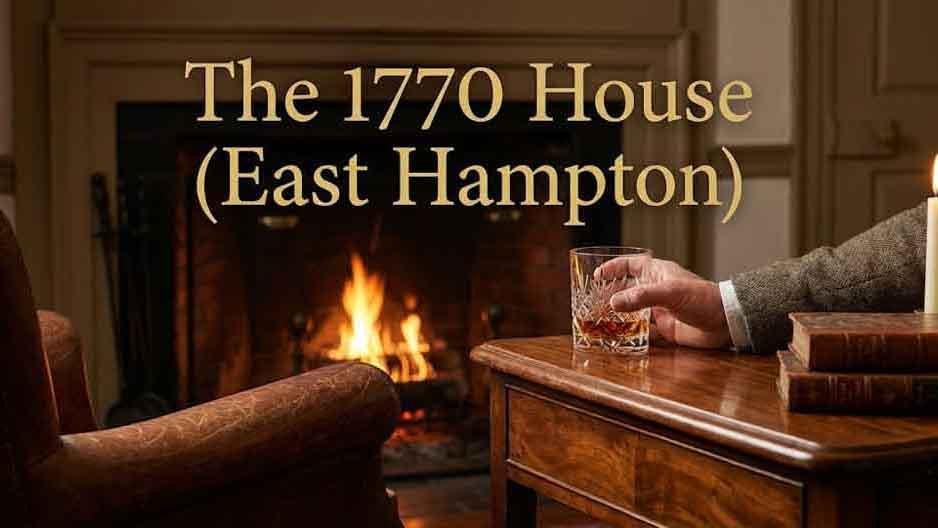
Certain buildings refuse to become relics. They absorb the centuries and emerge not as museums but as living arguments for permanence — the kind of structures where the ceiling beams overhead have witnessed more American history than most libraries could catalog. The 1770 House sits at the corner of Dayton Lane and Main Street in East Hampton Village, a white colonial façade that has been welcoming strangers since before the Declaration of Independence was drafted. Originally constructed as a private residence for the Fithian family in the mid-1600s, the home was converted into an inn around 1770 by Jonathon Dayton — and the doors have not closed since. For more than 250 years, this building has operated on a single, unwavering premise: that hospitality is not a business model but a covenant between the host and the guest, between the table and the chair, between the fire in the hearth and the cold pressing against the windowpane. In the modern Hamptons, where restaurants open and vanish with the regularity of summer storms, The 1770 House endures as both a destination and a philosophy — one that insists excellence is not a seasonal offering.
As someone who has operated The Heritage Diner for twenty-five years on Route 25A in Mount Sinai, I recognize the architecture of longevity when I see it. A quarter-century is respectable. Two and a half centuries is something else entirely. And yet the principles are identical. The original wood paneling in the parlor is not a decorative choice — it is a commitment, the same way a saddle stitch through English bridle leather at Marcellino NY is not merely a technique but a declaration that the unseen details are the ones that matter most.
From Fithian Homestead to Hamptons Institution
The provenance of The 1770 House reads like a condensed history of East Hampton itself. The Fithian family, whose name still echoes through the village — Fithian Lane remains a local landmark — built the original structure as a private home during the colonial era (Frette, Hotel Stories). What began as a modest dwelling evolved over the decades into something far more consequential. The conversion to a public inn around 1770 placed the house at the crossroads of early American travel and commerce, and it has remained in continuous operation through revolution, industrialization, two world wars, and the transformation of the East End from agrarian outpost to international resort destination.
The modern chapter of The 1770 House begins in 2002, when Ben and Bonnie Krupinski — two of the most consequential figures in East Hampton’s postwar landscape — reopened the property as a boutique inn and fine dining destination (Yelp, 2024). Ben Krupinski was no ordinary restaurateur. Known throughout the region as the “Contractor to the Stars,” his firm built homes for Billy Joel, Martha Stewart, and Christie Brinkley, completed a $14.5 million renovation of Guild Hall, and donated millions of dollars of labor to the East Hampton Library’s children’s wing (The East Hampton Star, 2018). The Krupinskis understood that buildings are not investments — they are expressions of character. Their stewardship of The 1770 House reflected the same philosophy that guided their construction empire: build it once, build it right, and let the work speak for itself.
The tragic loss of Ben and Bonnie Krupinski, along with their grandson William Maerov and pilot Jon Dollard, in a June 2018 plane crash off Amagansett devastated the East Hampton community (Behind the Hedges, 2018). Martha Stewart described her friends as generous philanthropists whose warmth was matched only by their commitment to excellence. The hospitality businesses, including The 1770 House, continued under family ownership — a testament to the institutional resilience that the Krupinskis had deliberately cultivated. The inn did not merely survive their passing; it honored their legacy by refusing to compromise.
Chef Michael Rozzi: The East Ender Who Came Home
Every great restaurant orbits around a singular culinary intelligence, and at The 1770 House, that intelligence belongs to Executive Chef Michael Rozzi — a third-generation East Ender from Hampton Bays who has been commanding this kitchen since 2013. Rozzi earned his Associate of Science degree from Johnson & Wales University and spent fifteen years at the legendary Della Femina Restaurant in East Hampton before taking his skills to The Palm Restaurant and eventually returning to the village where he was raised (Dan’s Papers, 2023; ZoomInfo).
Rozzi is not an ego-driven chef chasing trends. He describes his approach with characteristic understatement, preferring to let the plates do the talking rather than the press releases. His culinary philosophy — what he calls “Hamptons Cuisine” — is rooted in a deep, almost geological knowledge of East End ingredients. Montauk Harbor provides the fluke, striped bass, lobster, and scallops that anchor his menus. Acabonac Farms supplies the grass-fed beef that forms the foundation of the Tavern’s celebrated burger. Milk Pail Orchards, Balsam Farms, and Mecox Bay Dairy contribute the seasonal produce and artisanal dairy that make his dishes unmistakably local (James Lane Post, 2023).
The concept of farm-to-table was never a trend for Rozzi — it was simply the way things were done on the East End before the phrase became a marketing strategy. He sources from growers and fishermen he has known for decades, and his menus shift with the natural rhythms of the South Fork. A dinner at The 1770 House in October will bear little resemblance to a dinner in June, and that is precisely the point. In an era of year-round consistency and industrial supply chains, Rozzi’s insistence on locality feels almost radical — a quiet act of resistance against the standardization of American dining.
His dinner at the James Beard House, which also celebrated The 1770 House’s fifteenth anniversary, confirmed what local diners had known for years: this kitchen operates at a national level of excellence. OpenTable recognized the establishment as one of America’s Top 100 Restaurants, awarding trifecta honors for Food, Service, and Ambiance (OpenTable, 2017). For a forty-seat dining room in a village of fewer than two thousand year-round residents, the achievement is extraordinary.
Two Restaurants Under One Roof
The genius of The 1770 House lies in its dual-identity concept — an architectural and culinary arrangement that offers two completely distinct dining experiences within the same colonial walls.
The main dining room occupies the parlor floor, accessed through a book-lined lounge warmed by an antique fireplace that has been burning since the eighteenth century. The room seats forty guests at antique wooden tables flanked by high-back cushioned wicker chairs, all arranged on colorful Oriental rugs. Candlelight replaces overhead fixtures. Frette linens — the same Italian house that supplies the inn’s bed linens, robes, and beach towels — cover the tables. The silver is fine, the crystal is real, and the atmosphere encourages the kind of unhurried conversation that has largely vanished from American restaurants (Hamptons Real Estate Showcase, 2021).
Chef Rozzi’s prix fixe and five-course tasting menus in the dining room represent the pinnacle of the experience. Signature dishes rotate seasonally, but the Spicy Fluke Tartare — featuring locally caught fluke laced with wasabi and radish, accompanied by a hijiki seaweed salad and crowned with tobiko — has become the dish most associated with Rozzi’s tenure. He resists calling it a signature, insisting that other people decide what defines a chef, but the fluke tartare’s trifecta of flavor, texture, and color has earned it near-mythic status among East End diners.
Down a steep, narrow colonial staircase — the kind of architectural detail that cannot be replicated in modern construction — lies The Tavern, a subterranean refuge defined by exposed brickwork and an original beehive oven. The atmosphere shifts from refined to convivial, and the menu follows suit. The Tavern offers elevated pub fare — an exceptional burger made from Acabonac Farms grass-fed beef, fish and chips, shepherd’s pie, and heritage pork ragu over house-made cavatelli. But the dish that put The Tavern on the national culinary map is the meatloaf.
The Meatloaf That Changed Everything
No profile of The 1770 House is complete without an accounting of the meatloaf — a dish that, in the hands of founding chef Kevin Penner and later amplified by the cultural machinery of the Food Network, became one of the most famous comfort food preparations in America.
The recipe is straightforward in concept and exacting in execution: naturally raised beef, veal, and Berkshire pork blended with fresh herbs — chives, thyme, Italian parsley — bound by eggs, milk, and finely ground panko, then shaped by hand and roasted at 350 degrees. The accompanying garlic sauce, a luxurious reduction of chicken stock, slow-roasted garlic, and butter, elevates the dish from nostalgic to extraordinary. The 1770 House serves it with mashed potatoes and spinach, a combination so satisfying that it borders on the medicinal.
Ina Garten — East Hampton’s most celebrated culinary resident and the host of the Barefoot Contessa — declared it the finest meatloaf she had ever tasted (Food Network). She featured the dish in her cookbook Barefoot Contessa Foolproof (Clarkson Potter, 2012), noting that her own mother’s version simply could not compete. The recipe, attributed to Penner with Garten’s imprimatur, spread across the internet like wildfire. It has been replicated by home cooks in every state and reviewed on hundreds of food blogs. The 1770 House meatloaf became, improbably, a cultural artifact — proof that a single dish, prepared with absolute integrity, can transcend its origins and become something approaching folklore.
At Marcellino NY, I understand this principle intimately. A single briefcase, hand-stitched with linen thread through English bridle leather sourced from J&E Sedgwick, is not merely an object. It is an argument for the proposition that mastery applied to fundamentals yields results that transcend the sum of their materials. The meatloaf at The 1770 House operates on the same logic.
The Wine Program and the Art of Service
Sommelier and restaurant manager Michael Cohen has overseen The 1770 House wine program since 2006, building one of the South Fork’s most respected cellars — a collection of 250 to 300 selections that leans heavily on California and French estates while incorporating notable offerings from Long Island’s own vineyards. The wine list has held Wine Spectator’s Award of Excellence every year since 2007 — a streak that reflects both the depth of the cellar and Cohen’s philosophy of tableside engagement (East Hampton Star, 2016; Wine Spectator).
Cohen’s approach is pedagogical without being pretentious. He describes wines through narrative rather than technical jargon, telling the story of a bottle rather than lecturing on tannin structure. He works closely with local winemakers, including Roman Roth of Wölffer Estate Vineyard, and his blind tasting sessions with colleagues have become a quiet institution within East Hampton’s culinary community. The Burgundy selections are particularly strong, complemented by California Pinot Noirs and Chardonnays — including a coveted vertical from Peter Michael — alongside Bordeaux, Piedmont, and Tuscan reds that reward exploration.
The service culture at The 1770 House has drawn consistent praise from critics and guests alike. Newsday awarded four stars, noting the establishment’s ability to separate itself from the Hamptons pack through the caliber of its hospitality. The New York Times acknowledged professional staff and real firepower in the kitchen. Haute Living called it a celebrity favorite, while Modern Luxury Manhattan Magazine described the outdoor patio experience in almost transcendent terms. These are not the kinds of accolades purchased through public relations campaigns — they are the accumulated evidence of a team that understands, night after night, that service is not performance but partnership.
The Inn: Six Suites and a Legacy of Comfort
The 1770 House functions simultaneously as one of the Hamptons’ most intimate boutique hotels. Six exclusive guest suites, each individually appointed, occupy the upper floors of the historic structure, while a separate two-story carriage house provides additional lodging for guests seeking greater privacy. Every room features Frette linens, Molton Brown amenities, flat-screen television, private safe, and complimentary WiFi — modern comforts integrated so seamlessly into the colonial architecture that they feel less like upgrades than natural extensions of the building’s character (1770house.com).
Suite One, a spacious 300-square-foot king bedroom on the second floor, retains its original eighteenth-century paneling and working fireplace. The view overlooks historic Main Street. Suite Six, located in the carriage house, offers a full kitchen, living area, and the kind of seclusion that makes extended stays feel less like vacations and more like temporary residencies in a village that has been perfecting the art of welcome since the seventeenth century.
For those of us in the real estate world — my wife Paola and I are preparing to launch Maison Pawli, a boutique real estate venture focused on Long Island’s North Shore luxury market — The 1770 House represents a masterclass in how heritage properties generate value. The building’s longevity is not incidental to its desirability; it is the foundation of it. In a market saturated with new construction, the irreplaceable character of a 350-year-old colonial inn appreciates in ways that no modern build can replicate. The 1770 House proves that the oldest investment strategy in real estate — buying what cannot be rebuilt — remains the soundest.
Community, Celebrity, and the Soul of East Hampton
The 1770 House occupies a unique position in East Hampton’s social ecosystem. It is simultaneously a neighborhood institution and a magnet for international celebrity. Ina Garten, Bobby Flay, Martha Stewart, Florence Fabricant, Alex Guarnaschelli, Giada De Laurentiis, Katie Lee, and Jimmy Fallon have all been spotted dining within its colonial walls (Hamptons Real Estate Showcase, 2021). The restaurant’s location — directly across from Town Pond on Main Street, within walking distance of Guild Hall, the galleries, and the boutiques — makes it the de facto living room of East Hampton Village.
Yet the celebrity presence never overwhelms the atmosphere. The 1770 House succeeds because it refuses to behave like a scene. The lighting is low, the music is absent, and the scale is deliberately intimate. A forty-seat dining room cannot accommodate spectacle. What it can accommodate is connection — the kind of focused, unhurried encounter between diner and dish that has become increasingly rare in a hospitality landscape dominated by large-format restaurants and social media optimization.
The Krupinski family’s commitment to community philanthropy established a charitable tradition that continues to define the institution. Ben Krupinski’s support of the East Hampton Fire Department, the Ladies Village Improvement Society, the East Hampton Food Pantry, and the Retreat’s shelter for domestic violence victims created a model of civic engagement that transcended his business interests. The 1770 House carries that spirit forward — not through ostentatious gestures but through the daily practice of treating every guest, whether a celebrity or a first-time visitor, with identical care and attention.
The garden patio, open seasonally, extends the dining experience into the East Hampton landscape and has become a preferred setting for intimate weddings, corporate gatherings, and celebrations that benefit from the property’s 350-year story. Private events at The 1770 House do not merely use the space — they become part of its ongoing narrative.
Contact Information & Reservations
Address: 143 Main Street, East Hampton, NY 11937
Telephone: (631) 324-1770
Fax: (631) 324-3504
Website: 1770house.com
Email: info@1770house.com | Private Events: events@1770house.com
Dinner Reservations: OpenTable | Resy
Hours: Dinner served nightly. Monday–Wednesday & Sunday: 5:30–8:30 PM | Thursday: 5:30–9:00 PM | Friday–Saturday: 5:30–9:30 PM
Takeout: Available — call (631) 324-1770
Instagram: @1770house
Google Rating: 4.7 stars (288 reviews) | OpenTable Rating: 4.9 stars (1,464 reviews) | Tripadvisor: Travelers’ Choice Award
Price Range: $$$$
Parking: Street parking on Main Street. Private lot reserved for hotel guests.
Inn Reservations: Six guest suites and a two-story carriage house available year-round. Contact the inn directly or visit the website for current rates and availability.
Peter from the Heritage Diner has spent twenty-five years studying what makes Long Island institutions endure. He holds graduate degrees in Philosophy from Long Island University and The New School University in NYC.