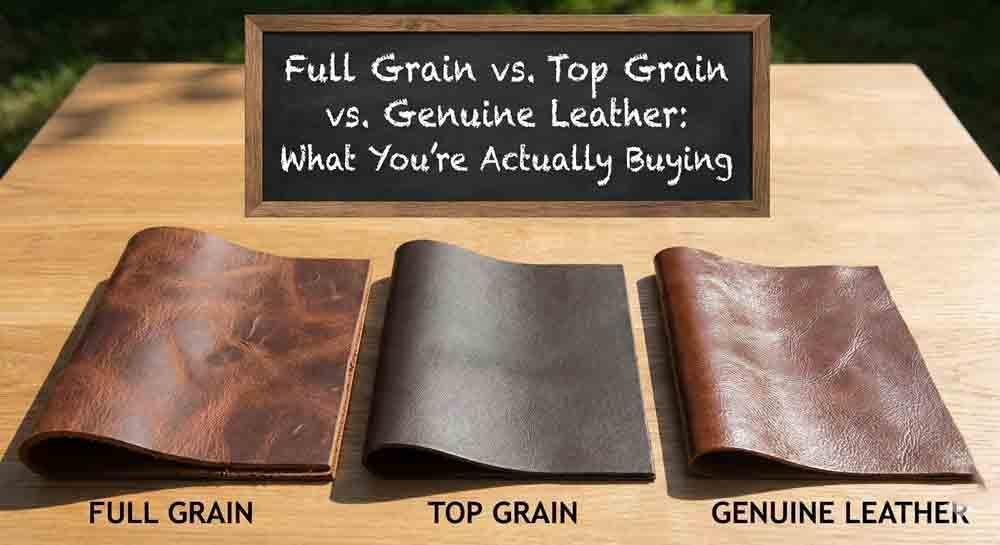
There is a moment that separates the uninitiated from the converted. It happens when you hold a piece of full-grain, vegetable-tanned American leather for the first time—really hold it—and something primal registers. The weight. The faint sweetness of tree bark and beeswax. The surface that feels less like a commodity and more like a living thing, still warm with the memory of the tannery drum. I have spent twenty-five years at The Heritage Diner in Mount Sinai learning to trust that feeling, that tactile verification of quality, whether I am pressing my thumb into the sear on a Heritage Burger or running my fingers along a side of Wickett & Craig English bridle leather on my Marcellino NY workbench. The truth is the same in both cases: the real thing announces itself. You do not need a marketing department to tell you that you are holding something exceptional.
What follows is a curated, deeply researched guide to the finest American-made leather wallets, bags, and belts you can buy right now—organized by budget tier so that entry-level buyers and seasoned collectors alike can find exactly what they need. Every brand listed manufactures on American soil. Every recommendation reflects the kind of material integrity and craftsmanship ethos we hold sacred at Marcellino NY (marcellinony.com), where bespoke English bridle leather briefcases are built not for seasons, but for generations.
This is not a listicle scraped from affiliate databases. This is a field guide from someone who sources hides for a living.
The Hidden Geography of American Leather
Before a single wallet is cut, before a belt blank is beveled and burnished, the story of American-made leather goods begins in the tannery—and America’s tannery landscape has contracted with a ferocity that should alarm anyone who values domestic manufacturing. In 1978, roughly 250 tanneries operated across the United States (Horween Leather Company, 2018). By 2013, that number had fallen below a dozen. Today, the survivors are not merely businesses; they are cultural institutions, each one a repository of irreplaceable knowledge that took generations to accumulate.
The three names you must know are Horween, Wickett & Craig, and Hermann Oak. Horween Leather Company, founded in 1905 on Chicago’s North Branch of the Chicago River, remains the sole tannery in a city that once housed forty. Now in its fifth generation under the stewardship of Nick Horween, the company processes approximately 4,000 cowhides and 1,000 horsehides per week, producing everything from their legendary Chromexcel—a combination-tanned pull-up leather whose formula dates to 1913—to their Genuine Shell Cordovan, a six-month tanning process so labor-intensive that only two craftsmen at the entire facility possess the skill to shave the hides (Wikipedia, 2025). Wickett & Craig, operating out of Curwensville, Pennsylvania since 1867, stands as one of only two remaining vegetable-only tanneries in North America, producing bridle, harness, and tooling leathers through a traditional process involving mimosa and quebracho bark extracts (Wickett & Craig, 2025). Hermann Oak, founded in 1881 in St. Louis, rounds out the triad with a deep specialization in natural and drum-dyed vegetable-tanned leather that has become the backbone of the Western saddlery and premium goods trade.
When you buy American-made leather goods from brands that source from these tanneries, you are not simply purchasing a product. You are investing in a supply chain that respects EPA environmental regulations, adheres to Leather Working Group sustainability standards, and provides skilled employment in communities that have been making leather since before the automobile existed. At my Marcellino NY bench in Huntington, I source Wickett & Craig English bridle and J&E Sedgwick hides specifically because the provenance is traceable, the quality is consistent, and the material tells a story that begins in the pit house and ends in the board room.
For a stunning visual tour of this process, see Stridewise’s in-depth feature on Horween’s tanning operation at stridewise.com, or search “Horween tannery tour” on YouTube for the Ashland Leather-produced walkthrough of the entire five-floor facility.
Tier One: The Entry Point ($25–$75) — Where the Journey Begins
The democratization of American leather goods is one of the most encouraging developments in domestic manufacturing over the past decade. A generation ago, a genuine full-grain American-made wallet was effectively a luxury item. Today, a handful of small-batch makers have found ways to deliver real leather at accessible prices without compromising on the fundamentals.
Wallets: Rogue Industries, operating out of Maine, produces bison leather wallets starting around $45 that have earned remarkable customer loyalty—their front-pocket wallet alone carries over 600 reviews. The bison leather develops a distinctive patina that differs markedly from traditional cowhide, with a slightly more textured grain that recalls the rugged heritage of the American West. For an even more accessible entry, Flowfold, also based in Maine, produces minimalist card holders from recycled sailcloth for those who want American-made durability in a vegan option. And Main Street Forge, headquartered in Michigan, offers their full-grain bifold at a price point that would have been unthinkable for domestic production a decade ago—backed by a lifetime warranty and hand-selected American leather.
Belts: All American Clothing Company provides genuine leather belts at around $40, tanned, cut, burnished, and buckled entirely within the United States. For a modest step up, Lifetime Leather in Arizona produces hand-waxed full-grain belts with genuine beeswax finishing and optional personalization. These are not the bonded-leather department store belts that delaminate after six months of wear—what I call the “fast fashion trap” that operates on the same disposable logic as frozen burger patties shipped in from industrial processing plants. When you feel the difference between bonded leather and a single piece of full-grain hide, you understand why the extra twenty dollars is not an expense but an investment.
Bags: At this tier, bags are admittedly harder to find in pure leather, but Flowfold’s recycled sailcloth briefcases and laptop bags deliver remarkable durability with a commitment to domestic production that mirrors the ethos of the buy-it-for-life community.
The key question at Tier One is not whether you can afford to spend $50 on a wallet. The question is whether you can afford to keep replacing $15 wallets every year for the rest of your life. The math, as any Heritage Diner regular who has watched me season the same cast-iron skillets for a quarter century will tell you, always favors the thing that lasts.
Tier Two: The Sweet Spot ($75–$200) — Serious Craft, Accessible Luxury
This is the tier where American leather goods begin to genuinely compete with—and often surpass—imported luxury brands retailing at three and four times the price. The makers operating in this range have typically identified specific tanneries they trust, established direct relationships with those suppliers, and developed the kind of obsessive attention to edge finishing, thread tension, and hardware sourcing that separates a good leather product from a great one.
Wallets: Ezra Arthur, a four-brother operation sourcing leather from two tanneries in Chicago and St. Louis, produces wallets in the $80–$150 range that represent perhaps the single best value proposition in American leather goods. Each piece is handcrafted from full-grain leather, and because the brothers select their own hides, no two wallets are exactly alike—a hallmark of genuine artisan production. Holtz Leather Company, working exclusively with full-grain American steerhides from domestic tanneries, offers their personalized fine leather bifold around $89. And for the shell cordovan purists, Ashland Leather in Chicago crafts wallets exclusively from Horween hides, sitting at the upper end of this tier and delivering the kind of dense, lustrous, crease-resistant leather that develops a mirror-like patina over decades of use.
Belts: Tanner Goods, operating out of Portland for over seventeen years, has built a reputation for belts that achieve a near-perfect balance of durability and refinement, typically retailing between $90 and $130. Their vegetable-tanned leather develops what I can only describe as a narrative patina—every scratch, every shade of darkening tells the story of the wearer’s life. Noble Buffalo, a one-man operation using Grade A showcase hides from centenarian tanneries including Horween, Hermann Oak, and Wickett & Craig, produces heritage belts in the $95–$150 range with custom sizing and solid brass hardware. American Bench Craft rounds out this tier with their popular Working Man’s Belt, sourced from domestic tanneries and built for the kind of daily punishment that would destroy an imported belt in months.
Bags: Buffalo Billfold Company, handcrafting in Worthington, Minnesota since 1972, produces American bison leather bags, totes, and briefcases that occupy this tier with a rugged authenticity that is impossible to fake. Their custom-tanned bison leather—sourced from USA ranches and processed at domestic tanneries—has a texture and character that bovine leather simply cannot replicate. Copper River Bag Company, nestled in the foothills of California’s Sierra Nevada Mountains, also operates in this range with handcrafted laptop bags and briefcases.
This is the tier I recommend to Heritage Diner regulars when they ask me where to start. It mirrors my philosophy at the grill: the best ingredients, prepared with care, at a price that respects both the craft and the customer.
Tier Three: The Connoisseur’s Choice ($200–$600) — Where Legacy Begins
At this tier, you are no longer buying leather goods. You are commissioning objects that will outlive you. The brands operating here typically employ full-time artisans with decades of experience, source from specific lots at the finest tanneries, and construct their products using techniques—hand-stitching, hand-burnished edges, hand-rubbed finishes—that no machine can replicate.
Wallets: Ashland Leather’s shell cordovan wallets, crafted exclusively from Horween hides in Chicago, push into the $200–$400 range for their premium offerings. Shell cordovan is the caviar of the leather world—extracted from a dense, fibrous membrane beneath the rump of a horsehide, tanned for six months using vegetable liquors, then hand-curried, shaved, dyed, and glazed by artisans whose skills take years to develop. A shell cordovan wallet does not crease; it rolls. It does not scuff; it self-polishes. At Marcellino NY, I work with English bridle leather that shares many of shell cordovan’s properties—the hot-stuffing process that infuses waxes and tallows deep into the fiber structure, the hand-rubbed finishing that reveals the leather’s true depth—and I can tell you from direct experience that the price of these materials reflects not markup, but the extraordinary labor required to produce them.
Belts: Coronado Leather in San Diego specializes in American Bison and Horween leather belts crafted using traditional saddlemaker techniques—double-layered construction with vegetable-tanned liners, hand-beveled and polished edges, solid brass hardware with Chicago screws. These are belts built to the same standard as equestrian tack, where structural failure is not merely an inconvenience but a safety hazard.
Bags: Korchmar, a fourth-generation family-owned manufacturer established in 1917, produces briefcases and travel bags in this tier that carry over a century of institutional knowledge in every stitch. Their vertical integration—from design to manufacturing to customer service—is almost unheard of in modern consumer goods. WaterField Designs, handcrafting in San Francisco with premium full-grain leather, produces briefcases and laptop bags that bridge the gap between traditional craftsmanship and modern functionality. Holtz Leather’s tote bags, weekenders, and briefcases, all made from 100% full-grain American leather hand-picked from local tanneries, also occupy this space with the kind of personalization options that turn a bag into an heirloom.
As someone preparing to launch Maison Pawli, our 2026 boutique real estate venture here on the North Shore with my wife Paola, I think constantly about the relationship between quality objects and the spaces they inhabit. A home tells a story about the people who live in it, and the objects those people carry tell the same story in miniature. A Korchmar briefcase says something different than a mass-produced import, just as a Heritage Diner meal says something different than a drive-through window.
Tier Four: The Summit ($600+) — Bespoke, Heirloom, Legacy
This is the tier where American leather goods achieve the status of functional art. The makers here are not competing on price; they are competing on legacy. Their products are not designed for a market segment; they are designed for a specific human being.
Wallets and Small Goods: At this level, custom commissions from individual artisans—Rose Anvil in Utah, Dark Forest in Portland, and a handful of unnamed makers working from home workshops across the country—produce one-of-a-kind pieces from specific cuts of Horween shell cordovan or Wickett & Craig bridle leather that approach jewelry in their precision and personalization.
Bags and Briefcases: Frank Clegg Leatherworks, crafting in Fall River, Massachusetts since 1970, represents the pinnacle of American bag-making. Their briefcases, starting around $600 and extending into the thousands for exotic leathers, are handmade by artisans under one roof with over fifty years of New England craftsmanship behind them. Their American Alligator Satchel, starting at $9,000, exists in a category of its own—a piece that will appreciate in both personal and material value over a lifetime of use. Lotuff Leather, also working out of Providence, Rhode Island, produces vegetable-tanned leather briefcases guaranteed for life, handmade by artisans using Brazilian full-grain leather, solid brass hardware, and hand-burnished edges that take hours to complete.
Colonel Littleton, based in Tennessee, offers what may be the most comprehensive collection of premium American-made leather bags available, including pieces in American Buffalo and American Alligator that occupy the absolute summit of domestic leather production. Their Navigator Briefcase, available in vintage brown, American Buffalo, and American Alligator, is the kind of object that makes people stop and ask where you got it—not because of a logo, but because of the unmistakable presence of exceptional material and exceptional craft.
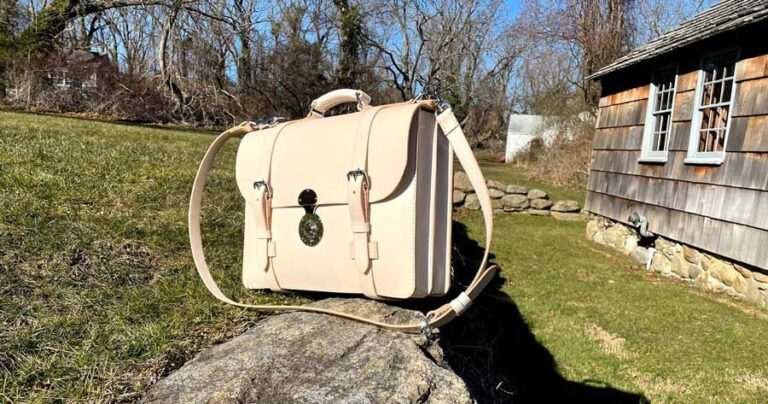
And then there is the Marcellino NY standard. At our workshop in Huntington, I build bespoke English bridle leather briefcases for attorneys, surgeons, executives, and collectors who have tried everything else and arrived at the conclusion that true luxury is not about the name on the clasp but the hand that selected the hide. Every Marcellino briefcase begins with a personal consultation, proceeds through hand-selection of specific hides from Wickett & Craig and J&E Sedgwick, incorporates hand-stitching techniques that are structurally superior to any machine stitch, and results in a piece that, with proper care, will serve three generations. This is not aspiration; this is arithmetic. A properly maintained full-grain vegetable-tanned leather briefcase, built with hand-saddle stitching and solid brass hardware, has a functional lifespan measured not in years but in decades—often exceeding fifty years of daily use.
Visit marcellinony.com to explore the collection.
The Leather Literacy Test: What to Look for Before You Buy
Whether you are spending $50 or $5,000, the fundamentals of evaluating American-made leather goods remain constant. Here is what twenty-five years of working with leather has taught me to examine:
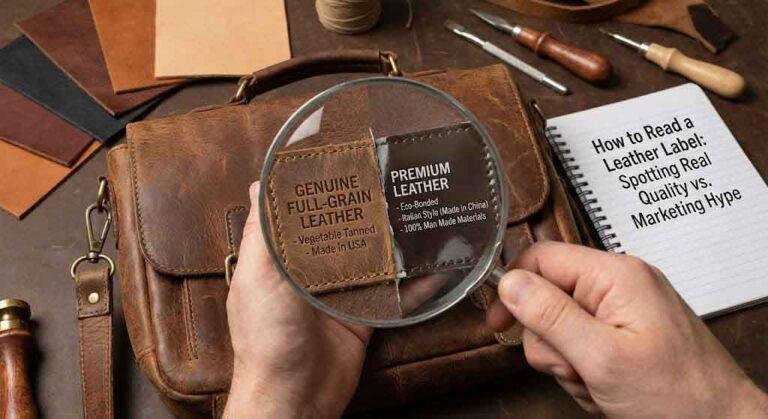
Full-grain versus corrected grain. Full-grain leather retains the complete outer surface of the hide, including its natural markings—insect bites, healed scratches, variations in fiber density. These are not defects; they are proof of authenticity. Corrected grain leather has been sanded, buffed, and embossed with an artificial pattern to create a uniform appearance. The distinction matters because full-grain leather’s intact fiber structure is what gives it superior strength, breathability, and patina development over time. Think of it the way I think about beef at The Heritage Diner: a hand-selected, dry-aged steak from a local purveyor will have more variation than a vacuum-sealed commodity cut, and that variation is precisely what makes it extraordinary.
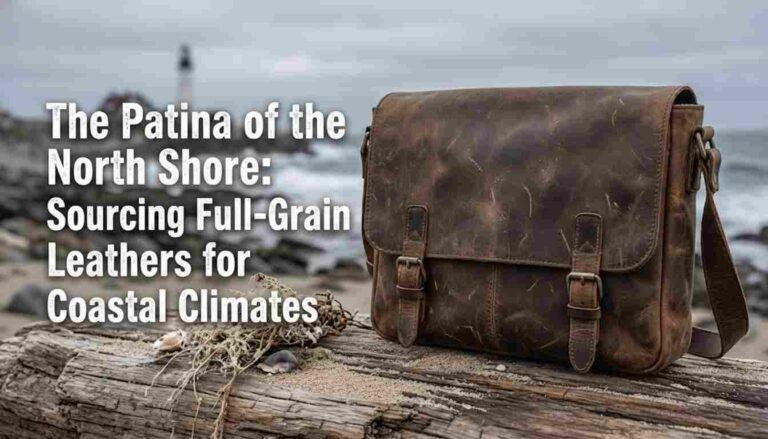
Vegetable-tanned versus chrome-tanned. Vegetable tanning uses natural tannins derived from tree bark—mimosa, quebracho, chestnut—in a process that takes weeks or months. Chrome tanning uses chromium sulfate in a process that takes days. Both methods produce viable leather, but vegetable-tanned leather develops a richer patina, burnishes more beautifully, and can be finished to a higher standard. At Wickett & Craig, the vegetable tanning process takes approximately six weeks from start to finish (Filson Journal, 2020). At Horween, shell cordovan spends two months in the tanning pits alone before beginning its four-month finishing journey. When you see “veg-tan” on a product listing, you are looking at a commitment to process over efficiency.
Construction details. Hand-stitching using a saddle stitch—where two needles pass through each hole from opposite sides—is structurally superior to machine lock-stitching because if one stitch breaks, the rest hold. Edge finishing should be burnished, not merely painted. Hardware should be solid brass, not plated base metal. Thread should be waxed linen or polyester, not cotton. These details are invisible to the casual observer, but they determine whether a product serves you for five years or fifty.
The “Made in USA” claim. According to the Federal Trade Commission, products labeled “Made in USA” must be “all or virtually all” manufactured domestically—including significant parts, processes, and labor. Many brands source American hides but tan or finish them overseas before final domestic assembly, earning the less rigorous “Assembled in USA” designation. True American-made leather goods come from domestic hides, processed at domestic tanneries like Wickett & Craig, Horween, or Hermann Oak, and constructed entirely on American soil (Federal Trade Commission, 2024).
The 100-Year Argument: Why American-Made Leather Goods Are the Ultimate Hedge
I have watched from behind the Heritage Diner counter as Mount Sinai and the broader North Shore have evolved over a quarter century. Strip malls have risen and fallen. National chains have opened with fanfare and shuttered in silence. What has endured—in dining, in real estate, in craft—is the local, the authentic, the thing made by human hands with materials that honor the customer’s intelligence.
The argument for American-made leather goods is not merely economic or patriotic, though it is both. It is philosophical. In a world increasingly dominated by algorithmic optimization and disposable consumption—what Heidegger might call the reduction of all things to “standing reserve,” mere resources awaiting extraction—the choice to carry a wallet hand-stitched in Chicago from leather tanned in Pennsylvania is an act of resistance. It is a declaration that some things should take six weeks to make. That some processes should not be accelerated. That the quality of your daily objects shapes the quality of your daily experience.
Marcus Aurelius wrote that we should attend to what is directly before us with precise and genuine seriousness. The leather goods you carry every day—the wallet in your pocket, the belt at your waist, the bag over your shoulder—are precisely what is before you. They are the objects you touch most frequently, the tactile baseline of your waking life. They deserve your serious attention.
At The Heritage Diner, we have served this community for twenty-five years by refusing to compromise on ingredients, technique, or hospitality. At Marcellino NY, we build briefcases that embody that same refusal. And as Paola and I prepare to bring Maison Pawli to life in 2026, connecting families with North Shore homes that reflect the same commitment to enduring quality, the thread that runs through all of it is provenance. Know where your food comes from. Know where your leather comes from. Know who made the thing you carry, and why they made it the way they did.
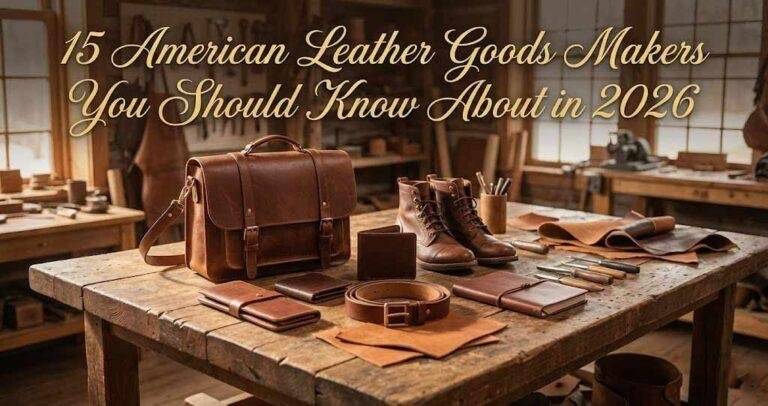
The American leather goods renaissance is not a trend. It is a correction—a return to the standards that built this country’s reputation for craftsmanship before the great offshoring of the late twentieth century hollowed out entire communities and supply chains. Every wallet, belt, and bag on this list represents a family business, a tannery town, a set of hands that chose to stay and make something that matters.
Your move.
Peter from The Heritage Diner is a 25-year restaurateur, founder of Marcellino NY bespoke leather goods (marcellinony.com), and co-founder of Maison Pawli, a boutique real estate venture launching in 2026 on Long Island’s North Shore. More at heritagediner.com and x9m8.com.
Tags: American made leather goods, best leather wallets made in USA, buy it for life leather, Horween leather, Wickett Craig bridle leather, full grain leather wallet, American leather belt, handmade leather briefcase, bespoke leather goods, Long Island artisan, heritage craftsmanship, vegetable tanned leather, shell cordovan wallet, leather bags made in America, North Shore luxury, Mount Sinai NY, Marcellino NY, buy American leather